

Most property managers charge 8% to 12% of the monthly collected rent, and national fixed-price averages run from $152 to $857 per month, with most owners paying around $355. That monthly fee is only the starting point, because the full cost of hiring a property manager includes leasing, setup, renewals, inspections, vacancy handling, and how well the manager protects your rental income.
If you're reading this, there's a good chance you already know the feeling. The tenant texts at dinner. A repair turns into three calls and two invoices. Then you realize California compliance isn't something you can handle casually on a Sunday night.
For owners in Redlands, Beaumont, Yucaipa, Calimesa, Loma Linda, Mentone, Highland, and Banning, the right question isn't just how much does it cost to hire a property manager. The better question is what you are buying, what it should include, and whether the total cost improves your return instead of draining it.
Is Hiring a Property Manager a Cost or an Investment?
You buy a rental in Redlands expecting steady income. Three months later, you are coordinating a plumbing call from work, chasing late rent, and trying to figure out whether your lease file would hold up if a dispute turns into a legal problem. At that point, the management fee stops looking like a simple expense. It becomes part of the cost to keep the property performing.
That is the right way to judge it. Owners who focus only on the monthly percentage usually miss the bigger number, the total cost of ownership. A lower fee does not help much if the home sits vacant longer, the rent is set too low, the tenant turns over early, or repairs get handled slowly and end up costing more.

What the fee is really paying for
A management agreement is paying for execution. That includes leasing, screening, rent collection, maintenance coordination, inspections, vendor follow-through, documentation, and California compliance handled on time.
In the Inland Empire, those details have a direct dollar impact. If a Redlands rental brings in strong rent but loses two extra weeks during turnover, that vacancy can cost more than several months of management fees. If a Beaumont owner saves a little on management but places the wrong tenant, one bad lease cycle can wipe out a full year of those savings. If a Yucaipa property has delayed maintenance on a small roof or plumbing issue, the repair bill can jump fast.
Here is the practical test I use. Compare the fee against the losses a good manager can prevent:
- Shorter vacancy: fewer days without rent during turnover
- Better rent positioning: pricing the property to the local market without leaving money on the table
- Stronger screening: reducing missed payments, damage, and early move-outs
- Faster maintenance response: fixing small problems before they become larger repairs
- Cleaner documentation: reducing exposure when disputes come up
A basic example makes the math clearer. If a home rents for $2,500 and management costs 10%, the monthly fee is $250. That is $3,000 a year. If professional management helps avoid just one extra month of vacancy, one weak tenant placement, or one preventable repair escalation, the fee often pays for itself.
That is why owners with one or two homes often reach the same conclusion as larger investors. The question is not whether management has a price. It does. The question is whether the service improves net income after vacancy, turnover, repairs, and risk are counted.
For many first-time landlords, that answer becomes clearer after reading this guide on whether hiring a property manager makes sense for your rental.
Where owners misjudge the cost
Owners usually miscalculate management in one of two ways. They treat their own time as free, or they ignore preventable losses because those costs show up in different months and under different line items.
A self-managed rental in Beaumont may look cheaper on paper until you add missed work, slower vendor response, leasing delays, and a turnover that drags out because no one is pushing the process daily. A low-fee manager can create the same problem if the service level is thin. Cheap management is expensive when it leads to poor screening, weak communication, or slow turns.
In Redlands, Beaumont, and Yucaipa, local response time matters. So does knowing the rental pool, common maintenance issues, and what renters expect at each price point. Owners who choose management based only on the smallest headline fee often end up paying more through vacancy, lower rent, and avoidable repair costs.
Understanding Percentage-Based vs Flat-Fee Management
A Redlands owner with a $2,400 rental and a Beaumont owner with a $1,950 rental can both hear the same sales pitch. One company quotes a percentage. Another quotes a flat monthly fee. The cheaper option on the first page of the proposal is not always the lower-cost option by year-end.
That is the vital comparison. Owners are not just choosing a billing style. They are choosing how the manager gets paid, what work is included, and how much risk stays on the owner's side.
How percentage-based pricing works
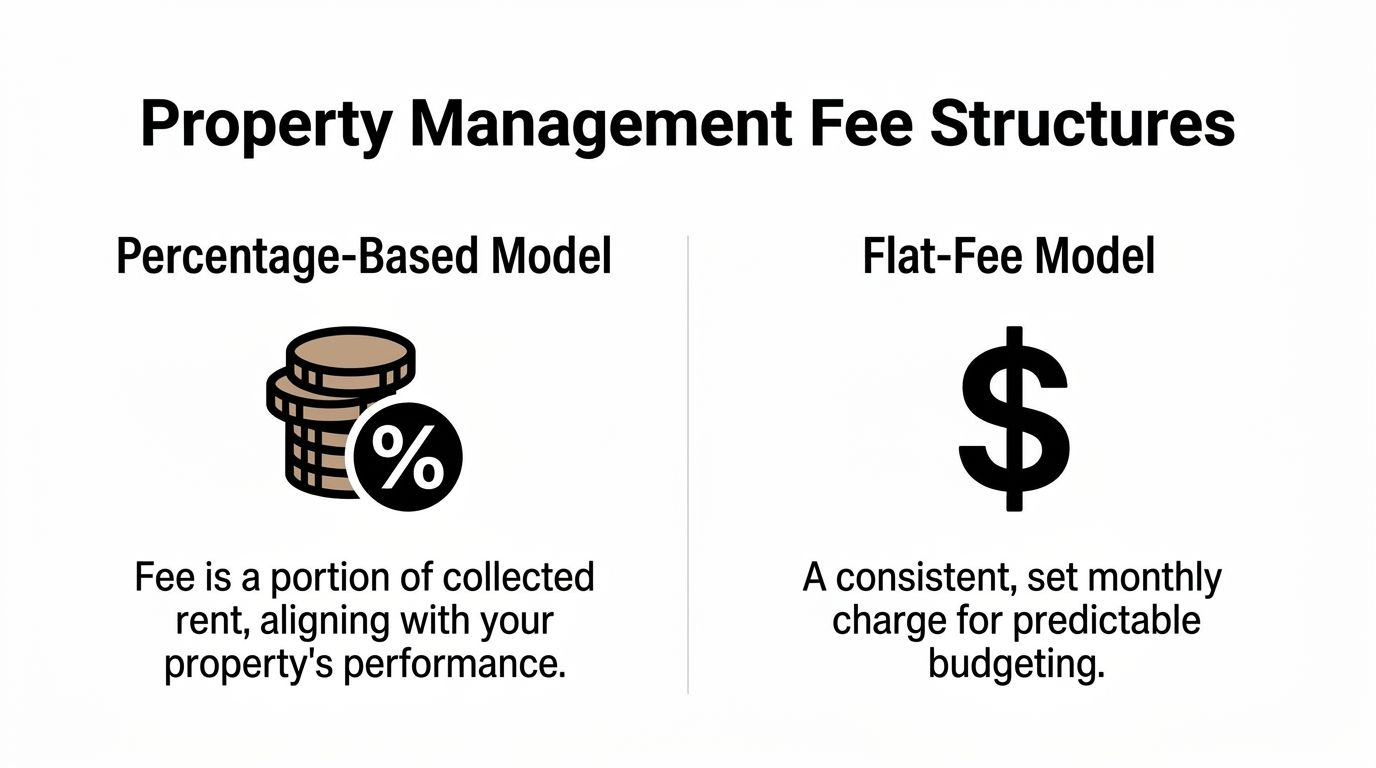
With percentage-based management, the fee rises and falls with rent collected. In practice, that usually keeps the manager focused on leasing speed, collections, and keeping the property occupied with qualified tenants.
For Inland Empire single-family rentals, that alignment matters. If a Yucaipa home sits vacant for two extra weeks because pricing was off or showings were slow, the owner loses far more than a small difference in monthly management fees. On a $2,300 rental, half a month of vacancy costs about $1,150 in gross rent. A management fee difference of $40 or $60 per month does not carry the same financial weight.
Percentage pricing also tends to fit properties where the workload changes throughout the year. Leasing a home, handling maintenance, and managing tenant issues in a busy season takes more effort than a quiet month where rent comes in on time and nothing breaks.
How flat-fee pricing works
A flat-fee manager charges the same amount each month regardless of rent level. Some owners like that because it makes budgeting simple.
The trade-off is straightforward. Once compensation is fixed, the owner has to pay closer attention to what the company includes and what it bills separately. A flat fee can work well for a stable property with long-term tenants, few service calls, and an owner who is comfortable watching performance closely. It becomes less attractive when leasing, inspections, coordination, and communication are carved out into extra charges.
I see this mistake often with newer landlords in Beaumont. They compare $199 flat-fee management to 8% or 9% management and assume the flat fee wins. Then a leasing charge, inspection fees, vacancy oversight, or markups on routine coordination erase the savings.
Side-by-side comparison
| Fee model | How it works | Best fit | Main concern |
|---|---|---|---|
| Percentage-based | Fee tracks collected rent | Owners who want the manager's incentives tied to occupancy, rent level, and collections | You need to confirm exactly what the monthly fee includes |
| Flat-fee | Same monthly charge every month | Owners who want predictable billing on a stable property | Lower headline pricing can shift costs into separate line items |
The better question is not, "Which model is cheaper?" It is, "Which model leaves me with more net income after vacancy, leasing costs, repairs, and oversight are counted?"
For example, if a Redlands property rents for $2,500, 8% management is $200 per month. A $250 flat fee looks close enough. But if the flat-fee company also charges separately for leasing support, routine inspections, or renewal handling, the annual cost can pass the percentage model quickly. The reverse can happen too. On a lower-rent property in Beaumont, a flat fee may be reasonable if the scope is clear and the service level is strong.
What usually works better in Redlands, Beaumont, and Yucaipa
For most single-family homes and townhomes in these markets, percentage-based pricing is usually the cleaner model. It matches the day-to-day reality of local management work. Rent pricing shifts by neighborhood. Leasing demand changes by season. Vendor coordination and resident follow-up are not fixed-effort tasks.
That does not mean flat-fee management is wrong. It means the owner should read the agreement with a sharper eye.
Review the proposal line by line. Check what happens during vacancy. Ask who handles leasing, inspections, renewals, notice posting, and maintenance coordination. A lower monthly price only helps if the total operating cost stays lower over the full year. This property management fee structure guide will help you compare those details before you sign.
Decoding Your Property Management Statement
A management statement shouldn't feel like a mystery. If you can't read it quickly and understand why each line exists, the agreement isn't transparent enough.
For most single-family homes and small multifamily properties, the benchmark remains familiar. Industry analyses summarized by HomeRiver show fees have standardized around 8% to 12% of collected rent, with 10% staying a common benchmark for single-family homes and small multifamily properties. That same review gives simple examples: $1,500 rent at 8% equals $120 monthly, and $1,200 rent at 10% also equals $120 monthly, as discussed in HomeRiver's cost overview.
The recurring monthly management fee
This is the main operating charge. It typically covers the ongoing work owners don't want to handle themselves. That often includes rent collection, tenant communication, coordination of repairs, bookkeeping, and routine oversight.
The key word is typically. Some firms include more in that monthly fee. Others strip out items and bill them separately.
The one-time onboarding or setup charge
Many companies charge a startup fee when the property first comes under management. HomeRiver notes onboarding fees of $100 to $500 are common.
That fee usually covers account setup, intake paperwork, document handling, and the administrative work needed to move a property into the manager's system. This is normal. The issue isn't whether the fee exists. The issue is whether the company tells you about it clearly before you sign.
Leasing and tenant placement
Leasing is where many owners underestimate first-year cost. The manager markets the vacancy, handles showings, screens applicants, prepares the lease, and gets the unit occupied.
This fee often sits outside the monthly management charge. It can be substantial, which is why owners should ask exactly when it's charged and whether it repeats after every turnover.
What to watch: The cheapest monthly rate often pairs with a higher leasing charge. That's not always bad, but you need to evaluate the full package, not one line.
Vacancy-related charges
Some managers charge during vacancy because vacant homes still need oversight. HomeRiver notes that vacant properties often incur fixed fees of $100 to $200 minimum or an equivalent rent percentage because they still require inspections and security attention.
That matters in Inland Empire markets where a property can look quiet from the street but still need regular checks, vendor access, and status updates. Owners who assume "no tenant means no management work" are usually surprised by this line item.
Inspection fees and document handling
Inspection billing varies by company. Some include routine inspections. Others charge each time. The point of inspections isn't to create extra billing. It's to catch problems early and document the condition of the home.
For owners who want cleaner records, stronger lease enforcement, and fewer disputes, good documentation matters more than the invoice line itself. This is also where organized records pay off over time. A practical reference is this guide to property management document best practices, especially if you've ever had to track repairs, notices, and lease changes after the fact.
Eviction-related fees
No owner wants to use this part of the contract, but you need to know how it works before there's a problem. HomeRiver notes that evictions are often billed hourly or as a flat fee, plus court costs.
That doesn't mean every managed property ends up there. It means you need to know whether notices, filing coordination, court attendance, and communication are included or separate. A contract that stays vague here usually creates the worst surprises later.
A statement you should be able to understand
| Fee Type | Purpose | Typical Cost |
|---|---|---|
| Monthly management | Ongoing oversight, collections, communication, coordination | 8% to 12% of collected rent |
| Onboarding | Account setup and administrative intake | $100 to $500 |
| Vacancy fee | Oversight while unoccupied | $100 to $200 minimum or equivalent rent percentage |
| Eviction handling | Process management beyond routine service | Hourly or flat plus court costs |
A clean management statement should answer four questions fast:
- What is included every month: You should know which services are part of the core fee.
- What only appears at turnover: Leasing, vacancy work, and setup costs should be obvious.
- What depends on events: Evictions, unusual repairs, and special handling need clear terms.
- What gets documented: If there is no paper trail, there is no real accountability.
Owners shopping Redlands property management, Beaumont property management, or property management Yucaipa should read statements with the same care they give a lease. The monthly percentage matters, but the billing logic matters more.
Sample Pricing for Redlands, Beaumont, and Yucaipa Rentals
Abstract fee ranges only help so much. Owners usually want to know what the total cost looks like on an actual house they could own.
The catch is that your first-year cost depends on more than the management percentage. Leasing, setup, renewal, and maintenance handling all affect the total number. That's why total cost of ownership is a better lens than the monthly fee alone.
Scenario A in Redlands
Take a single-family home in Redlands renting for $2,800 per month. If management is charged at 10% of collected rent, the base annual management cost is $3,360.
Now add one common first-year leasing cost. Leasing fees often range from 50% to 100% of one month's rent, based on the California benchmarks summarized by LeaseRunner. On this home, that means a leasing charge could land between $1,400 and $2,800. If there is also a setup fee, LeaseRunner notes a $300 average. If the tenant renews, the same benchmark shows lease renewals of $200 to $500 can apply.
That means a Redlands owner could be looking at a first-year management-related cost range of:
- Base annual management: $3,360
- Leasing: $1,400 to $2,800
- Setup: about $300
- Renewal, if charged in year one: $200 to $500
The practical lesson for Redlands property management isn't that the cost is too high. It's that owners should budget for turnover-related fees up front instead of acting surprised later.
Scenario B in Beaumont
Now take a newer Beaumont townhome renting for $2,400 per month. At 10%, annual management comes to $2,880.
Using the same leasing benchmark of 50% to 100% of one month's rent, tenant placement would likely fall between $1,200 and $2,400. Add the same $300 average setup cost and possible $200 to $500 renewal fee, and first-year management-related costs become materially higher than the monthly percentage alone suggests.
That is why owners comparing Property Management Beaumont options should ask for a first-year estimate, not just a monthly quote.
If a proposal only shows the monthly fee and skips turnover charges, it isn't giving you the number you actually need.
Scenario C in Yucaipa
A Yucaipa rental can be priced differently, but the budgeting logic stays the same. Start with monthly management as a percentage of collected rent. Then add the turnover pieces. Then ask whether maintenance coordination includes any markup and whether vacancy months are billed differently.
For owners exploring Yucaipa property management or property management Yucaipa, this is also where investment strategy matters. If your goal is lower turnover and steadier tenancy, a slightly higher operating cost may still produce a cleaner long-term result than a cheaper proposal with more churn and weaker screening.
A useful next step is to compare your expected operating costs against your larger plan for the asset. This overview of rental property investment strategies helps frame management cost in the context of holding period, cash flow, and risk.
The Hidden ROI of Professional Property Management
A Redlands owner with a $2,300 rental can save $40 a month by choosing the lowest management quote and still lose far more to one extra vacancy week, one weak tenant approval, or one repair that gets handled late. That is the important math. The monthly fee matters, but total cost of ownership matters more.
ROI shows up in the costs you avoid
Owners usually see the management fee and miss the expenses sitting behind poor execution. In practice, return comes from four places. Lower vacancy loss, better tenant retention, tighter maintenance control, and fewer legal or paperwork mistakes.
That changes the conversation from "What do you charge?" to "What does this save me over a year or two?"
Take a simple example. If a Beaumont home rents for $2,100 and stronger leasing cuts vacancy by just two weeks, that alone protects roughly half a month's rent. If better screening also prevents one avoidable turnover, the owner may save another leasing fee, cleaning bill, utility carry, and make-ready cycle. A manager does not need to be the cheapest option to produce the better net result.
First-year cost is only part of the picture
The first year often looks expensive because leasing and setup costs hit early. Some owners stop there and conclude management is a drag on returns. I would look at what happens after placement.
If the tenant stays longer, pays on time, and the property is maintained without small issues turning into large ones, the math improves quickly. A rough first-year statement can still produce a better two-year or three-year outcome than a bargain manager who fills the home fast and creates churn.
That is why turnover control matters so much in the Inland Empire.
Local ROI in Redlands, Beaumont, and Yucaipa
In Redlands, the opportunity cost of vacancy is usually higher because rents are higher. One extra vacant month on a well-located single-family home can cost more than the difference between management quotes for much of the year.
In Beaumont, fee sensitivity is real because cash flow margins can be tighter. But Beaumont owners also get hurt quickly by repeated leasing cycles. A lower quote loses its appeal if it leads to one extra turnover, looser screening, or slow repair follow-up.
In Yucaipa, I often see owners benefit from steady, longer-term tenancy. That makes lease renewal handling, inspection follow-through, and responsive maintenance worth more than a rock-bottom monthly rate. The better question is whether the management process supports a stable resident who treats the property well.
Where the fee often pays for itself
A good manager improves return in ways that are easy to miss on the proposal:
- Faster, cleaner leasing that reduces vacant days
- Screening standards that lower the odds of nonpayment, damage, and early move-outs
- Maintenance coordination that solves small problems before they become expensive repairs
- Notice handling, documentation, and lease enforcement that reduce owner risk
These savings are uneven, but they are real. One year may look ordinary. The next year, a single avoided eviction or a single retained tenant can cover a large share of the management cost.
This short video gives a useful owner-level perspective on what professional oversight changes in day-to-day rental operations.
Judge management on process, not just price
Owners comparing proposals should ask how the company handles showings, screening, inspections, repair approvals, renewals, and delinquency. That is where ROI is built or lost. A low fee with weak systems is often the expensive choice.
If you are sorting through options, this guide on how to choose a property management company will help you evaluate process quality, not just the monthly percentage.
Key Questions to Ask Any Property Management Company
A management proposal tells you the price. Your questions tell you the true cost.
Most owners don't get into trouble because the monthly fee was high. They get into trouble because the contract was vague, the billing rules were unclear, or the company handled leasing and maintenance inconsistently.
Ask what the monthly fee actually includes
Start here. Ask for a plain-language answer, not a brochure answer.
- What is covered in the management fee: Rent collection, tenant communication, repair coordination, notices, owner statements, inspections, and lease enforcement should all be addressed clearly.
- What is billed separately: Leasing, renewals, inspections, vacancy oversight, court coordination, and maintenance markups should never be hidden.
- What happens during vacancy: Some companies charge while the home is empty. Ask how and why.
If the answer feels slippery, keep looking.
Ask how they handle leasing and renewals
Leasing quality affects almost every other cost you will pay. A rushed placement can become unpaid rent, property damage, conflict, or turnover.
Ask questions like:
- How do you market a vacant rental in Redlands, Beaumont, or Yucaipa
- What does your screening process include
- Who approves the final applicant
- Do you charge again at renewal, and what does that fee cover
"Show me the full first-year estimate, not just the monthly percentage."
That single question filters out a lot of weak proposals.
Ask how maintenance decisions are made
Owners often discover too late that "maintenance coordination" can mean very different things. One company may use vetted contractors and clear approval thresholds. Another may pass through work with limited communication.
Ask:
- How are after-hours emergencies handled
- Do you add a markup to vendor invoices
- When do you contact me for approval
- How do you document repairs and inspection findings
For California rentals, document handling matters as much as the repair itself.
Ask about local compliance knowledge
If a company manages in multiple cities, ask how they stay current in the communities where your property sits. Owners looking for property management near me should care less about a broad map and more about local operating discipline in places like Yucaipa, Loma Linda, Redlands, and Beaumont.
This guide on how to choose a property management company is a good checklist to keep open while you interview firms.
Ask for examples of communication rhythm
Not every owner wants the same level of involvement. Some want approval on every decision. Others want exceptions-only communication.
A good management company should be able to tell you:
- When you'll receive statements
- How you'll be notified about repairs
- What gets documented
- How renewals, notices, and tenant issues are communicated
The right manager won't just answer these questions. They'll answer them plainly.
Your Next Steps to Smarter Property Management
A Redlands owner gets two proposals. One quotes a lower monthly fee. The other charges more but fills vacancies faster, documents repairs better, and keeps tenant issues from turning into expensive turnover. The cheaper proposal can cost more over a year.
That is the decision in front of most Inland Empire landlords. The key question is not, "What is the management fee?" It is, "What will this company cost me, and save me, over 12 months?"
For owners in Redlands, Beaumont, Yucaipa, Calimesa, Loma Linda, Banning, Highland, and Mentone, compare proposals based on total operating impact. A lower fee loses its appeal fast if the home sits vacant longer, screening is weak, maintenance gets sloppy, or records are poor when a dispute shows up.
A practical decision filter
Use this filter before you sign:
- Run first-year numbers: Add monthly management, leasing, renewals, inspection charges, vacancy time, and likely maintenance coordination costs.
- Check for local fit: A company handling rentals in Beaumont and Yucaipa should be able to explain how they staff showings, inspections, and vendor response in those cities.
- Read the statement, not just the quote: Owners should know how income, reserves, repairs, and pass-through charges will appear each month.
- Judge execution: Good systems protect revenue. Slow follow-up, vague repair notes, and weak tenant placement usually show up later as lost rent and higher turnover.
A simple ROI test helps. If a manager charges more each month but cuts vacancy, avoids one bad tenant, or keeps a resident longer, the math often works in your favor.
Quick FAQ
How much does it cost to hire a property manager for one rental house
For a single house, many owners will see a monthly fee based on collected rent, plus separate charges for leasing, renewals, inspections, or setup. The only useful number is the full annual estimate.
Is flat-fee management cheaper than percentage-based management
Sometimes. A flat fee can make budgeting easier on a higher-rent home. Percentage pricing can make more sense when rent level, service needs, and vacancy risk vary. The right choice depends on the full fee schedule and how the company performs once the property is occupied.
Should I search for property management near me
Yes, if local follow-through matters to you. A manager who knows Redlands, Beaumont, and Yucaipa can usually price rent more accurately, coordinate vendors faster, and spot neighborhood-specific leasing issues earlier. Owners comparing options in those markets can review Property Management Beaumont and Yucaipa property management.
What should I ask before I hire a property manager
Ask for a sample owner statement, a full first-year cost estimate, and a clear explanation of who handles leasing, inspections, maintenance approvals, and tenant communication. If the answers are vague before you sign, the reporting will usually be vague after you sign too.
If you own a rental in Redlands, Beaumont, Yucaipa, Calimesa, Loma Linda, Banning, Highland, or Mentone and want a clear proposal with transparent pricing, contact AIM PROPERTY MANAGEMENT COMPANY. A good proposal should show the monthly management fee, expected first-year costs, and how the company handles screening, maintenance, inspections, and compliance before you commit.