Solid document management isn't just about filing papers away. It's about building a secure, structured, and easy-to-use system for all your critical records. This means having clear rules for storage, access, retention, and disposal. For a landlord, this isn't just good housekeeping—it's the blueprint for running a profitable and legally sound business.
Your Foundation for Profitable Property Management

As a property owner in communities like Redlands or Beaumont, your success is built on more than just cashing rent checks; it's built on flawless organization. Think of document management as the central nervous system of your rental business. It’s the framework that backs up every single decision, from screening tenants in Yucaipa to handling a late-night maintenance call in Banning.
Your property is a huge investment, and your documents are the legal and financial records that protect it. A misplaced lease, a lost receipt for a repair, or a disorganized tenant file can snowball into lost money, legal fights, and a whole lot of stress.
From Chaos to Control
Without a system, you’re flying blind and taking on unnecessary risks. Imagine trying to justify a security deposit deduction without the move-in inspection report, or defending against a tenant claim without proof of your communications. The fallout can be expensive, draining both your time and your bank account.
A disorganized system forces you to react to problems. An organized one allows you to prevent them. It turns your documentation from a source of liability into a strategic advantage, ensuring every action is recorded, defensible, and compliant.
This is where a modern, organized approach can turn that potential chaos into a smooth, secure operation. Creating a solid foundation means adopting sound content management best practices. When you have a structured process, you build a reliable history for every part of your rental business.
Key Documents You'll Manage
For landlords, the amount of paperwork can feel overwhelming. Every document serves a vital purpose and needs to be handled properly. Here are some of the most critical records you'll be juggling:
- Lease Agreements and Addenda: The core legal contract that defines the tenancy.
- Tenant Screening Reports: Highly sensitive data, including credit checks and background information.
- Move-In/Move-Out Inspection Forms: Your crucial evidence for handling security deposit returns.
- Maintenance and Repair Records: A complete log of all work done on the property.
- Financial Statements: Records of rent payments, property expenses, and overall profit and loss.
- Legal Notices: Documented proof of notices for rent increases, entry, or eviction proceedings.
Keeping these files in order is absolutely essential to protecting your investment. If you're curious how an expert-level system works, it’s worth looking into what happens when you hire a property manager to take care of these critical tasks for you. This guide will walk you through the best practices to build your own rock-solid system.
Building Your Digital Document Fortress

Think about the last time you had to dig through a filing cabinet for a lease agreement or a maintenance invoice. Now, imagine pulling up that same document on your phone in under ten seconds. That's the difference between an old-school paper trail and a secure digital system.
For landlords with properties in places like Calimesa or Loma Linda, moving away from overflowing binders and vulnerable paper files is no longer optional. It’s about building a digital vault for your most critical information.
This isn’t just a passing trend. The property management software market, which is all about digital tools, was valued at $6.13 billion in 2024 and is expected to more than double to $13.20 billion by 2032. Landlords are voting with their wallets, and an overwhelming 72.41% are choosing cloud-based systems over local storage. The industry is clearly moving online.
Creating Your Digital Filing Cabinet
A messy digital system is just as useless as a chaotic paper one. The first step is to create a logical, intuitive folder structure. Your goal is simple: find any document you need, instantly.
We recommend a simple hierarchy that works wonders for landlords: Property > Tenant > Document Type. For a tenant in your Beaumont property, a file path might look like 123 Main St, Beaumont > John Smith > Executed Lease Agreement.
This clean organization means no more lost files. You can pull up records in a snap, whether you’re at your desk or checking on a property.
Implementing Role-Based Access Control
Not everyone needs the keys to the entire kingdom. Your handyman doesn't need to see a tenant's credit score, and your accountant doesn't need to read maintenance requests. This is where role-based access control (RBAC) is essential.
Think of it like a digital keycard system. You give each person a key that only opens the doors they need to do their job.
Role-Based Access Control (RBAC) is a security practice that restricts access to information based on a person’s role. It’s crucial for protecting sensitive data like tenant applications and financial records, minimizing breach risks and keeping you compliant.
For instance, a property manager might have full access, while an assistant can only view and organize maintenance logs. This kind of granular control is a hallmark of professional management and something we build into our processes at AIM.
The right tools make this easy. To see what features to look for, check out our guide on the best property management software for landlords, which covers systems with robust security and access controls.
To help you visualize this, here’s a breakdown of common document types and the security they require.
Document Types and Recommended Security Protocols
| Document Type | Example | Required Security Level | Who Needs Access? |
|---|---|---|---|
| Lease Documents | Executed Lease, Addendums | High | Property Owner, Property Manager |
| Tenant Screening | Credit Report, Background Check | Highest | Property Manager, Designated Staff |
| Financial Records | Rent Rolls, Expense Reports | High | Property Owner, Accountant, PM |
| Maintenance Logs | Work Orders, Invoices | Medium | Property Manager, Maintenance Staff |
| Legal Notices | 3-Day Notice, Lease Violations | Highest | Property Manager, Legal Counsel |
Assigning these roles correctly from the start prevents accidental data exposure and keeps your operations running smoothly and securely.
Ensuring Redundancy with Backups
What would happen if your computer crashed right now? A single hard drive failure or accidental file deletion could wipe out years of critical rental records if they're only stored in one place.
That’s why automated, regular backups are non-negotiable.
Modern cloud-based systems are great for this, as they often handle backups automatically. They create multiple copies of your data and store them in different secure locations. This redundancy means that even if something happens to one copy, your information is safe and easily recoverable. It’s the ultimate peace of mind.
California Document Retention and Disposal Rules
Knowing what to keep and what to shred is one of the trickiest parts of being a landlord. Hoarding every piece of paper forever is a storage nightmare and a security risk. But tossing a critical document too early can leave you defenseless in a legal dispute. This is where a smart document management strategy comes in, especially for California landlords who have to follow specific state laws.
A document retention and disposal policy is your official game plan. It’s a simple set of rules that outlines exactly how long you need to keep certain records and, just as importantly, how to get rid of them securely when the time is up. Without one, you’re just guessing, and in this business, a bad guess can be incredibly expensive.
Understanding California's Timelines
California law is very clear about the minimum time you need to hold onto different documents. Sticking to these timelines is your first line of defense. Think of it this way: imagine a tenant moves out and, four years later, they decide to dispute their security deposit deduction. If you shredded their move-in inspection photos and the invoices for repairs, it's your word against theirs. That's a battle you're likely to lose.
Here are the key timelines every California landlord needs to know:
- Lease Agreements: Keep these for at least four years after the tenancy is over. This aligns with the state's statute of limitations for any breach of a written contract.
- Financial Records: This covers everything from rent payment logs and receipts for repairs to the final security deposit accounting. You'll want to hold onto these for a minimum of four years to back up your tax filings and protect yourself in any financial disagreements.
- Tenant Applications: For tenants you accept, their application becomes part of their file and should be kept for four years after they move out. For rejected applicants, you must hang onto their applications for at least three years. This is your proof that your decision was based on legitimate screening criteria, not discrimination.
Having a clear retention policy isn’t just a good idea—it’s non-negotiable. It’s what protects you from the legal and financial mess that comes from both shredding things too soon and holding onto sensitive tenant data for too long. For landlords in communities like Redlands or Yucaipa, this is a cornerstone of professional, compliant property management.
This structured approach ensures you’re ready for anything, whether it’s an audit, a tenant dispute, or a legal challenge. To get a better handle on the rules governing your rental, take a look at the California landlord-tenant laws in our detailed guide.
The High Stakes of Improper Disposal
Once a document has passed its retention date, your job isn’t quite done. How you dispose of it is just as critical as how long you kept it. Simply tossing an old tenant application with a Social Security number into the recycling bin is a massive mistake and a huge liability. This is where the "secure disposal" part of your policy becomes essential.
Improperly disposing of documents with personally identifiable information (PII) can open you up to serious lawsuits and hefty fines under state and federal privacy laws. PII is any data that can identify a specific person, including:
- Social Security numbers
- Driver's license numbers
- Bank account information
- Credit history reports
You have a legal duty to make sure this information is completely and irreversibly destroyed.
Creating Your Disposal Process
Your disposal process has to work for both paper documents and digital files. Each needs its own secure method.
For Paper Documents:
- Identify and Separate: Regularly go through your files and pull any documents that are past their retention deadline.
- Use a Cross-Cut Shredder: A basic strip-cut shredder just isn't secure enough. A cross-cut shredder is the minimum standard, turning sensitive papers into tiny, unreadable confetti.
- Hire a Professional Service: If you have a lot of documents, a certified shredding service is a great option. They provide secure, documented destruction and save you a ton of time.
For Digital Files:
- "Deleting" Isn't Enough: Dragging a file to the trash bin on your computer doesn't actually erase it. That data can often be recovered with basic software.
- Use Secure Deletion Software: To truly erase a file, you need specialized software that overwrites the data multiple times, making it impossible to recover.
- Destroy Old Hardware: For old hard drives, USB sticks, or backup disks, physical destruction is the only foolproof method. Drilling holes through them or using a media shredding service ensures the data is gone for good.
Of course, for landlords who work with a property manager, this entire headache is handled for you. At AIM PROPERTY MANAGEMENT COMPANY, we have strict, established procedures for both document retention and secure disposal, ensuring your portfolio stays compliant and shielded from these kinds of risks.
4. Shift to Smart Digital Workflows
Great document management is about more than just secure storage—it's about building smart digital workflows that make your documents do the heavy lifting for you. Making the switch from manual, paper-based tasks to automated processes is one of the most powerful moves you can make. It’s the difference between constantly chasing paperwork and running a smooth, efficient rental business.
Think of a workflow as a digital assembly line for your documents. Instead of papers getting passed from hand to hand—or worse, getting lost or delayed—they move automatically from one step to the next. This simple shift saves an incredible amount of time and cuts down on the administrative headaches that plague so many independent landlords.
A perfect example is tenant onboarding. What used to be a clunky, multi-day process can become a seamless digital experience. An applicant fills out a form on your website, the system automatically runs a background check, and if they’re approved, it sends a standardized lease for an e-signature. Just like that, one workflow connects multiple documents and actions, saving you hours of manual work.
Automating Your Key Property Management Tasks
So many of the day-to-day tasks in property management are repetitive and loaded with paperwork, which makes them ideal for automation. When you create digital workflows, you're not just saving time; you're ensuring consistency, slashing errors, and freeing yourself up to focus on what matters—growing your investment portfolio.
Take a simple maintenance request. Instead of a messy trail of phone calls, texts, and emails, a digital workflow creates a clean, trackable record from start to finish:
- Tenant Submission: A tenant in your Highland property submits a maintenance request with photos through a dedicated online portal.
- Automated Notification: The system instantly creates a digital work order and notifies you or your property manager.
- Contractor Dispatch: You can forward the work order to a trusted contractor, who gets all the necessary details in one go.
- Documentation Linkage: The contractor’s quote, final invoice, and payment receipt are all automatically attached to the original request, creating a complete, unified record for that repair.
This kind of efficiency is no longer just a "nice-to-have." In 2026, an astonishing 73% of property managers expect major strains from operations and staffing, and 42% are bracing for legal challenges that demand perfect documentation. This is where having your processes dialed in really counts. Repair and maintenance records, which account for a massive 33.5% of industry revenue, are best managed through integrated software that tracks everything from emergency calls to contractor payments.
The Power of Standardized Templates
Another key to building strong digital workflows is using standardized templates. Whether you own properties in Mentone or manage a portfolio across the Inland Empire, using consistent, pre-approved documents for common tasks is your best defense for legal protection and operational sanity.
Templates for notices, inspection reports, and lease addenda make sure every document you issue is legally sound and uniform across all your properties. It completely removes the guesswork and the risk of using old or non-compliant language—a huge relief in a state with complex rental laws like California.
Using standardized templates ensures every action is consistent, every notice is compliant, and every report is thorough. It’s like having a legal expert pre-approve your paperwork, giving you peace of mind and strong legal footing.
These templates become the building blocks for your automated workflows. For instance, a "Late Rent" workflow can automatically generate and send a pre-approved 3-Day Notice to Pay or Quit once a tenant's payment is a set number of days overdue. To dig deeper into setting up these kinds of workflows, there are some great guides on how to streamline business processes effectively.
This diagram shows the basic lifecycle your documents will follow within these workflows.
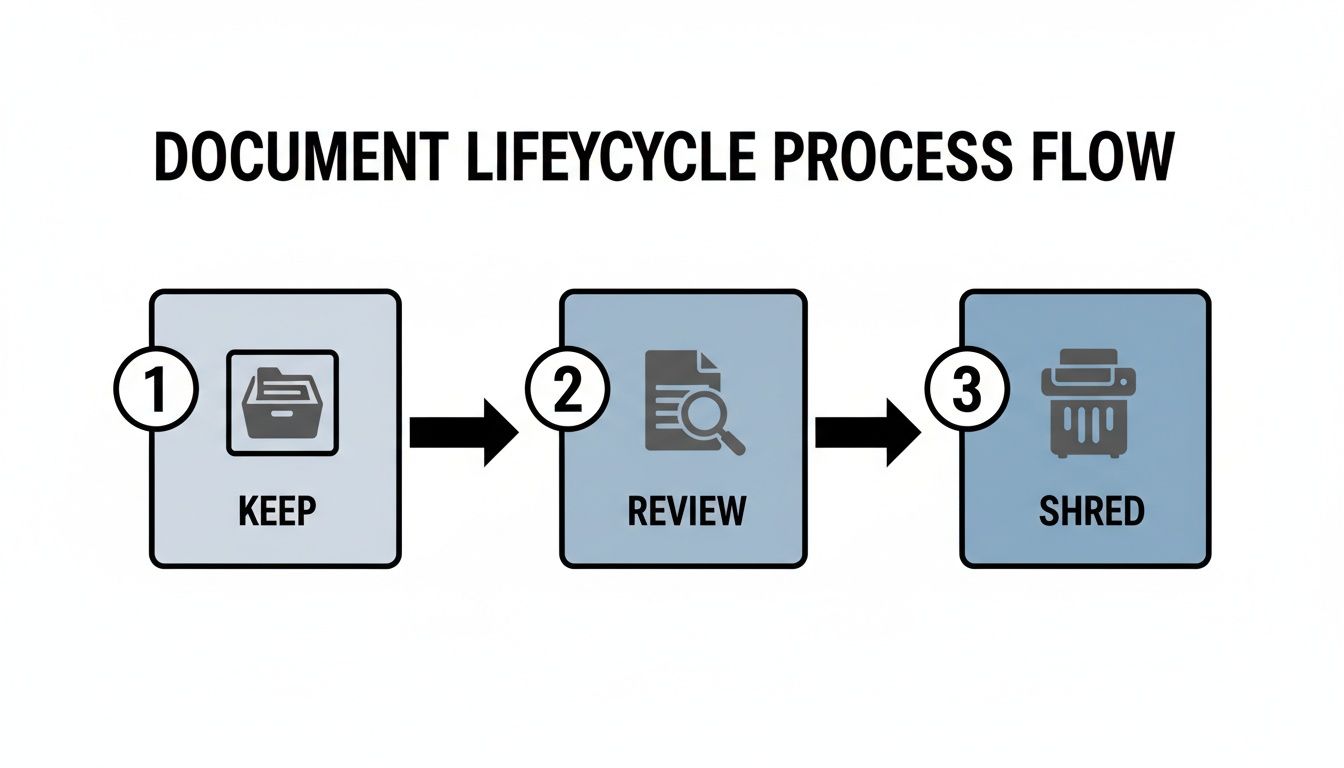
As you can see, every document requires active management, from its creation and storage (Keep), through periodic evaluation (Review), to its final, secure disposal (Shred). If you want to build a rock-solid system for your property documents, you might find our guide on best practices for contract management helpful.
Using Advanced Technology in Document Management
Going beyond just storing files in the cloud, modern technology gives us powerful tools that can turn your document management system into a real strategic asset. By embracing automation and artificial intelligence (AI), you can dramatically improve how you manage your rental properties, turning static records into a goldmine of valuable insights.
Think of it like upgrading from a basic calculator to sophisticated financial planning software. Sure, both can do the math, but the software gives you forecasts, alerts, and insights that the simple calculator just can't. In the same way, advanced tech can analyze your property data to help you make smarter, more proactive decisions.
This isn't some far-off, hypothetical benefit; it solves the real-world challenges property owners like you face every single day. These tools offer practical solutions that directly impact your bottom line and operational efficiency.
Unlocking the Power of AI and Automation
"Artificial intelligence" and "automation" might sound complicated, but in property management, their uses are surprisingly straightforward and incredibly effective. These technologies are brilliant at spotting patterns, handling repetitive tasks, and flagging issues a person might easily miss. This transforms your document management from a passive filing cabinet into an active defense system for your investment.
A perfect example is tenant screening. A manual review of an application is a good start, but an AI-powered tool can dig much deeper. It can cross-reference information across multiple documents—like pay stubs, bank statements, and the application itself—to spot inconsistencies that could signal fraud.
With a reported 75% of companies seeing a spike in fraud, this capability is more critical than ever. AI acts as a tireless extra set of eyes, constantly scanning to protect you from fraudulent applications and the costly eviction process that often follows.
The benefits go far beyond just screening, too. Automating rent reminders, late fee notices, and the generation of financial reports can free up hours of your time each month. This lets you focus on what really matters—growing your portfolio—instead of getting bogged down in administrative busywork.
Moving From Reactive to Predictive Management
One of the most powerful ways to use this technology is through predictive analytics. This is where we use your existing data to forecast future events. For a landlord, this is a total game-changer, especially when it comes to maintenance.
By analyzing years of maintenance logs and repair invoices, a predictive system can start to identify patterns. For instance, it might notice that a specific model of water heater in your properties tends to fail right around the eight-year mark. This allows you to proactively schedule a replacement before it breaks, saving you from a costly emergency flood and a very unhappy tenant.
This data-driven approach is essential if you want to scale your investments. While 75% of real estate companies are planning to grow their portfolios by 2026, only 55% actually succeeded in the past year, often because operational bottlenecks held them back. Standardized digital systems are the key to closing that gap. Investors who hire a property manager often adopt these tools much faster; in fact, 58% of high-earning investors are already benefiting from AI that automates fraud-prone document processes, as detailed in recent property management trend reports.
When you adopt these advanced document management practices, you’re doing more than just organizing paperwork. You are building a smarter, more resilient rental business that can anticipate problems, reduce risk, and operate with maximum efficiency in competitive markets like Redlands and Beaumont.
Partner with AIM for Expert Document Management
Knowing the rules of proper document management is one thing. Actually putting them into practice, day after day, is a completely different ballgame. For most property owners, the sheer volume of paperwork—from secure storage and retention policies to digital workflows—quickly turns into a full-time job.
This is where theory hits reality, and it's exactly where AIM PROPERTY MANAGEMENT COMPANY steps in. We serve the following communities: Redlands, Beaumont, Calimesa, Yucaipa, Loma Linda, Mentone, Highland, and Banning, California. We don’t just advise on best practices; we integrate them into the very fabric of our services. Our entire operation, from tenant screening and rent collection to 24/7 maintenance and legal compliance, is built on a foundation of meticulous, professional record-keeping.
Local Expertise in Your Community
If you own property in Redlands, Beaumont, or Yucaipa, you’re not just dealing with California rental law—you’re navigating a minefield of specific local ordinances, too. One misfiled notice or an improperly stored tenant record isn’t a small slip-up; it can expose you to serious legal and financial risk.
Our team lives and breathes the local regulations across all the communities we serve, including Calimesa, Loma Linda, Mentone, Highland, and Banning.
We handle your documentation with the precision needed to keep you compliant and protected. This isn’t just about organizing files—it’s about turning the administrative burden of property ownership into a streamlined, risk-managed investment that gives you true peace of mind.
This hyper-local focus means we’re not applying generic, one-size-fits-all rules. We’re actively managing your portfolio in line with the specific legal landscape where your property is located.
The Clear Choice to Hire a Property Manager
Ultimately, our expert document management is the engine that drives a stress-free ownership experience. By taking on the tedious, detail-oriented work of record-keeping, we free you from the daily operational grind. You can stop worrying about chasing down invoices or making sure your lease agreements are ironclad and up to date.
This is our direct invitation to property owners who are ready to hire a property manager and offload that administrative weight for good. When you partner with AIM, you get to enjoy the financial rewards of your investment without the risks and headaches that come with it. We handle the paperwork so you can focus on what matters most.
Frequently Asked Questions About Document Management
When it comes to property management paperwork, a lot of questions come up. Getting the details right is the key to staying protected and profitable. We've gathered some of the most common questions we hear from property owners to give you clear, straightforward answers.
What Is the Single Most Important Document to Keep?
Without a doubt, the fully executed lease agreement is the most vital document for any rental property. Think of it as the constitution for the tenancy—it’s the legally binding contract that outlines every right and responsibility for both you and your tenant.
This isn't a file-and-forget document. It needs to be stored securely but remain easy to access throughout the tenancy. Even after a tenant moves out, California law requires you to hold onto it for several years. This simple step can be your saving grace if a dispute ever arises down the road.
How Do I Securely Dispose of Old Tenant Applications?
Tossing documents loaded with sensitive information into the recycling bin is a recipe for disaster. Proper disposal is a non-negotiable step to protect tenant privacy and keep you out of legal hot water. The goal is to make the data completely unrecoverable.
- For paper documents: A cross-cut shredder is your best friend. Unlike basic strip-cut models, a cross-cut machine turns records into tiny, unreadable confetti, which is the bare minimum for security.
- For digital files: Just hitting 'delete' or emptying the trash folder won't cut it. You need to use a secure file deletion program that overwrites the data multiple times, making it impossible to restore.
Professional managers serving areas like Yucaipa and Beaumont have these compliant protocols built into their workflow, taking all the risk and guesswork off your plate.
Is Standard Cloud Storage Secure Enough for Rental Documents?
While services like Google Drive or Dropbox are great for personal photos, they often fall short of the security needed for sensitive rental documents. For true protection, you need a platform built specifically for business or property management.
A professional system offers layers of security like end-to-end encryption, role-based access controls, and detailed audit logs. It creates a digital fortress that properly shields both you and your tenants' data from prying eyes, which is exactly what modern document management demands.
If you're curious about the kind of systems the pros use, you can learn more about the software that helps property managers stay organized.
What Happens If I Violate California's Document Retention Laws?
Failing to follow California's document retention laws can hit you hard, both legally and financially. Imagine a former tenant disputes a security deposit deduction, but you’ve already tossed the move-in photos and repair invoices. In that scenario, you’re almost certain to lose the case.
Even worse, improperly destroying files with sensitive data can lead to steep fines and expensive lawsuits over privacy violations. This is one of the biggest areas where hiring a professional property manager provides immediate value, ensuring every single document is handled correctly from start to finish.
Partnering with AIM PROPERTY MANAGEMENT COMPANY takes the confusion and risk out of document management. We manage every detail, from secure digital storage to compliant disposal, so you can enjoy the rewards of owning property without the administrative headaches. Hire a property manager today and get your peace of mind back.