
Owning a rental should build wealth, not hijack your evenings.
If you're asking should i hire a property manager, you're probably already feeling the drag. A tenant texts during dinner. A repair turns into three vendor calls. Rent follows up turns into awkward confrontation. Then the weekend disappears into work you never intended to take on.
For many Inland Empire owners, especially in Redlands, Beaumont, Yucaipa, Highland, Banning, Calimesa, Loma Linda, and Mentone, this isn't a management style question. It's a capital allocation question. Are you using your time where it creates the highest return, or are you spending premium hours on tasks someone else can handle better and more consistently?
The Real Question Is Your Time Worth It
A lot of owners start with the wrong math. They look at a management fee and assume self-management is cheaper.
Then reality hits. The water heater leaks on Saturday night. The tenant wants an answer now, not Monday. You call a plumber, wait for a callback, reschedule your plans, approve the repair, then wonder whether the issue could've been caught earlier.

That is the job. Not collecting a rent check. Not “checking in” once a month. The job is handling interruptions, decisions, compliance, tenant communication, and repairs without letting one bad week damage your income stream.
The market has already shifted in that direction. In the U.S., 52% of rental property owners currently use professional property management services, and 36% of all U.S. rentals are now professionally managed, according to the 2024 Property Management Trends Report. Owners across Banning, Loma Linda, Beaumont, Highland, Redlands, Yucaipa, and Calimesa are outsourcing because rentals stopped being casual side projects a long time ago.
Practical rule: If your rental regularly interrupts your work, family time, or travel, you're already paying a management cost. You're just paying it in a less visible form.
Even broad landlord education points in the same direction. If you're weighing ownership responsibilities more generally, EHF Mortgages' landlord advice is a useful companion resource because it frames renting as an operating business, not passive income.
If you own in Redlands property management, Property Management Beaumont, Beaumont property management, Yucaipa property management, or property management Yucaipa markets, the useful question isn't “Can I do this myself?” You probably can.
The better question is whether you should.
Calculating the True Cost of Self Management
Forget the generic pros and cons list. Use a break-even formula.
A property management decision can be evaluated with this model: (Monthly Rent × Management Fee %) versus (Hours Spent Monthly × Your Hourly Value). In one published example, a $1,800 rental with an 8% fee costs $144 monthly, but if self-managing takes 5 hours a month and your time is worth $50 an hour, the DIY opportunity cost is $250, making professional management financially superior, according to Mynd's break-even framework.
Use the formula honestly
Most owners undercount their hours. They count obvious tasks like collecting rent and arranging repairs, but they ignore:
- Context switching: stopping your real work to answer tenant messages
- Vendor management: finding, scheduling, confirming, and following up
- Documentation: lease updates, notices, records, and payment tracking
- Problem recovery: the extra time caused by late action or missed details
If you're a physician, attorney, executive, business owner, or high-income professional, this matters more. Your hour often has a higher economic value than the management fee you're trying to avoid.
The fee is visible. The opportunity cost is usually larger, and owners hide it from themselves because it doesn't arrive as one invoice.
A better way to judge the fee
The wrong question is, “What percentage does a manager charge?”
The right question is, “What am I personally giving up to avoid that charge?”
Here’s a simple way to think about it:
| Item | DIY | Professional management |
|---|---|---|
| Direct monthly cost | No management invoice | Management fee applies |
| Time cost | You absorb the labor | Team handles daily operations |
| Income disruption risk | Higher if you delay leasing, repairs, or enforcement | Lower with established systems |
| Scalability | Gets harder with each property | More repeatable across a portfolio |
Tax treatment matters too. If you're evaluating your real net return, include the broader ownership picture, not just rent minus fee. A practical reference on that side of the equation is rental property owner deductions from Nanak Accountants and Associates.
When the math says hire the manager
You should strongly consider outsourcing if any of these are true:
- Your hourly value is high enough that a few monthly landlord hours exceed the fee.
- You own more than one unit and admin work keeps multiplying.
- You live at a distance from the property and every issue takes longer to solve.
- You want to grow but your current setup already feels like a second job.
If you want to compare fee structures against expected service levels, review what it costs to hire a property manager and then run your own numbers with your actual time value.
That will give you a decision grounded in ROI, not emotion.
The Four Pillars of Professional Property Management
The fee only makes sense if the service solves expensive problems. Good property management does that in four ways.

Published industry data supports the scope of the work. 73% of managers perform critical tasks like property inspections, advertising vacancies, and facilitating leases, which directly addresses turnover and occupancy pressure, according to this property management statistics summary. That same source notes professional services help maintain efficient occupancy against a national vacancy benchmark of 6.4%.
Tenant placement and lease execution
Many owners often first lose money at this stage.
Advertising, inquiry handling, showings, screening, lease preparation, and move-in coordination all sound manageable until you do them repeatedly under time pressure. Weak screening creates late payments, conflict, and turnover. Weak marketing creates longer vacancy.
A disciplined leasing process should include background checks, credit review, income verification, and clear lease documentation. That isn't busywork. It's income protection.
Financial control and compliance
Collecting rent is the visible part. The core value is consistency and documentation.
A manager should have systems for rent collection, late-payment follow-up, owner statements, lease files, notices, and California compliance workflows. That administrative discipline matters because rental ownership creates legal exposure the moment records are incomplete or deadlines slip.
If you want a practical summary of the role, property management company responsibilities gives a straightforward breakdown of the operating tasks a firm should handle.
Maintenance response and property preservation
Maintenance is where DIY owners get trapped. Not because repairs are impossible, but because every repair steals attention at the worst time.
A reliable management setup should provide:
- Emergency intake: tenants need a clear reporting path at all hours
- Vendor coordination: scheduling, dispatch, access, approvals, and completion tracking
- Routine oversight: recurring issues should be identified before they become expensive
- Inspection discipline: regular reviews help catch wear, neglect, and lease violations
That keeps tenants calmer and protects the asset itself.
A short video can help clarify what owners should expect from a professional management relationship:
Risk containment and difficult situations
This is the least glamorous pillar and one of the most important.
When a tenant stops paying, violates the lease, damages the unit, or creates conflict, most owners realize they never wanted to be the direct enforcer. Professional management creates distance, procedure, and documentation. That's valuable because difficult tenant situations require calm execution, not improvisation.
For an owner in property management Redlands, Redlands property management, Beaumont property management, or Yucaipa property management, the point is simple. The manager isn't just handling chores. The manager is operating a system that protects revenue, limits friction, and keeps your property functioning like an investment instead of a recurring interruption.
How Professional Management Boosts Your Net Income
Time savings matter, but they aren't the strongest argument. Higher net income is.
Owners often assume management fees reduce profit. Sometimes they do. But in many cases, better leasing, faster fill times, and stronger pricing more than offset the fee. That's why the right way to answer should i hire a property manager is to focus on revenue performance, not just expense control.
Vacancy is the silent profit killer
A unit doesn't have to sit empty for long to damage annual returns. Every lost leasing week creates an income gap you usually can't recover later.
Professional managers improve this in practical ways. They market consistently, respond faster to leads, screen with a repeatable process, and move qualified applicants through leasing without owner delay. That operational speed matters because vacancy usually lasts longer when the owner is also juggling a full career.
The published case evidence is telling. An Orange County case study documented a 40% reduction in vacancy time within 6 months after hiring professional management, along with $350 monthly rent increases, resulting in net gains despite management fees, according to Good Life Property Management's analysis.
Faster leasing doesn't just protect one month of rent. It protects the entire annual return profile of the property.
Rent optimization matters more than owners think
Many self-managing owners underprice because they fear vacancy more than they respect market demand. Others overprice, then chase the market down after losing weeks of exposure.
A professional manager should price with discipline, not guesswork. That means using local comparable properties, timing, current tenant demand, and unit condition to set a rate that attracts qualified tenants while protecting yield.
The same published source gives a second useful example. In Los Angeles, a property manager increased multifamily rents 8% higher than the owner originally planned, which boosted annual cash flow by $24,000.
That doesn't mean every property will see the same result. It does show the mechanism clearly. Better pricing decisions can produce gains large enough to dwarf the management fee.
Small improvements compound across a portfolio
One property with better rent, lower vacancy, and smoother renewals is helpful. Several properties run that way becomes a strategy.
For owners who are actively building a portfolio, management creates standardization:
- Leasing gets repeatable
- Turnover gets more controlled
- Maintenance decisions get documented
- Cash flow becomes easier to forecast
That consistency is what lenders, investors, and serious owners want. If you're analyzing your rental as a financial asset, not a side hustle, review how rental property cash flow works with the same discipline you'd apply to any other investment.
Where this hits hardest in Inland Empire ownership
In Property Management Beaumont, Beaumont property management, property management Yucaipa, and property management Redlands, many owners hold single-family homes and individually owned residential properties. Those properties don't need institutional complexity, but they do need process.
The strongest financial case for outsourcing usually appears when the owner is busy, the property is valuable, and each vacancy or pricing mistake has a real annual impact. That's common in Inland Empire ownership.
So if you're asking whether a manager costs money, the answer is yes.
If you're asking whether a manager can produce more net income than they cost, the evidence says that happens often enough that you should test the math before dismissing it.
A Decision Checklist for Hiring a Property Manager
You don't need more theory. You need a decision.
Use this checklist the way an investor would. If you answer “yes” to several of these, hiring help is probably the rational move, not a luxury.
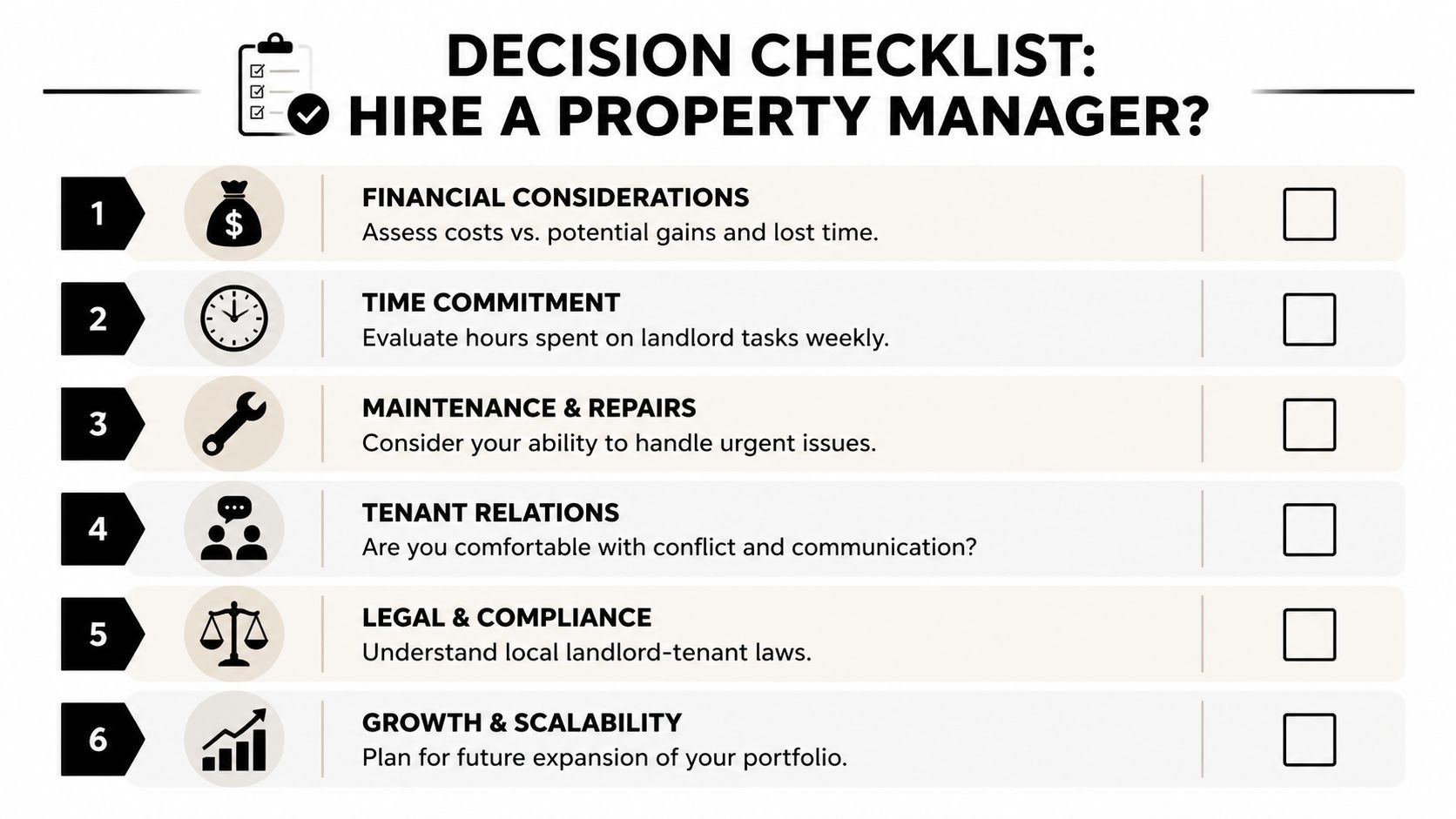
The owner-side checklist
Your time is expensive
Your primary career produces more value than landlord administration.You don't live close to the rental
Distance turns every repair, showing, and inspection into a larger disruption.You dislike tenant conflict
Late rent, lease enforcement, and difficult conversations drain attention quickly.You aren't fully current on California compliance
Rental law isn't forgiving when notices, timelines, or documentation go wrong.You want portfolio growth
Acquiring another property is hard if the first one already consumes your evenings.Your rental keeps interrupting family time
If the property dictates your schedule, it isn't operating efficiently.
The property-side checklist
Some assets are simple on paper and annoying in practice. Ask yourself:
| Question | If yes, what it usually means |
|---|---|
| Does the property need regular maintenance coordination? | Operational burden is already recurring |
| Has leasing or turnover felt harder than expected? | Revenue may be leaking through vacancy or weak execution |
| Do you own an individually managed condo, townhome, or single-family rental? | Professional systems can stabilize small-portfolio ownership |
| Do you want clearer reporting and cleaner records? | Administrative support will likely add value |
If your rental behaves like a second job, treat management as an operating solution, not as an optional add-on.
The decision standard I recommend
Hire a manager if your answer is yes to the majority of the checklist and your personal time value exceeds the likely fee burden.
Don't hire one just because ownership feels annoying for a week. Hire one because the economics, workload, and risk profile justify it.
If you're comparing firms, this guide on how to choose a property management company is the right next step. It helps separate firms that only collect fees from firms that run reliable systems.
How to Vet a Management Partner in the Inland Empire
A lot of owners make a costly mistake after deciding to outsource. They assume all managers are basically the same.
They're not. Some are organized, insured, documented, and disciplined. Others are cheap until something goes wrong.

Insurance is not optional
One of the most overlooked due diligence items is insurance verification.
A critical risk-management source notes that owners are exposed if they don't confirm Errors and Omissions insurance, business liability insurance, and workman's comp. It also states that uninsured manager mishaps lead to 20% to 30% higher claim payouts for owners, while professionally insured firms can reduce owner liability by 85% through layered coverage, according to Rent Grace's insurance-focused checklist.
That changes the screening process immediately. Fee comparisons come after coverage verification, not before.
Ask for documents, not assurances
Don't accept verbal comfort.
Ask the management company to show proof of:
- E&O coverage for management mistakes and administrative errors
- Business liability coverage for broader claims exposure
- Workman's comp coverage if employees or workers are involved
- Management agreement clarity on authority, approvals, and owner protections
If a company hesitates, redirects, or acts offended, move on. You're hiring them to reduce operational risk. If they create hidden risk at the company level, the relationship is already flawed.
A low management fee loses its appeal fast when the wrong claim lands on the owner.
Evaluate operating discipline, not sales language
Once insurance is confirmed, evaluate how they run properties.
Listen for concrete answers about screening, inspections, maintenance dispatch, documentation, owner reporting, and legal processes. Vague phrases like “we handle everything” aren't enough. You want a company that can describe the workflow, the records, and the escalation path.
One practical next step is reviewing what it means to hire a property manager and using that as a benchmark for your interview questions.
What Inland Empire owners should prioritize
In California, process matters because conflict, compliance mistakes, and repair issues can become expensive quickly. Owners in Redlands property management, Property Management Beaumont, and property management Yucaipa should prioritize:
- Insurance verification first
- Clear screening standards
- Reliable maintenance coordination
- Documented communication
- Comfort with lease enforcement and legal notices
This is also the one place where naming a specific local option is useful. AIM PROPERTY MANAGEMENT COMPANY handles residential management tasks such as tenant screening, rent collection, maintenance coordination, inspections, and document management for owners in communities including Beaumont, Yucaipa, Redlands, Banning, Highland, Loma Linda, and Calimesa.
That doesn't mean you should stop your search there. It means you should compare every firm against the same due diligence standard and reject anyone who can't meet it.
Local Expertise in Beaumont and Yucaipa Property Management
Local execution matters more than national talking points.
An owner in Beaumont doesn't need generic landlord advice written for a downtown high-rise. An owner in Yucaipa doesn't benefit from systems designed around a different tenant profile and housing stock. You need management that fits the properties people rent in these communities.
For busy professionals in Inland Empire markets like Redlands and Yucaipa, self-management's hidden costs can exceed 10% to 15% of gross rents. The same source notes that average self-managing landlords spend 15 to 20 hours per week on tasks, compared with typical professional management fees of 8% to 12%, according to The Coastal Project's opportunity-cost discussion.
Why Beaumont owners should think differently
Property Management Beaumont and Beaumont property management decisions often involve owners of single-family homes, condos, and townhomes who don't want daily operating work.
That makes local leasing execution especially important. The property has to be marketed well, shown promptly, screened carefully, and maintained without delay. In a growing residential market, small timing mistakes can turn into unnecessary vacancy or weaker tenant placement.
If you own in Beaumont, focus on these questions:
- How quickly does the manager respond to leasing inquiries?
- How do they verify income and credit?
- Who handles emergency repairs after hours?
- How are inspection findings documented and shared?
Those details shape your actual return more than a polished website does.
Why Yucaipa owners should focus on operational consistency
Yucaipa property management and property management Yucaipa often center on well-kept residential homes where tenant experience matters. Owners here usually benefit from a manager who can maintain professionalism with tenants while preserving the property's condition over time.
That means consistency matters. Not occasional effort. Not reactive problem-solving. Consistent communication, repair coordination, lease enforcement, and inspection follow-through.
A strong Yucaipa operator should help you with:
| Priority | Why it matters |
|---|---|
| Tenant screening | Better placement lowers friction and protects rent flow |
| Maintenance coordination | Faster response helps preserve the home and the tenant relationship |
| Inspection routines | Ongoing oversight catches issues before they expand |
| Financial reporting | You should be able to review performance without chasing information |
Redlands owners should use the same lens
Even if your main search starts with Redlands property management or property management Redlands, the same principle applies. Local knowledge isn't branding. It's the ability to execute in the actual neighborhoods, with the actual housing types, and with the actual owner constraints common to the Inland Empire.
If you're a high-income owner asking should i hire a property manager, local expertise matters because it shortens response time, improves tenant handling, and reduces the amount of oversight you have to provide yourself.
That is the point of outsourcing in the first place.
Your Next Steps and Frequently Asked Questions
Here's the cleanest way to decide.
If your rental is consuming high-value time, creating avoidable stress, or underperforming because leasing, maintenance, and compliance aren't being handled with enough discipline, hire a property manager. If your property is nearby, simple, stable, and you genuinely want the work, self-management can still make sense.
For most busy owners in the Inland Empire, the answer is straightforward. Run the break-even math, review the workload realistically, verify insurance, and choose a manager with local operating discipline.
The best reason to hire a manager isn't convenience. It's protecting income while reclaiming your time for higher-value work.
Frequently asked questions
| Question | Answer |
|---|---|
| How do I calculate my personal ROI for hiring a manager? | Start with the break-even model discussed earlier: compare your likely management fee against the value of the hours you spend each month on leasing, tenant communication, rent follow-up, maintenance coordination, records, and compliance. Then factor in whether better leasing and pricing could improve revenue. |
| What if I only own one rental home? | One property can still justify management if your time is valuable, you live far away, or you don't want direct involvement in tenant issues. Unit count matters less than time pressure, risk tolerance, and the quality of your current operations. |
| What insurance policies should I ask to see? | Ask for proof of Errors and Omissions coverage, business liability coverage, and workman's comp. Don't rely on verbal confirmation. Request documentation and review it before signing anything. |
| How do I switch from self-management to professional management? | Gather your current lease, tenant ledger, maintenance history, deposit records, and vendor information. A good manager should review the file, identify gaps, and create a clean handoff plan for communication, rent collection, maintenance, and documentation. |
| Should I search for property management near me or choose based on systems? | Start with both. “property management near me” helps you find local options, but proximity alone isn't enough. Pick the company with stronger screening, reporting, maintenance coordination, compliance processes, and insurance verification. |
| When should I hire a property manager instead of waiting another year? | Hire one now if the property is affecting your career, travel, or family time, or if you're already seeing friction around leasing, repairs, collections, or documentation. Waiting usually means paying the hidden cost longer. |
| What should I expect after I hire a property manager? | You should expect clearer reporting, less tenant interruption, a structured maintenance process, documented communication, and more consistent execution. You should not expect to disappear completely. You're still the owner. The difference is that you stop acting as the on-call operator. |
If you've reached the point where you're seriously considering whether to hire a property manager, don't make the choice based only on the fee. Make it based on time value, risk control, and income protection.
If you want a practical next conversation, AIM PROPERTY MANAGEMENT COMPANY works with residential property owners in Beaumont, Yucaipa, Redlands, Banning, Highland, Loma Linda, Calimesa, and nearby communities to handle tenant screening, rent collection, maintenance coordination, inspections, and compliance support. The right next step is a direct review of your property, your workload, and whether professional management improves your actual return.