
Before you even consider interviewing a property management company in Beaumont,
the first step is a bit of introspection. You need to get crystal clear on what you actually want and need from a partner. Without this internal scorecard, you're just throwing darts in the dark.
This isn't about finding the "best" company; it's about finding the best company for you—one with proven systems in place since 1997, professional contractors that do it right, and pricing that lets you keep more money in your pocket.
Defining Your Property Management Needs
The journey to learning how to choose a property management company really starts with looking in the mirror. Are you the type of investor who wants to sign off on every little repair, or do you prefer to set it and forget it, letting the pros handle the day-to-day so you can enjoy a truly passive income?
There’s no right answer here, but your personal style is the most important filter you have. And remember: bringing on a manager is a major act of delegation. If you're not used to that, learning how to delegate tasks effectively is a great starting point. It helps you set clear expectations from day one, which is the secret to avoiding a lot of headaches and misunderstandings down the road.
Hands-On vs. Hands-Off Investor Style
Your ideal level of involvement is a fork in the road, and it will lead you to very different types of management companies.
-
Hands-On Investors: You're probably looking for a partner who provides incredibly detailed monthly reports and gets your approval for any maintenance over a low threshold, say $100. You want someone who keeps you in the loop and collaborates on the bigger decisions.
-
Hands-Off Investors: You need a full-service firm that can operate with autonomy. They'll have the authority to manage repairs and tenant issues on their own, only reaching out for the big stuff. You trust them to run the show.
Knowing which camp you fall into helps you ask sharp, targeted questions. For example, if a company's policy is to handle all maintenance under $500 without owner approval, that’s a dream for a hands-off investor but a potential deal-breaker for someone who wants more control.
The Stability of Long-Term Rentals
The next big decision is your rental strategy. Short-term rentals might look tempting with high nightly rates, but they bring a ton of volatility, hands-on management, and much more wear and tear on your property. For most investors who are after steady, predictable returns, long-term rentals are simply the smarter play.
The case for a long-term rental strategy is pretty clear-cut: you get consistent monthly income, lower costs from tenant turnover, and a maintenance schedule you can actually plan for. It’s a strategy built for stability, not constant chaos.
At AIM, we only manage long-term rentals—leveraging our over 27 years of expertise to maximize stable returns and avoid the constant cleaning, marketing, and guest turnover that short-term platforms like Airbnb demand. A firm with deep roots and mature relationships with the community translates into better pricing and reliable work, which saves you money in the long run. Their systems are built to protect your asset over years, not just manage a high-turnover vacation spot.
Creating Your Non-Negotiables Checklist
Last but not least, sit down and make a list of your absolute deal-breakers and must-haves. This isn't a wish list; it's a practical tool you'll use to objectively measure every company you talk to.
Your checklist should get specific. Think about things like:
-
Communication: How often do you want to hear from them? Are you an email person, or do you prefer a quick phone call? Does an online portal appeal to you?
-
Maintenance: What’s the maximum repair cost you're comfortable with them handling without your direct approval?
-
Financials: When do you get paid each month? What do their owner statements look like?
-
Inspections: How often do they physically inspect the property? A yearly inspection is a fantastic, proactive way to protect your investment.
With this framework in place, you’re no longer just interviewing companies. You're strategically searching for a true partner who fits the exact criteria you’ve already laid out.
Understanding the True Cost of Management Fees
Property management fees can feel like a maze. You see percentages here, flat rates there, and it’s tough to get a clear picture of your actual bottom line. Too many property owners get tunnel-vision on that main monthly management percentage, but honestly, that number is often just the tip of the iceberg. If you want to know how to choose the right property management company, you have to learn how to dissect their entire fee structure to see what you'll actually be paying.
The biggest trap is the "low fee" leader. A company might dangle a tempting 6% monthly fee, but then you find yourself buried in extra charges for everything—tenant placement, routine paperwork, you name it. This is exactly why a transparent, all-inclusive pricing model is so valuable. It lets you budget accurately and, more importantly, keep more of your hard-earned money.
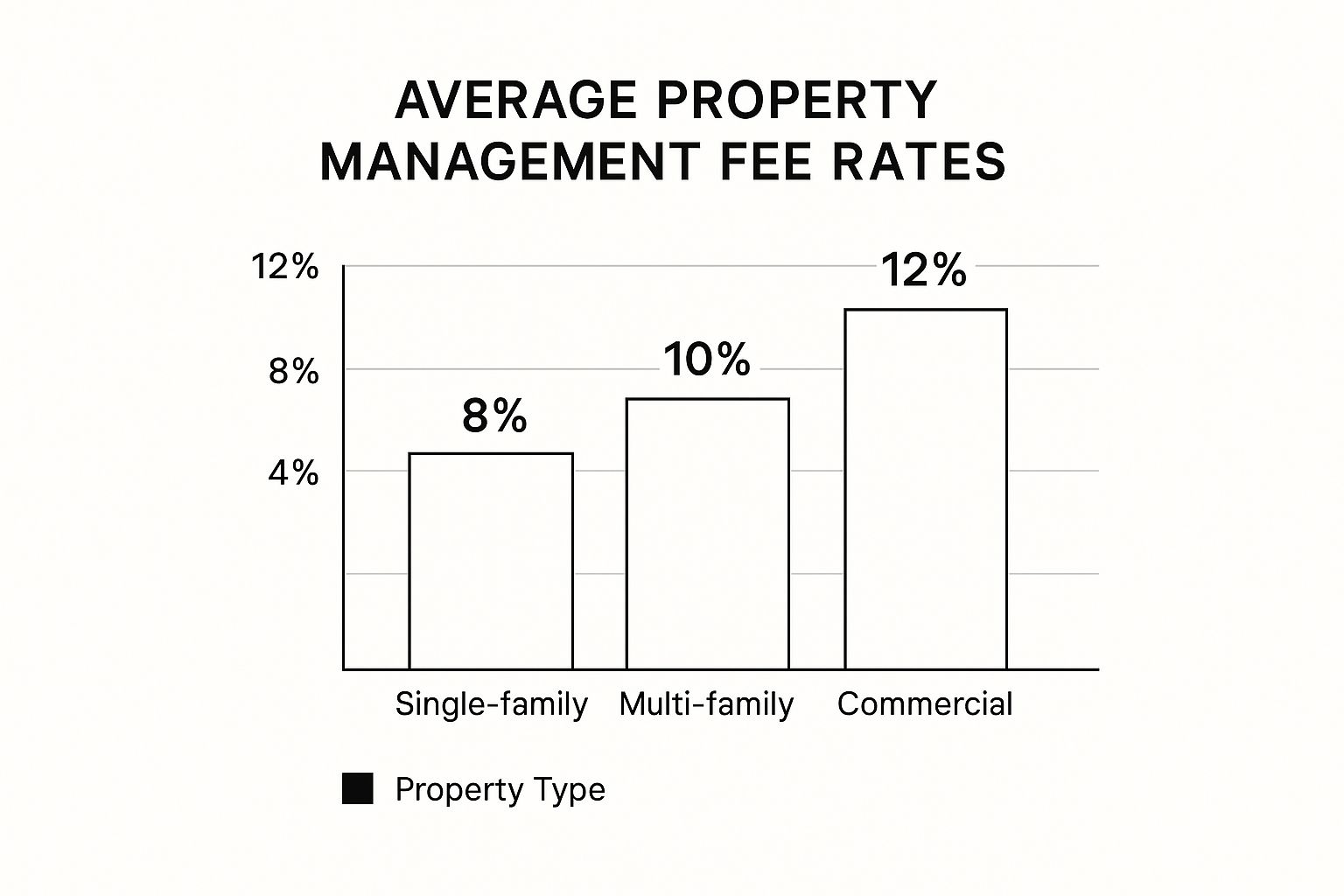
This chart gives you a general idea of how average fees can shift based on property type, but the real devil is in the details—those hidden costs many companies conveniently forget to mention upfront.
Deconstructing the Fee Structure
To really get a handle on the cost, you have to look past that single monthly percentage. A complete fee structure has several moving parts, and every single one can make a dent in your return on investment.
A clear, affordable model we recommend is a 7.9% monthly management fee paired with a flat $750 tenant placement fee, with no other add-on fees. Why? Because a simple structure like this removes all the guesswork and protects your profits from those nasty surprise charges. Let's break down the typical fees you'll run into and see why this straightforward approach just makes more sense.
-
The Monthly Management Fee: This is the most obvious cost, usually falling somewhere between 8% to 12% of the monthly rent collected. It’s meant to cover the day-to-day work: collecting rent, handling tenant calls, and sending you financial reports. A rate like 7.9% is very competitive and ensures you keep more of your rental income each month without seeing a drop in service quality.
-
The Tenant Placement Fee (or Leasing Fee): This fee covers the work involved in finding and screening a new tenant. It can be a flat rate or, more commonly, a percentage of the first month's rent—often as high as 50% to 100%. A flat fee of $750 is predictable. It often saves you hundreds of dollars, especially in markets where rents are higher.
The most crucial question to ask is: "What other fees are attached to this?" Some companies will tack on advertising fees, application processing fees, or administrative fees on top of their placement fee, which quickly inflates the total cost.
Uncovering the Hidden Costs
This is where so many property owners get burned. Hidden fees are almost always buried in the fine print of the management agreement. To protect your investment, you have to ask direct, specific questions about these common "add-on" charges. A great way to see how these fees eat into your profits is to plug the numbers into a rental yield calculator and watch the difference.
Here’s what you absolutely must ask every potential manager:
-
Lease Renewal Fees: "Do you charge a fee when a good tenant wants to renew their lease?" Believe it or not, some companies will charge you hundreds of dollars just to sign a renewal document. You're essentially being penalized for keeping a great tenant.
-
Maintenance Markups: "Do you add a surcharge to contractor invoices?" It's a common practice for firms to add 10% to 20% on top of what a plumber or electrician actually charges. An experienced company, especially one that's been in business for over 27 years, will have built solid relationships with professional contractors. They can leverage these connections to get you fair pricing without needing to pad the bill.
-
Inspection Fees: "Are property inspections included, or do they cost extra?" Proactive yearly inspections are vital for protecting your asset, but they shouldn't show up as a surprise bill. This should be a standard part of the service.
-
Administrative or 'Junk' Fees: "Are there any other standard fees I should know about?" Ask about account setup fees, technology fees, or even vacancy fees (yes, some charge you when the property is empty!).
Fee Structure Comparison: Transparent vs. Hidden Costs
|
Fee Type |
Typical Industry Range |
Our Transparent Model (AIM) |
Potential Impact on Your ROI |
|---|---|---|---|
|
Monthly Management Fee |
8-12% of monthly rent |
7.9% of collected rent |
A lower, fixed percentage directly increases your monthly cash flow. |
|
Tenant Placement Fee |
50-100% of 1st month’s rent |
Flat $750 |
A flat fee provides predictability and significant savings in higher-rent markets. |
|
Lease Renewal Fee |
$200 – $500 |
$0 (Included) |
Eliminating this fee encourages long-term tenancies, reducing turnover costs. |
|
Maintenance Markup |
10-20% on invoices |
$0 (Pass-through cost) |
You pay the direct contractor price, saving hundreds or thousands annually on repairs. |
|
Inspection Fees |
$50 – $150 per inspection |
$0 (Included) |
Proactive inspections are part of the service, not an extra charge. |
As you can see, the company with the "higher" 7.9% fee can actually save you a significant amount of money over the course of a year. The initial percentage isn't the whole story. By seeking out a company with a simple, transparent fee structure—like a flat 7.9% monthly rate and a $750 placement fee with no hidden extras—you ensure your interests are aligned with theirs. Their goal becomes maximizing your income, not nickel-and-diming you with a confusing menu of charges. That's how you find a true partner, not just another service provider.
Why Experience and Reputation Matter

When you start digging into how to choose a property management company, you'll quickly discover it’s a crowded field. The U.S. property management industry has roughly 325,037 businesses, and a sharp-looking website doesn't tell you the whole story. For more data on this market, ibisworld.com is a great resource.
In a market this packed, experience and reputation are the two things that truly separate the pros from the newcomers. They’re your most reliable signals of a company’s competence and staying power.
A company's history is more than just a number. It's proof they can handle market swings, build solid relationships in the community, and have fine-tuned their operations over years of trial and error. A newer company might tempt you with a low introductory rate, but they often haven't developed the battle-tested systems that prevent expensive mistakes down the road.
Think about it: a firm that’s been around since 1997 has over 27 years of experience under its belt. That isn't just trivia; it translates into real, tangible benefits for your bottom line—systems in place to save you money with professional contractors and proactive yearly inspections built right in.
The Power of Longevity and Established Systems
Decades in the business means a company has seen it all. They've weathered economic downturns, navigated complex changes in rental laws, and dealt with every tenant issue you can possibly imagine.
This kind of longevity allows them to build incredibly efficient systems for everything, from collecting rent on time to handling those dreaded 3 a.m. emergency maintenance calls. More importantly, that experience cultivates deep-rooted relationships with professional, reliable contractors. An established firm can tap into its long-standing network to get you better pricing and priority service on repairs. They’ve already done the hard work of vetting the best plumbers, electricians, and handymen in the area. This means quality work gets done right the first time, saving you a ton of money and headaches.
Verifying a Company's Track Record
Reputation is the other side of the experience coin. A long history is a great start, but you need to confirm that their track record is actually a good one. Don't just take their word for it—do your own homework.
Start with a simple online search. Check out reviews on Google, Yelp, and the Better Business Bureau. Pay close attention to what people are complaining about. Are they isolated incidents, or do you see a recurring pattern of the same problem? Also, look at how the company responds to negative feedback. A professional, proactive response is a great sign that they take accountability seriously.
A company's true character often shows up not when things are going perfectly, but in how they handle problems. You want a manager who takes ownership of issues and actively works to solve them.
After you've scoured their online presence, your next step is crucial: ask for references from current or former clients who own properties similar to yours.
Questions to Ask When Checking References
Talking directly to other property owners gives you unfiltered, real-world insight into what it’s like to work with the company day-to-day. Here are a few essential questions to get the conversation started:
-
Communication: "How responsive are they when you have a question or concern? Do you feel like you're kept in the loop?"
-
Maintenance: "Can you give me an example of how they handled a maintenance issue? Were you happy with the cost and the quality of the work?"
-
Financials: "Are your owner statements clear and easy to understand? Do they always arrive on time? Have you ever had issues with rent payments?"
-
Overall Satisfaction: "What's been the single best thing about working with them? And the worst? If you were in my shoes, would you hire them again?"
Asking these direct questions helps you paint a complete picture. A firm with a proven history, like one with over 27 years in business, and a stellar reputation is more than just a vendor—they're a partner dedicated to protecting and growing your investment. Their affordable pricing lets you keep more of your money, and their proactive yearly inspections help catch small issues before they blow up into expensive disasters.
Diving Deep into Tenant Screening and Maintenance

Alright, you've confirmed a company is legit and you understand their fees. Now we get to the heart of what a property manager actually does day-to-day. When you're figuring out how to choose a property management company, nothing—and I mean nothing—is more critical than how they handle tenant screening and property maintenance.
These aren't just line items on a service list. They are the twin pillars that support your entire investment. Get them wrong, and you're in for a world of hurt.
One nightmare tenant can easily cost you thousands in unpaid rent, legal fees, and repairs, completely erasing a year's profit. In the same way, a small, ignored leak can quickly turn into a massive, expensive mold problem. This is where a manager’s real skill, or lack thereof, becomes painfully obvious.
Tenant Screening: Your First Line of Defense
Think of tenant screening as the gatekeeper for your property. A truly professional manager knows this is the single most important step in securing a profitable, low-stress tenancy. It's not just about filling a vacancy; it's about finding the right person.
A quick glance at an application form just doesn't cut it. A thorough screening process is a deep dive, a full investigation to make sure you’re getting a responsible and reliable tenant.
Here’s what a serious screening process must include:
-
Credit Checks: This shows you how they handle their financial obligations. You're looking for a solid history of paying bills on time.
-
Criminal Background Searches: This is non-negotiable for the safety of your property and the neighborhood.
-
Eviction History Reports: A past eviction is a giant red flag. It’s a strong predictor of future issues.
-
Income and Employment Verification: You need solid proof they can afford the rent. The industry standard is an income of at least three times the monthly rent.
Any company that treats this as a simple box-checking exercise is playing Russian roulette with your investment. You want a partner who understands that this is the bedrock of a successful rental. In fact, a recent survey found that over 70% of property managers see thorough screening as absolutely critical to their success. You can get more details like this from the 2025 Property Management Industry Report from Buildium.
Keeping Your Property in Top Shape
The second pillar is maintenance. The best managers are proactive, not reactive. Simply waiting for a tenant to call with a broken pipe is a failing strategy that leads to costly emergency repairs and frustrated tenants.
It all starts with proactive yearly inspections—included at no extra charge. Having a professional walk through your property at least once a year is invaluable. They'll spot the small drip under the sink before it floods the kitchen or notice the HVAC unit making a funny noise before it dies in the middle of a heatwave. These inspections are your best defense against expensive surprises.
A great property manager doesn't just fix things; they protect the long-term value of your asset. Their maintenance strategy should focus on prevention to save you money and preserve the property's condition.
You should also ask about their network of vendors and contractors. A firm with over 27 years of experience isn't just finding a plumber on Google. They've spent decades building relationships with reliable, vetted tradespeople who show up on time, do quality work, and charge a fair price. Those relationships directly save you money and headaches.
Get specific with your questions about their process:
-
How do tenants put in a maintenance request? Is there an online portal?
-
What’s your typical response time for non-emergencies?
-
How do you handle a furnace that goes out at 2 a.m. on a holiday?
Their answers will tell you everything you need to know about how organized and reliable they really are. A manager who combines preventative inspections with a rock-solid vendor network will keep your property in great shape, your tenants happy, and your bottom line healthy.
Looking Under the Hood: Technology and Communication
In this day and age, how a property management company uses technology tells you almost everything you need to know about them. It's not just a bonus feature—it’s the engine that drives their entire operation. We’re long past the days of paper rent checks and phone tag for maintenance calls. That stuff just creates headaches and costly delays for everyone.
The best companies use tech to make the whole process smooth for both you and your tenants. Think about it: you should be able to see your financial reports with a click, and your tenants should be able to pay rent or report a leaky faucet just as easily. This isn't about being fancy; it's a sign that a company is organized, transparent, and built to run a modern rental business efficiently.
It All Starts with Online Portals
If there’s one piece of tech that's non-negotiable, it's a solid online portal system. These are the secure, central hubs where all the important information lives, available 24/7. They cut out the guesswork and the endless chain of emails and phone calls.
Here’s what you should be looking for:
-
An Owner Portal: This is your command center. A good one gives you a real-time window into your investment’s performance. You should be able to pull up financial statements, review maintenance invoices, and check inspection reports whenever you want. No more waiting for a month-end report to see when rent was collected or when you were paid.
-
A Tenant Portal: This is a huge win for everyone. It lets tenants handle their business on their own time. They can pay rent online, set up recurring payments (which is great for cash flow), and submit maintenance requests with photos attached. This not only makes their lives easier but also creates a perfect, time-stamped digital paper trail for every interaction.
These portals aren't just a nice perk anymore; they're the standard. A company that doesn't offer them is likely lagging behind in other critical areas too.
When you're interviewing a potential manager, flat-out ask for a demo of their portals. A quick walkthrough will tell you volumes about how user-friendly their system is. If they hesitate or can't show you, that’s a major red flag.
Communication and Marketing in a Digital World
Beyond the portals, look at how they handle day-to-day communication. Quick, clear responses are crucial, especially when a pipe bursts at 2 AM. A key part of their setup is their choice of top property management answering service options, which determines how well emergencies and after-hours calls are handled.
This tech-savvy approach should absolutely carry over to how they market your property. A great manager uses every digital tool available to get your vacancy filled fast because an empty property is a money pit. They should be syndicating your listing to all the major rental sites, using professional-quality photos, and writing ad copy that actually sells the place. Their online marketing game is directly linked to how quickly you get a paying tenant.
The global property management market is expected to hit $28 billion by 2028, and that growth is being fueled by companies embracing technology to automate and improve how things get done. The trend is clear: the market rewards managers who have mastered these digital tools. Your final choice should, too.
Common Questions When Picking a Property Manager
After you've done the research and narrowed down your options, a few final questions always seem to surface. Choosing the right property management company is about finding a partner you trust completely. Let's tackle some of the most frequent questions I hear from property owners to give you that last bit of confidence.
What Should I Really Be Paying in Management Fees?
This is the big one, isn't it? Everyone wants to know the magic number, but the truth is, the monthly percentage is only part of the story.
You’ll see a lot of companies advertising fees between 8% and 12%, but that figure can be a bit of a smokescreen. A company might offer a lower rate, say 8%, but then you find your statement nickeled-and-dimed with extra charges for lease renewals, administrative tasks, or maintenance coordination. It adds up quickly.
I've found that a more transparent model works best for everyone. For example, a clear structure like a 7.9% monthly management fee with a straightforward $750 tenant placement fee—and no other add-on fees—tells you exactly what to expect. There are no hidden costs, no surprises—just a simple, predictable expense that lets you budget effectively.
Are Long-Term and Short-Term Rental Managers Interchangeable?
Absolutely not. It's like comparing a marathon runner to a sprinter; they require completely different skill sets.
A short-term rental manager is essentially in the hospitality business. They're focused on high turnover, managing listings on sites like Airbnb, coordinating constant cleanings, and dealing with guest communication. It's a very hands-on, daily operation.
A long-term rental specialist, on the other hand, is all about asset management and building stable, passive income for you. Their expertise is in a different universe:
-
Finding the Right Tenants: They run deep background checks to find reliable people who will treat your property like their own home.
-
Managing the Tenancy: They handle everything from collecting rent to enforcing the terms of a solid lease agreement.
-
Protecting Your Investment: Their main goal is proactive maintenance—annual inspections included—to preserve your property's value for years to come.
If your goal is steady, predictable returns with less wear and tear on your property, you need a manager who lives and breathes long-term rentals.
Does a Company’s Years in Business Actually Matter?
Experience isn’t just a number; it’s a direct indicator of how well a company can protect your investment through thick and thin. Think about a firm that’s been operating since 1997. That's over 27 years of navigating market cycles, evolving rental laws, and building a bulletproof system.
That kind of history translates into real-world advantages for you. An established company has had decades to build a network of trusted, affordable contractors. When a pipe bursts, they know exactly who to call to get quality work done at a fair price—a benefit a newer company just can't match.
A seasoned manager has seen it all. They won't be rattled by a tricky eviction or a sudden market downturn, giving you peace of mind that your investment is in a steady pair of hands.
How Do I Spot a Good Maintenance Process?
A great maintenance plan is all about being proactive, not just putting out fires. The first sign of a solid process is a commitment to regular property inspections. When a company inspects your property every year—at no extra charge—they're looking for the small issues—a little water stain, a leaky faucet—before they turn into a full-blown crisis that costs you thousands.
Next, you need to ask about their vendor network. Do they have a list of go-to plumbers, electricians, and handymen they've worked with for years? Or are they just Googling someone when you have a problem?
A company with deep roots in the community will have long-standing relationships with reliable tradespeople. This means repairs get done faster, the quality of work is better, and you aren't being overcharged. It's this one-two punch of preventative inspections and a trusted vendor network that keeps your property in top shape, your tenants happy, and your repair costs under control.
Ready to work with a property management company that pairs decades of real-world experience, systematic processes, and professional contractors who do it right with a transparent, owner-friendly fee structure? AIM PROPERTY MANAGEMENT COMPANY has been helping owners maximize their returns since 1997 with our flat 7.9% management fee, simple $750 placement fee, and no other add-on fees—plus proactive yearly inspections and affordable pricing to keep more in your pocket.
Find out more about how we can help you and get started today.