

A lot of owners start asking how much does it cost to hire a property manager after a bad night, not after a good month. A tenant calls after midnight because water is coming through a ceiling. A rent payment is late again. A repair invoice shows up with no context. Suddenly, self-managing a rental in Redlands, Beaumont, Yucaipa, or Banning doesn’t feel like a side task. It feels like a second job.
That’s where the true decision starts. Not just “What’s the monthly fee?” but “What am I paying for, what extra fees show up later, and what does professional management save me in time, risk, and stress?” Owners who hire a property manager usually aren’t trying to avoid involvement altogether. They’re trying to stop small problems from becoming expensive ones.
The monthly fee matters. So do leasing costs, renewal fees, maintenance coordination, inspections, legal compliance, and vacancy handling. The owners who make the best decision are the ones who look at the full operating picture instead of comparing one headline percentage against another.
Investing in Peace of Mind Not Just Property
A 2 AM maintenance call changes how landlords think about management. It’s one thing to collect rent from a good tenant. It’s another to coordinate emergency repairs, document the issue, protect the property, and decide what to do next while you’re half awake.

That’s why property owners in communities like Redlands, Loma Linda, Highland, and Banning usually come back to the same question. Is professional management an expense that eats into cash flow, or is it a practical investment that protects the property and stabilizes returns?
The honest answer is that it can be either, depending on the fee structure, the company’s process, and the type of property you own. A cheap manager who communicates poorly can cost you more than no manager at all. A capable manager who screens thoroughly, handles maintenance correctly, and stays current on California compliance can save you from problems that don’t show up on a simple spreadsheet.
Practical rule: Don’t judge management by the monthly percentage alone. Judge it by the total financial result and the number of problems you no longer have to personally solve.
Owners searching for Property Management Beaumont, Beaumont property management, Yucaipa property management, property management Yucaipa, Redlands property management, or property management Redlands usually want straight answers. They want to know the actual first-year cost, what changes in later years, and whether the service is worth handing over a meaningful share of rent.
That full picture matters more in the Inland Empire, where one rental home can look simple on paper but still require constant decisions. Leasing, inspections, maintenance calls, rent collection, notices, documentation, and vendor coordination all have a cost, whether you pay for them with money or with your time.
Understanding Property Management Fee Structures
Most residential management companies use one of two pricing models. They either charge a percentage of collected rent or a flat monthly fee. Everything else in the agreement usually builds on that base.
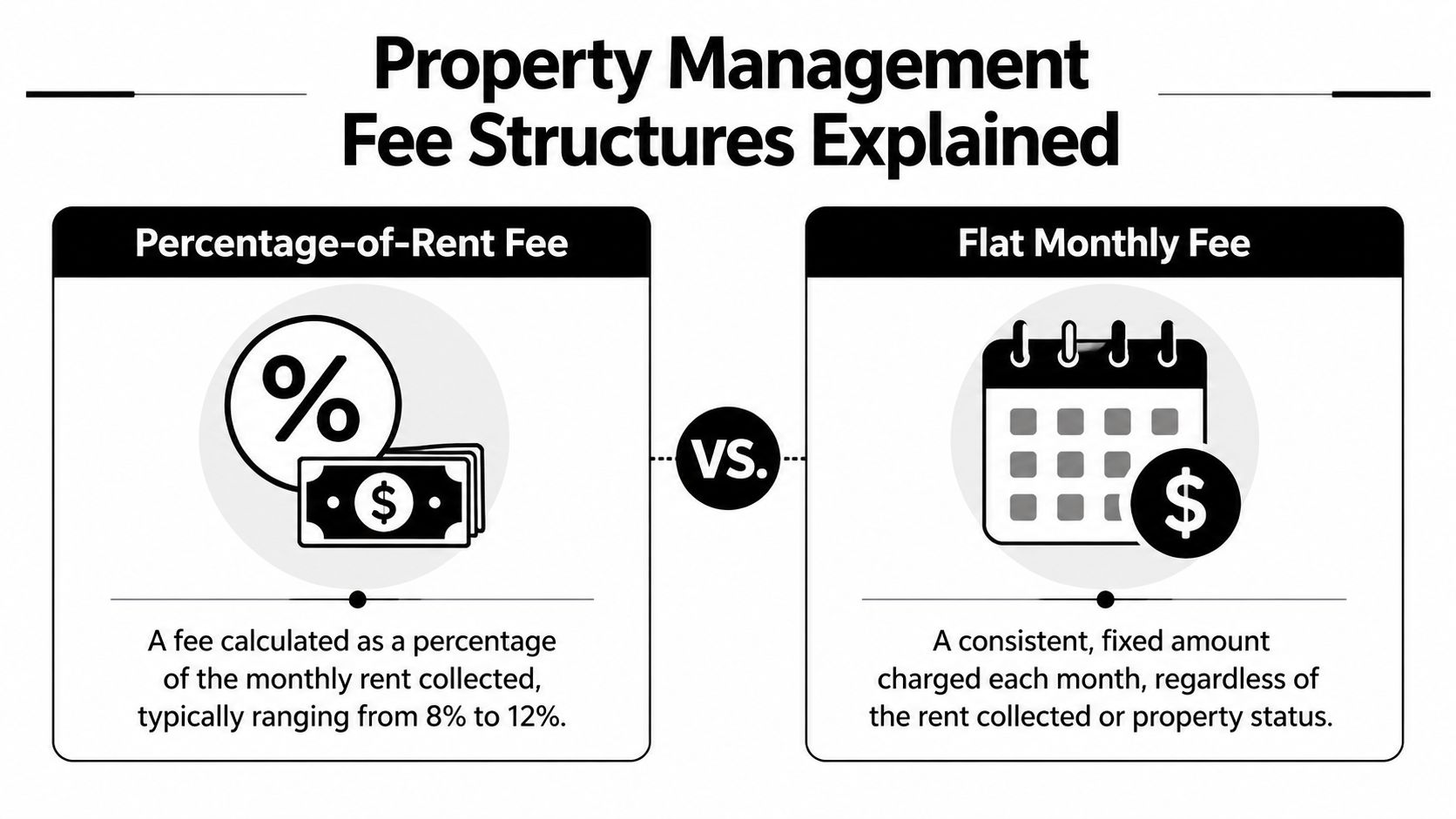
Percentage pricing works like a commission model
The most common structure is a percentage of rent collected. In major U.S. markets, including California, the standard monthly fee typically ranges from 8% to 12% of collected rent, and on a $2,000 monthly rental, a 10% fee equals $200 per month, according to HomeRiver Group’s property management cost breakdown.
That structure matters because it ties the manager’s compensation to rent collection. If the property isn’t producing rent, the management company has more incentive to keep it leased, collect on time, and limit disruptions. In practical terms, it behaves more like a commission partnership than a salary.
For many owners in the Inland Empire, that alignment makes sense. A manager handling a single-family home in Beaumont or a condo in Redlands should be focused on occupancy, rent collection, and keeping the home in rentable condition.
Flat fees are simpler, but not always better
Flat-fee management is the other common option. It gives owners predictability, which some people like for budgeting. You know what the monthly management charge is, and it doesn’t move with rent.
The trade-off is incentive. A flat fee can work well when the service package is clearly defined and the company is highly disciplined. But in some cases, the manager gets paid the same amount whether the property performs well or not. That’s where some owners start to feel the difference between “account maintenance” and active management.
A flat monthly fee is easier to budget. A percentage fee is often better aligned with the owner’s revenue.
This is also where service scope matters. Basic rent collection is not the same thing as full-service management. A company might advertise a lower number and then treat leasing, inspections, document handling, and maintenance coordination as separate charges. If you’re comparing options, review the actual service list, not just the headline price. A deeper explanation of common pricing models helps on this property management fee structure page.
What usually works best for Inland Empire owners
For individually owned condominiums, townhomes, and single-family rentals, the percentage model is still the most common fit. It scales with rent, reflects workload more realistically, and usually matches what owners expect from full-service oversight.
A flat monthly fee can look appealing for a higher-rent property in Yucaipa or Redlands. But if that lower apparent price comes with extra billing every time there’s a leasing task, inspection, coordination issue, or tenant transition, the savings can disappear quickly.
Here’s the practical way to compare quotes:
| Fee model | Best for | Main advantage | Main risk |
|---|---|---|---|
| Percentage of collected rent | Full-service long-term rental management | Incentives stay tied to rent performance | Total cost varies with rent and added services |
| Flat monthly fee | Owners who want fixed budgeting | Predictable monthly charge | Incentives may be less aligned and service may be narrower |
In short, the monthly management fee is only the first layer. The actual number is the operating cost of management across a full year.
The Hidden Costs Beyond the Monthly Fee
The monthly fee gets advertised. The add-ons are where owners either feel informed or blindsided.
A lot of first-time landlords assume management means one simple monthly charge that covers everything. That isn’t how many agreements work. The actual cost of hiring a property manager often includes leasing fees, setup charges, renewal fees, inspection charges, and sometimes maintenance-related markups or coordination costs.
The fees that usually surprise owners
Tenant placement is the biggest one. Leasing and ancillary charges can significantly increase what you spend, with tenant placement typically costing 70% to 100% of one month’s rent, setup fees ranging from $200 to $500, and lease renewals running $500 to $1,000, based on Belong’s property management fee overview.
That leasing charge exists for a reason. Filling a vacancy isn’t one task. It usually includes marketing, inquiry handling, showing coordination, application processing, screening, lease preparation, and move-in administration. In a competitive rental market like property management Redlands or property management Yucaipa, that work can be substantial.
Still, owners should know exactly when it’s charged and what it includes.
First-year cost is usually higher than later years
The largest pricing mistake owners make is comparing only the recurring monthly percentage. That overlooks the fact that the first year often carries the heaviest cost because it includes lease-up activity and onboarding.
If you’re hiring management for a newly vacant home in Beaumont or Yucaipa, your first-year spend can look very different from the second year, even if the monthly percentage stays the same. That doesn’t mean the fee is unfair. It means the labor profile is different.
A useful way to review a quote is to split it into two buckets:
- Startup and placement costs that happen once or occasionally
- Ongoing management costs that continue each month
That simple separation makes it easier to compare companies fairly.
What to ask when you review the agreement
Most “hidden fees” aren’t hidden in the contract. They’re just buried in the details and not discussed clearly during the sales conversation. Owners should ask for a line-by-line explanation before signing.
Use this checklist when comparing firms:
- Leasing fee terms: Is the tenant placement fee charged as a percentage of rent or a flat amount, and when is it due?
- Setup costs: Does the company charge an onboarding or account setup fee?
- Renewal billing: Are lease renewals included, discounted, or billed separately?
- Inspection charges: Are routine inspections covered by the monthly fee or invoiced separately?
- Maintenance handling: Does the company add administrative or coordination charges to repairs?
- Vacancy process: What happens financially when the property is vacant?
For owners who want a clearer breakdown of common line items, this guide on property management services cost is a useful reference point.
The cheapest quote on page one often becomes the most expensive contract by month six if the service menu is built around add-on charges.
What works and what doesn’t
What works is transparent pricing with clearly defined service boundaries. If a manager explains which tasks are covered by the monthly fee, which are triggered only during turnover, and which are owner-approved extras, you can budget realistically.
What doesn’t work is comparing one company at 8% and another at 10% without reading the rest of the agreement. In practice, that’s how owners end up paying more for less service.
That matters for Property Management Beaumont, Beaumont property management, and Redlands property management because many owners in these markets are not trying to shave every possible dollar. They’re trying to protect net income and avoid operational friction. Clear pricing helps them do that. Confusing pricing doesn’t.
How Property Type and Location Affect Your Cost
There isn’t one universal answer to property management pricing because the final quote changes when you move the dials. Property type, condition, location, service level, and turnover demands all push the number up or down.

Think of pricing like a soundboard
Every property has its own settings.
A newer single-family home in a stable Yucaipa neighborhood may be relatively straightforward to manage. An older property with deferred maintenance in another part of the Inland Empire may require more vendor coordination, more tenant communication, and more owner decision-making. That difference shows up in pricing, even when both homes are nominally “single-family rentals.”
Professional management pricing also changes by market segment. Short-term rentals typically command 25% to 40% of collected rent, compared with 8% to 12% for long-term rentals, and geographic location within major markets like California can create 15% to 25% pricing variance due to local regulations and labor rates, according to Coastline Equity’s breakdown of management costs.
That’s one reason local experience matters. The manager isn’t just collecting rent. They’re operating in a labor market, a vendor market, and a compliance environment that all shape the true cost.
Property type changes the workload
Single-family homes, condos, small multifamily properties, and short-term rentals all produce different management demands.
A condo may involve HOA coordination and architectural restrictions. A detached house may bring more exterior maintenance issues. A small portfolio spread across Beaumont, Highland, and Calimesa may be harder to service efficiently than several homes clustered in one submarket.
Owners considering furnished or vacation-style rentals should understand that the economics are very different from long-term leasing. If you’re weighing that route, this overview of vacation rental property management services gives a helpful operational comparison.
Service density can help owners
One overlooked factor is territory efficiency. A manager with established vendor coverage and concentrated operations across Redlands, Beaumont, Yucaipa, Loma Linda, and nearby communities can often respond more smoothly than a company stretching across too many disconnected markets.
That doesn’t automatically mean lower fees, but it often means better coordination. For owners searching locally, reviewing a company’s Inland Empire property management coverage helps show whether your home sits inside an active service area or at the edge of one.
Here’s a simple way to look at it:
| Cost factor | Tends to lower complexity | Tends to raise complexity |
|---|---|---|
| Property type | Standard long-term rental | Short-term or high-turnover rental |
| Condition | Newer or well-maintained home | Older home with frequent repair needs |
| Location | Area with established vendor coverage | Area with higher service friction |
| Service level | Basic administrative support | Full-service oversight with inspections and coordination |
Owners in Beaumont property management and Yucaipa property management conversations often focus on the percentage. The more useful question is this: how much management effort does this specific property require?
Calculating Your True ROI A Cost-Benefit Analysis
If you only compare the monthly management fee, you’re not calculating return. You’re just looking at one expense line.
The better approach is to compare the total operating picture. That includes what management costs, what owner time is worth, how vacancies are handled, how repairs are coordinated, and what financial surprises become less likely when someone experienced is running the day-to-day work.
Start with total cost, not headline cost
One of the clearest examples of this comes from first-year ownership or first-year management. The true first-year cost to manage a $2,000 per month rental can reach approximately $4,330 when a 75% leasing fee of $1,500 and other charges are included, not just the $2,400 annual management fee, as explained in LeaseRunner’s total cost of ownership analysis.
That’s the number many owners miss. They budget for the monthly fee and forget the turnover-related charges that come with setting up and stabilizing the tenancy.
The good news is that first-year cost and long-term value are not the same thing. A heavier upfront cost can still make sense if management reduces friction, shortens downtime, improves tenant quality, and prevents mistakes that cost more later.
Many owners don’t object to paying management fees. They object to being surprised by them.
A practical comparison
The table below uses the requested rent example of $2,500 per month. It is intentionally qualitative in the places where hard numbers have not been verified. That’s the honest way to evaluate ROI.
| Cost/Benefit Factor | DIY Landlord Scenario | Professional Management Scenario | Financial Impact |
|---|---|---|---|
| Monthly operations | Owner handles rent collection, communication, notices, and coordination personally | Manager handles recurring administration and tenant contact | Professional help shifts workload away from the owner |
| Leasing workload | Owner markets, shows, screens, drafts lease, and manages move-in | Leasing process is outsourced, but usually comes with a placement fee | DIY may save cash up front, but costs significant time |
| Vacancy risk | Depends on owner availability and process discipline | Structured leasing process may improve consistency | Better process can protect revenue even when fees are higher |
| Maintenance response | Owner finds vendors, approves work, fields emergencies | Manager coordinates vendors and tenant communication | Faster handling can reduce disruption and owner stress |
| Compliance exposure | Owner must track California requirements alone | Manager usually handles notices, documentation, and routine procedures | Reduced legal and paperwork risk has real value |
| Time cost | Nights, weekends, and workday interruptions fall on owner | Day-to-day issues are delegated | High-income owners often value time more than fee savings |
| First-year cash outlay | Lower direct management spend, but owner absorbs labor | Higher due to management plus turnover-related charges | First-year professional cost is often materially higher |
| Later-year stability | Varies by owner attention and tenant quality | Can be smoother when the tenancy is stable | Ongoing value often improves after lease-up |
The part owners undervalue most
For many higher-income owners, the missing number isn’t a repair bill. It’s personal time. If you earn well, manage a business, travel often, or own more than one rental, every interruption has an opportunity cost attached to it.
That’s why discerning owners often think in terms of friction reduction instead of just fee minimization. They’re not trying to avoid every management charge. They’re trying to avoid late-night repairs, delayed leasing decisions, inconsistent screening, and preventable tenant disputes.
Material choices also affect this analysis. Owners who reduce turnover and maintenance headaches at the property level often improve management efficiency too. If you’re reviewing upgrades between tenants, this guide on best flooring for rental properties to reduce turnover costs is worth reading because durable finishes can lower recurring wear issues.
Use management cost in your investment math
Owners who only evaluate management as an operating nuisance usually miss the bigger investment question. Management affects net income, cap rate assumptions, turnover timing, and long-term hold strategy.
If you want to evaluate that side more rigorously, use a framework that ties operating expenses back to asset performance, such as this guide on how to calculate cap rate on rental property.
The bottom line is straightforward. A property manager doesn’t automatically improve ROI. A competent one can. The difference comes from process quality, clarity of pricing, and whether the manager helps you avoid the expensive mistakes that self-managing owners commonly make under pressure.
Questions to Ask Before You Hire a Property Manager
A management agreement can look clean on paper and still create problems in practice. That’s why owners should interview a property manager the same way they’d interview someone handling any other income-producing asset.

Ask questions that expose the operating model
Don’t start with “What’s your fee?” Start with “How do you run the property?”
Good questions include:
- How do you screen tenants? You want a clear answer that includes background checks, credit review, and income verification.
- Who handles after-hours emergencies? If the answer is vague, the process probably is too.
- How do you coordinate repairs? Listen for details about vendor communication, approval thresholds, and documentation.
- What does your monthly fee include? Add-ons usually surface here.
- How do you handle lease renewals and notices? Clarity here prevents confusion later.
- How often do you inspect the property? A serious manager should have a defined process.
- How familiar are you with California compliance requirements? That answer should sound operational, not theoretical.
A useful reference for owners evaluating companies is this guide on how to choose a property management company.
Compare DIY management against professional help honestly
Some owners should self-manage. If you live close to the property, know the rules, already have reliable vendors, and don’t mind tenant communication, DIY can work.
Other owners shouldn’t. If you travel often, own multiple rentals, have limited time, or don’t want to be on call for every problem, professional management is usually the more realistic choice.
Use this quick comparison:
| Decision factor | DIY may fit if | Professional management may fit if |
|---|---|---|
| Time availability | You can respond consistently | Your schedule is already full |
| Local presence | You live near the property | You’re not always available locally |
| Vendor network | You already have trusted contractors | You’d prefer established coordination |
| Compliance comfort | You understand the process and paperwork | You want a manager handling routine procedures |
| Stress tolerance | You don’t mind interruptions | You want separation from daily issues |
Here’s a short video that gives owners another perspective on the hiring process and what to listen for in an interview:
What a strong answer sounds like
Strong operators answer with process. Weak operators answer with generalities.
For example, a strong screening answer names the checks performed and how decisions are documented. A strong maintenance answer explains who takes calls, how emergencies are triaged, and how owners are updated. A strong pricing answer separates monthly management from leasing, renewals, inspections, and any other non-routine charges.
If a manager can’t explain their process clearly before you sign, they probably won’t communicate clearly after you sign either.
That standard matters whether you’re comparing Property Management Beaumont, Beaumont property management, Yucaipa property management, property management Yucaipa, Redlands property management, or a broader property management near me search. The best hiring decision usually comes from asking sharper questions, not just collecting more quotes.
AIM Property Management Your Partner in the Inland Empire
A good local manager affects your total cost of ownership more than owners expect. In Redlands, Beaumont, and Yucaipa, the difference is not just the monthly percentage. It shows up in how fast a vacancy gets filled, how maintenance gets priced and approved, how well tenant issues are documented, and how often small problems are caught before they become larger repair bills.
That matters most in the first year. A newly hired manager may be stepping into deferred maintenance, an outdated lease, poor tenant records, or a property that is not rent-ready. Year one often carries more cost because the operating system is being rebuilt. Later years are usually more stable if the property is occupied, the records are clean, and the manager is not constantly fixing inherited problems.
Beaumont rental owners
In Beaumont, many owners have single-family rentals that need consistent oversight rather than occasional help. The primary value is usually operational. Leasing speed, vendor coordination, inspection follow-through, and rent collection discipline all affect the annual return.
A weak process can cost more than a higher fee. If a home sits vacant longer than necessary, if repairs are handled late, or if screening is inconsistent, the owner feels it in lost income and avoidable expense.
Yucaipa rental owners
Yucaipa owners often care about preserving the condition of the home while keeping the rental predictable. That is especially true for owners who converted a former residence into an investment property and still think about long-term upkeep.
In practice, that means orderly records, clear tenant communication, routine property checks, and maintenance coordination that does not drift. Those items sound basic. They are also where ownership costs either stay under control or start creeping up.
Redlands and surrounding communities
In Redlands and nearby areas such as Calimesa, Loma Linda, Mentone, Highland, and Banning, owners usually want a manager who understands long-term residential rentals and local service expectations. A call-center model may collect rent, but it often falls short when a property needs judgment, local vendor follow-up, or clear owner communication on repair decisions.
AIM PROPERTY MANAGEMENT COMPANY manages residential properties in communities including Banning, Loma Linda, Beaumont, Highland, Redlands, Yucaipa, and Calimesa. Its published service scope includes tenant screening and placement, rent collection, 24/7 maintenance coordination, annual inspections, and document management for residential rentals.
The better hiring decision usually comes from matching the manager’s operating style to the property. Some owners want full delegation with defined approval limits. Others want the daily workload off their plate but still want to weigh in on repairs, renewals, and tenant decisions. Either approach can work if the process is clear and the full first-year cost is understood before the agreement is signed.
Frequently Asked Questions
Is it worth it to hire a property manager for just one rental?
It can be. A single rental still generates leasing work, maintenance calls, rent collection, tenant communication, and compliance obligations. If you have the time, live close by, and want to stay hands-on, self-management may fit. If your schedule is tight or you want fewer interruptions, hiring professional help can be the more efficient choice.
How much does it cost to hire a property manager for a single-family home?
In long-term residential management, the base monthly fee commonly falls within the percentage ranges discussed earlier, but the full cost usually includes more than that. Leasing fees, setup charges, renewals, and inspection-related charges can materially change the first-year number. That’s why owners should ask for a full annual cost estimate, not just the monthly percentage.
Why is the first year usually more expensive than later years?
Because the first year often includes onboarding and lease-up work. When a manager has to market the property, screen applicants, prepare documents, coordinate move-in, and establish the operating file, the cost profile is different from a stable renewal year.
What should I type if I’m searching for a property manager locally?
Most owners start with searches like property management near me, hire a property manager, or city-specific phrases such as Property Management Beaumont, Beaumont property management, Yucaipa property management, property management Yucaipa, Redlands property management, and property management Redlands. Those searches are useful, but don’t stop at rankings. Read the fee structure, review the service scope, and ask detailed operating questions.
Do property managers handle repairs and tenant issues directly?
Most full-service residential managers coordinate those items, but the exact process depends on the agreement. Some handle emergency response, vendor scheduling, owner approvals, and follow-up documentation. Others provide a narrower service package and bill separately for certain tasks. Always ask how repair approvals work and who takes after-hours calls.
What if I’m worried about hidden fees?
That’s a valid concern. The way to avoid surprises is to request a written breakdown of monthly fees, leasing charges, renewals, inspections, maintenance coordination terms, and any one-time setup costs before signing. If the explanation is hard to follow before the agreement starts, it usually won’t get easier later.
If you own a rental in Redlands, Beaumont, Yucaipa, Calimesa, Loma Linda, Mentone, Highland, or Banning and want a clearer picture of management costs, talk with AIM PROPERTY MANAGEMENT COMPANY . Ask for a detailed fee breakdown, compare first-year and later-year costs, and evaluate whether the service model fits your property, your schedule, and your investment goals.