
When you invest in a Redlands rental property, one of the first things you’ll encounter is the property management fee structure. This is simply the breakdown of costs you’ll pay a management company for their services, which usually comes in two flavors: a percentage of the monthly rent or a fixed flat fee. Getting this part right is crucial because it directly hits your bottom line and affects your property’s cash flow.
Decoding Your Property Management Fee Structure with property manager Redlands
Jumping into the rental market is a big financial step, but figuring out the ongoing costs can sometimes feel like solving a puzzle with missing pieces. A clear, straightforward fee structure is the bedrock of a good partnership with your management company. It lets you accurately map out your expenses and see how your investment is truly performing. Without that clarity, you’re flying blind, and surprise charges can quickly chip away at your returns.
Think of your rental property as a small business. The management fee is one of your main operating costs. When a fee model is transparent and easy to understand, you can budget with confidence and know exactly what you’re paying for. This is especially true in local markets like Redlands, Beaumont, Calimesa, Yucaipa, Loma Linda, Mentone, Highland, and Banning, where AIM Property Management has been providing experienced service since 1997.
The Importance of a Clear Framework
A solid fee structure is more than just a single percentage. It’s a complete financial roadmap that ensures there are no gotchas waiting for you down the line. For landlords, this kind of transparency is a non-negotiable for a few key reasons:
- Accurate Financial Planning: When you know exactly what you’ll pay each month, you can project your cash flow with precision and plan for future investments.
- True Cost Comparison: A clear breakdown lets you make a true apples-to-apples comparison between management companies. You can look past a flashy low rate and see the total cost of doing business.
- Building Trust: An upfront and honest fee schedule is the mark of a reputable company. It builds a relationship based on trust, not a constant worry about hidden costs.
Across the country, fee structures can vary, but for most residential properties, you can expect to see management costs somewhere in the 8% to 12% range of the collected monthly rent. But that’s just one piece of the puzzle. The total cost often includes other fees for tenant placement, maintenance, and potential legal issues. To get the most out of your investment, you need the full picture. You can explore a deeper dive into these national averages and what they cover to better understand the property management cost landscape on Showdigs.com.
For example, a company with a lower monthly fee, like AIM’s 7.9% rate, paired with a simple, flat placement fee of just $750, offers a cost model that’s both clear and predictable. This is a world away from firms that might hook you with a low rate but then pile on extra fees for services that should have been included from the start.
Before we dive deeper, here’s a quick look at the most common fees you’re likely to encounter. Think of this as your cheat sheet for understanding what you’re paying for and why.
Quick Overview of Common Property Management Fees
| Fee Type | What It Covers | Typical Cost Model |
|---|---|---|
| Monthly Management Fee | Ongoing, day-to-day operations like rent collection, tenant communication, and financial reporting. | 8% – 12% of collected rent or a flat monthly fee. |
| Tenant Placement Fee | The cost of finding and screening a new tenant, including marketing, showings, and lease signing. | One-time fee, often 50% – 100% of the first month’s rent. |
| Lease Renewal Fee | A charge for negotiating and preparing a new lease when a current tenant decides to stay. | A flat fee, typically a few hundred dollars. |
| Maintenance Markup | A small percentage added to the cost of repairs coordinated by the management company. | 5% – 15% on top of the contractor’s invoice. |
| Vacancy Fee | A fee charged while the property is empty to cover the costs of marketing and showing the unit. | A flat monthly fee or the standard management percentage. |
| Eviction Fee | Covers the cost of handling the legal process of removing a tenant. | A flat fee plus any associated court costs. |
This table covers the basics, but remember that every company structures its fees a little differently. The key is to find a partner who is transparent and whose model aligns with your financial goals.
Breaking Down the Core Management Fees

When you start digging into management services, the heart of any property management fee structure comes down to two main pieces: the ongoing management fee and the one-time tenant placement fee. Getting a handle on how these two work is the first step to making a smart financial choice for your rental property.
Think of the ongoing management fee as the engine that keeps your investment running day-to-day. This is what you pay for the rent collection, tenant calls, maintenance coordination, and all the little things that ensure your property operates without a hitch, month after month.
This fee is usually calculated one of two ways: either as a percentage of the monthly rent or a simple flat fee. Each approach has its own logic, and they can impact your cash flow in different ways.
The Percentage-Based Model: A Shared Goal
The most common method you’ll see in the industry is the percentage-based model. It’s best to think of this as a partnership; your property manager’s success is directly tied to yours. They earn a slice of the rent they collect, which gives them a powerful incentive to keep your property filled with a paying tenant at the best possible market rate.
This model is especially popular because it aligns your manager’s financial interests with your own. When your property is sitting empty, they aren’t making money either, so you can bet they’re motivated to fill that vacancy fast.
But that percentage is a critical number. While many companies out there charge 10% or even 12%, finding a more competitive rate can make a huge difference to your annual return.
For instance, a firm like AIM Property Management, with over two decades of experience since 1997, offers a monthly management fee of just 7.9%. On a property renting for $2,500 a month, that seemingly small difference from a 10% fee saves you over $600 a year in management costs alone.
This structure is a great fit for owners who want a true partner in their investment, especially in communities like Redlands and Loma Linda where maximizing every dollar of rental income really counts.
The Tenant Placement Fee: Filling Your Vacancy
Next up is the tenant placement fee, which you might also hear called a leasing fee. This is a one-time charge for all the heavy lifting involved in finding, screening, and placing a high-quality tenant in your property. It covers everything from marketing your rental and showing it to prospective renters to running background checks and getting the lease signed.
This is, without a doubt, one of the most vital services a manager provides. A great tenant is the bedrock of a successful rental investment, while a poor one can lead to a world of headaches like late payments, property damage, and expensive evictions.
The cost for this service can vary quite a bit. Many companies will charge a percentage of the first month’s rent, often somewhere between 50% and 100%. Others, however, opt for a more predictable flat-fee model.
A straightforward flat fee takes the guesswork out of the equation and helps you budget accurately when a tenant moves out.
- AIM’s Approach: We keep it simple with a single, transparent placement fee of just $750.
- No Hidden Add-Ons: This fee covers the entire placement process from start to finish. You won’t see surprise charges for advertising or administrative work that some competitors like to tack on.
This clear-cut approach means you know exactly what you’re paying, making financial planning that much easier. It’s a key part of the exceptional property management services in Beaumont CA and nearby areas, where property owners value transparency and predictability.
Comparing Core Fee Models
To really see the difference, let’s put the two main management fee models side-by-side:
| Fee Model | How It Works | Best For Owners Who… |
|---|---|---|
| Percentage-Based | A percentage (e.g., 7.9%) of the collected monthly rent. | Want to ensure their manager is motivated to maximize rental income and minimize vacancies. |
| Flat-Fee | A fixed dollar amount each month, regardless of rent collected. | Prefer a completely predictable monthly expense, often for higher-rent properties. |
Ultimately, the right structure comes down to your financial goals and what you value most. A lower percentage like 7.9% combined with a simple $750 placement fee offers a powerful mix of aligned incentives and predictable costs, putting more money back in your pocket every month.
Why Long-Term Rentals Build Stronger Investments
When you first look at a property management fee structure, it’s easy to get lured in by the high nightly rates of short-term vacation rentals. On paper, it looks like a goldmine. But that flashy potential often hides a much more complicated and unstable reality. For serious investors, the long-term rental model offers a far more dependable path to building real wealth.
Think of it as two different ways to invest. Short-term rentals are like day trading—they’re volatile, demand constant attention, and can be wiped out by sudden market shifts. Long-term rentals, on the other hand, are like a solid dividend stock. They just keep delivering predictable, steady income, month after month.
That stability is the bedrock of a strong real estate portfolio. When you have a long-term lease, you have a guaranteed income stream. That makes it so much easier to forecast your cash flow, budget for expenses, and plan your next move.
The True Cost of High Turnover
One of the biggest hidden costs of the short-term model is the relentless turnover. A new guest every weekend or even every few days creates a massive operational headache and dramatically accelerates the wear and tear on your property.
This constant churn means you’re always paying for deep cleanings, restocking supplies, and managing a revolving door of guests who have zero incentive to treat your property with care. Each turnover is like a mini-move-out, and the cumulative damage to your furniture, appliances, and fixtures can be staggering.
In contrast, long-term tenants see a property as their home. They are naturally more invested in its upkeep and are far less likely to cause the kind of damage that comes from a “vacation mindset.” The result? Fewer repair bills and a better-preserved asset for you.
A stable, long-term tenancy minimizes the two most significant profit killers for rental owners: high turnover costs and extended vacancy periods. This is a core reason why our focus since 1997 has been exclusively on this model.
Beyond the costs, managing a short-term rental is practically a full-time job. You’re constantly communicating with guests, managing bookings, and coordinating cleaning crews. It often demands 24/7 availability, which is a far cry from the passive income stream most investors are looking for. For homeowners in communities like Redlands, Beaumont, Calimesa, Yucaipa, Loma Linda, Mentone, Highland, and Banning, the goal is financial freedom—not a second career in hospitality.
Navigating Community and Regulatory Hurdles
On top of the operational grind, the short-term rental market is facing more and more regulatory pressure. Cities and HOAs are cracking down with strict rules, special permits, occupancy taxes, and even outright bans. Trying to navigate this shifting legal landscape can be a huge burden.
Long-term rentals do the opposite—they promote community stability. Tenants become part of the neighborhood fabric, supporting local businesses and contributing to a sense of community. This is a huge reason why cities and HOAs in areas from Calimesa to Loma Linda overwhelmingly favor long-term residential leases.
Here’s a direct comparison of the two models:
| Feature | Long-Term Rentals | Short-Term Rentals |
|---|---|---|
| Income Stream | Consistent, predictable monthly payments. | Volatile, subject to seasonal demand and market fluctuations. |
| Turnover Rate | Low, typically once every 1-2 years. | High, can be daily or weekly. |
| Wear & Tear | Minimal, as tenants treat it as their home. | Accelerated due to frequent guest changes. |
| Management | Lower intensity, more passive for the owner. | High intensity, requires daily operational involvement. |
| Regulations | Generally stable and well-established. | Increasingly complex and restrictive. |
For property owners who value predictability, asset preservation, and true passive income, the choice is clear. The long-term rental model provides a more secure and, ultimately, a more profitable strategy. To learn more about our philosophy, you can explore our detailed guide on why homeowners should choose AIM Property Management for their investment journey. By focusing on this stable approach, we help our clients in Mentone, Highland, and Banning build lasting financial success.
What You Are Actually Paying For

When you see a line item for a management fee, it’s easy to write it off as just another expense. But a quality property management fee structure is really an investment—one that directly impacts your property’s performance and, just as importantly, your own peace of mind.
You aren’t just paying someone to collect a check. You’re hiring a dedicated team to protect and optimize your valuable asset, transforming what could be a hands-on headache into a source of passive income.
The property management industry is a cornerstone of the real estate market for this very reason. Across the United States, the sector employs roughly 910,000 people. The vast majority—about 720,000 workers—are focused on residential properties just like yours. This growth shows just how essential professional oversight has become in today’s rental market. You can explore more of these key property management statistics on Doorloop.com.
Comprehensive Tenant Management
Let’s be honest: the single most important factor for a successful rental is the quality of your tenant. A great property manager handles the entire lifecycle of tenant relations, starting with a rigorous screening process that goes far beyond a basic credit score.
We’re talking about comprehensive background checks, income verification, and a thorough analysis of their rental history to find reliable, responsible people who will treat your property with respect.
Once a qualified tenant is in place, the manager becomes their go-to person for everything. That means they’re the ones fielding late-night emergency calls, scheduling maintenance, and handling all communications. You’re insulated from the daily demands.
Financial and Administrative Operations
Beyond managing people, your management fee covers the crucial financial side of your investment. This includes diligent rent collection to ensure you receive your income on time, every single month. It also means managing security deposits in strict compliance with state laws and providing you with clear, detailed financial statements.
These monthly and yearly reports give you a transparent look at your property’s performance. Tax time becomes simpler, and you have the hard data you need to make smart decisions about your investment. Think of your manager as your property’s dedicated financial steward.
Proactive Maintenance and Vendor Relationships
Good property management isn’t just about reacting to problems—it’s about preventing them. Your fee pays for regular property oversight and the coordination of all maintenance and repairs. This is where local experience becomes invaluable. A company that has been operating in the Inland Empire since 1997 has built decades of trust with local vendors.
For owners in communities like Redlands, Beaumont, Calimesa, Yucaipa, Loma Linda, Mentone, Highland, and Banning, this means you get access to a vetted network of reliable and cost-effective plumbers, electricians, and contractors. Our mature relationships in the community ensure repairs are done right and at a fair price, directly protecting your bottom line.
This deep community knowledge translates into a smoother, faster experience. Whether it’s a routine fix in Loma Linda or an urgent issue in Highland, an established manager knows exactly who to call. To see the full financial impact, check out our guide on how property management saves you money.
At the end of the day, that monthly fee is your investment in expertise, convenience, and security. It’s what transforms property ownership from a demanding job into a truly passive and profitable venture.
Calculating Your True Cost With a Real Example
It’s one thing to understand the different parts of a property management fee structure, but what really matters is seeing how it all adds up—or subtracts—from your bottom line. Abstract percentages and industry jargon can be confusing, so let’s walk through a real-world scenario to show how a transparent, fair fee model puts more money back in your pocket every year.
We’ll compare two different approaches using a hypothetical single-family home in Redlands, California, a community we’ve proudly served since 1997. Let’s say the property brings in a realistic $2,500 per month in rent.
Setting The Stage A Tale Of Two Fee Structures
In one corner, you have AIM Property Management. Our model is simple: a 7.9% monthly management fee and a one-time $750 placement fee with no other add-on fees.
In the other corner is a typical competitor. They might advertise a seemingly standard 10% monthly fee, but the real costs are often buried in the fine print—the add-on charges they don’t always talk about upfront. This side-by-side comparison will show you just how quickly those “small” differences add up over a year.
The goal isn’t just to find the lowest percentage. It’s about calculating your total annual cash outlay. Hidden costs like lease renewal fees or maintenance markups can easily wipe out any perceived savings from a slightly lower monthly rate.
This chart breaks down the common fees you’ll run into when comparing your options.
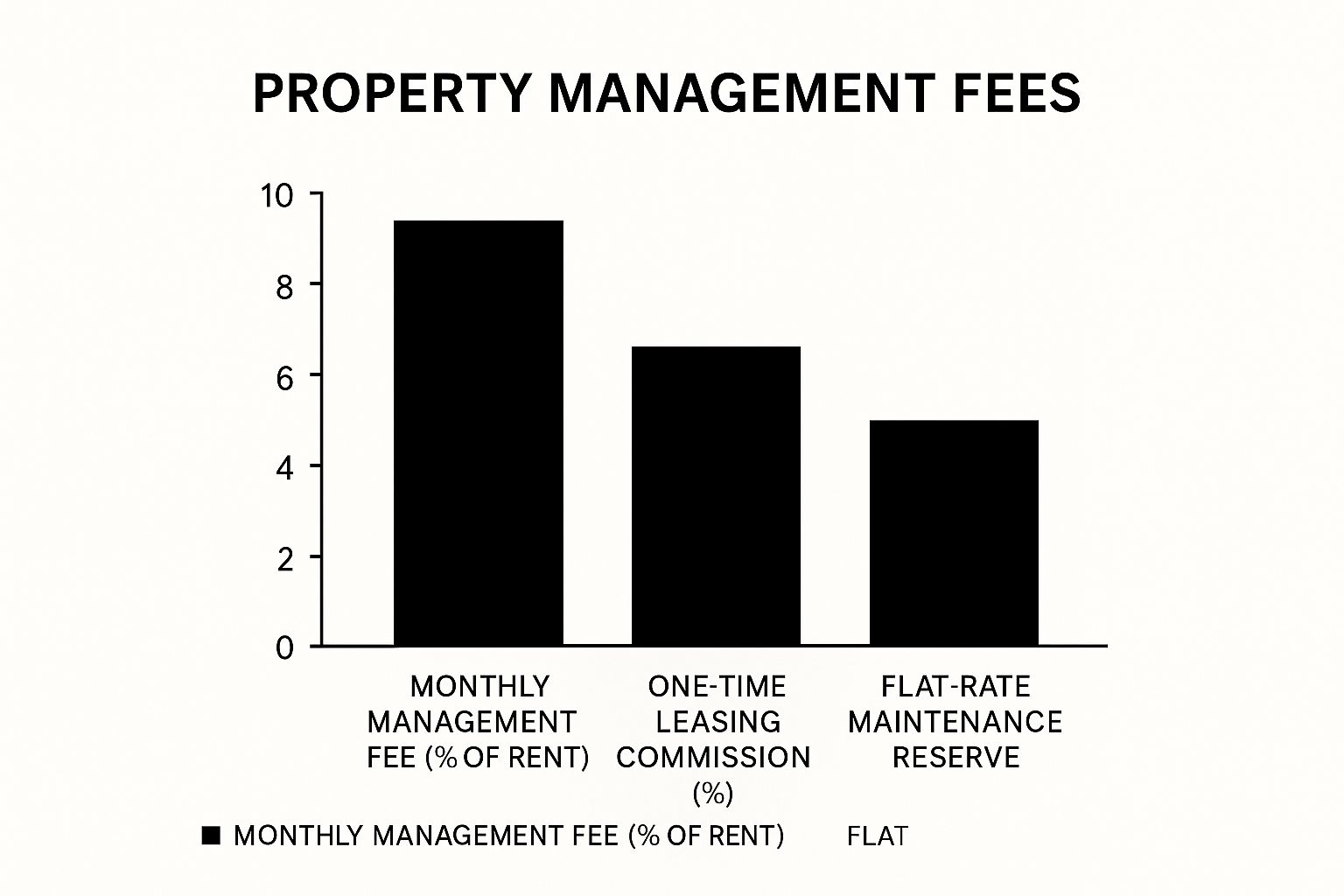
As you can see, your total cost is a mix of the ongoing monthly fee, a one-time leasing commission, and other potential charges. You have to factor in everything to get the full picture.
The Annual Cost Breakdown
Let’s assume we place a new tenant at the beginning of the year. Here’s a clear breakdown of how the annual costs would look for our Redlands rental. And remember, to truly understand your investment’s health, it’s a good idea to calculate your rental income to see the full financial picture.
To make it easy, we’ve put together a simple table comparing the numbers head-to-head.
Annual Cost Comparison: AIM vs. A Typical Competitor
| Cost Item | AIM (7.9% + $750 Placement) | Competitor (10% + Fees) |
|---|---|---|
| Monthly Management Fee | $197.50 ($2,500 x 7.9%) | $250 ($2,500 x 10%) |
| Annual Management Cost | $2,370 ($197.50 x 12) | $3,000 ($250 x 12) |
| Tenant Placement Fee | $750 (Flat Fee) | $1,250 (50% of 1st Month’s Rent) |
| Lease Renewal Fee (Year 2) | $0 (We don’t charge this) | $250 (A typical add-on) |
| Total Year 1 Cost | $3,120 | $4,250 |
| Annual Savings with AIM | $1,130 | – |
The numbers don’t lie. AIM’s transparent, competitive structure saves you over $1,130 in the very first year. That’s a significant amount of cash that stays with you, the owner.
This example doesn’t even get into the other “nickel-and-dime” charges many companies tack on, like maintenance coordination fees or administrative markups, which would make the gap even wider. Our experience in local markets from Beaumont to Banning has shown us time and again that a simple, honest fee structure is what provides the best value and financial predictability for property owners like you.
Choosing the Right Partner for Your Property

Picking a property manager is about much more than just comparing numbers on a fee sheet. It’s about finding a genuine partner who’s committed to the long-term health and profitability of your real estate investment. A great partnership really boils down to three key things: transparent fees, a smart investment strategy, and deep-rooted local knowledge.
This means you need a company whose financial interests are aligned with yours. A straightforward monthly rate paired with a simple, flat placement fee takes the guesswork out of budgeting. That kind of clarity is the foundation for a trusting, successful relationship where you know your returns aren’t being chipped away by surprise charges.
Experience and Stability Matter
Just as important is finding a manager who shares your philosophy on investment stability. While the high nightly rates from short-term rentals can look tempting, they often bring higher costs, more wear and tear, and a whole lot of operational headaches.
A focus on long-term rentals, on the other hand, provides a much more predictable income stream. It also attracts tenants who will treat your property like a home, which goes a long way in preserving its value. This is the strategy for building sustainable wealth, not just chasing quick cash.
The demand for professional services has driven huge growth in the property management market, which is expected to hit a value of around $27,812.8 million in 2025. This just goes to show how much owners are recognizing the value of expert management.
At AIM, our entire approach is built on this foundation. We keep it simple and fair with a highly competitive 7.9% monthly management fee and a $750 tenant placement fee—no hidden add-ons, ever.
We’ve been at this since 1997, and we’ve dedicated ourselves exclusively to long-term rentals. This has allowed us to build mature, trusted relationships in communities like Redlands, Beaumont, Calimesa, Yucaipa, Loma Linda, Mentone, Highland and Banning. Our deep local experience ensures your investment is managed with unmatched care and know-how.
For more guidance, check out our article on how to choose the right property management company. When you’re ready, partner with a team that puts your success first through transparency, experience, and stability.
Frequently Asked Questions
When you’re trying to get a handle on property management fees, it’s natural for a few questions to pop up. We get it. To help you make a smart, confident decision for your investment, here are some straight-talking answers to the questions we hear most often.
Is a Lower Property Management Fee Always Better?
Not always, but transparency is everything. A low percentage like our 7.9% is a huge advantage, but only if it’s backed by solid service without a bunch of hidden charges. Some companies will hook you with a low rate, then tack on extra fees for things like inspections, lease renewals, or even basic administrative work. You have to look at the whole picture.
We keep it simple: a highly competitive rate combined with a flat $750 placement fee. This way, you get incredible value without any nasty surprises on your statement. The real goal isn’t just to find the lowest number on a brochure—it’s to get the best possible net return on your investment.
What Should I Ask a Property Manager About Their Fees?
When you’re interviewing a property manager, don’t be shy about asking for a complete fee schedule. Clarity is your best friend here, so dig into the details to avoid headaches down the road.
Here are a few questions you should absolutely ask:
- What does your monthly management fee cover, specifically?
- Is your tenant placement or leasing fee a flat rate or a percentage of the rent?
- Are there any other fees I should know about, like for renewals, inspections, or coordinating repairs?
- Do you mark up what your vendors charge for maintenance, or do you pass the actual cost on to me?
A good, honest company will give you clear answers without making you feel like you’re prying. Their willingness to be upfront about their entire fee structure says a lot about how they do business. We’ve been building our reputation on that kind of honesty since 1997.
Why Do You Only Manage Long-Term Rentals?
We made a conscious decision to focus only on long-term rentals because we believe it’s the best way to build financial stability and protect our clients’ assets. Short-term rentals are a different beast entirely—they come with constant tenant turnover, a lot more wear and tear on the property, and incredibly intensive management for cleanings and guest communications.
Long-term rentals give you consistent monthly income, much lower vacancy rates, and tend to attract tenants who will treat the property like their own home. This approach lines up perfectly with our mission: building profitable, sustainable, long-term investments for property owners in communities like Redlands, Beaumont, Calimesa, Yucaipa, Loma Linda, Mentone, Highland and Banning.
Ready to work with a property management company that puts transparency, stability, and your financial success first? AIM PROPERTY MANAGEMENT COMPANY has been delivering top-tier service across the Inland Empire since 1997. Let us show you how our fair, straightforward fees can unlock your investment’s true potential.