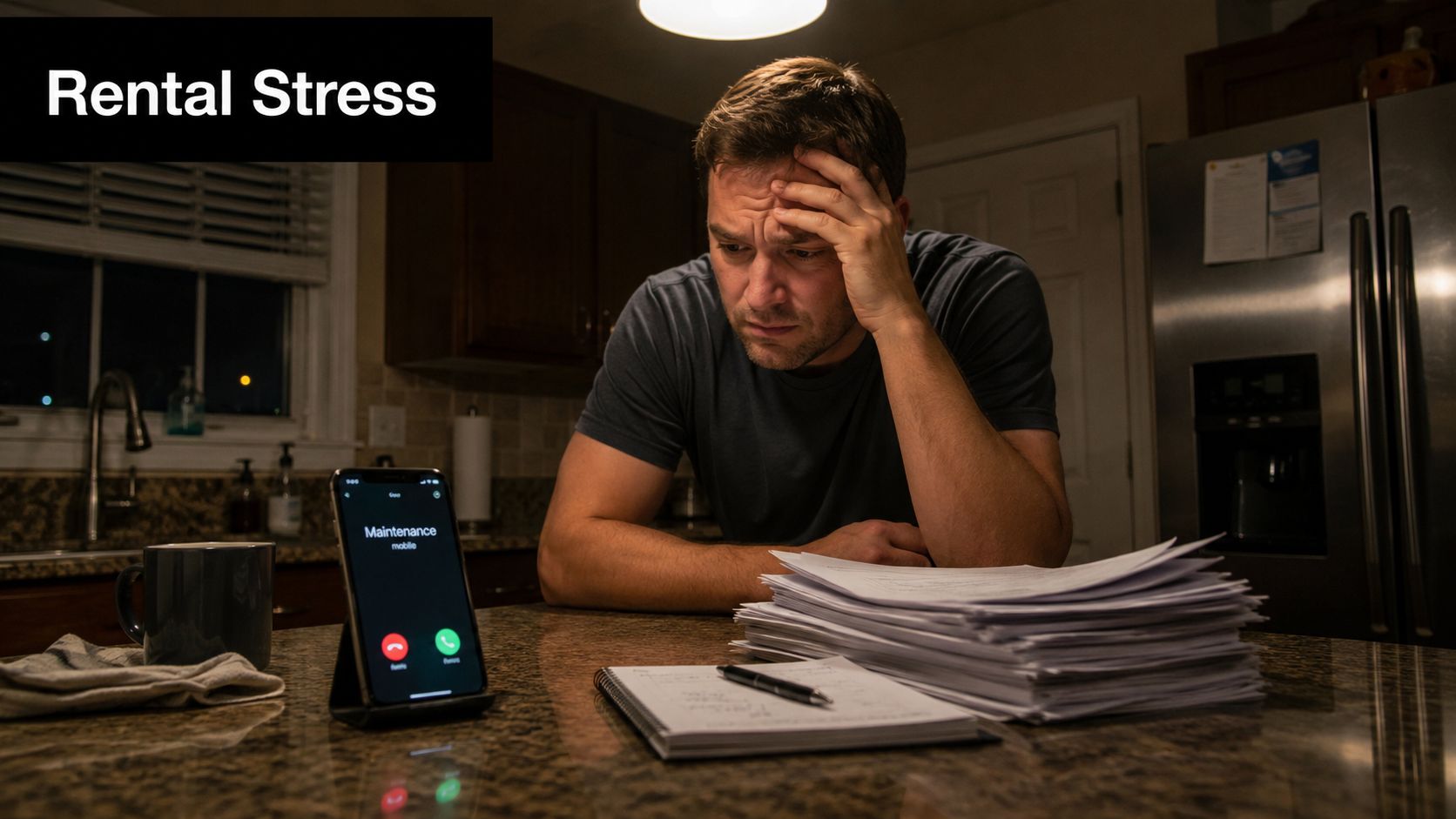
Owning a rental usually becomes stressful before an owner admits it. The rent comes in, but so do late-night repair calls, lease questions, vendor coordination, and the constant concern that one missed compliance step could become an expensive problem.
That's usually the moment serious owners stop asking, “Can I manage this myself?” and start asking a better question: Should I hire a property manager because it improves the business? In the Inland Empire, that question matters even more. Redlands, Beaumont, Yucaipa, Calimesa, Loma Linda, Mentone, Highland, and Banning all have their own tenant expectations, housing mix, commute patterns, and service-vendor realities. A manager who looks fine on paper can still be the wrong fit for your property.
Is It Time to Hire a Property Manager for Your Rental?
The most common mistake I see is treating property management as a convenience purchase. It's not. It's an operating decision.
If you're chasing rent after work, taking maintenance calls during dinner, or trying to interpret lease issues with a browser full of open tabs, the property is no longer passive. It's a part-time job. For owners with demanding careers, families, or plans to buy more rentals, that job starts eating into returns because time, attention, and consistency all affect performance.
Hiring help isn't unusual. It's a standard move inside a large professional market. In the United States, property, real estate, and community association managers held about 466,100 jobs in 2024, and the field is projected to add about 39,000 openings per year over the 2024 to 2034 decade, according to the Bureau of Labor Statistics occupational outlook for property managers. That scale tells you something important. Professional management is established, specialized, and widely used.
Signs self-management is costing you
Some owners should keep managing their own property. But the decision changes when any of these are true:
- You live far from the rental. Distance turns small problems into scheduling problems, and scheduling problems into vacancies or deferred maintenance.
- You own more than one unit or plan to. Systems matter more as soon as the workload multiplies.
- You value time more than hands-on control. Many high-income owners can do the work, but it doesn't mean they should.
- You dislike collections and enforcement. Tenant communication is easy when everything is smooth. It's harder when rent is late or lease terms need to be enforced.
- You don't have clean financial reporting. If you can't see your rental clearly, you can't manage it well.
A good first step is tightening your numbers before you outsource. A structured financial template for landlords helps owners see whether they're preserving cash flow or just reacting month to month.
Practical rule: Hire a property manager when inconsistency becomes more expensive than the fee.
Why the Inland Empire changes the equation
In Redlands property management and property management Redlands work, response time and local vendor depth matter. In Property Management Beaumont and Beaumont property management, growth corridors and newer single-family inventory often change tenant expectations around communication, maintenance speed, and lease enforcement. In Yucaipa property management and property management Yucaipa, the housing stock can require a manager who understands both older-home maintenance and newer subdivision standards.
Some owners also want a clearer answer to whether outsourcing fits their situation. This guide on whether you should hire a property manager is useful if you're still weighing control against time, risk, and scale.
How to Find and Vet Property Management Candidates
The best hiring process starts earlier than most owners expect. A practical workflow is to begin 75 to 90 days before vacancy, build a shortlist, interview candidates, verify references, and then compare proposals and fee structures, as outlined in this property manager evaluation workflow. Waiting until the tenant has already moved out usually leads to rushed decisions.
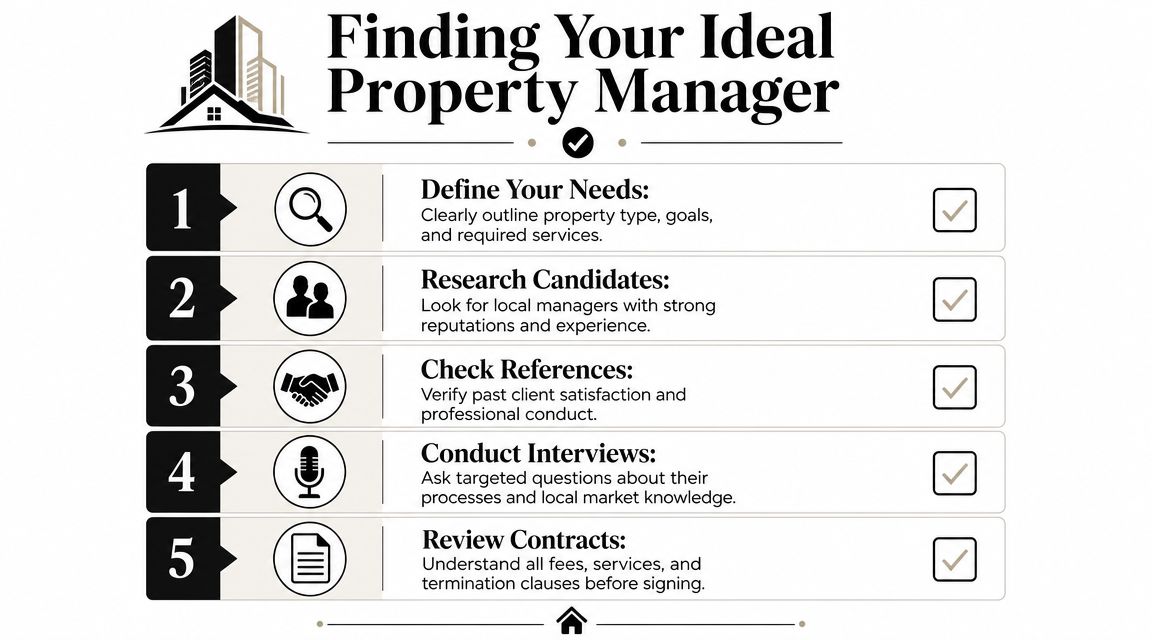
Start with a list, not a favorite. Owners often choose the first company with a polished website and a quick callback. That's not due diligence. That's relief shopping.
Build your shortlist the right way
Use several channels at once so your list reflects the local market, not just search rankings.
- Ask professionals who see rental operations up close. A real estate agent, CPA, real estate attorney, or insurance broker often knows which managers communicate well and which ones create cleanup work.
- Search by city and property type. Look for terms tied to your area and asset, such as Property Management Beaumont, Beaumont property management, Yucaipa property management, property management Yucaipa, Redlands property management, and property management Redlands.
- Review managed inventory, not just branding. A manager should show evidence that they handle homes like yours, not just apartments if you own a single-family rental.
- Check whether their process feels operational. Strong firms explain maintenance intake, leasing workflow, financial reporting, and owner communication clearly.
Technology can also reveal how detail-oriented a firm is. If a company can't explain simple reporting or tracking systems, that's a warning sign. The same logic applies in other operational fields. For example, companies that need clean analytics often hire a GTM consultant because hidden setup problems distort decision-making. Rental operations work the same way. Bad systems produce bad visibility.
After your initial search, use this practical guide on how to find a property manager to compare candidates more systematically.
What to check before you schedule interviews
Before you spend time on calls, pre-qualify each company.
Website clarity
Can you tell what they manage, where they work, how maintenance is handled, and what owners receive each month?Local presence
Do they seem active in the cities you care about, or are they claiming an oversized territory with little detail?Property condition
If you can identify homes they manage, drive by them. You're not inspecting the tenant. You're checking exterior standards, signage, curb appeal, and whether deferred maintenance shows.
Here's a useful video overview before you begin making calls:
- Review patterns
Don't focus only on star counts. Read for operational clues. Do owners mention responsiveness, accounting clarity, repair handling, and tenant quality?
A strong shortlist usually has three traits: local depth, process clarity, and evidence that the company manages properties similar to yours.
What doesn't work
A few shortcuts usually backfire:
- Choosing on price alone. Low fees can hide weak leasing, weak screening, or slow maintenance coordination.
- Confusing friendliness with structure. Nice people can still run loose operations.
- Skipping reference checks. The proposal is marketing. References are operations.
Essential Interview Questions to Ask Potential Managers
Most owners ask shallow questions and get polished answers. “How do you screen tenants?” almost always produces the same response. “Very thoroughly.” That tells you nothing.
The better interview tests the manager's operating model. Owners should ask about repair approval spend limits, frequency of financial statements, and contract exit clauses so the relationship matches their needs, because a bad fit can cost more than the management fee itself, as discussed in this guidance on hiring a property manager.
Ask scenario questions, not brochure questions
A real interview sounds like this:
- What happens if a plumbing leak is reported after hours?
- Who decides whether to dispatch a vendor immediately?
- What is my approval threshold?
- When am I notified?
- Do you use in-house maintenance, outside vendors, or both?
- How do you document the repair and the invoice?
These questions force the manager to show process. Good operators answer in sequence. Weak operators drift into generalities.
Owner mindset: You are not buying promises. You are buying a workflow.
Good answers and bad answers
Below is the difference I'd listen for in a manager interview.
| Question | Strong answer sounds like | Weak answer sounds like |
|---|---|---|
| Repair approvals | Clear spend limit, emergency criteria, owner notification steps | “We handle it as needed” |
| Financial reporting | Specific schedule, owner portal access, statement contents | “We send reports regularly” |
| Lease enforcement | Documented notices, consistent follow-up, escalation path | “We try to work with tenants” |
| Communication | Defined contact method and response expectations | “Call us anytime” |
| Contract exit | Clear notice period, file transfer process, no confusion | “We'd have to check the agreement” |
Questions that reveal alignment
Use a tighter interview set for Inland Empire rentals, especially single-family homes and condos:
- How often do owners receive financial statements? You want consistency, not “upon request.”
- What repairs require my approval? A vague limit creates conflict.
- Do you add markups to vendor work? If yes, ask how that affects decision-making.
- Who conducts inspections, and how are findings reported?
- How do you handle tenant communication boundaries? Good managers reduce drama. They don't inflame it.
- What happens if I want to exit early? You need the answer before you sign, not after frustration builds.
Owners who are new to outsourcing often benefit from reviewing the full scope of what a property manager does before interviews. It sharpens your questions because you'll know which tasks are core, which are optional, and which are often outsourced.
A local warning for Inland Empire owners
In Redlands, Beaumont, Yucaipa, Highland, and nearby communities, a manager may know the region generally but still lack depth in your submarket. Ask where they already manage similar homes. A company that understands apartment turnover may struggle with a scattered portfolio of individually owned houses, townhomes, or condos.
If the answers are scripted, keep looking. You want operational specificity.
Understanding Property Management Contracts and Fees
The management agreement matters more than the sales call. By the time an owner reads the contract carefully, they often feel mentally committed. That's exactly when hidden costs slip through.
Neutral guidance notes that typical fee structures commonly fall around 8% to 12% of monthly rent, often with additional charges for leasing or maintenance, as described in this overview of hiring a property manager. The headline percentage matters, but it's not the whole cost.
Compare the fee model, not just the percentage
A lower monthly fee can still be more expensive if the contract includes layered add-ons.
| Fee Type | Typical Cost | What It Covers |
|---|---|---|
| Monthly management fee | Commonly around 8% to 12% of monthly rent | Day-to-day management, rent collection, communication, coordination |
| Leasing fee | Additional charge | Marketing, showings, application processing, lease preparation |
| Maintenance-related charges | Additional charge | Coordination, oversight, sometimes administrative markup |
| Renewal or admin fees | Additional charge | Lease renewals, documentation, account handling |
That's why I tell owners to compare total operating friction, not just the management fee.
Clauses worth slowing down for
Read these sections line by line:
Termination language
Can you leave on reasonable notice, or are there penalties that trap you in a bad relationship?Authority limits
What can the manager approve without you? Repairs, notices, vendors, and legal steps should be defined.Leasing responsibilities
Who pays for marketing, tenant placement, and any re-leasing effort if a placement fails quickly?Vendor relationships
Is the manager required to disclose whether they use affiliated vendors or internal maintenance?
If the exit clause is confusing, assume the working relationship will be too.
Some owners like to compare the management agreement against a baseline lease document so they can separate tenant-facing terms from manager-facing authority. If you want a clean reference point, these LegesGPT legal templates can help you think through lease structure while reviewing management paperwork.
For a more direct breakdown of owner-manager obligations, this guide on what a property management agreement is is worth reviewing before you sign.
What works and what doesn't
What works is a contract that makes authority, reporting, repair approvals, and offboarding obvious. What doesn't work is relying on verbal assurances that never appear in writing.
A manager may say, “We always keep owners informed.” Good. The agreement should still define how and when.
Local Insights for Managing Property in Redlands and Beaumont
Generic property management advice breaks down fast in the Inland Empire. The work looks different across Redlands, Beaumont, Yucaipa, Calimesa, Loma Linda, Mentone, Highland, and Banning because the housing stock, tenant base, commute patterns, and vendor logistics are different.
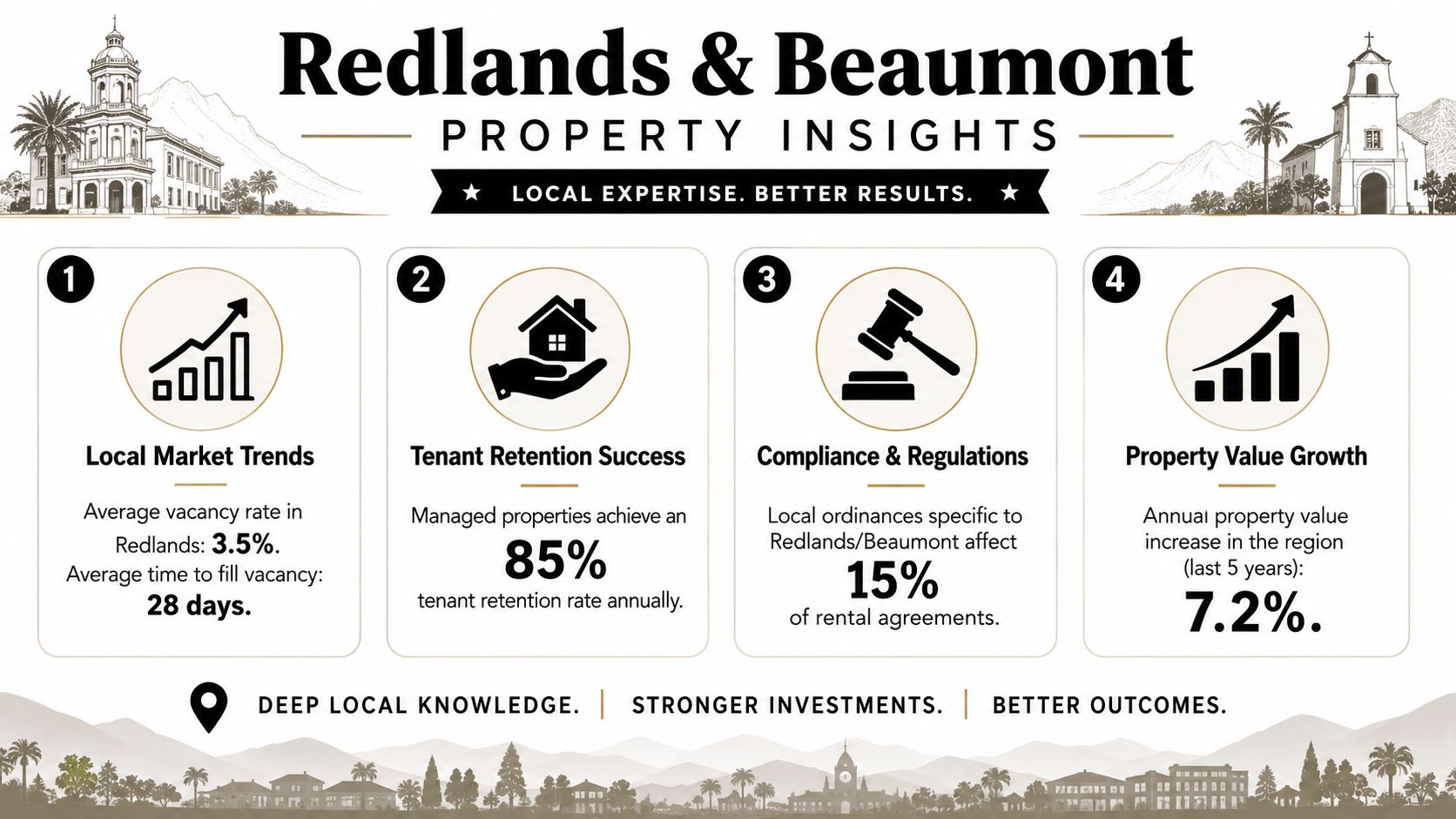
That's why local due diligence matters so much when you hire a property manager. A firm can be competent in broad terms and still be a poor fit for your specific neighborhood.
Redlands, Beaumont, and Yucaipa require different operating habits
Redlands property management often involves a wider mix of tenant profiles, established neighborhoods, and properties where condition, presentation, and maintenance follow-through directly affect tenant quality. Managers need judgment, not just software.
Property Management Beaumont and Beaumont property management often involve newer homes, growing residential areas, and residents who expect quick communication and organized maintenance coordination. A manager who delays simple decisions can create avoidable turnover.
Yucaipa property management and property management Yucaipa often require a practical understanding of mixed housing types. Some homes need tighter preventative maintenance because age, lot configuration, or deferred repairs can create recurring service calls if not handled early.
Why tenant screening matters more in suburban single-family rentals
Historical industry guidance notes that the average eviction can cost up to three months of lost rent, according to IBISWorld's property management industry overview. That's one reason local owners searching for Property Management Beaumont, Beaumont property management, Yucaipa property management, and Redlands property management are usually trying to reduce costly mistakes, not just delegate paperwork.
Single-family rentals in the Inland Empire often carry a different risk profile than larger multifamily buildings. One vacancy has a concentrated effect. One bad tenant relationship can disrupt the whole return profile of the property.
Good local management is often less about collecting rent and more about preventing the expensive chain reaction that starts with a weak placement.
What to look for in a locally capable manager
A local manager should be able to discuss:
Vendor coverage by city
They should know who can handle routine work versus urgent calls in Redlands, Beaumont, Yucaipa, and nearby communities.Inspection style
Annual inspections, photo documentation, and clear follow-up are especially important in scattered-site single-family portfolios.Property-specific communication
Condos, townhomes, and detached homes don't need the same level of owner involvement or maintenance planning.Owner control preferences
Some owners want approval on nearly every repair. Others want broad authority delegated. The manager should adapt without confusion.
One local option owners may evaluate is AIM PROPERTY MANAGEMENT COMPANY, which states that it manages individually owned condominiums, townhomes, single-family homes, and investment properties across Inland Empire communities including Beaumont and Yucaipa. The important point is not brand familiarity. It's whether the company's operating model matches your asset type and reporting expectations.
Your Top Questions About Hiring a Property Manager
Is it worth it to hire a property manager for one rental home?
Sometimes yes, sometimes no. One property can still justify professional management if it's high-value, located away from where you live, or if your time is better spent elsewhere. The key question isn't unit count. It's whether self-management creates avoidable risk, delayed decisions, or weak tenant oversight.
How do I find the best property management near me?
Search locally, then narrow fast. Look for companies that already manage the same type of property you own in the same cities you care about. A condo in Loma Linda has different operational needs than a single-family rental in Beaumont or Yucaipa. “Property management near me” should mean local fit, not just a nearby office.
Use this checklist:
- Match the asset type. Ask whether they regularly manage homes like yours.
- Verify local depth. Make sure they know your city, vendor base, and common tenant expectations.
- Test communication. Slow replies during the sales process usually get worse after onboarding.
What should I ask before signing?
Focus on operating details, not marketing language.
Ask who approves repairs, how often you receive statements, how tenant issues are documented, whether maintenance includes markups, and what happens if you want to terminate early. If the answers are vague, the relationship will likely stay vague.
Should I choose the manager with the lowest fee?
Usually not. A lower fee can still cost more if leasing is weak, maintenance is poorly controlled, or reporting is unclear. Compare the entire operating model, the contract, and the company's city-level experience.
What matters most in Redlands, Beaumont, and Yucaipa?
Local execution. Redlands property management often depends on consistent condition standards and communication. Property Management Beaumont often requires speed and structure. Property management Yucaipa often depends on how well the manager handles varied housing stock and preventative maintenance.
What's the simplest hiring process?
Keep it disciplined:
- Start before vacancy when possible
- Build a shortlist of local candidates
- Interview for process, not personality
- Check references and managed property condition
- Read the agreement line by line
- Choose the manager whose workflow fits your property and your control preferences
If you own a rental in Redlands, Beaumont, Calimesa, Yucaipa, Loma Linda, Mentone, Highland, or Banning and want help evaluating whether professional management makes financial sense, AIM PROPERTY MANAGEMENT COMPANY offers residential property management for individually owned homes, condos, townhomes, and investment properties.