
Rental ownership often starts with a clean spreadsheet and a simple goal. Collect rent, build equity, keep the home in good shape, and let the asset work for you.
Then real life shows up. A tenant texts after hours about a leak. A repair vendor gives a vague arrival window. Rent comes in late. A notice has to be served correctly. A lease clause that looked standard suddenly needs to line up with California rules. What looked passive in Redlands, Beaumont, Calimesa, Yucaipa, Loma Linda, Mentone, Highland, or Banning starts to feel like a second job.
Owners searching for the best property manager usually aren’t looking for “help” in the abstract. They’re looking for a way to protect income, reduce legal exposure, and stop spending mental energy on tasks that shouldn’t require their attention in the first place. That’s especially true for homeowners and investors with strong incomes and limited time. If you’re managing a single-family home, condo, or townhome, the wrong manager creates friction. The right one gives you back control without forcing you into daily operations.
Your Inland Empire Investment Dream vs Reality
A lot of Inland Empire owners bought with a clear vision. Keep the property, rent it well, and let it support long-term wealth. That vision still makes sense. The problem is that self-management usually asks owners to play several roles at once: marketer, leasing agent, bookkeeper, maintenance coordinator, compliance manager, and sometimes conflict mediator.

In practice, the stress doesn’t come from one dramatic event. It comes from accumulation. A late rent payment here. A missed maintenance follow-up there. A lease renewal that drags on too long. A repair invoice with no context. Owners who expected dependable income instead spend evenings tracking details that should already be handled.
That’s why the conversation has changed across the region. The question isn’t just whether to get support. It’s whether the management approach improves the investment. In Inland Empire communities, owners increasingly want a system that handles tenant screening, maintenance coordination, inspections, documentation, and communication without constant owner intervention. A local Inland Empire property management partner should make the asset easier to own, not add another layer of confusion.
Practical rule: If your rental still depends on you remembering every next step, you don’t have a management system. You have a collection of tasks.
The dream is still possible. Passive income isn’t a myth. But it usually requires handing the day-to-day work to people who treat management as asset protection, not just rent collection.
What 'Best' Really Means for Property Management in 2026
The phrase best property manager gets used loosely. Many owners think it means friendly service, fast answers, or a competitive fee. Those matter, but they aren’t enough. In today’s market, “best” means a manager who runs your property like a financial asset with legal exposure attached to it.
That changes how you evaluate the work. Rent collection is only one line item. A serious manager also protects occupancy, controls turnover, handles documentation correctly, keeps maintenance from drifting into bigger repairs, and communicates in a way that lets you make decisions without chasing information.
Asset manager, not rent collector
A strong way to think about modern property management is this: it should feel closer to working with a financial advisor than hiring a handyman. Your manager is responsible for the performance of a physical asset. That means balancing return, risk, timing, and tenant experience at the same time.
For owners comparing Redlands property management, property management Redlands, Property Management Beaumont, and Yucaipa property management options, the most useful question is not “What do you charge?” It’s “How do you protect the value and stability of this property over time?”
The broader industry has moved in that direction. The largest U.S. property management companies in 2026 manage over 2 million units collectively, led by Greystar with 823,581 units, according to Avantio’s property management performance metrics overview. That same source notes the importance of 95-96% occupancy rates in prime urban areas and highlights 10-20% annual turnover as a costly benchmark for less efficient managers. Local firms don’t need national scale, but owners should still expect local operators to think in terms of performance.
The standards owners should expect
The best managers usually show their quality in a few specific ways:
- They tie decisions to outcomes. If they recommend a repair, pricing change, screening standard, or lease strategy, they can explain why it protects income or reduces risk.
- They don’t rely on memory. Good operators use repeatable systems for notices, maintenance coordination, collections, inspections, and records.
- They understand tenant experience without losing owner focus. Happy tenants alone don’t make a great manager. Neither does being overly harsh. Good management keeps standards clear and communication steady.
- They speak in useful reports. Owners should be able to see what happened, what changed, and what needs approval.
A strong local property management company near you should feel organized before you ever sign an agreement. If the onboarding conversation is vague, the monthly management process usually will be too.
The best property manager isn’t the one who promises the most. It’s the one who can show how decisions are made, documented, and followed through.
That’s the shift many owners need to make. You’re not hiring someone to “watch the property.” You’re selecting a strategist for one of your larger assets.
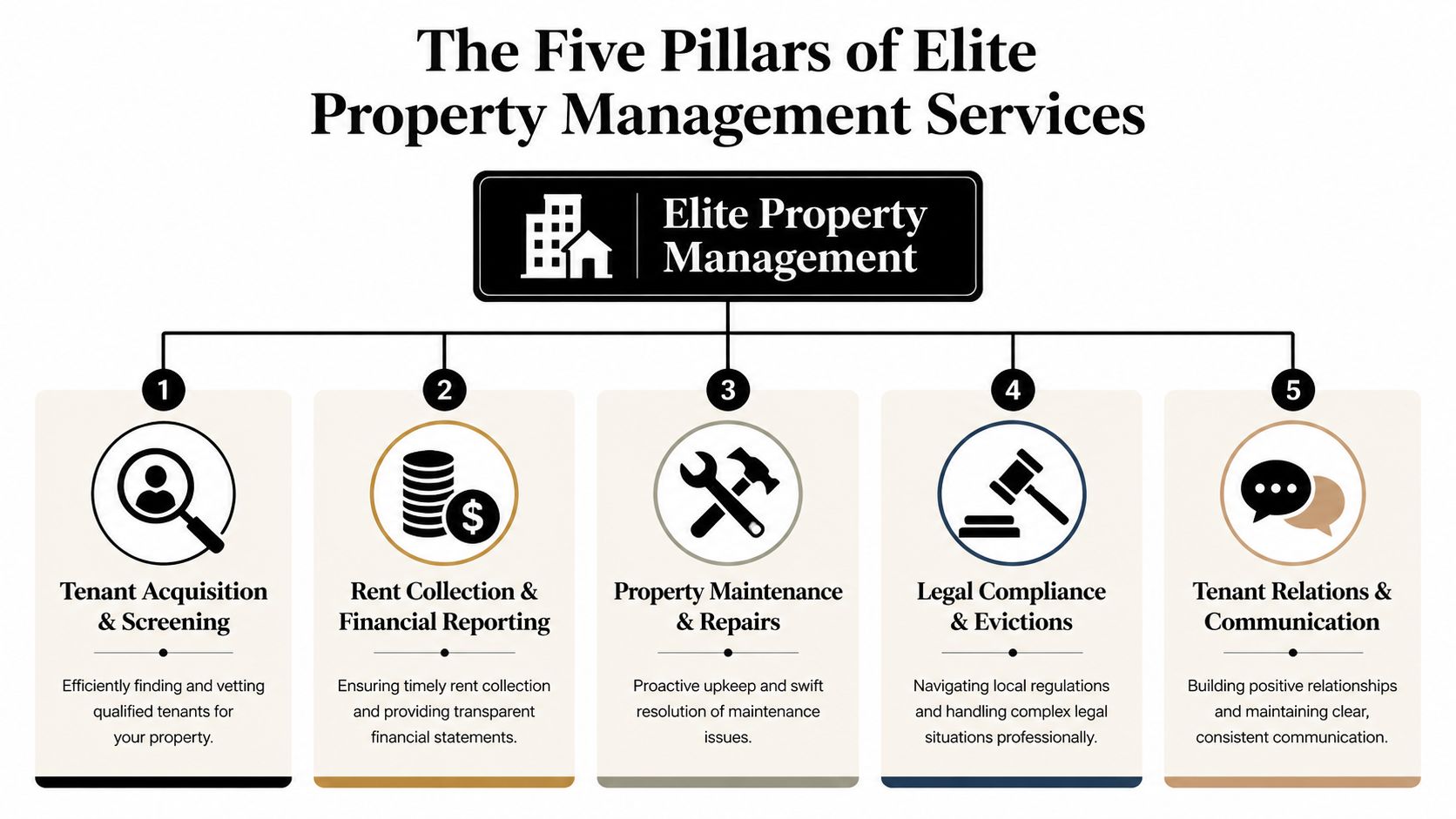
The Five Pillars of Elite Property Management Services
Owners often ask what separates average management from elite management. The difference usually isn’t one big feature. It’s whether the company executes the core disciplines consistently, month after month, without creating new problems while solving old ones.
Ironclad tenant screening
Everything gets harder when the wrong resident moves in. Collections become reactive. Maintenance requests become contentious. Lease enforcement becomes personal. Turnover risk rises.
Good screening isn’t about being overly restrictive. It’s about being disciplined and consistent. That means documented criteria, reliable verification, and a process that helps you place tenants who can pay on time, follow lease terms, and care for the property.
Ask direct questions:
- What do you verify first
- How do you handle incomplete applications
- Who reviews supporting documents
- How do you keep the process consistent
If the answer sounds improvised, it probably is.
Proactive 24/7 maintenance
Maintenance is where many managers either earn trust or lose it. Owners don’t need a company that solely forwards repair requests. They need one that triages urgency, protects the property, manages vendors, and documents the work clearly.
Reactive maintenance is expensive because small issues don’t stay small. A minor leak can turn into flooring damage, drywall replacement, and tenant frustration. That’s why annual inspections, vendor relationships, and a real after-hours process matter.
For flooring decisions in particular, durability affects both repair frequency and turnover readiness. Owners comparing materials for rentals may find this Comprehensive guide to durable floors useful because it focuses on surfaces that hold up better under repeated tenant use.
Flawless financial and legal management
Discerning owners should pay the closest attention. A manager can sound responsive and still underperform financially if reporting is weak, records are sloppy, or compliance work is casual.
In Property Management Beaumont, elite firms prioritize Net Operating Income, or NOI, as a cornerstone KPI. According to Pacific Apartment Brokerage’s KPI overview, top performers achieve 5-10% NOI growth, and the same source notes that a 2% dip in occupancy can erode NOI by 3-5%, reinforcing the importance of 95-96% occupancy benchmarks in competitive urban markets. That matters because owners often focus on rent amount while missing the wider picture. Expense control, vacancy control, and documentation quality all influence what the property yields.
What to look for here:
- Monthly statements that are easy to read
- Clear tracking of rent, expenses, and owner disbursements
- Documented notices and lease files
- A process for staying current with California requirements
Owner mindset: If you can’t quickly tell how the property is performing, your manager is asking you to trust what should be visible.
Strategic marketing and minimized vacancy
A vacant property doesn’t just lose rent. It creates downstream problems. Leasing timelines stretch. Showing quality drops. Owners feel pressure to approve weak applicants. Deferred maintenance gets exposed at the wrong time.
Strong marketing starts before the listing goes live. The property has to be rent-ready. Photos have to reflect the actual condition. The leasing process has to move fast enough that qualified applicants don’t drift elsewhere.
A capable manager also understands that pricing strategy isn’t just about reaching for the highest possible number. It’s about aligning rate, condition, timing, and demand so the property doesn’t sit while carrying costs continue.
Transparent communication
Communication sounds soft, but it has hard financial consequences. Owners make poor decisions when updates are incomplete. Tenants lose confidence when responses are inconsistent. Vendors become harder to manage when approvals aren’t clear.
Transparent communication usually has three traits:
- It is timely. Not every update needs to be immediate, but silence creates uncertainty.
- It is specific. “Handled” is not an update. “Vendor scheduled, tenant confirmed access, estimate pending approval” is.
- It is documented. Verbal reassurance doesn’t help much when there’s a dispute later.
That combination is what owners should expect from any company claiming to be the best property manager in the Inland Empire.
Your Step-by-Step Guide to Hiring a Property Manager
Most owners don’t make a bad hiring decision because they ignored obvious red flags. They make it because the interview stayed too general. The company seemed professional, the fee sounded reasonable, and the owner never pushed far enough into process.
A better approach is to evaluate a manager in stages. Start broad, then get specific, then read the agreement like an investor instead of a consumer.
Start with how they present themselves
Before you speak with anyone, review the company’s website, service pages, and public messaging. A manager who can’t clearly explain screening, maintenance coordination, financial reporting, and compliance practices online often won’t explain them well in person either.
Look for local relevance, not generic promises. If you’re trying to choose a property management company, the most useful websites will tell you how they operate in your market, what they manage, and how owners stay informed.
Ask questions that reveal process
The interview should test whether the company has a repeatable operating system. Ask questions that force specifics.
One question many owners miss is how the manager handles ancillary income. According to this article on choosing the perfect property manager, top firms in Property Management Redlands are boosting owner NOI by 5-10% through resident opt-in programs and other low-effort revenue shares. You don’t need a complicated add-on strategy for every property, but you do want to know whether the manager thinks beyond base rent when operating costs rise.
Use a checklist during interviews so you don’t rely on memory.
| Question Category | Key Questions to Ask | Notes / Manager's Response |
|---|---|---|
| Screening | How do you verify applicant qualifications and keep screening consistent? | |
| Leasing | How do you price a vacancy and what happens if the property sits longer than expected? | |
| Maintenance | Who handles after-hours issues, how are vendors selected, and how are estimates approved? | |
| Financial reporting | What will I receive each month, and how quickly can I see income and expenses? | |
| Compliance | How do you handle notices, lease documentation, and changing California requirements? | |
| Communication | Who is my point of contact, and how are updates delivered during active issues? | |
| Ancillary income | Do you offer resident programs or other approved income streams that support NOI? | |
| Turnover | What happens between move-out and re-listing, and who oversees readiness? |
Read the management agreement carefully
A polished interview doesn’t matter if the agreement is vague. Read every clause that addresses authority, owner approvals, repair limits, lease renewals, termination, reserve requirements, and how disputes are handled.
Pay special attention to these areas:
- Repair approval language that gives broad discretion without clear thresholds
- Termination clauses that are difficult or costly to exit
- Fee language that leaves room for undefined charges
- Communication expectations that aren’t spelled out at all
A good agreement should make the relationship easier to understand. If it creates more questions than answers, keep asking.
Compare the full operating model
Don’t choose based on fees alone. Compare responsiveness, clarity, local knowledge, reporting style, and how confidently the team explains difficult situations. Owners often save money with the company that prevents bad tenancies, handles maintenance cleanly, and documents everything well, even if that company isn’t the cheapest on paper.
The best hiring decision usually feels calm, not rushed. You should know who’s responsible, how the property will be run, and how your investment decisions will be supported.
Spotlight on Beaumont Property Management
Beaumont owners face a practical challenge. The area attracts renters who want a well-kept home and a neighborhood lifestyle, but that doesn’t mean management can be casual. Homes have to stay presentable, maintenance has to move quickly, and leasing standards have to stay consistent if you want reliable performance.

A generic approach to Property Management Beaumont usually falls short in two ways. First, it treats every rental like a commodity. Second, it assumes owner communication can be loose as long as rent arrives. Neither works well for higher-value homes or owners who expect professional oversight.
What Beaumont owners should insist on
In Beaumont property management, the best operator is usually the one who pays close attention to condition, presentation, and follow-through. Single-family homes and townhomes often compete on cleanliness, upkeep, and how smoothly the application-to-move-in process runs.
Owners should expect:
- Detailed tenant placement standards that protect the property from avoidable turnover
- Fast maintenance coordination so small problems don’t become expensive repairs
- Regular inspections that catch wear, policy violations, and deferred issues early
- Clear monthly reporting so financial performance is visible, not guessed at
A local Beaumont property management team should also understand that suburban rentals live or die by consistency. If landscaping slips, repairs drag, or communication gets vague, the property starts to feel mismanaged fast.
That local rhythm matters. Beaumont renters often compare homes by livability as much as price. Owners who keep standards high usually protect both income and long-term condition more effectively than those who operate reactively.
A short local overview helps make that point concrete:
The key takeaway is simple. Property Management Beaumont is not just about collecting rent in a growing market. It’s about managing a residential asset in a way that matches how Beaumont renters choose homes and how Beaumont owners build equity.
Spotlight on Yucaipa Property Management
Yucaipa has a different feel from some neighboring markets, and owners should want a manager who recognizes that. Many rentals in this area are single-family homes, condos, or townhomes where tenant fit matters just as much as lease speed. A rushed placement can create months of avoidable friction.
That’s one reason professional management adoption matters here. In markets like Yucaipa, 51% of rental property owners rely on professional managers to optimize their investment, according to Buildium’s property management KPI benchmarks. The same source notes 10-20% average annual client turnover in the industry. For owners evaluating Yucaipa property management options, that means choosing a firm with stable systems matters as much as choosing one with local familiarity.
Why local fit matters in Yucaipa
A manager handling property management Yucaipa well should understand that residents often value stability, responsiveness, and a well-maintained home environment. That has practical implications.
Leasing should be careful, not hurried. Maintenance communication should be respectful and direct. Inspections should protect the property without turning routine oversight into tenant conflict. Owners who ignore those details often end up with more turnover pressure and more management friction than they expected.
What good Yucaipa management looks like
Owners should look for a manager who can handle the basics cleanly and still think strategically:
- Thoughtful screening for long-term fit in single-family and condo rentals
- Prompt maintenance follow-up that keeps residents engaged and properties protected
- Strong records and compliance habits so the owner isn’t exposed by sloppy paperwork
- Consistent reporting that makes decisions easier during renewals, repairs, and move-outs
If you’re comparing local options, a Yucaipa property management provider should be able to explain not just what they do, but how their process fits this market. That includes how they communicate with tenants, how they prepare homes for leasing, and how they keep owners informed without flooding them with noise.
Good Yucaipa management respects the property as a long-term holding, not just a monthly rent check.
That’s the standard owners should use. In Yucaipa, local knowledge isn’t branding. It affects tenant quality, property condition, and how sustainable the investment feels year after year.
Choosing Your Partner for Long-Term Investment Success
The right manager changes the ownership experience in a very practical way. Problems stop landing on your phone first. Decisions become clearer. The property runs on process instead of memory. That’s what owners should mean when they talk about hiring the best property manager.
The strongest companies share a few traits. They screen carefully, coordinate maintenance well, document thoroughly, report clearly, and understand the local realities of markets like Redlands, Beaumont, Yucaipa, Banning, Loma Linda, and Highland. They also know that performance isn’t just about collecting rent this month. It’s about protecting the asset so it remains stable over time.
If you’re comparing Redlands property management, property management Redlands, Beaumont property management, or property management Yucaipa options, keep the standard high. Choose the company that treats your rental like an investment with both upside and exposure. That usually means disciplined systems, steady communication, legal awareness, and local operating judgment.
Owners don’t need a vendor who only responds when something breaks. They need a partner who helps turn a rental home into a well-run, lower-friction investment.
Frequently Asked Questions About Hiring a Property Manager
Many owners reach this point with the same concern. They know self-management takes time, but they still want clarity before they hire a property manager. That’s fair. The practical questions matter.

How do I know if I need property management near me
You probably need local management if tenant communication, maintenance coordination, rent follow-up, or compliance tasks are taking too much of your time or attention. You should also consider it if you live outside the immediate area, own a higher-value home, or want more structure around documentation and inspections.
A local manager is often the better fit when you want faster vendor coordination and better market-specific judgment.
What does the best property manager actually handle
A strong manager usually handles tenant placement, rent collection, maintenance coordination, property inspections, lease documentation, notices, and owner reporting. The better question is how they handle each task.
You’re not just hiring for task completion. You’re hiring for judgment, consistency, and risk control.
Is the cheapest option usually the best choice
Usually not. A lower fee can look attractive until weak screening, poor maintenance oversight, or vague reporting starts costing you time and money.
The better comparison is total operating value. Ask what systems are in place, how communication works, and how problems are documented and resolved.
What should I ask before I hire a property manager
Ask about screening standards, maintenance approvals, after-hours response, inspection routines, reporting, lease documentation, and how they stay current with California rules. Also ask how they handle owner communication during a vacancy, repair issue, or tenant dispute.
If answers stay broad, keep pressing. Specifics matter.
How local should a manager be
For most owners, local matters a lot. A company working in your immediate market will usually have a better sense of renter expectations, vendor responsiveness, and neighborhood-level leasing realities.
That’s especially important when comparing homes in communities like Beaumont, Yucaipa, and Redlands, where property type and presentation can strongly influence leasing quality.
Can a property manager help reduce stress even if I own only one rental
Yes. In many cases, single-property owners feel the most stress because they don’t have internal systems or staff. One late-night repair or one poorly handled tenant issue can absorb a disproportionate amount of time.
Professional management is often most valuable when the owner wants the income but doesn’t want the property to dictate their schedule.
How long should it take to feel confident in a manager
You should have confidence before signing, not months later. That confidence comes from clear answers, a readable agreement, defined processes, and a team that communicates directly.
If you still feel uncertain after multiple conversations, keep looking. The right fit should feel organized, not ambiguous.
If you own a rental in Redlands, Beaumont, Calimesa, Yucaipa, Loma Linda, Mentone, Highland, or Banning and want a more stable, better-managed investment, talk with AIM PROPERTY MANAGEMENT COMPANY . Their team focuses on residential property management for single-family homes, condos, townhomes, and investment properties, with the screening, maintenance coordination, financial reporting, inspections, and compliance support owners need to turn a stressful rental into a more predictable asset.