Investing in rental properties is a smart way to build financial freedom, but your success really boils down to one thing. When homeowners in communities like Redlands or Yucaipa ask, "Should I hire a property manager for my house?" the conversation always comes back to profitability and cash flow. For investors looking for expert Beaumont Property Management, getting a firm grip on this concept is absolutely essential. With professional property management in Beaumont, you can ensure your investment is optimized for success. So, what is cash flow in real estate? Put simply, it’s the money left in your bank account after you’ve collected all the rent and paid all the bills. It’s the true financial pulse of your investment.
Decoding Your Investment's Heartbeat
Understanding your cash flow is like checking your property's vital signs. It’s the clearest, most direct indicator of its financial health, showing you exactly how much money your property is putting in your pocket month after month. For anyone needing reliable property management in Beaumont, this metric is far more crucial for long-term wealth than just crossing your fingers for market appreciation. When considering whether to hire a property manager for my house, know that a professional will focus on this key metric. AIM provides experienced Beaumont Property Management in communities like Redlands, Beaumont, Calimesa, Yucaipa, Loma Linda, Mentone, Highland, and Banning, California.
Think of your rental as a small business. The rent you collect is your revenue. The expenses—like your mortgage, taxes, insurance, and maintenance—are your operating costs. The profit left over at the end of the month? That’s your cash flow. It’s this real, tangible return that pays the bills and builds your wealth over time.
To see how these pieces fit together, let's break them down.
Table: Core Components of Real Estate Cash Flow
This table offers a quick summary of the key financial elements that determine a rental property's cash flow.
| Financial Component | Description | Example |
|---|---|---|
| Gross Rental Income | The total rent collected from tenants before any deductions. | $2,500 monthly rent |
| Vacancy Loss | Potential income lost when the property is unoccupied. | 5% of gross rent ($125) |
| Operating Expenses | All costs to run the property (taxes, insurance, repairs, management fees). | $800 per month |
| Debt Service | The mortgage payment, including principal and interest. | $1,200 per month |
| Net Operating Income (NOI) | Gross income minus operating expenses (before the mortgage). | $1,575 ($2,500 – $125 – $800) |
| Cash Flow | What's left after paying the mortgage (NOI – Debt Service). | $375 ($1,575 – $1,200) |
Ultimately, the goal is to have more money coming in than going out each month.
Positive vs. Negative Cash Flow
Every rental property lands in one of two buckets, and knowing which one is critical for your financial success.
- Positive Cash Flow: This is what we’re all aiming for. It means your rental income is higher than all your operating expenses and mortgage payments combined. Every month, the property puts money directly into your pocket.
- Negative Cash Flow: This is a major red flag. It happens when your total expenses are more than your rental income. Each month, you have to dip into your own savings just to keep the investment going.
At AIM, we focus on securing long-term leases of six months or more. It’s a strategy we’ve honed since 1997 to lock in consistent, positive cash flow for our clients in communities like Redlands, Loma Linda, and Yucaipa. Unlike the ups and downs of short-term rentals, long-term tenancy creates a predictable income stream—the bedrock of any successful real estate portfolio. If you want to delve deeper into cash flow real estate investing principles, it’s a great starting point.
Why Stable Income Matters Most
While watching your property value go up is a fantastic long-term bonus, it’s also completely unpredictable. Positive cash flow, on the other hand, is the immediate, tangible reward of a well-managed investment.
A steady income stream gives you the financial cushion to handle unexpected repairs, cover vacancies without panicking, and continue growing your portfolio. It all starts with choosing the right property, so understanding what makes a good rental property is the key to maximizing your returns from day one.
How to Accurately Calculate Your Property's Cash Flow
Knowing what cash flow is gets you in the game. But learning how to calculate it is how you start winning. This isn't about guesswork or crossing your fingers. It's about a simple, repeatable process that gives you a precise picture of a property's financial health. When you ask, "should I hire a property manager for my house?" a key reason is their expertise in these calculations. Our Beaumont Property Management team has mastered this process. For reliable property management in Beaumont, this skill is non-negotiable.
Once you master this formula, you can confidently analyze any deal and know exactly what to expect in your bank account each month.
The whole process is really just a funnel. You start with the total potential income at the top and subtract all the costs until you’re left with the final profit at the bottom.
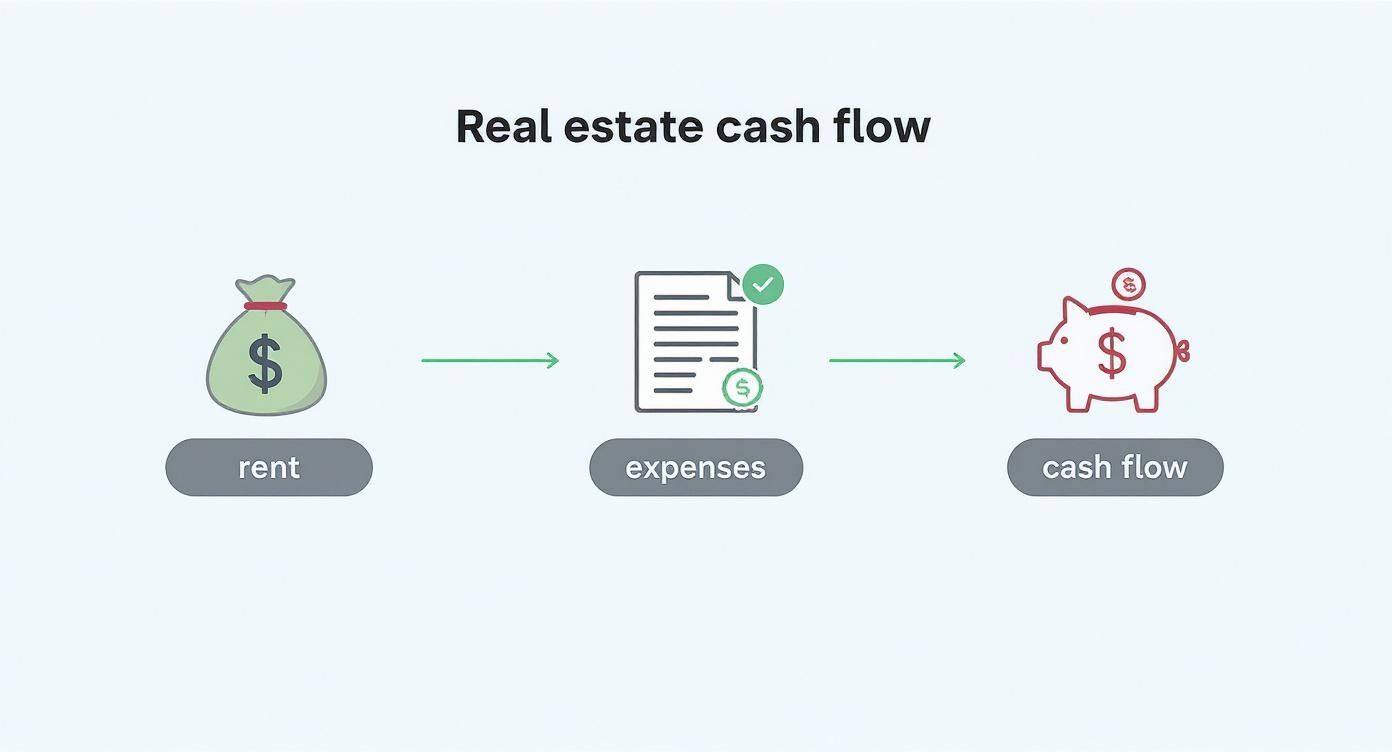
As you can see, it’s a straightforward series of subtractions. Let's walk through it step-by-step.
Step 1: Start with Gross Scheduled Income
Your journey begins with the Gross Scheduled Income (GSI). Think of this as the absolute best-case scenario—the total rent you could possibly collect if your property was occupied every single day of the year and every tenant paid on time, without fail.
Let's say you own a single-family home in Highland that you rent for $2,800 a month. Your annual GSI would be $33,600 ($2,800 x 12). That’s your starting line.
Step 2: Account for Vacancy and Credit Losses
Reality check: no property stays occupied 100% of the time. You have to plan for the gaps between tenants or, unfortunately, for times when a tenant might not pay. This is your vacancy and credit loss.
A smart investor always budgets for this. A conservative estimate is typically 5-10% of your GSI. For our Highland property, a 5% vacancy rate means an annual loss of $1,680 ($33,600 x 0.05).
When you subtract that from your GSI, you get your Effective Gross Income (EGI), which in this case is $31,920. This is a much more realistic picture of your potential income.
Step 3: Itemize All Operating Expenses
Now for the bills. You need to tally up every single expense required to keep the property up and running—everything except for your mortgage. These are your Operating Expenses (OpEx).
Common operating expenses include:
- Property Taxes: What the local government charges you each year.
- Property Insurance: Essential coverage for liability and property damage.
- Repairs & Maintenance: Set aside a fund for things that inevitably break. 5-10% of GSI is a good rule of thumb.
- Property Management Fees: Our competitive fee is just 7.9% per month, keeping your costs predictable and low.
- HOA Dues: If your property is in a community in areas like Loma Linda or Redlands.
- Utilities: Any services, like water or trash, that you cover as the owner.
Subtract your total operating expenses from your EGI, and you’ll arrive at your Net Operating Income (NOI). This is a critical number for investors because it shows how profitable the property is on its own, before financing even enters the picture. If you want to dive deeper into related metrics, check out our guide on how to calculate the cap rate on a rental property.
Step 4: Subtract Your Debt Service
The last piece of the puzzle is your mortgage payment, also known as debt service. This is the total amount, including both principal and interest, that you pay your lender. It's crucial to treat this separately from your operating expenses.
For our Highland home example, let's assume an annual mortgage payment of $22,800 ($1,900 per month).
The Final Calculation:
Net Operating Income (NOI) – Annual Debt Service = Total Annual Cash Flow
The stability of cash flow is also shaped by larger market forces. In 2024, the global private credit market swelled to $238 billion in assets under management, with private debt funding 24% of all US commercial real estate lending. This highlights a powerful investor demand for stable, income-generating properties. In the US, the average debt service coverage ratio (DSCR) for these assets was 1.4x in 2024, which means the net operating income was 40% higher than the required mortgage payments—a healthy cushion that reinforces cash flow stability.
Key Factors That Influence Your Rental Cash Flow
Knowing how to run the numbers on cash flow is one thing. Actually managing all the moving parts that impact your bottom line is where the real work begins. Your property's cash flow isn't a fixed number—it's a living, breathing metric that responds to your decisions and the world around it. Deciding to hire a property manager for my house is one of the most impactful decisions you can make. A professional Beaumont Property Management firm like AIM has the expertise to navigate these factors. When seeking property management in Beaumont, it's crucial to partner with a company that understands these nuances.
A handful of key variables can either pad your profits or slowly bleed your bank account dry. By getting a handle on these factors, you can build a more resilient and profitable investment strategy. Let's break down the forces, both internal and external, that have a direct say in your rental income.
Internal Factors You Can Control
These are the variables squarely within your sphere of influence. Getting proactive in these areas is absolutely critical for protecting and growing your monthly profit.
-
Rental Rate: Setting the right rent is a delicate balancing act. Go too high, and you’re staring down the barrel of a long, costly vacancy. Price it too low, and you're leaving money on the table every single month. We use deep market analysis for communities like Redlands and Beaumont to lock in competitive rates that pull in quality tenants fast.
-
Vacancy Periods: Every single day your property sits empty, it's actively costing you money. Minimizing vacancy is one of the most powerful ways to protect your cash flow. That means smart marketing, lightning-fast unit turnovers, and a rock-solid tenant screening process to find reliable, long-term renters.
-
Operating Expenses: These are the non-negotiable, ongoing costs of owning a rental property. Think property taxes, insurance, maintenance, and HOA fees. The key is to keep a tight lid on these expenses without ever cutting corners on quality. For example, our longstanding relationships with local vendors, built since 1997, help us secure cost-effective repairs for our clients.
The Impact of Property Management
One of the biggest internal factors is your approach to management. While hiring a professional is an expense, the right partner more than pays for themselves by optimizing your income and clamping down on costs.
At AIM, we keep our fees simple and competitive to maximize what you take home. Our monthly management fee is a low 7.9%, and our tenant placement fee is just $750—with no hidden add-on fees. This predictable cost structure makes it easy to plug into your cash flow calculations. To see how this fits into the bigger picture, you can check out our guide on how to calculate rental yield.
External Forces Beyond Your Control
While you can't control these market-wide trends, you can absolutely prepare for them. An experienced property manager helps you anticipate and pivot when these shifts happen, safeguarding your investment from the unexpected.
-
Local Economic Trends: The financial health of local areas like Banning and Calimesa directly fuels rental demand. A booming job market brings in more tenants, while an economic downturn can lead to higher vacancies and put downward pressure on rents.
-
Supply and Demand Dynamics: It's basic economics. The balance between available rental units and the number of people looking for a place to live is a huge driver of cash flow. A housing shortage almost always means higher rents and fewer empty units. For instance, in 2025, supply shortages are expected to get worse for multifamily properties across North America, which will likely lead to stronger rental income. You can discover more global real estate insights on jll.com.
-
Interest Rates and Insurance Premiums: Changes in the wider financial markets can also hit your wallet. A jump in interest rates can inflate your payments on a variable-rate mortgage, while climbing insurance premiums can take a bite out of your net operating income. Staying informed helps you adjust your financial strategy before it becomes a problem.
Key Takeaway: Real success in real estate investing comes from obsessively managing the factors you can control while intelligently navigating the ones you can't. A strategic approach, especially with long-term rentals, gives you the stability needed to weather market storms and consistently generate positive cash flow.
Why Long-Term Rentals Win for Stable Cash Flow
In real estate investing, the road to predictable profit often boils down to one key decision: long-term or short-term rentals. For investors wondering what is cash flow in real estate and how to build it reliably, the answer becomes crystal clear with experience. At AIM, we've been in this business since 1997, and our decades of work have shown us that a long-term rental strategy is the undisputed champion for building stable, reliable wealth.
It’s precisely why we exclusively manage leases of six months or longer. This isn't just a preference; it's a core philosophy that directly protects our clients' financial security and provides a dependable income stream. If you're looking for Beaumont Property Management and asking, "should I hire a property manager for my house?" you'll find our long-term focus delivers the stability you need. With solid property management in Beaumont, this strategy simply minimizes risk and maximizes your returns.

The Foundation of Financial Predictability
The biggest advantage of long-term rentals is consistency. Simple as that.
When a qualified tenant signs a lease for six months, a year, or longer, you're locking in a predictable stream of revenue. You know exactly what's coming in each month, which makes budgeting, planning for the future, and even sleeping at night a whole lot easier.
This stability is a world away from the volatile nature of short-term rentals. Nightly or weekly bookings create a choppy, erratic income flow that can swing wildly from one month to the next. One great month during tourist season might be followed by a painful stretch of vacancies, leaving you scrambling to cover your mortgage and other expenses.
Long-term leases transform a rental property from a high-maintenance side hustle into a dependable, self-sustaining asset. The predictability they offer is the bedrock of a sound investment strategy, allowing owners to forecast cash flow with confidence.
Drastically Lower Turnover and Costs
Tenant turnover is one of the biggest silent killers of an investor's cash flow. Every time a tenant moves out, a whole new set of expenses kicks in, eating directly into your profits.
With short-term rentals, this cycle is constant. You're perpetually marketing the property, managing new bookings, and coordinating cleanings between every single guest. These activities come with very real costs that add up faster than most people realize.
A long-term tenant, on the other hand, dramatically cuts down these expenses. Just look at the financial impact:
- Zero Marketing Costs: Once a great tenant is in place, you have no advertising expenses for the entire lease term.
- Reduced Administrative Work: You get to avoid the daily grind of responding to inquiries, juggling calendars, and processing frequent payments.
- Lower Cleaning and Prep Fees: Professional cleaning between every short-term guest can easily run into hundreds of dollars a month. A long-term tenant completely eliminates this recurring cost.
Less Wear and Tear on Your Property
Short-term rentals often attract guests with a "vacation mindset," which can unfortunately lead to more wear and tear on your property. The constant in-and-out of luggage, different usage habits, and a lower sense of personal ownership can take a toll on furniture, appliances, and finishes.
Long-term tenants, however, treat the property as their home. They are far more likely to take pride in its upkeep, report maintenance issues right away, and generally maintain the property with care. This responsible stewardship means fewer repair bills for you and helps preserve the value of your asset over time.
For property owners in communities like Mentone, Yucaipa, or Banning, preserving your investment's condition is crucial for long-term appreciation and sustained cash flow. A long-term lease is your best defense against premature aging and costly damage.
Long-Term vs Short-Term Rentals A Cash Flow Comparison
When you break it down, the financial and operational differences between the two strategies become obvious. This table highlights the key factors that directly impact your net cash flow.
| Factor | Long-Term Rentals (6+ Months) | Short-Term Rentals (Nightly/Weekly) |
|---|---|---|
| Income Stream | Highly predictable and stable monthly revenue. | Erratic and seasonal; prone to sudden drops. |
| Vacancy Costs | Minimal; typically occurs once every 1-2 years. | High and constant; gaps between bookings are common. |
| Management Time | Low intensity; requires minimal day-to-day effort. | High intensity; demands constant communication and oversight. |
| Operating Expenses | Lower and more predictable (marketing, cleaning). | Significantly higher due to frequent turnover. |
| Wear & Tear | Reduced, as tenants treat the property like a home. | Accelerated due to constant guest traffic. |
Ultimately, the math is simple. By focusing exclusively on long-term leases, we help our clients in Redlands, Loma Linda, and Highland build more sustainable wealth. It’s a proven strategy for maximizing net income and achieving true financial peace of mind.
How Professional Management Maximizes Your Net Income
Generating positive cash flow is one thing; maximizing it is another game entirely. Many investors get the basic formula of income minus expenses, but the real secret to unlocking a property's full financial potential? It’s all in the oversight. When you hire a property manager for my house, you partner with an expert dedicated to this goal. Our Beaumont Property Management firm strategically boosts income while reining in costs. For reliable property management in Beaumont, this systematic approach is key.
Since 1997, we've been refining our approach, turning our deep community knowledge in areas like Redlands, Beaumont, Calimesa, Yucaipa, Loma Linda, Mentone, Highland and Banning into real financial gains for our clients. It’s not just about collecting rent. It’s a systematic process designed to turn a good investment into a great one, focusing on the key drivers of profitability so you can enjoy the rewards without the daily headaches.
Optimizing Income from Day One
The first step to maximizing your net income is simple: minimize vacancies. A property sitting empty isn't an asset—it's a liability, costing you money every single day. Our strategic marketing and deep understanding of local markets like Redlands, Yucaipa, and Highland ensure your property gets seen by the right people, fast.
Once we attract a pool of applicants, our rigorous tenant screening process takes over. We focus on securing reliable, long-term tenants for leases of six months or longer who pay on time and treat your property with care. This commitment to quality placement is the foundation of consistent, uninterrupted cash flow.
Keeping Your Expenses Low and Predictable
Controlling costs is just as crucial as boosting income. Unpredictable expenses can wipe out your profits in a heartbeat. Our management philosophy is built on transparency and efficiency, and that starts with our straightforward fee structure.
At AIM, we believe in clear, simple pricing. Our competitive 7.9% monthly management fee and a flat $750 placement fee—with absolutely no hidden add-on fees—keep your costs predictable and your budget intact.
This approach means you always know what to expect. On top of that, our decades of experience in communities like Beaumont, Loma Linda, and Banning have allowed us to build a trusted network of vendors. When a repair is needed, we tap into these long-standing relationships to get high-quality work at cost-effective prices, passing those savings directly on to you. Proactive maintenance also helps prevent small issues from turning into costly emergencies.
When you entrust your property to us, you’re not just hiring a manager. You're partnering with a team dedicated to protecting and enhancing your investment's financial performance. A deep dive into all of the property management company responsibilities reveals just how much value a professional team adds to your bottom line, from handling legal compliance to providing 24/7 tenant support. Professional management is the key to turning your property into a truly passive, high-performing asset.
Actionable Strategies to Grow Your Cash Flow
Once your property is generating positive cash flow, the journey isn't over—it's time to fine-tune its performance. Maximizing your return requires a proactive approach, blending smart income-boosting tactics with strategic expense reduction. A key strategy is deciding to hire a property manager for my house to implement these changes professionally. With expert Beaumont Property Management, you can actively enhance your investment's financial output year after year. Our property management in Beaumont services are designed to identify and execute on these opportunities.

This process is all about looking at both sides of the financial equation. It’s knowing what levers to pull to increase what you earn and what dials to turn to decrease what you spend.
Smart Ways to Increase Rental Income
Boosting your top-line revenue is the most direct path to a healthier bottom line. Instead of letting your rent stagnate, you can implement several effective strategies to ensure you're earning what your property is truly worth.
A few key methods include:
- Conduct Regular Market Analyses: The rental market is always in motion. We regularly analyze rental rates in communities like Beaumont and Redlands to ensure your rent is competitive but not underpriced, adjusting as needed to reflect current demand.
- Make Cost-Effective Upgrades: Not all renovations deliver a strong return. We focus on high-impact, low-cost upgrades—like a fresh coat of paint, modern light fixtures, or updated hardware—that can justify a rent increase without a massive capital outlay.
- Introduce Ancillary Income Streams: You can add small, value-added services that tenants are happy to pay for. This could include allowing pets for a reasonable monthly fee, offering premium parking spots, or providing optional furnishing packages.
Powerful Tactics for Reducing Expenses
Just as important is tightening control over your operating expenses. Every dollar you save on costs goes directly to your bottom line, increasing your net cash flow without you having to raise the rent. A disciplined approach to expense management can yield significant long-term savings.
Consider these powerful cost-saving tactics:
- Appeal Property Tax Assessments: Your property tax bill isn't always set in stone. If you believe your property has been over-assessed compared to similar local properties, filing an appeal could lead to a substantial reduction in your annual tax burden.
- Review Insurance Policies Annually: Don't just auto-renew your landlord insurance. Shopping for new quotes each year can reveal better rates or more comprehensive coverage for less, trimming a significant recurring expense.
- Establish a Preventative Maintenance Schedule: The most expensive repairs are almost always the unexpected ones. A proactive schedule for servicing HVAC systems, checking for leaks, and inspecting the roof helps you avoid those budget-breaking emergencies.
Key Takeaway: The relationship between income and expenses directly defines what is cash flow in real estate. Thoughtful management of both sides is crucial for long-term financial success. To further reduce operating expenses and boost your net income, you can even explore how to calculate the return on investment for solar panels, which can significantly lower utility costs.
Additionally, financial strategies like refinancing your mortgage during periods of lower interest rates can drastically reduce your monthly debt service, freeing up hundreds of dollars in cash flow. The tax implications are also significant; for more details, you can explore our complete guide to rental property tax deductions.
A Few Common Questions About Real Estate Cash Flow
To really nail down what cash flow means for your investment, let's tackle a few of the questions I hear all the time from property owners. Getting these straight will give you a lot more confidence as you move forward.
What Is Considered Good Cash Flow for a Rental Property?
Honestly, what’s "good" depends on your market and personal goals. But if you’re looking for a solid benchmark, many investors aim for a net monthly income of at least $100 to $200 per unit.
Another great metric is your cash-on-cash return, and a target between 8-12% is often considered a strong performance. At the end of the day, a good cash flow doesn't just hit your targets—it gives you a comfortable financial cushion to handle those surprise repairs without breaking a sweat.
Can a Property With Negative Cash Flow Be a Good Investment?
It’s possible, but it’s a high-stakes gamble that hinges entirely on market appreciation. When you buy a property with negative cash flow, you’re betting that its value will shoot up enough to cover the money you're losing every single month.
This is a speculative play, and it’s not for investors who need reliable, steady income. Here at AIM, our philosophy since 1997 has always been to lock in investments that produce positive cash flow right out of the gate. We focus on securing long-term leases (6+ months) because it's a much more sustainable path to building real wealth. We do not deal with short-term rentals, ensuring our focus remains on stable, long-term investments for our clients.
How Does Depreciation Affect My Actual Cash Flow?
This is a big one, and it's where a lot of people get mixed up. Depreciation is an incredible tax benefit, but it's what accountants call a "phantom" expense. That means it does not reduce the actual cash that lands in your bank account.
Instead, depreciation simply lowers your taxable income on paper. This can lead to massive tax savings, working hand-in-hand with your monthly cash flow to boost your overall return. It’s a powerful tool that lets you keep more of the money you earn.
Ready to maximize the cash flow from your rental property with a trusted, experienced partner? At AIM PROPERTY MANAGEMENT COMPANY, we offer transparent pricing with a low 7.9% management fee and a flat $750 placement fee. We serve communities including Redlands, Beaumont, Calimesa, Yucaipa, Loma Linda, Mentone, Highland and Banning. Let our decades of experience work for you. Learn more about our services at AIM Properties.