

When you own a rental property, the IRS allows you to subtract certain expenses from your rental income. These are your rental property tax deductions. Think of them as the key to unlocking your investment's true financial potential.
Understanding how to use these deductions properly can transform everyday operating costs into significant savings, turning what might seem like a good investment into a truly great one. From property management fees to minor repairs, these are the costs that directly boost your net return at the end of the year.
Your Property is a Business—Treat It Like One
The easiest way to think about your rental property is as a small business. Like any business, it generates income (your rent payments) and has expenses (everything you pay to keep it running smoothly). The government doesn't tax you on your total income; it taxes you on your profit.
Rental property tax deductions are simply the recognized business expenses that shrink your profit on paper. This legally reduces the amount of tax you owe.
Nearly every dollar you spend owning, operating, and maintaining your property is a potential write-off. The interest on your mortgage, the cost of a new water heater, the fees you pay for professional management—all these costs are subtracted from your gross rental income. The result is a lower taxable income, which means more of your hard-earned money stays right where it belongs: in your pocket.
Before we dive into the specific deductions, let's take a quick look at the most common ones you'll encounter. This table is a great starting point for understanding what's possible.
Top Landlord Tax Deductions at a Glance
| Deduction Category | What It Covers | Common Example |
|---|---|---|
| Mortgage Interest | The interest portion of your loan payments. | The interest paid on your property's mortgage. |
| Property Taxes | State and local property taxes you pay. | Your annual county property tax bill. |
| Insurance | Premiums for landlord, flood, or liability insurance. | Your yearly landlord's insurance premium. |
| Repairs & Maintenance | Costs to keep the property in good working condition. | Fixing a leaky faucet or replacing a broken window. |
| Depreciation | The "wear and tear" cost of the property itself. | Deducting a portion of the building's value over 27.5 years. |
| Professional Fees | Fees paid to lawyers, accountants, or property managers. | The low 7.9% fee paid to a management company. |
| Utilities | Costs for utilities you pay on behalf of the tenant. | Water, sewer, and trash bills included in the rent. |
This isn't an exhaustive list, but it covers the heavy hitters that most landlords can and should be claiming. Now, let's get into the nitty-gritty of some of these key concepts.
Repairs vs. Improvements: A Crucial Difference
One of the first hurdles for new landlords is understanding the difference between a repair and an improvement. Getting this right is critical because it determines how and when you can claim the expense.
-
Repairs: These are the routine fixes that keep your property in good, livable condition but don't add significant value. Think of things like fixing a running toilet, patching a small hole in the drywall, or replacing a single broken windowpane. These are everyday costs of doing business, so you can deduct the full cost in the same year you pay for them.
-
Improvements: These are bigger-ticket items that add real value to your property, extend its useful life, or adapt it for a new purpose. We're talking about a full kitchen remodel, adding a new deck, or replacing the entire roof. You can't deduct the full cost of an improvement all at once. Instead, you recover the cost over time through something called depreciation.
The Magic of Depreciation
Depreciation is hands-down one of the most powerful tax deductions available to real estate investors. It allows you to "write off" the cost of the building itself—not the land—over its useful life. It’s a bit of a "paper loss," but it has very real financial benefits.
In the United States, the IRS considers the useful life of a residential rental property to be 27.5 years. This means you get to deduct a portion of your property's value from your rental income each year for 27.5 years. The best part? You can take this deduction even if you didn't spend a dime on capital improvements that year.
This powerful tool is essential for reducing your annual tax burden and maximizing the cash flow from your investment property. If you're serious about real estate, getting a handle on rental property taxes and depreciation is non-negotiable.
Essential Deductions Every Landlord Should Know
Now that you have a solid grasp of how rental property deductions work, let's start building your checklist. Think of these write-offs as the everyday costs of doing business—expenses that directly chip away at your taxable income. When you track them diligently, you ensure you’re getting the best possible return on your investment, year after year.

Many of these are recurring costs you're already paying anyway. The real trick is to transform them from simple line items in your bank account into powerful tax-saving tools.
Core Property Ownership Costs
These are the big, non-negotiable expenses that come with just owning the property. For most landlords, they represent some of the largest and most impactful deductions you can claim.
- Mortgage Interest: That big chunk of your mortgage payment that goes toward interest? It's 100% deductible. Just remember, you can't deduct the principal portion that actually pays down your loan.
- Property Taxes: The annual state and local property taxes you pay are a straightforward and significant deduction. For property owners in communities like Redlands, Beaumont, or Yucaipa, this is an absolutely vital write-off.
- Insurance Premiums: Your landlord insurance, as well as any extra policies like flood or liability coverage, are all necessary business expenses. That means they are completely deductible.
Key Takeaway: The first step to thinking like a pro is separating these core costs from your personal finances. When you have clear documentation, claiming these deductions becomes simple and, more importantly, audit-proof.
Day-to-Day Operating Expenses
Beyond the major-ticket items, there are countless smaller costs that really add up. These day-to-day operating expenses are what keep your rental business humming, and they're just as deductible.
This category covers everything from running an ad for a vacancy in Loma Linda to buying office supplies for your record-keeping in Mentone. It also includes any utilities you cover for the property, like water or trash service, if they aren’t paid directly by the tenant.
While each expense might seem minor on its own, tracking them meticulously can make a huge difference in your final tax bill. Keeping an eye on these costs also gives you a clearer picture of your property's true profitability and helps you figure out the best ways to https://aim-properties.com/how-to-increase-property-value/.
Professional and Management Fees
Bringing in expert help isn't just a smart business decision—it's also a tax-deductible one. This is exactly where partnering with a seasoned property management firm provides incredible value.
With experience since 1997 and mature community relationships, we know that professional services are a direct investment in your property's long-term success. The best part? That investment is a fully deductible expense.
- Management Fees: Our industry-low 7.9% monthly management fee is completely tax-deductible.
- Placement Fees: Our straightforward $750 tenant placement fee, with no hidden add-ons, is also a deductible business expense.
Hiring professionals like accountants, lawyers, and property managers helps you run your rental far more efficiently. At the same time, it creates valuable tax deductions that directly boost your bottom line.
Depreciation: The Landlord's Most Powerful Tool
Out of all the tax deductions available to landlords, depreciation is easily the biggest—and the most misunderstood.
Think of your rental property in Redlands or Loma Linda as a workhorse. The IRS gets it: over time, the building itself (not the land it sits on) is going to see some wear and tear. It slowly loses value. Depreciation is simply the way you get to write off that gradual loss in value as a paper expense every single year.

This is a game-changer because you're getting a hefty tax break without spending a single dollar out-of-pocket that year. For residential properties, the IRS lets you claim this deduction over a predictable 27.5 years. This creates a steady, long-term tax benefit that’s invaluable for investors who prefer the stability of long-term rentals over the unpredictable nature of short-term lets.
How to Calculate Your Depreciation Deduction
The concept might sound a little intimidating, but the actual math is surprisingly simple. Once you get the hang of it, this formula becomes a key part of your investment strategy, giving you a much clearer picture of your actual profitability.
Here’s the breakdown:
- Figure Out Your Basis: This is usually what you paid for the property, plus some of the closing costs. The key is to subtract the value of the land, since land itself doesn’t depreciate.
- Divide by Its "Useful Life": Take your property's basis (the building's value) and divide it by 27.5 years.
- Claim Your Annual Deduction: That final number is what you can deduct from your rental income each year.
Let's say your property's basis comes out to $300,000. Your annual depreciation deduction would be right around $10,909 ($300,000 / 27.5). Nailing this calculation is crucial, and you can see how it fits into the bigger financial picture by reading our guide on how to calculate rental yield.
The Other Side of the Coin: Depreciation Recapture
Depreciation is a fantastic benefit while you own the property, but the IRS always gets its due. When you eventually sell, you'll run into something called depreciation recapture.
Basically, the government wants to "recapture" the tax savings you enjoyed over the years. When you sell the property, all the depreciation you've claimed is added back to your income. Here's the catch: it's taxed as ordinary income, not at the more favorable capital gains rate.
It’s just one of those things you have to plan for. A smart, long-term investment strategy always accounts for the taxes you'll owe down the road, not just the savings you get today.
Repairs Versus Improvements: A Critical Distinction
One of the most common spots where landlords accidentally leave money on the table is by mixing up everyday repairs with long-term improvements. It’s an easy mistake to make. Both are absolutely essential for keeping your property in great shape, but the IRS looks at them in completely different ways.
Getting this distinction right is fundamental to maximizing your write-offs every single year.
Think of a repair as routine maintenance. It’s anything you do to keep your property in good working order—fixing a leaky faucet, patching a small hole in the drywall, or replacing a single broken window pane. These tasks don't really add new value; they just bring the property back to the condition it was already in. Because of this, you can deduct 100% of the cost of a repair in the year you pay for it.
An improvement, on the other hand, is a much bigger deal. This is an expense that adds substantial value to your property, significantly prolongs its life, or adapts it for a new use. We’re talking about major projects like a full kitchen remodel, replacing the entire roof, or adding a brand-new deck. These are considered capital expenditures, so you can't deduct the full cost at once. Instead, you recover the cost over time through depreciation.
Repair vs. Improvement: How to Categorize Your Expenses
Correctly classifying your expenses means you can claim immediate deductions whenever possible while staying compliant on those bigger, value-adding projects. This is a crucial skill, especially for landlords with long-term rentals where consistent upkeep is the key to keeping good tenants and avoiding costly turnover.
Knowing what to look for in your property can also help you spot problems before they escalate. It’s a skill that sharpens over time, much like learning to identify the top 5 tenant red flags every landlord should watch for.
To help clear things up, here’s a table breaking down some common landlord expenses.
| Expense Example | Category | How to Deduct It |
|---|---|---|
| Repainting a single room | Repair | Deduct the full cost this year |
| Replacing all windows | Improvement | Depreciate the cost over 27.5 years |
| Fixing a running toilet | Repair | Deduct the full cost this year |
| Installing a new central A/C unit | Improvement | Depreciate the cost over 27.5 years |
| Replacing a faulty light switch | Repair | Deduct the full cost this year |
| A complete bathroom remodel | Improvement | Depreciate the cost over 27.5 years |
As you can see, the immediate tax benefit of a repair is a huge advantage. That’s why getting the category right matters so much for your bottom line.
Accurate Record-Keeping Is Non-Negotiable
Sometimes, the line between a repair and an improvement can feel a little blurry. Your best defense and the only way to ensure you’re making the right call is through meticulous, organized record-keeping. Holding onto every receipt, invoice, and contractor agreement isn't just a good idea—it's essential.
This infographic breaks down the core pillars of strong financial management for your rental business.
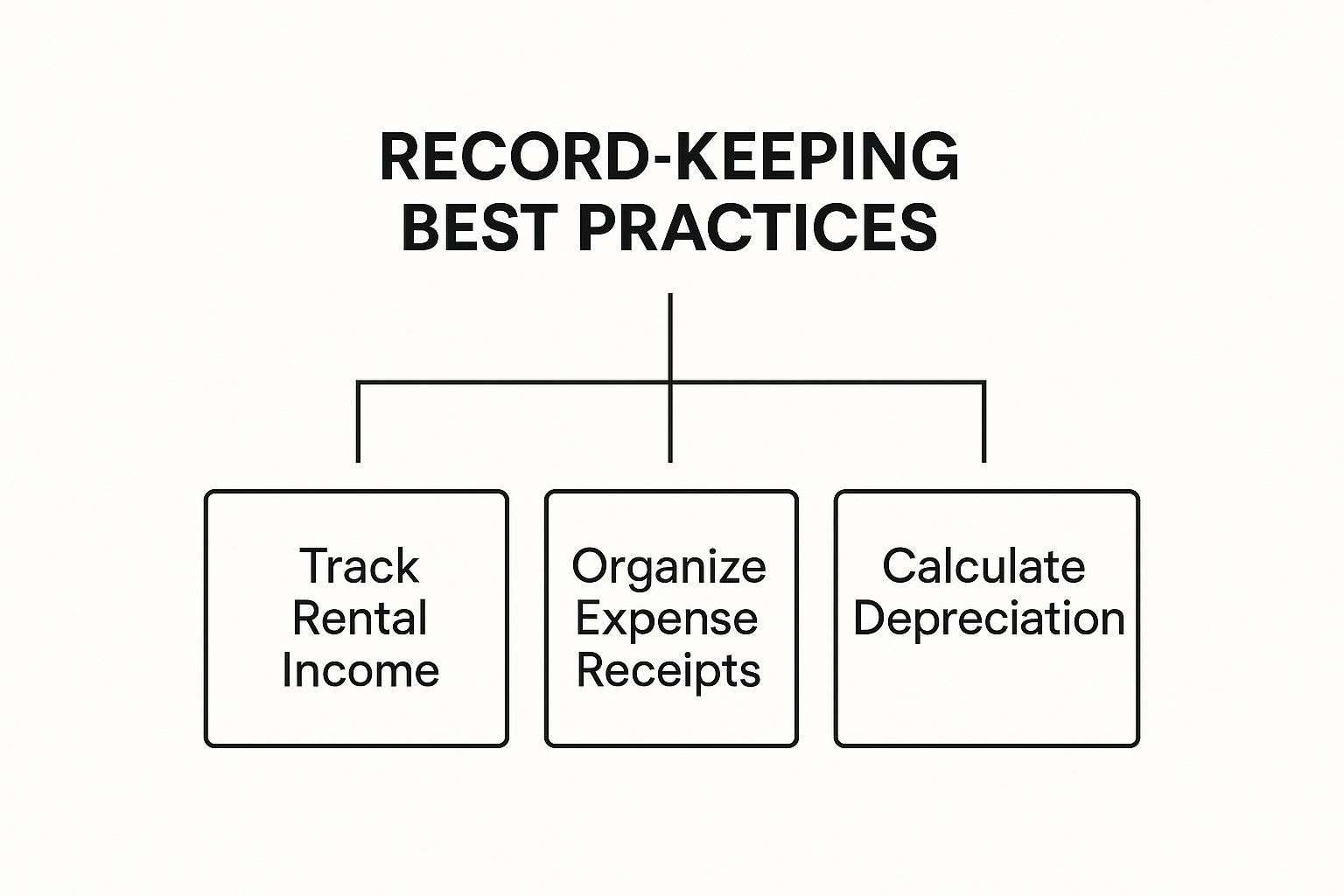
As the diagram shows, it all boils down to three foundational practices: tracking your income, organizing all your expenses, and correctly calculating depreciation. Master these, and you’ll be in a great position come tax time.
The Tax Advantage of Professional Property Management
Hiring a property manager isn't just about handing off the day-to-day work; it's a savvy financial decision that directly beefs up your bottom line. Think of it this way: every dollar you spend on professional management is a tax-deductible expense. That fee doesn't just disappear—it actively works to lower your taxable income, saving you real money come tax season.

For instance, our competitive 7.9% monthly management fee is completely deductible. The same goes for our clear-cut $750 tenant placement fee. These write-offs immediately reduce the true cost of our services, all while you get invaluable peace of mind and expert oversight for your property.
More Than Just a Fee Deduction
But the financial perks don't stop there. After serving the Inland Empire since 1997, we've built a solid network of trusted, affordable vendors in communities like Redlands, Yucaipa, and Loma Linda. This isn't just about convenience; it's about cost control.
First, you get access to reliable pros who get the job done right at a fair price, protecting your property's value from shoddy work and inflated invoices. Second, every bill for repairs and maintenance that we handle for you becomes a perfectly documented, deductible expense. No more hunting for receipts.
A professional property manager essentially becomes your financial record-keeper, turning a chaotic shoebox of receipts into organized, year-end statements that ensure you never miss a potential deduction.
This alone makes tax time infinitely less stressful. If you want to take it a step further, it's worth exploring the benefits of outsourcing your accounting and bookkeeping needs to truly get your financial house in order.
An Investment in Stability and Simplicity
Working with a seasoned manager who focuses exclusively on long-term rentals adds another critical layer of financial stability. Forget the wild income swings and high turnover of short-term rentals. Our approach is built on securing a consistent revenue stream with fewer vacancies, which simplifies your financial planning and forecasting.
At the end of the day, professional management pays for itself through greater efficiency, optimized maintenance costs, and, of course, those powerful rental property tax deductions. We are proud to serve landlords in Redlands, Beaumont, Calimesa, Yucaipa, Loma Linda, Mentone, Highland, and Banning, California.
Why Long-Term Rentals Offer a Tax Advantage
While short-term rentals often steal the spotlight, seasoned investors know that the classic, long-term rental model is the real powerhouse for building wealth and maximizing your tax benefits. The consistent income and low turnover of a long-term tenancy create a far more stable and predictable investment—a massive advantage when it comes to planning your finances and preparing for tax season.
This stability isn't just about reliable cash flow; it has a direct and powerful impact on your tax situation. The steady business activity from a long-term rental makes it much easier to prove material participation to the IRS. For some investors, this is the key that unlocks the ability to deduct rental losses against other income, a game-changing benefit.
Predictability and Simpler Deductions
Long-term rentals streamline the whole process of claiming rental property tax deductions. With tenants staying put for a year or more, you have fewer, more predictable expenses to keep track of. You can forget the constant churn of cleaning fees, restocking supplies, and relentless marketing that comes with short-term lets. Instead, your costs are focused on routine maintenance and straightforward management.
This predictable expense structure not only makes your record-keeping a breeze but also paves a clearer path to profitability. Your focus shifts from managing day-to-day operations to optimizing the long-term value of your investment.
This simplified approach is echoed in tax rules worldwide. Most developed countries tax rental income after allowing deductions for expenses like mortgage interest and property upkeep. However, many also slap on significant transaction taxes that can really hurt short-term investment strategies. For a deeper dive into these global trends, you can explore the full OECD report on housing taxation.
By focusing on long-term stability, investors in communities like Redlands and Beaumont can build a more resilient, profitable portfolio. If you're aiming for that kind of stability, it's essential to understand what makes a good rental property for this exact strategy.
Your Top Tax Questions Answered
When it comes to rental property taxes, a few key questions come up time and time again. Getting clear, straightforward answers is the first step toward managing your investment with confidence. Let's break down some of the most common tax situations landlords face and demystify the rules so you can keep more of your hard-earned money.
Can I Deduct Travel Expenses to My Rental Property?
Absolutely. If you’re traveling to your rental property, those costs are often deductible. The key is that the main reason for your trip must be to handle property-related business, like collecting rent, overseeing repairs, or performing maintenance.
This includes mileage if you use your own car, but it can also cover airfare and hotel stays for longer-distance trips. The non-negotiable part? Meticulous records. To satisfy the IRS, you need a detailed mileage log with the date, purpose, and miles driven for every single trip.
What Happens If My Rental Expenses Exceed My Income?
It’s not unusual, especially in the early years of ownership, for your expenses to be higher than your rental income. When this happens, you have what the IRS calls a "passive activity loss." Generally, you can't use this loss to offset income from your day job.
But that loss isn't gone for good. You can carry it forward to future years and use it to offset future rental profits. There are also some important exceptions to these rules, especially for investors who qualify as real estate professionals, which might allow for immediate deductions.
Are Property Management Fees Tax Deductible?
Yes, and this is one of the easiest and most valuable rental property tax deductions you can take. The fees you pay to a property management company are a direct business expense, making them 100% deductible in the year you pay them.
For example, our highly competitive 7.9% monthly management fee and straightforward $750 tenant placement fee are both fully deductible. We make it easy by providing you with clear, itemized monthly statements. This simple record-keeping turns our services into a powerful write-off that directly lowers your taxable income.
Can I Claim a Home Office Deduction?
This one is possible, but you have to follow the IRS rules to the letter. To qualify for a home office deduction, you must have a specific area of your home that you use exclusively and regularly for your rental business activities.
This could be a desk where you handle bookkeeping, screen tenants, or coordinate maintenance for your properties in areas like Redlands or Beaumont. The IRS offers a couple of ways to calculate the deduction, usually based on the square footage of your dedicated office space.
Maximizing your deductions while staying compliant is the cornerstone of a profitable rental investment. Since 1997, AIM PROPERTY MANAGEMENT COMPANY has been the go-to partner for landlords across Redlands, Beaumont, Calimesa, Yucaipa, Loma Linda, Mentone, Highland, and Banning. We focus on securing stable, long-term rentals and providing transparent financial reporting that makes tax season a breeze. Let our two-plus decades of experience start working for you. Visit us online at https://aim-properties.com to learn more about our services.