

Figuring out your rental income tax doesn't have to be a headache. The core idea is actually pretty simple: take your total rental income, subtract all your legitimate expenses, and what's left is your taxable income. This section will break down that process into real-world terms.
Your Guide to Calculating Rental Income Tax
Getting a handle on your tax obligations is one of the first things you need to do to maximize your investment returns. For landlords in communities like Redlands, Yucaipa, and Loma Linda, getting this right can turn tax season from a dreaded chore into a strategic financial opportunity.
While a rental income tax calculator is a powerful tool, it’s only as good as the numbers you put into it. This all starts with identifying every source of income beyond just the monthly rent. Did you collect any late fees or pet fees this year? Those count, too.
From there, you'll subtract every single deductible expense. A crucial part of this process is understanding how to calculate your rental yield, which gives you a clear picture of your property's true profitability before taxes ever enter the equation.
Why Long-Term Rentals Make Tax Time Easier
At AIM, we have been in business since 1997, providing experienced and mature relationships with the community. We've focused exclusively on long-term rentals (leases of six months or longer), and we do not deal with short-term rentals. It’s a strategy that offers significant advantages over the constant churn of short-term rentals, especially when it comes to taxes.
Here's what that long-term approach gives you:
- Consistent Income: Monthly rent provides a predictable, stable cash flow. That makes it much easier to forecast your annual income for tax purposes without any wild guesses.
- Lower Turnover Costs: With fewer tenant changes, you spend less on cleaning, marketing, and placement fees—all of which just add more complexity to your expense tracking.
- Simplified Tax Reporting: Long-term rentals typically avoid the complicated local transient occupancy taxes that often apply to short-term stays, saving you a major compliance headache.
This stability is exactly why we believe it's the superior investment model. The reality is, a rental income tax calculator is critical for property investors globally, especially in places where tax rules get complicated. For instance, rental income tax rates can swing wildly from 12.5% to 48% in popular European markets, with entirely different rules for short-term versus long-term rentals.
For property owners in areas like Redlands, Beaumont, Calimesa, Yucaipa, Loma Linda, Mentone, Highland, and Banning, California, a stable, long-term lease simplifies everything. You get reliable tenants, consistent income, and a much clearer path to calculating your year-end tax liability. This is the foundation of a sound investment strategy.
Unlock Tax Savings With Key Landlord Deductions

Many California landlords end up paying more in taxes than they need to, simply because they aren't aware of every write-off available. Getting a handle on these deductions is the key to making sure any rental income tax calculator gives you an accurate—and hopefully smaller—tax bill. It's about claiming every single deduction you rightfully deserve.
Of course, everyone knows about the big ones, like mortgage interest and property taxes. But beyond those basics, a whole world of deductible expenses can significantly lower your taxable income. Depending on how your rental business is structured, you might find even more opportunities. For instance, if you're operating as an LLC, this Ultimate Guide to Single Member LLC Tax Deductions is a fantastic resource for uncovering valuable write-offs.
Maximizing Deductions Beyond The Basics
To really get your tax situation optimized, you have to look at every single cost tied to owning and running your rental. These are the expenses that often slip through the cracks but can add up to a ton of savings over a year.
Think about these often-overlooked deductions:
- Insurance Premiums: This isn't just your standard landlord or hazard insurance. Any flood, fire, or liability policies you carry are on the list, too.
- Professional and Legal Fees: Did you pay a lawyer to draft your lease or an accountant for tax advice? Those professional fees are deductible.
- Travel Costs: If you have to drive to your rental property to collect rent, show the unit, or check on repairs, you can deduct the mileage. Just be sure to keep meticulous records.
One of the most powerful—and predictable—deductions you have is your property management fee. It’s a direct expense that comes right off your gross rental income, bringing your tax burden down with it.
Partnering with a professional manager not only frees up your time but also hands you a significant, consistent tax deduction. At AIM, our competitive 7.9% monthly management fee and straightforward $750 placement fee, with no other add-on fees, are fully deductible expenses that put money back in your pocket.
The Power Of Professional Management In Your Tax Strategy
Think of your management fee as an investment that pays you back in both time and tax savings. We've been serving communities like Redlands, Beaumont, and Yucaipa since 1997, so we know the local market inside and out. More importantly, we understand the kind of detailed financial reporting you need to make tax time a breeze.
Our long-term focus is a core part of how we operate. We only provide services for long-term leases of over 6 months or longer, which gives our clients stable, predictable income streams and simplifies their bookkeeping. We do not deal with short-term rentals, as their chaotic nature often leads to more frequent and unpredictable expenses, making deductions a nightmare to track.
With a long-term rental strategy, your deductible costs—like our management fee—become a stable, reliable part of your financial plan. This predictability helps you maximize your savings and build an audit-proof system for your investment. For a deeper dive, you can explore our complete guide to rental property tax deductions for more insights.
Here is a quick checklist to help you start thinking about all the potential write-offs for your property.
Common Landlord Deductions Checklist
| Expense Category | Description | Example |
|---|---|---|
| Mortgage Interest | Interest paid on the loan used to purchase or improve the rental property. | The interest portion of your monthly mortgage payment. |
| Property Taxes | State and local taxes paid on the property. | Your annual property tax bill from the county. |
| Insurance | Premiums for landlord, hazard, flood, and liability insurance. | The annual premium for your landlord insurance policy. |
| Repairs & Maintenance | Costs to keep the property in good working condition. | Fixing a leaky faucet, patching a hole in the wall, or hiring a plumber. |
| Professional Fees | Fees paid to lawyers, accountants, or property managers. | The monthly fee you pay to AIM Property Management. |
| Utilities | Costs for utilities paid by the landlord. | Water, sewer, trash, or electricity bills that are in your name. |
| Travel Expenses | The cost of traveling to your rental property for business purposes. | Mileage for driving to show the unit or oversee repairs. |
| Depreciation | The annual deduction for the wear and tear on the property itself. | A calculated amount based on the property's value and lifespan. |
| Advertising | Costs to market your vacant rental property. | Placing an online ad on a rental listing site. |
Keeping a detailed record of these expenses throughout the year is the best way to ensure you don't miss a single deduction when it's time to file.
Why Long-Term Rentals Win for Tax and Stability
When you own a rental property, one of the biggest forks in the road is deciding between short-term and long-term leases. It’s a choice that shapes everything—your profitability, your stress levels, and how complicated your tax season will be. While the high nightly rates of short-term rentals look tempting, they come with a rollercoaster of volatility and hidden headaches. A long-term strategy, on the other hand, is all about building a solid foundation for sustainable wealth.
This is exactly why, since our founding back in 1997, we've focused exclusively on long-term leases of six months or longer. For property owners in the communities we serve—Redlands, Beaumont, Calimesa, Yucaipa, Loma Linda, Mentone, Highland and Banning California—this approach creates a predictable income stream and makes financial planning infinitely simpler. You’re not left guessing what your occupancy will be next month; you have a signed lease agreement delivering consistent cash flow you can count on.
The Financial Edge of Stability
The biggest advantage of long-term rentals is financial consistency. A steady tenant paying rent every month means far fewer vacancies and a massive reduction in turnover costs. Think about it: you're not constantly paying for cleanings, marketing campaigns, and re-listing fees that chip away at the profits of a short-term rental.
That stability has a direct impact on your bottom line and makes tax calculations a breeze. Instead of trying to piece together income from dozens of short stays, you have one clean, annual income figure to work with. This predictability is absolutely essential for forecasting your finances and building a truly passive income source. You can dive deeper into the specific benefits in our comparison of short-term vs. long-term rentals in Redlands.
We're seeing a huge shift in the industry as investors get more serious about accurate financial modeling. The rise of digital rental income tax calculators shows a demand for precision, but these tools are only as reliable as the numbers you feed them. According to data from platforms like Stessa, roughly 60% of investors now use these calculators to project profitability. This trend highlights a growing awareness that solid tax forecasting is the cornerstone of any successful rental strategy, especially with tax rates being updated for 2025.
Long-Term vs. Short-Term Rentals: A Financial Comparison
To put it in perspective, let's break down the core financial and operational differences between these two strategies.
| Factor | Long-Term Rentals (6+ Months) | Short-Term Rentals |
|---|---|---|
| Income Stream | Consistent, predictable monthly payments. | Highly variable, seasonal, and dependent on tourism. |
| Vacancy Rate | Very low, often with zero vacancy between tenants. | High, with frequent gaps between guest stays. |
| Operating Costs | Lower; minimal marketing, cleaning, and turnover costs. | High; constant cleaning, restocking, and marketing fees. |
| Management Effort | Low; once a good tenant is placed, it's hands-off. | High; daily communication, check-ins, and scheduling. |
| Tax Complexity | Simple; straightforward income and expense tracking. | Complex; requires tracking transient taxes and fluctuating income. |
| Regulatory Risk | Low; follows standard landlord-tenant laws. | High; subject to strict city ordinances and zoning rules. |
As the table shows, while short-term rentals can offer higher potential gross income, the net profit is often eroded by higher costs and complexity. Long-term rentals provide a much clearer path to stable, predictable returns.
Avoiding Unnecessary Complexity
Beyond the numbers, long-term rentals help you steer clear of the operational and regulatory chaos tied to the short-term market. Many cities, including those in our service areas of Loma Linda and Highland, have slapped on specific regulations and transient occupancy taxes for short-term stays. This just creates another layer of compliance and paperwork that most investors would rather live without.
With a long-term lease, you sidestep these complex local tax laws. Your focus remains on maintaining a quality property for a reliable tenant, not on navigating the ever-changing rules of the vacation rental market.
This streamlined approach is at the very core of our management philosophy. We provide experienced, dedicated service to property owners in Mentone, Calimesa, and Banning, built on decades of community relationships. Our transparent fee structure—a low 7.9% monthly management fee and a single $750 placement fee with no hidden costs—is designed for the stability that only long-term rentals can provide. In our experience, this strategy has proven to be the smarter, more profitable path for building lasting real estate wealth.
A Practical Walkthrough of Your Tax Calculation
Theory is one thing, but seeing the numbers in action is where it really clicks. Let's run through a realistic scenario for a rental property in Redlands, CA, to show you just how much deductions can impact your bottom line. You can use this as a template for your own properties, whether they're in Banning, Calimesa, or Mentone.
Let's say you own a single-family home in Redlands that brings in a steady $2,800 per month.
- Annual Gross Rental Income: $2,800/month x 12 months = $33,600
This is your starting point—the total cash you collected before a single expense is factored in. Now, the goal is to legally and ethically shrink this number as much as possible.
Subtracting Your Key Operating Expenses
Next, we'll start chipping away at that gross income with all the predictable costs of owning and managing the property. For this example, we’ll use AIM Property Management’s straightforward fee structure as a baseline.
- Management Fees: At our competitive 7.9% rate, your annual fee comes out to $33,600 x 0.079 = $2,654.40.
- Tenant Placement Fee: If we placed one new tenant for you this year, that’s a flat $750 fee with no other add-on fees.
- Property Taxes: California’s effective property tax rate hovers around 0.70%. On a home valued at $500,000, that’s about $3,500 for the year.
- Landlord Insurance: A standard policy will likely run you about $1,200 annually.
- Repairs & Maintenance Budget: A smart rule of thumb is to budget 1% of the property value, so we'll set aside $5,000.
Tallying these up gives you a solid grasp of your major deductions. The better you know your property's financials, the more accurately you can project its long-term performance. If you want to dive even deeper, you can learn how to calculate the cap rate on your rental property with our detailed guide.
This infographic does a great job of breaking down the core differences between long-term and short-term rental strategies.
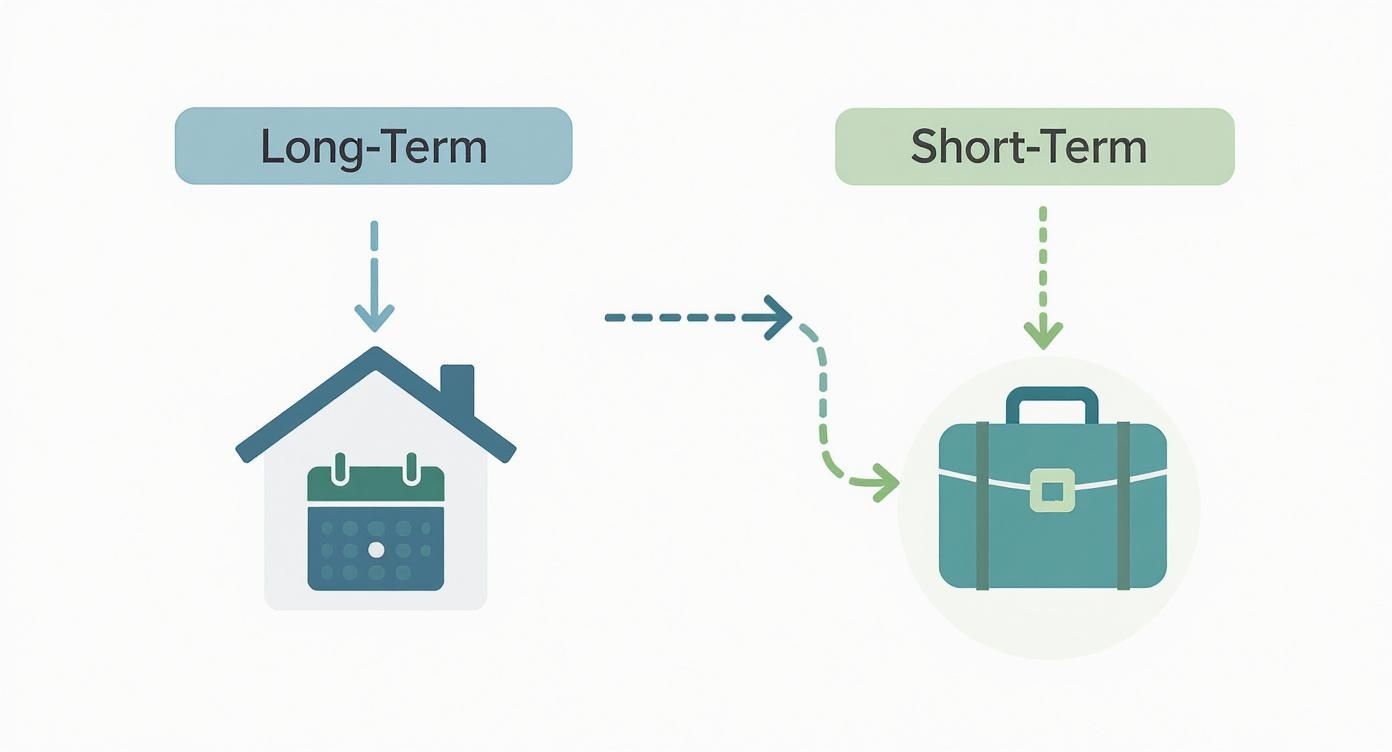
As you can see, the stability of a long-term lease makes tracking both your income and expenses far more predictable, which is a huge advantage when it's time to do your taxes.
Calculating Your Net Taxable Income
With all our numbers gathered, the final step is simple subtraction. We take our gross income and subtract the grand total of our itemized deductions.
Total Deductible Expenses:
$2,654.40 (Management) + $750 (Placement) + $3,500 (Taxes) + $1,200 (Insurance) + $5,000 (Repairs) = $13,104.40
Now, let's see what your income looks like to the IRS.
Net Taxable Income:
$33,600 (Gross Income) – $13,104.40 (Total Deductions) = $20,495.60
By diligently tracking every single expense—from our low 7.9% management fee to the annual property taxes—you’ve successfully cut your taxable income from $33,600 all the way down to $20,495.60. This is the real-world power of strategic expense management.
This same process can be applied to any long-term rental, giving you the financial clarity needed to invest wisely. It’s a method we’ve perfected since 1997, helping owners across Loma Linda, Yucaipa, and Highland by focusing exclusively on stable, long-term leases of six months or more. It’s the key to simplifying tax season and maximizing your returns.
How Expert Management Maximizes Your Returns
Effective property management is about so much more than just collecting rent—it's about optimizing your entire investment for long-term financial peace of mind. While a rental income tax calculator is a powerful tool, its output is only as good as the financial data you plug into it. This is where professional management becomes a true game-changer.
Experience is everything here. A firm like AIM, with deep roots in the Redlands, Beaumont, and Yucaipa communities since 1997, brings decades of boots-on-the-ground knowledge to your portfolio. Our transparent fee structure—a low 7.9% monthly management fee and a single $750 placement fee with no hidden costs—is designed to maximize your net income, not ours.
By focusing exclusively on stable, long-term rentals with leases of six months or more, we help you minimize vacancies and the operational stress that comes with short-term turnover. When you partner with a professional manager, you're not just freeing up your time; you're boosting your bottom line through expert tenant screening, compliance, and meticulous record-keeping. To optimize financial tracking and maximize the profitability of your rental portfolio, consider utilizing professional property business accounts services.
The Strategic Advantage of Local Expertise
A seasoned property manager provides an invaluable buffer between you and the day-to-day hassles of being a landlord. We've spent decades building relationships with trusted local contractors and the community, which means maintenance issues get handled efficiently and affordably. This local expertise is a huge advantage for owners in areas like Redlands, Beaumont, Calimesa, Yucaipa, Loma Linda, Mentone, Highland, and Banning California.
Choosing a manager with a proven track record is an investment in your property's profitability. Our focus on long-term stability ensures your income is consistent, making it easier to forecast tax liabilities and plan for the future.
This stable, long-term approach simplifies tax season dramatically. We provide detailed financial statements that clearly outline your income and deductible expenses, including our management fees. Accurate and organized records are non-negotiable for any property owner, and we handle that administrative burden for you. Learn more about how our dedicated team provides top-tier property management services tailored to your needs.
Common Questions About Rental Income Tax
Navigating the world of rental property taxes can bring up a lot of questions. As a landlord, getting a firm handle on your financial obligations isn't just about staying compliant—it's about making sure your investment is actually working for you. Let's walk through some of the most common questions we hear from California property owners.
Since 1997, we've helped countless owners in communities like Redlands, Yucaipa, and Loma Linda build profitable rental portfolios. One of the first things they ask is, "Can I really deduct my property management fees?"
The answer is a definite yes. Professional fees, including our low 7.9% monthly management fee and one-time $750 placement fee with no other add-on fees, are considered direct business expenses. They come right off your gross rental income, which in turn lowers your final tax bill.
Long-Term Leases And Tax Simplicity
Another point of confusion is how the lease term affects your taxes. Many investors wonder what the real financial difference is between long-term and short-term rentals.
At AIM, we only provide services for long-term leases of over 6 months or longer, and for good reason. We do not deal with short-term rentals. This strategy brings a level of clarity and simplicity to your tax prep that you just don't get with short-term rentals.
Here’s why it works so well:
- Predictable Income: A long-term lease provides a stable, consistent monthly income. This makes it incredibly easy to forecast your annual earnings without any guesswork.
- Simplified Expense Tracking: With fewer tenant turnovers, you have far fewer (and more predictable) expenses to track. Think less cleaning, marketing, and placement fees throughout the year.
- Avoids Complex Taxes: Long-term rentals typically steer clear of the local transient occupancy taxes that often apply to short-term or vacation rentals. Trust me, that’s a major compliance headache you want to avoid.
This focus on stability is a core part of how we serve owners in Redlands, Beaumont, Calimesa, Yucaipa, Loma Linda, Mentone, Highland and Banning California.
The biggest advantage of a long-term rental strategy is financial clarity. You get a steady, reliable income stream and a much simpler expense structure, which makes calculating your rental income tax far less stressful.
What About Property Taxes?
"How do property taxes fit into my rental tax calculation?" This is another crucial question we get all the time. Property taxes are a significant—and fully deductible—expense.
In California, the effective property tax rate averages around 0.70%. Depending on your property's value, that can easily amount to several thousand dollars a year.
This annual expense is one of the largest single deductions you can claim, so it's absolutely essential to include it in any rental income tax calculator you use. By meticulously tracking these and all your other expenses, you get the most accurate picture of your property's true profitability and ensure you’re not overpaying Uncle Sam.
Ready to simplify your landlord experience and maximize your returns? AIM PROPERTY MANAGEMENT COMPANY has been the trusted partner for property owners across the Inland Empire since 1997. Our low 7.9% management fee and dedicated focus on stable, long-term rentals are designed to protect your investment and give you peace of mind. Let our experience work for you. Learn more about our personalized services at https://aim-properties.com.