
You bought the rental for income and long-term appreciation. Then the operating side took over. A tenant texts after hours. A vendor misses an appointment. Rent comes in late. A small repair turns into a larger dispute because no one documented the first issue properly.
That's usually the point when owners start asking how to hire a property manager, not as a convenience, but as a capital allocation decision. If your time is better spent evaluating acquisitions, financing improvements, or protecting family wealth, daily property operations shouldn't keep pulling you back into reactive work.
For owners in Redlands, Beaumont, Calimesa, Yucaipa, Loma Linda, Mentone, Highland, and Banning, the decision is rarely about whether management matters. It's about choosing a manager with the systems, reporting discipline, and local judgment to protect income and reduce avoidable risk.
Is It Time to Hire a Property Manager
A familiar scenario plays out like this. An owner starts with one house and self-manages successfully enough. Then the portfolio grows to a few homes or a mix of single-family rentals and condos, and the friction changes. It's no longer just collecting rent. It's coordinating repairs, keeping records clean, responding consistently, and making sure every decision holds up under California rules.
That tipping point matters because self-management can hide its true cost. Owners often focus on the fee they're avoiding and ignore the opportunities they're missing. A day spent chasing a plumbing vendor or navigating a tenant conflict is a day not spent underwriting the next purchase or reviewing tax and estate strategy.
The scale of the industry tells you something important. The U.S. property management industry generated over $130 billion in annual revenue as of 2024, with 466,100 property, real estate, and community association managers employed in 2024, a median annual wage of $66,700, top earners above $141,000, and 4% projected growth through 2034 according to TenantCloud's property management industry overview. The same source notes that 80% of managers are involved in maintenance, rent collection, and inspections, which is exactly where many owners lose time and expose themselves to preventable problems.
The real tipping point
You're usually ready to hire when one or more of these are true:
- Your availability is inconsistent. Tenants and vendors need timely answers, even when you're traveling or focused on other business.
- Your holdings are becoming a business. A portfolio with multiple units, different property types, or different cities needs process, not improvisation.
- You want better records. Clean financials, inspection notes, lease documentation, and maintenance history matter when you refinance, sell, or defend a decision.
- You're thinking beyond cash flow. Professional management supports occupancy, tenant retention, and asset condition, which all affect exit value.
Practical rule: If your operating decisions are becoming reactive, your portfolio has already outgrown casual management.
For many high-income owners, the question isn't whether they can still self-manage. It's whether they should. If your broader planning includes trusts, liability structure, or succession, operations should align with that. This is also why owners who are planning estates with California property often tighten up management systems at the same time.
A good manager provides a distinct advantage. You keep control of the investment thesis and major decisions. The manager handles the execution, the communication cadence, and the operational follow-through. If you're weighing that move, this guide on when to hire a property manager is a useful next read.
Defining Your Property Management Needs
Before you interview anyone, define the job clearly. Most hiring mistakes happen before the first call. Owners often ask broad questions and get polished, broad answers back.
Start with your portfolio, not the manager. A manager who fits a single luxury home in Redlands may not be the right fit for a small group of condos in Yucaipa. The right operating model depends on property type, tenant profile, your risk tolerance, and how much authority you want to delegate.

Audit the asset before you audit the manager
Write down the basics first.
- Property mix: List each asset by type. Single-family homes, townhomes, and condos don't create the same maintenance pattern or tenant expectations.
- Location complexity: A home in Beaumont, a condo in Redlands, and a rental in Yucaipa may each require different vendor relationships and leasing judgment.
- Tenant profile: Long-term family tenants, professional tenants, and relocation tenants often expect different levels of communication and maintenance speed.
- Condition and deferred work: If the property needs active oversight, say so upfront. A lease-up assignment is different from steady-state management.
That exercise helps you avoid the most common mismatch. Some firms are built for volume. Others are built for tighter oversight and more detailed owner reporting. If your priorities aren't clear, you won't know which model you're buying.
Decide how hands-on you want to be
Many high-net-worth owners need to be honest. Some say they want “full service” and then want to approve every minor invoice. Others say they want control but disappear when decisions need to be made. Both approaches create friction.
Use this owner-side checklist:
| Decision area | What to decide now |
|---|---|
| Repairs | Do you want approval on every repair, or only above a set cap? |
| Communication | Do you want monthly reporting only, or updates on leasing, delinquency, and major maintenance as they happen? |
| Leasing | Are you comfortable delegating pricing and tenant placement recommendations? |
| Renewals | Do you want the manager to lead renewals and market adjustments, or bring options for approval? |
| Legal notices | Do you want the manager to handle compliance documents and coordination as part of the normal process? |
The clearer your answers, the easier it is to compare firms on substance rather than personality.
A lot of owners also benefit from reviewing the full scope of property management company responsibilities before they start interviews. It helps separate tasks that should be fully delegated from decisions that should remain with ownership.
Define success in owner terms
Don't stop at “I want less hassle.” That's too vague to manage.
Define what success looks like in practical terms:
- You want stronger tenant quality
- You want cleaner monthly reporting
- You want fewer surprise maintenance issues
- You want a manager who can operate without constant supervision
- You want better documentation for taxes, legal compliance, and long-term planning
These priorities matter in Property Management Beaumont, Beaumont property management, Yucaipa property management, property management Yucaipa, Redlands property management, and property management Redlands because the local market may be similar at a distance, but the operating details aren't.
A quick explainer can help sharpen your checklist before you start screening firms:
Owners who define the manager's authority, reporting expectations, and property priorities in advance almost always make better hiring decisions than owners who start with fees.
Interview Questions That Reveal True Competence
Most property manager interviews are too easy. The owner asks how long the firm has been in business, whether they handle maintenance, and how they screen tenants. Every candidate says yes, sounds confident, and promises good communication.
That tells you almost nothing.
A better interview forces the manager to describe process under pressure. You want operating detail, judgment, and local awareness. That's what separates a polished salesperson from a real operator.

According to the California-focused benchmark summary in this DRE-linked hiring methodology discussion, a structured hiring process matters. It notes that top PMs average 24 to 36 month tenant stays versus a 12-month industry norm, recommends a trial period with KPIs such as 95%+ on-time rent collection and less than 5% eviction rate, and states that properties with vetted managers using this method see 40% higher NOI and 25% lower vacancy. It also notes that local expertise can reduce compliance risk by 50% in markets such as Redlands.
Ask for play-by-play answers
These questions tend to surface real competence quickly.
Walk me through a 2 a.m. maintenance emergency.
A good answer includes intake, triage, vendor dispatch, tenant communication, documentation, and owner notification protocol. A weak answer stays vague and leans on “we handle it.”How do you respond when a tenant pays late and also reports a repair issue?
You're testing whether the manager can separate lease enforcement from habitability and service obligations.Describe your screening workflow from inquiry to approval.
You want sequence, standards, documentation, and consistency. Sloppy screening language usually predicts future problems.Tell me how you price a renewal in a changing market.
Strong managers discuss comparables, tenant stability, property condition, and owner objectives. Weak managers default to “we just raise it when we can.”What does your monthly owner report include?
If they can't answer crisply, reporting is probably an afterthought.
Listen for specifics, not confidence
Good property managers don't just say they communicate well. They explain when they contact the owner, what they document, and how decisions are recorded.
Look for answers that include:
- Document trail: notes, photos, invoices, inspection records, lease files
- Decision thresholds: when they act independently and when they escalate
- Tenant handling: clear boundaries without unnecessary escalation
- Local knowledge: practical familiarity with neighborhoods, vendors, and compliance habits
A manager who can't explain a process step by step usually doesn't have one.
Use scenario questions tied to your actual assets
This is especially important in Beaumont property management and property management Yucaipa. Ask questions that match the realities of your holdings.
For example:
| Scenario | What a strong answer should show |
|---|---|
| A vacancy in Beaumont sits longer than expected | Repricing logic, marketing adjustments, showing feedback review, and property-condition diagnosis |
| A Yucaipa tenant reports recurring plumbing issues | Repair history review, vendor coordination, root-cause thinking, and resident communication |
| A Redlands lease violation needs enforcement | Calm documentation, notice procedure, consistency, and owner briefing |
| A condo repair affects an HOA relationship | Boundary awareness, documentation, and coordination with association rules |
These questions matter because many firms can manage “rent collection” in the abstract. Fewer can explain how they'll manage your property in your market.
If you want a practical comparison framework before interviews, this guide on how to choose a property management company helps owners evaluate service depth, communication style, and operational fit.
Red flags that should shorten the list
Some answers should concern you immediately.
- They avoid specifics about screening.
- They can't describe reporting beyond basic income and expense totals.
- They talk about being available all the time but don't explain systems.
- They dismiss local differences between neighboring Inland Empire markets.
- They give legal-sounding answers without a documented process.
The best interviews feel less like sales and more like operational reviews. That's what you want. If you're trusting someone with income, compliance, tenant relations, and asset condition, the conversation should sound like management, not marketing.
Vetting Finalists and Verifying Credentials
A strong interview gets a candidate onto the shortlist. It does not earn them the business.
Final vetting protects owners from preventable loss. At this stage, you verify the promises, inspect the systems, and confirm that the manager can do what they said they do. In practice, this is the stage many owners rush. It's also the stage that most often separates a reliable hire from a costly one.
The technical benchmarks in this SmartMove discussion of hiring a property manager are useful because they force specificity. It recommends requiring credit score standards above 650 and 3x rent-to-income verification for tenant screening, asks owners to demand automated monthly statements and expense caps of $300 to $500 per incident, and suggests 24/7 emergency response under 2 hours. That same source states rigorous screening can cut bad debt by 65%, proactive maintenance can reduce repair costs by 30% to 40%, and unverified licenses or weak local knowledge can contribute to a 15% to 20% NOI loss.
What to verify before signing
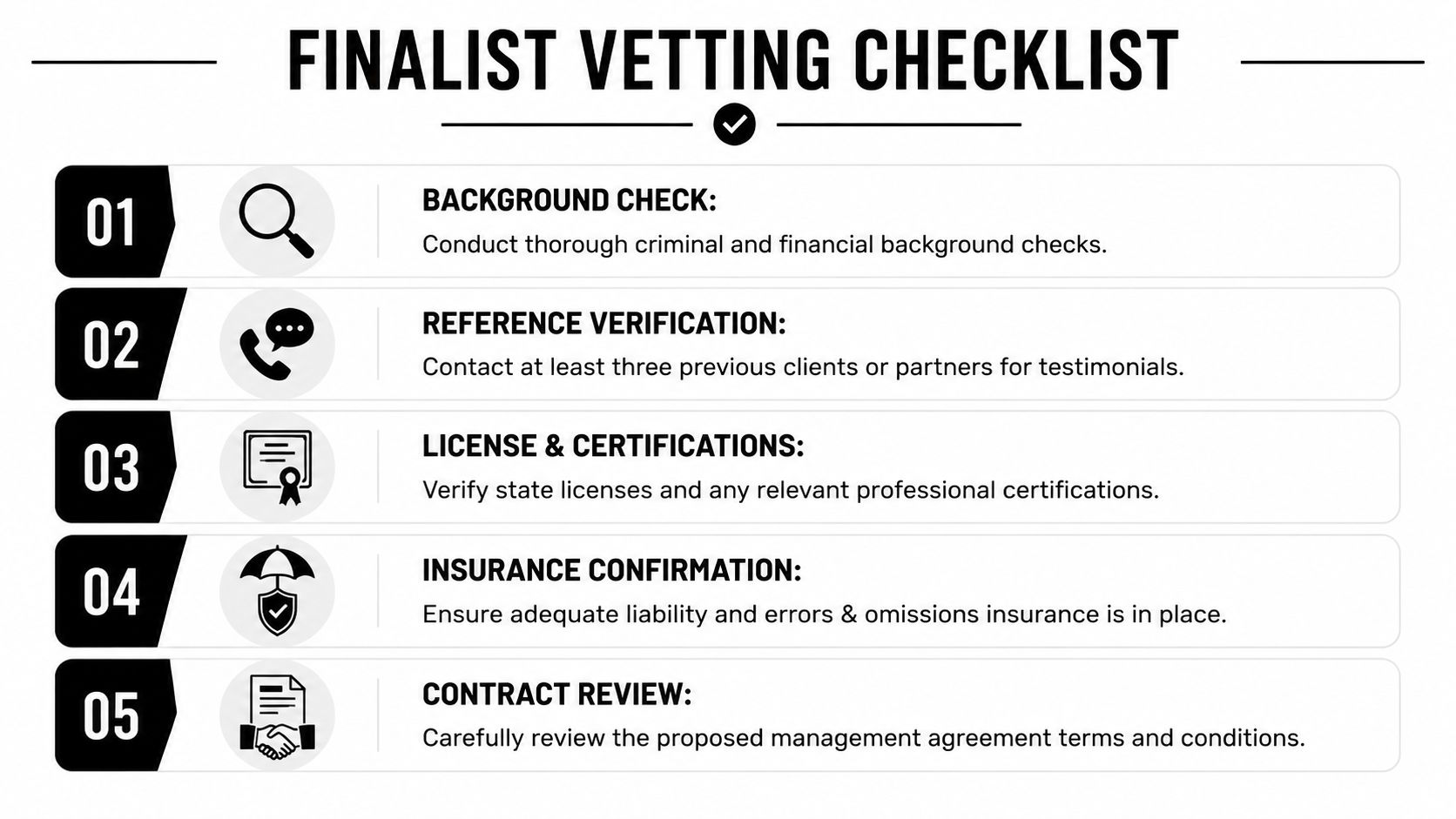
Use a finalist checklist that covers documents, references, and operating proof.
- License status: Verify the manager's real estate license directly through the California DRE.
- Insurance: Ask for proof of E&O coverage and general liability coverage.
- Owner references: Speak with current clients, not just the handpicked easiest ones.
- Former clients: If possible, ask why they left. The answer often reveals more than a current testimonial.
- Sample reporting: Review a real monthly statement, owner ledger, and inspection sample.
- Maintenance protocol: Ask how emergency calls are triaged, dispatched, and documented.
- Screening standards: Confirm written screening criteria and whether they're applied consistently.
The logic is straightforward. If a firm resists documentation, they are asking you to trust a system you haven't seen.
Reference calls should be structured
Don't ask, “Do you like them?” Ask operational questions.
Try these instead:
- How quickly do they communicate during a repair issue?
- Are monthly statements easy to understand?
- Do they escalate problems early or after they've grown?
- Have there been surprise charges or vague invoices?
- Would you hire them again for a newly acquired property?
For owners who already think carefully about contractors and construction risk, the mindset is similar to the CozyCube advice on vetting builders. Different industry, same principle. Trust should follow verification, not replace it.
Owner safeguard: A sample report tells you more than a polished pitch deck. If the financials are hard to read now, they won't become clearer after you sign.
Review the documents they actually use
Ask to see documents tied to execution, not marketing.
A serious review includes:
| Document | What to look for |
|---|---|
| Monthly statement | Clear income, expenses, reserve balance, and readable coding |
| Inspection report | Photos, condition notes, follow-up actions, and consistency |
| Management agreement | Authority limits, termination rights, repair approval terms |
| Screening criteria | Written standards, income verification, credit approach |
| Maintenance invoice workflow | Approval path, documentation, and vendor transparency |
For owners comparing Property Management Beaumont, Beaumont property management, Yucaipa property management, property management Yucaipa, Redlands property management, and property management Redlands providers, this stage matters more than branding. The manager with cleaner systems usually produces cleaner outcomes.
Decoding Fee Structures and Contract Terms
The management fee only tells part of the story. Owners who focus on the headline percentage and ignore the agreement usually end up paying for confusion later.
The better approach is to study incentives. You want a fee structure and contract that reward occupancy, tenant stability, fast issue resolution, and disciplined reporting. You do not want a structure that creates revenue for the manager every time friction appears.
Read fees in the context of performance
A lower monthly fee can still be expensive if the manager allows longer vacancies, weak screening, poor follow-up, or slow maintenance coordination. A higher fee can be reasonable if the operating results are documented and the service level matches your risk profile.
That's why KPI visibility matters. This Reedy & Company article discussing the 2025 NARPM report says top-performing managers average 28 days time-to-rent versus 45+ for others, maintain eviction rates below 2%, and can produce 15% to 20% higher net yields, largely due to 30% faster maintenance resolution. It also notes that many managers still fail to track these metrics well, which is exactly why owners should ask for them before signing.
If you're comparing proposals, don't just ask what the manager charges. Ask what they measure.
Contract terms that deserve close attention
The management agreement should answer these questions clearly:
- Termination rights: Can you exit cleanly if service is poor?
- Authority to spend: What repairs can the manager approve without calling you?
- Leasing charges: How are lease-up work, renewals, and vacancy-related tasks handled?
- Reserve requirements: How much cash stays on hand for repairs and recurring expenses?
- Reporting cadence: When do statements arrive, and what detail is included?
- Vendor billing: Is there transparency around third-party repair invoices?
- Security deposit handling: Is the process clearly documented and segregated?
A contract should reduce ambiguity. If it relies on “industry standard” language without spelling out owner rights and manager duties, revise it.
Watch for misaligned incentives
Not every fee is unreasonable. But every fee should be understandable.
A useful way to review a proposal is this:
| Contract item | Healthy version | Concerning version |
|---|---|---|
| Repair authority | Clear owner approval threshold | Open-ended discretion |
| Reporting | Defined monthly statements and backup detail | Generic “reports available upon request” |
| Termination | Reasonable notice and clean file transfer | Punitive exit language |
| Leasing scope | Specific marketing and screening duties | Vague promise to “fill the unit” |
| Owner communication | Defined escalation rules | No stated standard |
For owners who want a practical breakdown of common billing models and owner protections, this overview of property management fee structure is worth reviewing alongside any proposal.
One practical note on providers. Some firms, including AIM Property Management Company, offer owner reporting, tenant screening, rent collection, maintenance coordination, and inspection workflows under one operating system. That can work well if the reporting is transparent and the authority limits are clearly defined in the agreement. The point isn't the branding. It's whether the system gives you oversight without forcing you back into daily management.
If a manager can't explain how they get paid in plain English, assume the contract will favor them more than it favors you.
The Unmatched Value of Local Expertise in Beaumont and Yucaipa
A manager can understand property management in general and still miss what matters on a specific street, in a specific submarket, with a specific tenant pool. That gap shows up in pricing, vendor choice, leasing strategy, and how quickly small issues are resolved before they become expensive ones.
Inland Empire owners feel this most when they compare broad regional operators with firms that know the local rhythm of Beaumont and Yucaipa. The difference isn't theoretical. It changes how a property gets shown, how repairs get coordinated, and how renewals are handled.

Why local knowledge changes execution
In Property Management Beaumont and Beaumont property management, local expertise helps a manager judge rental positioning more accurately. They know which areas attract stable long-term tenants, how nearby development affects demand, and when a vacancy issue is pricing versus presentation versus property condition.
In Yucaipa property management and property management Yucaipa, the operating details shift. Tenant expectations can differ. Vendor networks matter differently. The right manager understands how to market the property to the tenant most likely to stay, not just the first qualified applicant.
That same principle applies to Redlands property management and property management Redlands. A manager with local operating experience usually knows when to push rent, when to prioritize retention, and which maintenance vendors reliably show up and finish correctly.
Local expertise is risk control, not just convenience
Owners sometimes treat local knowledge as a soft benefit. It isn't. It affects hard outcomes.
A local manager is more likely to:
- Price with nuance instead of broad averages
- Use vendors who know the area and respond reliably
- Recognize neighborhood-specific leasing objections quickly
- Handle inspections and turnover with fewer delays
- Spot compliance and communication issues before they escalate
That matters even more for owners who don't live near the asset. Distance creates blind spots. Local management closes them.
A focused service page for Beaumont property management support can be useful when you want to compare what a market-specific manager should know about leasing, maintenance coordination, and owner reporting in that city.
The manager closest to the property usually sees trouble sooner. In this business, earlier intervention protects both income and asset condition.
Frequently Asked Questions About Hiring a Property Manager
How do I know when to hire a property manager instead of self-managing
Hire a property manager when the operating burden starts pulling you away from higher-value work, when consistent tenant communication becomes harder to maintain, or when compliance and documentation need a more disciplined system. For many owners, the shift happens when one property becomes several, or when one “simple” rental starts demanding professional processes.
What should I ask before I hire a property manager
Ask about screening standards, maintenance response process, financial reporting, communication cadence, repair approval limits, and how they handle lease enforcement. Then ask for proof. A sample monthly statement, inspection report, and management agreement tell you more than broad promises do.
What matters more, fees or local experience
Both matter, but local experience often drives the result that makes the fee worthwhile. A manager who understands Beaumont, Yucaipa, Redlands, Highland, Loma Linda, Calimesa, Mentone, and Banning at the operating level is more likely to price correctly, retain tenants, and resolve issues efficiently.
How do I compare property management near me without getting distracted by sales language
Use the same scorecard for every firm. Compare screening process, reporting quality, repair protocols, local vendor depth, contract clarity, and responsiveness during the hiring process. If you search for property management near me, don't choose based on convenience alone. Choose based on whether the manager runs a repeatable system you can verify.
Should I look for a manager who specializes in my property type
Yes. Single-family homes, condos, and townhomes create different leasing patterns, maintenance needs, and owner communication issues. The right fit is rarely the firm that says yes to everything. It's the firm that can explain how they handle your specific type of asset.
What's the biggest mistake owners make when hiring
They confuse friendliness with operational strength. Good relationships matter, but this is still an asset management decision. If the manager can't show process, reporting, and documented standards, the relationship usually becomes expensive later.
If you're evaluating whether to hand off day-to-day operations, AIM PROPERTY MANAGEMENT COMPANY provides residential property management for owners in Redlands, Beaumont, Calimesa, Yucaipa, Loma Linda, Highland, Banning, and nearby communities, including tenant screening, rent collection, maintenance coordination, inspections, and compliance support. The right next step is simple. Compare your current operating burden against the manager's actual systems, documents, and local execution standards, then choose the firm that protects income and reduces risk with the least friction.