
You bought a condo in Redlands, Yucaipa, or Beaumont because it looked manageable. One roof. Shared exterior maintenance. Predictable HOA dues. Then you decide to rent it out, and the cost picture gets murky fast.
Now you're looking at HOA dues, building rules, a rental management proposal, a leasing fee, maybe a renewal fee, and a maintenance policy that reads like it was written for lawyers. That's the moment most condo owners start asking the right question: what will this really cost me, all in?
Condo property management fees are rarely just one line item. In the Inland Empire, especially in communities like Loma Linda, Highland, Calimesa, Mentone, and Banning, condo owners often deal with two operating layers at the same time: the association handles the common areas, and a separate manager handles the rental unit itself. If you miss that distinction, your cash flow projections can be off before the first tenant moves in.
Understanding Your Total Cost of Condo Ownership
A condo owner in the Inland Empire usually starts with the obvious monthly expense: HOA dues. Those dues help cover the building's shared obligations, but they don't replace rental management for your individual unit.
That's where the confusion starts. An owner may assume the association already “manages the property,” then realize that tenant screening, lease administration, maintenance coordination inside the unit, rent collection, notices, and communication with the resident fall on a separate rental manager. Those are two different jobs with two different fee structures.
For tax planning, many owners also ask how HOA-related costs are treated once a condo becomes a rental. A useful starting point is this guide on deducting HOA fees, which helps frame the issue before you talk with your tax professional.
Practical rule: Condo ownership is simpler physically, but not always simpler financially. Shared maintenance reduces some owner headaches, yet it often adds another layer to the budget.
That matters in places where investors expect a condo to be the “easy” rental. In practice, condos can be easier to maintain on the exterior and harder to manage operationally because the owner has to work within HOA rules, approved vendor processes, parking rules, move-in procedures, and resident-use restrictions.
Owners who budget well usually separate costs into three buckets:
- Association costs tied to the building and common areas
- Rental management costs tied to the tenant and the unit
- Incident-based costs tied to turnover, repairs, paperwork, and special handling
If you're comparing options in property management Redlands or property management Beaumont, that full picture matters more than the headline monthly rate.
The Two Main Property Management Fee Structures
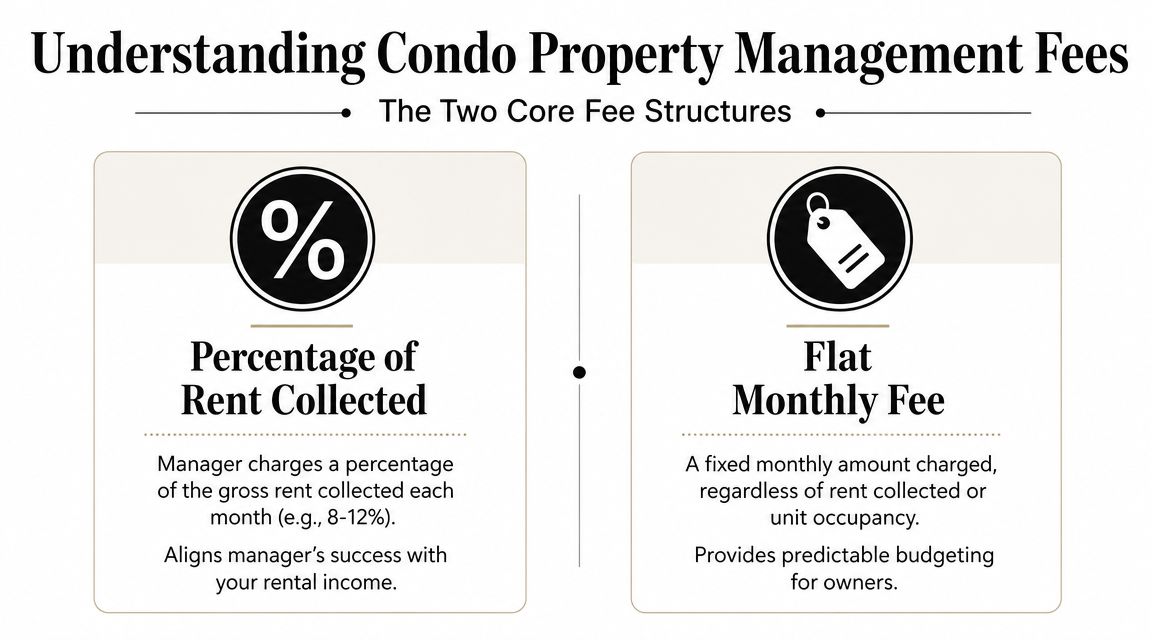
Most rental management agreements for condos use one of two pricing models. One is standard. The other sounds simple, but it needs closer inspection.
Percentage of collected rent
This is the model most owners will see first. The widely cited U.S. benchmark for residential rental management is 8% to 12% of gross monthly rent, and the fee is typically calculated on collected rent rather than scheduled rent. A commonly cited example is a $2,200 condo rental at a 10% rate, which would equal $220 per month in management fees, according to LeaseRunner's property management cost guide.
That structure exists for a reason. It ties the manager's compensation to actual collections rather than the rent number printed on the lease. If the unit sits vacant or collections slip, the manager doesn't get paid as if everything went perfectly.
From an owner's perspective, percentage pricing usually works best when you want incentives aligned around occupancy, tenant retention, and follow-through on collections.
Flat monthly fee
A flat fee charges the same amount each month regardless of rent level. Some owners like it because budgeting feels cleaner. If your condo rents for more than expected, the management company's base fee doesn't rise with the rent.
The trade-off is incentive design. A flat fee can still work well with a strong manager, but it doesn't automatically tie compensation to the unit's income performance the way a percentage model does. It also raises a practical question: what happens during vacancy, delinquency, or heavy service months?
A flat fee isn't automatically cheaper. It's only cheaper if the service scope is clear and the extras don't pile up.
Which model works better for condo investors
For most individually owned Inland Empire condos, percentage pricing is easier to compare because the market has settled around it. Flat-fee proposals need more scrutiny because two companies can quote the same monthly amount while including very different levels of service.
When owners compare proposals, I usually suggest looking at these points first:
- What triggers the fee. Is it collected rent, scheduled rent, or a fixed monthly amount?
- What's included. Does the base charge include routine coordination, statements, notices, and tenant communication?
- How vacancy is handled. Some contracts become much more expensive during turns.
If you want to see how one local company explains these moving parts, review this breakdown of property management fee structure.
For owners searching property management Yucaipa or Redlands property management, the best contract usually isn't the one with the lowest first number. It's the one you can underwrite without guessing.
A Complete Breakdown of Common Service Fees
The monthly management fee is only one part of the agreement. Most condo owners spend more money on the transaction points around the tenancy than they expect, especially at move-in, renewal, and turnover.
Industry guidance notes that leasing or tenant-placement fees often equal 50% to 100% of one month's rent, lease-renewal fees are commonly $100 to $350, and some contracts also include setup fees. That's why owners need to compare the full fee schedule, not just the monthly percentage, as explained in MRI Software's breakdown of residential rental management fees.
What each fee is really paying for
A leasing fee covers the work required to get the unit occupied. That often includes listing setup, showing coordination, application handling, screening, lease preparation, move-in documentation, and communication with the HOA when the building requires registration or scheduling.
A renewal fee pays for a smaller but still real workload. Lease updates, notice timing, rent-change documentation, compliance review, and signatures all take time. On condos, renewals can also involve confirming that building rules, parking information, and occupancy details are still accurate.
Setup fees are usually administrative. That can mean onboarding the owner, entering the unit into software, collecting association documents, logging vendor contacts, and organizing property-specific notes.
Standard Condo Management Fee Schedule
| Fee Type | Typical Cost (Inland Empire) | What It Covers |
|---|---|---|
| Monthly management fee | Often follows the standard residential percentage model | Ongoing rent collection, tenant communication, coordination, and routine administration |
| Leasing or tenant-placement fee | 50% to 100% of one month's rent | Marketing, showings, application processing, screening, lease preparation, move-in coordination |
| Lease-renewal fee | $100 to $350 | Renewal documents, updated terms, signatures, timing, and recordkeeping |
| Setup fee | Varies by company | Initial onboarding, account setup, property file creation, and administrative intake |
For a more owner-facing explanation of how these charges fit together, this guide on property management services cost demystified is worth reviewing.
What works and what doesn't
What works is a clean fee sheet that tells you exactly which events create charges. You should be able to tell, before signing, what happens when a tenant moves in, renews, pays late, requests repairs, or moves out.
What doesn't work is a proposal that advertises one low monthly number and leaves the important fees to an attached schedule you're expected to notice on page six.
A solid condo management agreement should answer basic operational questions without forcing you to infer them:
- Turnover handling means who pays for leasing activity and when.
- Renewal process means whether the manager proactively handles timing and documents.
- Administrative scope means whether routine owner and tenant support is bundled or billed in pieces.
If you can't map the fee schedule to the life cycle of a tenancy, you still don't know what the service costs.
That's especially true for condo investors, because the leasing process often involves more coordination than a detached home. Building access, key pickup, parking rules, pet restrictions, move scheduling, and HOA forms create more touchpoints, and every one of those touchpoints can show up in pricing somewhere.
Watch Out for These Hidden Management Charges
A low headline rate can be the most expensive proposal on your desk.

That sounds backward until you see how some contracts handle maintenance, claims, and exceptions. One neutral industry source notes that hidden add-ons can materially change your total cost. Maintenance markups can add 10% to 20% on vendor invoices, and some companies charge separately for insurance-claim handling, with one source noting those fees may reach 10% of the claim, according to Condo Control's discussion of average condo management company costs.
The fine print that changes your real cost
The most common hidden charge is the maintenance markup. A manager hires the vendor, supervises the work, and then adds a percentage to the invoice. Sometimes that's disclosed clearly. Sometimes it's buried in language about “project coordination” or “vendor administration.”
Insurance-claim work is another surprise item. Condo claims can be messy because responsibility may be split among the owner, tenant, HOA, and master policy. When the manager has to document damage, coordinate access, communicate with adjusters, and track repairs, some companies bill that time separately.
Here's a practical explainer on questions owners should ask when estimating how much it is to hire a property manager.
Questions to ask before you sign
Use plain language. If a manager can't answer these directly, keep digging.
- Do you mark up maintenance invoices or charge a coordination fee?
- Who handles insurance claims, and is that included in the base fee?
- Are after-hours issues billed separately?
- Do you charge for notices, inspections, or vendor access appointments?
- Is there a difference between routine maintenance and larger project oversight?
This short video is useful if you want a simple owner-level overview before comparing contracts:
What transparent pricing looks like
Transparent pricing doesn't mean every fee disappears. It means the company states, in writing, what's included, what's extra, and how extra charges are calculated.
That matters for condo owners in Yucaipa property management and Beaumont property management searches because condo operations create more exceptions than people expect. Entry coordination, HOA communication, and shared-building repair questions can all consume time. If the contract doesn't tell you who pays for that time, assume it may show up later.
California Legal and Compliance Fee Considerations
California changes the math on management. The paperwork burden is heavier, the compliance risk is higher, and mistakes are more expensive.
A cheap manager can cost more than an expensive one if they mishandle notices, screening practices, trust accounting, entry documentation, security deposit issues, or lease enforcement. Condo ownership adds another layer because the manager also has to work around association rules, building procedures, and shared-space obligations.
Why condo complexity raises management costs
For condominium associations, management fees commonly run 5% to 10% of the budget, and the main drivers are service scope and operating complexity. More amenities, higher maintenance demands, and responsibilities such as tenant coordination and emergency response raise the fee because they increase labor, vendor oversight, and compliance risk, as discussed by Merlin Law Group's review of condominium property management fees.
Even if you're hiring a manager only for your individual unit, those same complexity drivers still affect the work. A condo rental isn't just a lease. It's a lease inside a governed environment.
Examples of added friction include:
- Association procedures for keys, fobs, parking, and move scheduling
- Rule enforcement overlap between your lease and HOA restrictions
- Emergency coordination when the source of damage may involve neighboring units or common areas
Compliance is part of the service, not an extra luxury
Owners sometimes ask why condo management feels more administrative than single-family management. The answer is simple. There are more parties involved, more documents, and more chances for a bad handoff.
That shows up clearly with deposits and move-out handling. California owners should understand the rules before outsourcing the process. This summary of tenant security deposit laws is a useful reference when evaluating whether a manager has a compliant process.
The right manager isn't charging only for phone calls and rent collection. They're charging to keep routine issues from becoming legal problems.
If you own in Redlands property management or Highland-area rentals, legal competence is part of the fee discussion. It's not fluff. It's risk control.
Your Checklist for Comparing Management Proposals
Most owners compare proposals the wrong way. They put three monthly percentages side by side and assume the lowest one wins.
That shortcut misses the biggest issue in condo ownership: you may be paying both the building-level cost structure and the unit-level rental management cost structure. Association management fees commonly run 5% to 10% of total assessments or budget, which is separate from the fee for managing your individual rental unit, as explained by FirstService Residential's article on property management costs and value.
Use this checklist line by line
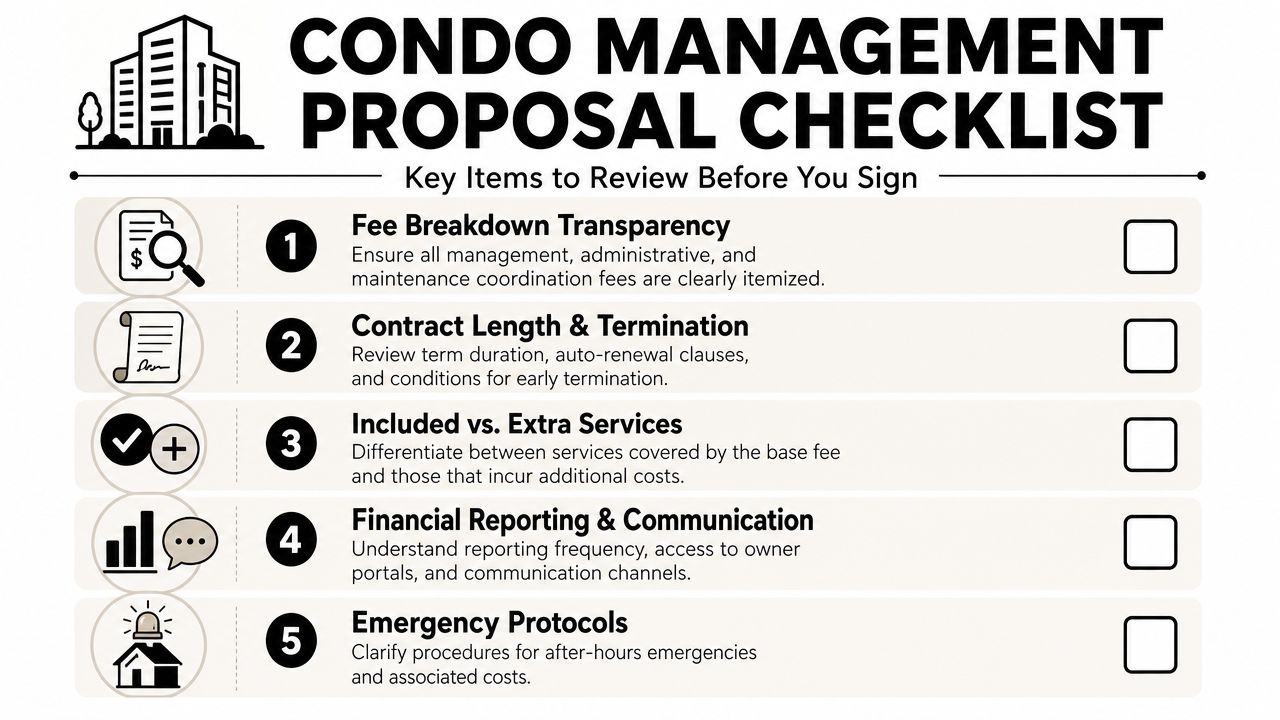
Print the proposals or put them side by side on one screen. Then verify each of these items.
Monthly fee basis
Is the charge tied to collected rent, scheduled rent, or a flat monthly amount?Leasing fee treatment
Is tenant placement included, partially included, or billed as a separate event?Renewal handling
Does the company charge at renewal, and what work is included in that charge?Maintenance billing
Ask whether vendor invoices are passed through at cost or subject to markup or coordination fees.Setup and onboarding
Check whether there's an upfront administrative fee before the property is even marketed.
Review the contract, not just the quote
The quote is the sales summary. The management agreement is the actual price sheet.
Read for these practical issues:
Termination language
If you leave mid-lease, does the company keep collecting, or is there a cancellation charge?Communication expectations
Owners with high-income careers often want concise reporting and quick escalation on larger issues. Make sure the company's process matches that need.Emergency authority
A condo leak can affect neighboring units fast. The agreement should explain what the manager can approve without waiting.HOA interaction
Ask whether the manager handles association notices, registration requirements, and tenant-facing rule communication.
If you're comparing options for property management near me, use a company-selection framework like this guide on how to choose a property management company.
Owner test: If two proposals can't be compared without a phone call to decode hidden terms, neither proposal is clear enough yet.
What a strong proposal feels like
A strong proposal is boring in the best way. The fee basis is plain. Event charges are listed. Authority limits are clear. Maintenance billing is easy to understand. HOA interaction isn't hand-waved.
That's what lets an owner compare Beaumont property management, property management Yucaipa, and property management Redlands options on an apples-to-apples basis instead of buying based on the lowest teaser number.
Local Expertise and Frequently Asked Questions
Local condo management is less about buzzwords and more about knowing how Inland Empire rentals operate. A manager working in Beaumont and Yucaipa needs to understand rent positioning, vendor responsiveness, HOA communication styles, inspection follow-through, and what owners expect from reporting and oversight.
For Property Management Beaumont, the practical issue is usually consistency. Owners want stable rent collection, fast repair coordination, and a manager who can keep the tenancy moving without creating noise. For Beaumont property management, that means understanding both investor expectations and the day-to-day reality of local service vendors.
For Yucaipa property management, the biggest advantage is local familiarity with neighborhood differences and owner goals. Some condo investors want minimal involvement. Others want approval on every repair. Good property management Yucaipa service adapts to that operating style while keeping the lease, communication, and records organized.
One local option is AIM PROPERTY MANAGEMENT COMPANY, which states that it manages individually owned condominiums, townhomes, single-family homes, and other residential investment properties in communities including Beaumont, Yucaipa, Redlands, Banning, Loma Linda, Highland, and Calimesa.
Frequently Asked Questions
| Question | Answer |
|---|---|
| Should I hire a property manager for one condo? | If you want professional handling of leasing, rent collection, maintenance coordination, notices, and tenant communication, one condo can still justify management. The decision usually comes down to time, risk tolerance, and how hands-on you want to be. |
| Why do condo fees feel higher than single-family management? | A condo often involves more coordination. The manager may need to work around HOA rules, access procedures, parking restrictions, common-area responsibilities, and neighbor-related issues. |
| What should I ask when searching for property management near me? | Ask for the complete fee schedule, not just the monthly rate. Then ask how they handle maintenance billing, leasing, renewals, HOA communication, emergencies, and contract termination. |
| Is Redlands property management different from other Inland Empire markets? | The fundamentals are the same, but local inventory mix, owner expectations, and HOA culture can change the day-to-day management approach. That's why local market familiarity matters. |
| What's the biggest mistake owners make before they hire a property manager? | They compare only the base monthly fee. The better approach is to review the all-in cost across the life of a tenancy, especially turnover, renewals, maintenance handling, and HOA coordination. |
If you own a condo in Redlands, Beaumont, Calimesa, Yucaipa, Loma Linda, Mentone, Highland, or Banning and want a straight answer on the actual cost of management, talk with AIM PROPERTY MANAGEMENT COMPANY . A useful first conversation should cover your HOA setup, rental goals, expected service level, and the full fee schedule so you can decide with clear numbers and no surprises.