

Hiring a property manager in California typically costs 8% to 12% of monthly rent, plus a one-time leasing fee, and the full annual cost often lands around $2,000 to $3,000 per single-family home depending on what's included. If you're trying to figure out how much is it to hire a property manager, the monthly percentage is only the starting point.
Most owners I talk to in Redlands, Beaumont, Yucaipa, and the surrounding Inland Empire already know the headline number. What they usually don't know is where the actual money goes after that. Leasing fees, renewal fees, inspection charges, eviction handling, and maintenance markups are what separate a reasonable management agreement from an expensive one.
If you're managing your own rental while also juggling work, family, and everything else, you've probably felt the pressure already. The tenant texts after dinner. The repair call comes on a weekend. Rent shows up late. A lease term is ending and you're trying to decide whether to renew, raise rent, or relist the home. That's the moment when hiring help stops sounding like a luxury and starts looking like basic risk control.
Is Hiring a Property Manager Really Worth The Cost
You get home from work, sit down for dinner, and your phone lights up. The tenant says there's a maintenance issue and wants an answer tonight. You've still got paperwork on the kitchen counter, a full inbox, and no time to call vendors, coordinate access, document the issue, and make sure you don't create a fair housing or habitability problem by handling it poorly.
That's where most self-managing landlords in the Inland Empire hit the wall. It's not just the time. It's the interruption, the liability, and the constant decision fatigue.

A property manager isn't just someone who collects rent. A competent manager screens tenants, handles maintenance coordination, documents lease issues, keeps communication professional, and protects your time. That matters whether you own one condo in Loma Linda or several single-family homes across Beaumont and Yucaipa.
Cost matters, but stress has a price too
Owners often focus on the monthly management fee because it's visible. The hidden cost of self-management is harder to see. It shows up in rushed tenant placement, delayed maintenance, weak documentation, and vacancies that stretch longer than they should.
If you're marketing a vacant unit, even presentation tools can affect how quickly a listing gets attention. One useful resource for owners and managers is automated furniture placement for vacant units, which can help vacant homes look more livable in online listings without physically staging the property.
Practical rule: If your rental interrupts your job, your evenings, or your weekends on a regular basis, you're already paying for management. You're just paying with time and risk instead of a line item.
The real question owners should ask
The smart question isn't “Can I avoid the fee?” It's “What am I getting for the total cost, and does it improve my net result?”
That's the right lens for owners who want cleaner operations, fewer surprises, and more predictable rental income. If you're weighing that decision right now, this guide on whether you should hire a property manager is a useful next step.
The Two Main Property Management Fee Structures
Most management agreements fall into two buckets: Percentage of rent or flat monthly fee. If you don't understand that difference, it's hard to compare companies accurately.
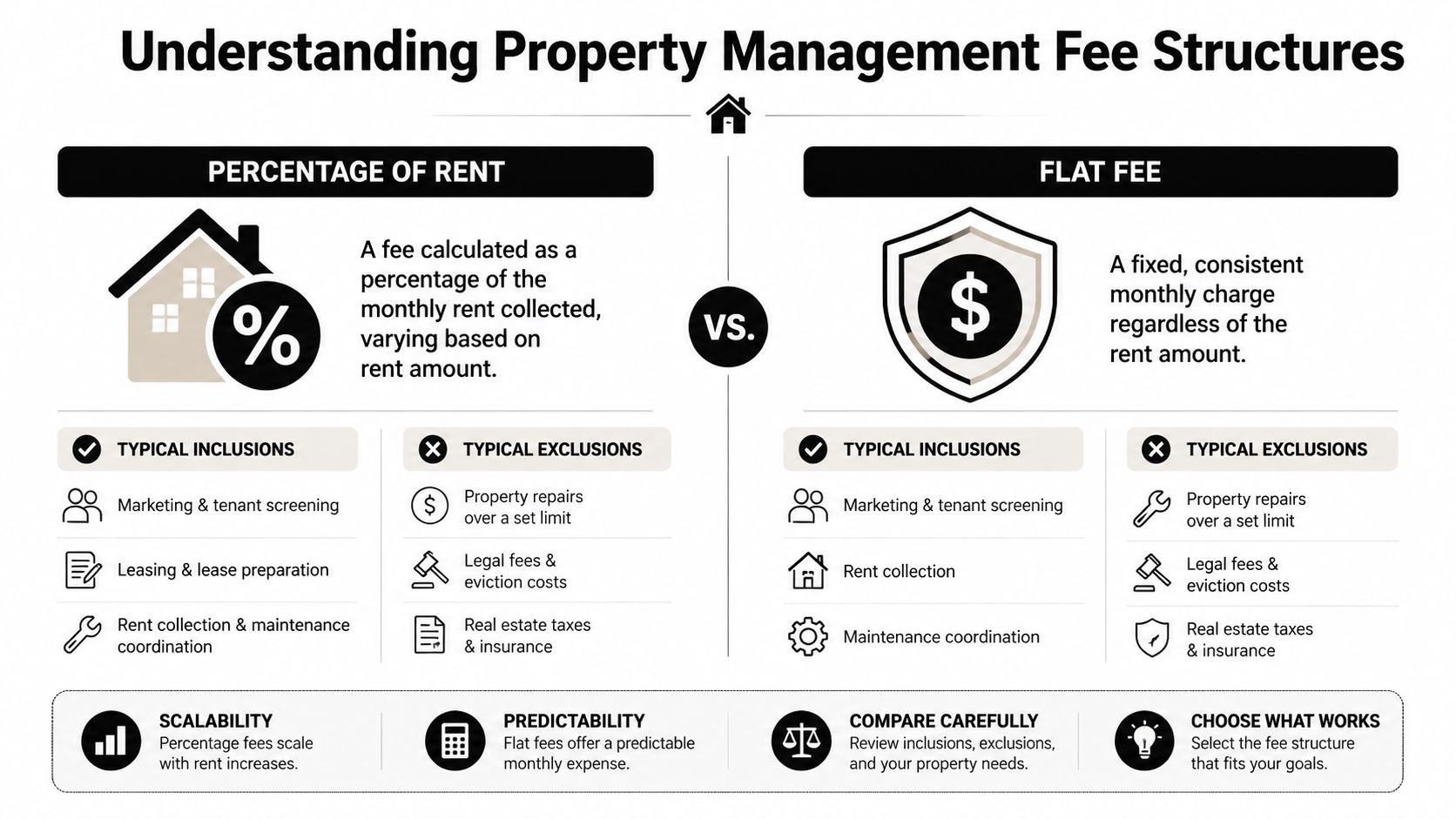
Percentage of rent
This is the standard model in California, including Property Management Beaumont, Yucaipa property management, and property management Redlands. Property management companies in California typically charge 8% to 12% of collected monthly rent, and on a $2,000 monthly rent property, that works out to $160 to $240 per month according to LeaseRunner's breakdown of property manager pricing.
This structure makes sense for one simple reason. It aligns incentives.
When the manager earns a percentage of collected rent, they care about occupancy, rent collection, and keeping income flowing. If the property sits vacant, everyone feels it. If market rent increases, the fee scales without forcing awkward renegotiation every time the lease changes.
Flat fee
A flat fee is more like putting someone on salary. The amount doesn't move much even if rent rises or market conditions change. In some situations, that predictability appeals to owners, especially for lower-rent properties or straightforward condos.
The problem is incentive. If the manager gets the same fee regardless of rent performance, the motivation to maximize revenue can weaken. That doesn't mean every flat-fee manager performs poorly. It means the structure itself doesn't naturally tie their compensation to your income.
A simple way to think about it
Think of it like this:
| Fee model | How it works | Owner upside | Owner risk |
|---|---|---|---|
| Percentage-based | Fee rises and falls with rent collected | Better alignment with occupancy and rent growth | Monthly cost varies with rent |
| Flat fee | Same monthly amount regardless of rent | Predictable budgeting | Less built-in motivation to push revenue |
For Beaumont property management and Redlands property management clients, I generally prefer the percentage model for full-service management. It fits the actual nature of the job. Leasing, rent collection, vendor coordination, and tenant issues don't happen in a perfectly fixed pattern every month.
A manager paid on collected rent has a built-in reason to keep your property occupied and your rent on time.
Which structure should you choose
Use a flat fee only if the contract is extremely clear about what's included and you're confident the service level won't drop once the agreement is signed.
For most owners trying to hire a property manager in the Inland Empire, percentage-based pricing is the cleaner choice. It usually reflects a full-service relationship more accurately. If you want to compare common setups in plain English, review this breakdown of property management fee structure options.
Deconstructing The Full Cost A Comprehensive Fee Breakdown
The monthly management fee gets the attention. The add-ons decide whether the deal is fair.
Across high-demand California markets, hiring a property manager typically costs 7% to 12% of monthly rent collected, plus leasing fees of 50% to 100% of one month's rent. On a $2,000 per month rental, a 10% monthly fee is $200, and a 75% leasing fee adds $1,500 when a tenant is placed. Total annual costs often average $2,000 to $3,000 per single-family home, based on this cost analysis of property management pricing.
That's why owners need to stop asking only, “What's your monthly fee?” and start asking, “What's the full cost if I hire you for a year?”
Monthly management fee
This is the core charge. It usually covers rent collection, routine communication, coordination with tenants, owner reporting, and day-to-day management.
For owners in property management Yucaipa and property management Redlands markets, this fee is only one part of the agreement. If the company quotes a low monthly percentage, look harder at every other line item before you assume it's a better deal.
Leasing or tenant placement fee
This is the big one. Many owners underestimate it.
The leasing fee usually covers:
- Marketing the property: Listing setup, photos, and showing coordination
- Screening applicants: Background checks, credit review, and income verification
- Preparing the lease: Drafting documents and handling signing
- Move-in setup: Getting the tenant onboarded and the file complete
If your property turns over often, this fee can matter as much as the monthly management percentage.
Lease renewal fee
Some firms charge when the tenant renews. That can be reasonable if they're renegotiating terms, preparing updated paperwork, and handling compliance properly. It can also be junk pricing if they're charging for a quick signature and little else.
Ask one direct question: What exactly happens during renewal that justifies the fee?
Setup fee
Some companies charge an onboarding fee when you first sign. That may cover file setup, document collection, and account activation.
A setup fee isn't automatically a problem. It becomes a problem when it's paired with high leasing fees, renewal fees, and maintenance markups. Then you're paying at every stage of the relationship.
Annual inspections
Regular inspections matter because they catch problems while they're still manageable. They also create a record of property condition and tenant compliance.
Owners should want inspections. What they shouldn't accept is vagueness. Ask how often inspections occur, what's documented, and whether the report includes photos and recommendations.
Maintenance markups
This is one of the most important cost categories because it changes your operating expenses.
A company may coordinate repairs through vendors and then add a markup to the invoice. If you don't ask about this upfront, you may not notice the impact until months later when your maintenance costs feel oddly heavy.
If a manager makes money every time a repair is ordered, you need to know that before you sign.
Vacancy-related charges
Some managers charge while the property is vacant. Others handle vacancy within the leasing fee structure. The key issue isn't whether a vacancy charge exists. It's whether the contract makes it easy to understand when that charge starts, stops, and what work it covers.
A vacant home in Beaumont or Yucaipa still needs oversight. Someone may be checking on condition, coordinating cleaning, or prepping the unit for showings. That work has value. The contract just needs to define it clearly.
Eviction handling
Eviction fees can be painful because they show up at the worst possible moment. If a tenant stops paying or violates the lease, you need clean documentation and proper process.
Don't assume eviction support is included. Ask whether notices, court coordination, and document handling are billed separately. A cheap management agreement can get expensive fast once tenant conflict enters the picture.
What to ask before comparing companies
Use this shortlist:
- Ask for a fee schedule: Every charge should be listed in writing
- Ask about maintenance markups: This can change your real ROI
- Ask about vacancy handling: Know what happens between tenants
- Ask about renewals and inspections: Don't leave these undefined
- Ask for first-year and ongoing-year estimates: Those are rarely the same
For owners who want to compare fees against actual service categories, this guide to property management costs and services is worth reviewing before you sign anything.
Local Pricing Examples Redlands Beaumont and Yucaipa
Numbers become useful when they look like your actual property.
The challenge is that local rents vary by home type, neighborhood, condition, and upgrades. So instead of pretending every house in Redlands, Beaumont, or Yucaipa rents for the same amount, I recommend using a simple range-based model that mirrors what owners face.
A practical Inland Empire cost table
The table below uses the verified California pricing ranges already covered above. For local rent assumptions, I'm using the $2,200 to $2,800 range identified for Inland Empire single-family homes in the verified data. This gives you a realistic framework for estimating first-year cost.
| City | Avg. Monthly Rent | Annual Management Fee | One-Time Leasing Fee | Estimated Total First-Year Cost |
|---|---|---|---|---|
| Redlands | $2,800 | $2,688 to $4,032 | $1,400 to $2,800 | $4,088 to $7,332 |
| Beaumont | $2,200 | $2,112 to $3,168 | $1,100 to $2,200 | $3,512 to $6,468 |
| Yucaipa | $2,500 | $2,400 to $3,600 | $1,250 to $2,500 | $3,950 to $6,400 |
These figures use the California monthly management range of 8% to 12%, plus leasing fees of 50% to 100% of one month's rent. They're estimates, not quotes, but they're much closer to reality than asking only about a monthly percentage.
What these examples tell you
For a Beaumont property management client, the spread between low-end and high-end first-year cost is meaningful. The same is true in the Yucaipa property management market. If one company looks cheap on the monthly fee but expensive on tenant placement and maintenance coordination, your actual annual cost can jump fast.
That's why local owners should compare the total operating model, not just the advertising headline.
Local reading of the numbers
- Redlands property management: Higher rents usually mean the percentage fee produces a higher dollar amount, even if the percentage itself looks normal.
- Property Management Beaumont: Lower rent than Redlands can reduce the management fee in raw dollars, but turnover and add-on fees still matter.
- Property management Yucaipa: Mid-range rental pricing means structure matters more than sticker price. A cleaner contract often beats a slightly lower percentage.
The cheapest-looking fee schedule often stops looking cheap once the first vacancy, renewal, and maintenance invoice come through.
Where owners make mistakes
The common mistake is comparing one company's monthly fee to another company's all-in cost. That's not a real comparison.
If you own a rental in Beaumont and want a market-specific starting point, review local Beaumont property management services and compare how fees are framed. Then ask every company to translate their pricing into a first-year total, not just a monthly rate.
Calculating Your ROI Beyond The Monthly Fee
If you only look at management as an expense, you'll make bad decisions.
The right question is whether the fee improves your net result after vacancy, repairs, tenant quality, and admin time are factored in. That's how experienced owners evaluate property operations.

The first-year trap
A lot of owners get frustrated because the first year usually costs more than the steady-state year. That's normal. Leasing fees, setup costs, inspections, and turnover-related charges tend to hit earlier.
Verified pricing data shows total annual costs beyond monthly fees can include leasing at 50% to 100% of one month's rent, renewals at $150 to $300, inspections at $100 to $200, and maintenance markups of 2% to 10%. First-year costs for a typical rental can hit $4,330 with tenant placement, and a firm with a no-maintenance-markup model can save owners 15% to 20% versus statewide averages, according to HomeRiver's property management cost breakdown.
That last point matters more than most owners realize. A low headline fee with recurring maintenance markups can undercut cash flow.
The break-even view
Here's the clean way to think about return:
- Better tenant placement can reduce the odds of nonpayment, damage, and costly turnover.
- Faster maintenance coordination can stop small issues from becoming larger repairs.
- Consistent rent collection and documentation can reduce friction and strengthen enforcement when problems arise.
- Renewal handling can keep good tenants in place and avoid another vacancy cycle.
You don't need a flashy spreadsheet to see the point. If management reduces one bad turnover, one poorly handled repair, or one avoidable compliance problem, the fee often stops looking expensive.
Owner test: Don't ask whether management costs money. Ask whether poor management, delayed decisions, or self-management mistakes cost you more.
What improves cash flow in practice
For Inland Empire owners, the biggest ROI levers are usually operational, not theoretical:
| ROI lever | Why it matters |
|---|---|
| Tenant screening | Better applicants reduce payment issues and lease violations |
| Maintenance process | Faster response lowers damage risk and tenant frustration |
| Inspection discipline | Problems get caught before they become larger expenses |
| Fee transparency | Clear pricing protects your operating margin |
One market reality I pay close attention to is maintenance markup. That's where owners lose margin without noticing. A clean fee structure is often more valuable than a slightly lower monthly rate.
For example, AIM PROPERTY MANAGEMENT COMPANY publicly discusses cash flow considerations and operational cost control, including a no-maintenance-markup approach that can materially change year-end owner returns when compared with firms that layer fees into vendor work.
A smarter way to judge value
Watch this before you judge the fee on percentage alone:
A property manager earns their keep when they tighten operations. Not when they send a nice monthly statement. Owners in Redlands, Beaumont, and Yucaipa should judge management by what it does to vacancy exposure, repair quality, documentation, and stress.
Critical Contract Terms to Scrutinize Before You Sign
A management agreement can look fine at a glance and still cost you later. Read the contract like an owner, not like a hopeful customer.
Termination clause
This is the first thing I'd check.
Can you leave the agreement without a fight if service slips? Is there a notice period? Is there an early termination charge? If the manager makes it easy to sign and hard to leave, that tells you something about how they expect the relationship to go.
Maintenance approval limits
You need to know how much the manager can spend without asking you first. If that threshold is too high, you may lose control over expenses. If it's too low, every small repair creates delay.
The right number depends on your tolerance and your property, but the clause needs to be clear. “As needed” is not clear.
Fee language
Don't settle for summaries. Look for every possible charge in the contract itself.
Review these items carefully:
- Leasing fee language: Confirm when it's earned and whether it applies at every turnover
- Renewal terms: Check whether a renewal triggers a separate charge
- Inspection charges: Make sure frequency and billing are spelled out
- Eviction support: Confirm what's included and what gets billed separately
Rent collection and reserve requirements
Some agreements require the owner to keep a reserve balance on file. That isn't unusual. What matters is how that reserve is used and when the manager can replenish it.
Also check what happens if rent isn't collected. Does the company still charge the monthly management fee? Is the fee based on rent due or rent collected? That distinction matters.
Read the section on fees, maintenance authority, and exit rights twice. Those three areas decide whether a contract feels manageable or expensive.
Renewal and contract length
Long contracts aren't automatically bad. Automatic renewals without clear notice requirements can be.
If you're trying to hire a property manager, insist on plain contract language. A reputable company shouldn't need fine print to make the economics work.
Frequently Asked Questions About Hiring a Manager
When should I hire a property manager
Hire a property manager when the rental starts taking attention away from your job, family, or other investments. If tenant communication, maintenance coordination, lease enforcement, or compliance issues keep landing on your plate at the wrong time, you've outgrown self-management.
Does professional management make sense for one property
Yes, it can. One property can still create late-night maintenance calls, rent collection issues, vacancy stress, and legal exposure. A single rental isn't simple if the tenant situation goes sideways.
How do I compare property management near me
Don't compare companies on the monthly fee alone. Compare the full fee schedule, maintenance markup policy, leasing charges, communication standards, inspection process, and contract exit terms. If you search for “property management near me,” start by eliminating any company that won't give you clear written pricing.
How do I know if a company is a good fit for Beaumont, Yucaipa, or Redlands
Ask how they handle local leasing pace, maintenance coordination, inspections, and tenant placement for homes like yours. Property Management Beaumont, property management Yucaipa, and property management Redlands all require local familiarity with rental expectations, vendors, and neighborhood-specific demand.
What's the biggest mistake owners make when they hire a property manager
They chase the lowest monthly percentage and ignore the rest of the contract. That's how owners end up paying more in leasing fees, repair markups, and avoidable extras.
Your Partner in Profitability Contact AIM Properties Today
If you've made it this far, the answer is simple. Hiring a property manager isn't cheap, but unmanaged or poorly managed rentals are usually more expensive.
The owners who do best treat management as an operating decision. They look at total cost, contract clarity, maintenance policy, tenant placement quality, and how much personal bandwidth the rental is consuming. That's the right standard whether you own in Redlands, Beaumont, Yucaipa, Banning, Calimesa, Loma Linda, Highland, or Mentone.
If you want straight answers, ask for a full annual cost view. Ask how leasing is priced, how repairs are handled, whether there's a maintenance markup, and what happens if you want to terminate the agreement. Those questions will tell you more than any sales pitch.
And if you're ready to hire a property manager, do it before the next vacancy, late payment issue, or emergency repair forces the decision for you. Calm decisions are almost always better than rushed ones.
If you own a rental in Redlands, Beaumont, Calimesa, Yucaipa, Loma Linda, Mentone, Highland, or Banning and want a clear breakdown of what management would cost for your property, contact AIM PROPERTY MANAGEMENT COMPANY . Ask for a personalized rental analysis, a written fee schedule, and a direct explanation of what's included so you can make the decision with real numbers instead of guesses.