
When you own a rental property, you're not just a landlord—you're running a business. And like any successful business, your foundation is built on smart accounting and tax solutions. This isn't just about tedious paperwork; it’s about turning your obligations into real opportunities to maximize your returns. For landlords in California, this means shifting from simply keeping records to actively managing your finances.
Building a Profitable Rental Business in California
Think of your rental property's finances like the dashboard of a car. You wouldn't drive blind, right? Without clear gauges showing your income, expenses, and cash flow, that's exactly what you're doing. Good accounting gives you that dashboard, offering a clear, real-time view of your investment's health. This empowers you, whether your property is in Redlands, Beaumont, Calimesa, Yucaipa, Loma Linda, Mentone, Highland, or Banning, to make smarter, data-driven decisions that actually boost your bottom line.
The goal here is to move beyond just tracking transactions and start building a real financial strategy. It’s about understanding not just where your money is going, but how every dollar you spend affects your tax liability and your overall return on investment.
From Reactive to Proactive Financial Management
Too many landlords fall into a reactive cycle—paying a surprise repair bill here, scrambling for receipts at tax time there. A proactive approach flips that script. It’s about anticipating these events and having solid systems in place to handle them without breaking a sweat.
This looks like:
- Consistent Income Tracking: Logging every single rent payment, late fee, or pet fee the moment it comes in, not just when you get around to checking the bank statement.
- Detailed Expense Categorization: Knowing the crucial difference between a simple repair (which you can deduct now) and a major improvement (which gets depreciated over time). This distinction is a big deal for your taxes.
- Regular Financial Reviews: Taking a look at your monthly reports to spot trends, get a handle on costs, and make accurate forecasts about how your property will perform.
A well-managed financial system does more than just get you ready for tax season; it puts you in the driver's seat of your investment, steering it toward greater growth and stability. When you treat your property in Loma Linda or Banning like the business it is, you unlock its true potential.
In a fast-growing market like Beaumont property management, having these systems isn't just a good idea—it's essential. The global property management market is expected to jump from USD 24.01 billion in 2025 to a staggering USD 52.99 billion by 2033. This explosion highlights just how critical precise accounting is for handling things like rent collection and financial reporting—services that experts can deliver seamlessly. You can dig into more of these market insights over at Technavio.com.
At AIM Property Management, we bake these crucial services right into our management for owners across Redlands, Beaumont, Calimesa, Yucaipa, Loma Linda, Mentone, Highland, and Banning. We take the tangled web of California's tax laws and turn it into a clear roadmap for your success, helping you understand and improve your rental property cash flow. Our approach makes sure you stay compliant while building a more profitable and sustainable rental business for the long haul.
The Landlord's Ledger: Keeping Meticulous Records
Think of your record-keeping system as the official storybook of your rental property's financial life. Every single transaction, from a rent check deposited in Beaumont to a receipt for a new faucet in Yucaipa, is a crucial chapter in that story. Meticulous records are the bedrock of sound accounting and tax solutions, giving you the concrete proof you need to maximize deductions and stay on the right side of the law.
The first, non-negotiable step is to get your finances separated. Open a dedicated bank account and credit card just for your rental property. Commingling funds—mixing your personal and business money—is one of the fastest ways to create an accounting nightmare, making it nearly impossible to see how your property is truly performing.
This simple act of separation creates a clean, auditable trail that will save you countless hours and headaches when tax season rolls around. It’s the difference between a shoebox full of mixed receipts and a clear, professional ledger.
The Anatomy of a Bulletproof Financial Record System
To build a complete financial picture, you need to track several key types of documents. Each one serves a specific purpose, from proving the income you’ve earned to justifying every single expense you claim. Dropping the ball in any of these areas can lead to costly mistakes down the road.
A well-organized system ensures every financial event is captured and categorized correctly. This simple flow shows how solid record-keeping leads directly to effective management and, ultimately, to better profitability.
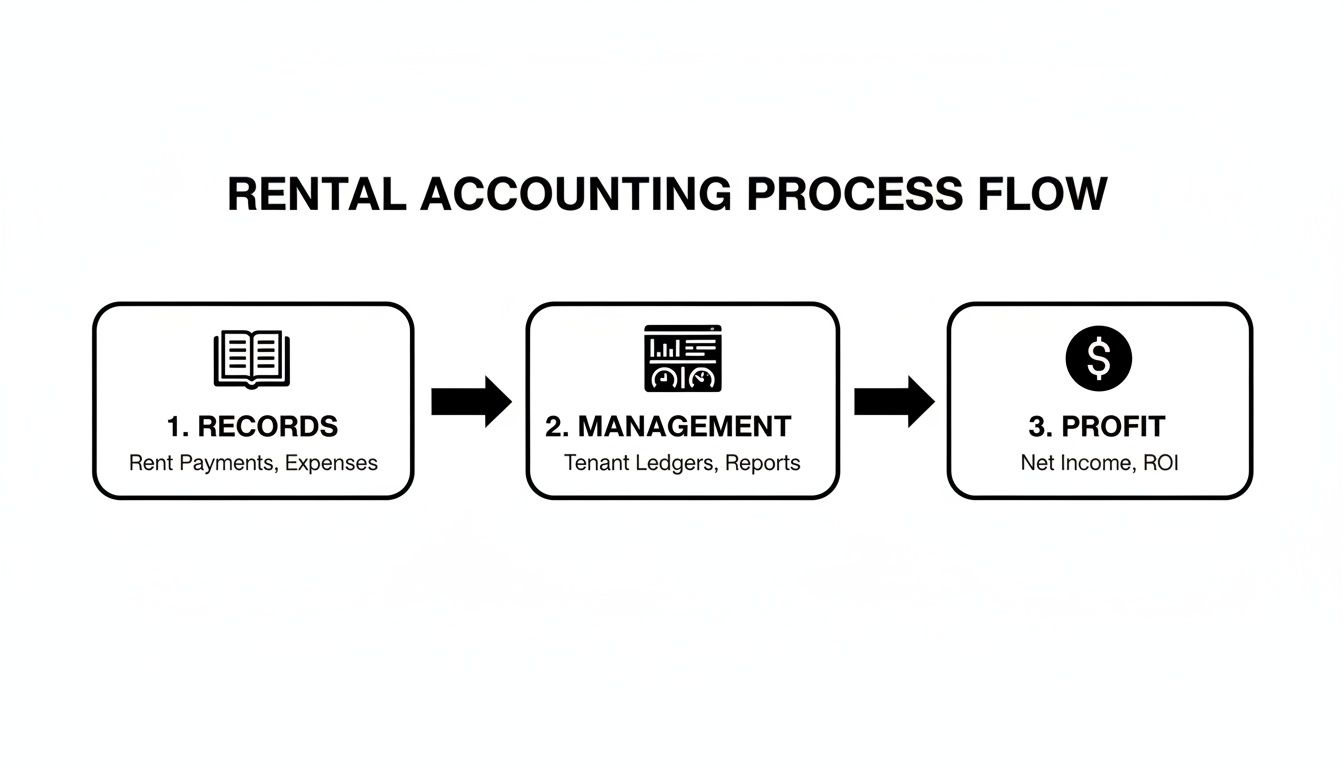
As you can see, profitability isn't an accident. It's the direct result of a disciplined process that starts with diligent record-keeping.
To help you get started, here’s a quick summary of the essential financial records every landlord in California should keep on hand.
Key Financial Records for Rental Property Owners
| Record Category | Examples of Documents | Primary Purpose |
|---|---|---|
| Proof of Income | Copies of rent checks, electronic payment confirmations (Zelle, Venmo), receipts for late fees or pet fees. | To accurately report all rental-related income to the IRS. |
| Expense Receipts | Invoices from contractors, receipts for materials (paint, lightbulbs), utility bills, insurance premiums, property tax statements. | To substantiate every deductible expense and reduce your taxable income. |
| Asset & Improvement Records | Receipts and contracts for new appliances, roof replacements, HVAC systems, or major renovations. | To track the cost basis of assets for depreciation and capital gains calculations. |
| Tenant & Legal Documents | Signed lease agreements, tenant screening reports, security deposit records, legal notices, and communication logs. | To ensure legal compliance, manage tenant relationships, and provide evidence in case of disputes. |
Having these documents organized and accessible isn't just good practice—it's your first line of defense in an audit and the foundation of a profitable investment.
The Real Cost of a Missing Receipt
Let's imagine a real-world scenario. A landlord in Highland hires a local contractor for a $4,000 emergency plumbing repair. He pays in cash and forgets to get a detailed invoice. Fast-forward to tax time, and without that receipt, he has no official proof of the expense.
This isn't just a record-keeping error; it's a direct financial loss. A missing receipt for a major repair means you can't deduct that expense, which directly increases your taxable income and costs you hundreds of dollars that should have stayed in your pocket.
This is exactly why meticulous records are your primary tool for financial clarity and legal protection. To simplify things and get an accurate picture of your earnings, you can use our rental income tax calculator to estimate your liabilities based on proper records.
Automating parts of this process can be a game-changer. For instance, to streamline the handling of PDF bank statements, a guide to bank statement converter software can be an invaluable resource, helping you turn raw data into organized reports with minimal effort. Keeping your ledger clean isn't just about avoiding audits; it’s about making sure your rental business in Mentone or Banning is as profitable as it can be.
Unlocking Your Property’s Tax Potential
Your rental property is more than just a source of monthly income—it's a serious wealth-building tool with major tax advantages. For property owners in communities like Banning and Yucaipa, understanding the specific tax rules that apply to rental real estate is how you truly maximize your returns. This isn’t about shady loopholes; it’s about strategically applying legitimate accounting and tax solutions to your investment.
Getting a handle on a few key concepts can completely change how you see your property's finances. We'll walk through the essentials every landlord needs to know, from what really counts as rental income to spotting every possible deductible expense. You'll start to see your property not just as an asset, but as a dynamic financial instrument.
Decoding Your Rental Income
The first step in any tax strategy is knowing exactly what income to report. While the monthly rent check is the obvious one, "rental income" is a much broader category. It’s critical to track every dollar your property brings in.
This includes:
- Advance Rent: If a tenant pays you in December for January's rent, the IRS sees that as income in December—the year you received the cash.
- Security Deposits: A standard security deposit isn't income if you plan to return it. But if you keep a portion to cover damages or unpaid rent, that amount becomes taxable income for that year.
- Fees: Every dollar from late fees, pet fees, or bounced check charges is part of your gross rental income.
- Tenant-Paid Expenses: Did your tenant pay a utility bill or for a minor repair that was your responsibility? That payment is considered rental income to you. The good news? You can then deduct that same repair or utility cost as a business expense.
The Power of Deductible Expenses
This is where savvy landlords in Redlands and Loma Linda make a real difference in their tax bill. The IRS lets you deduct all "ordinary and necessary" expenses you incur to manage and maintain your rental property. These deductions lower your taxable income dollar-for-dollar, meaning more of your hard-earned money stays with you.
You’d be surprised how many legitimate write-offs you can find when you look closely at your spending. Our comprehensive guide on rental property tax deductions gives you a detailed checklist so you don’t miss a single opportunity.
Understanding Depreciation: The “Paper Expense”
Depreciation is one of the most powerful—and most misunderstood—tax benefits for real estate investors. Think of it as a "paper expense." You get to claim a deduction for the wear and tear on your property over time, even though you aren't actually spending any cash.
The IRS allows you to deduct a portion of your property's cost basis each year, reflecting its gradual decline in value due to aging. This non-cash deduction can significantly lower your taxable income, creating a tax shield that boosts your real cash flow.
For residential rental properties in the U.S., the building itself (not the land) is depreciated over a period of 27.5 years. This systematic deduction is a cornerstone of any smart rental property tax strategy.
When we look at Beaumont property management, historical tax reforms have had a huge impact. The 1986 U.S. Tax Reform Act, for instance, slashed top income tax rates from 50% to 28%, which kicked off a boom in real estate investing and drove the need for smarter accounting. For higher-income homeowners in Beaumont property management areas earning over $300k, that means making the most of depreciation schedules—which, over 27.5 years, can yield average annual deductions of $10,000-$20,000 per property.
Navigating 1099 Rules for Contractors
Finally, you need to know your obligations when paying for services. If you pay an independent contractor—like a plumber, electrician, or handyman in Highland or Mentone—$600 or more during the tax year, you are generally required to send them a Form 1099-NEC.
This rule applies to individuals and unincorporated businesses, not to corporations. Dropping the ball on filing 1099s can lead to some painful penalties from the IRS. Keeping careful track of what you pay your vendors is a non-negotiable part of keeping your tax strategy on solid ground.
Choosing Your Financial Toolkit From Spreadsheets to Software
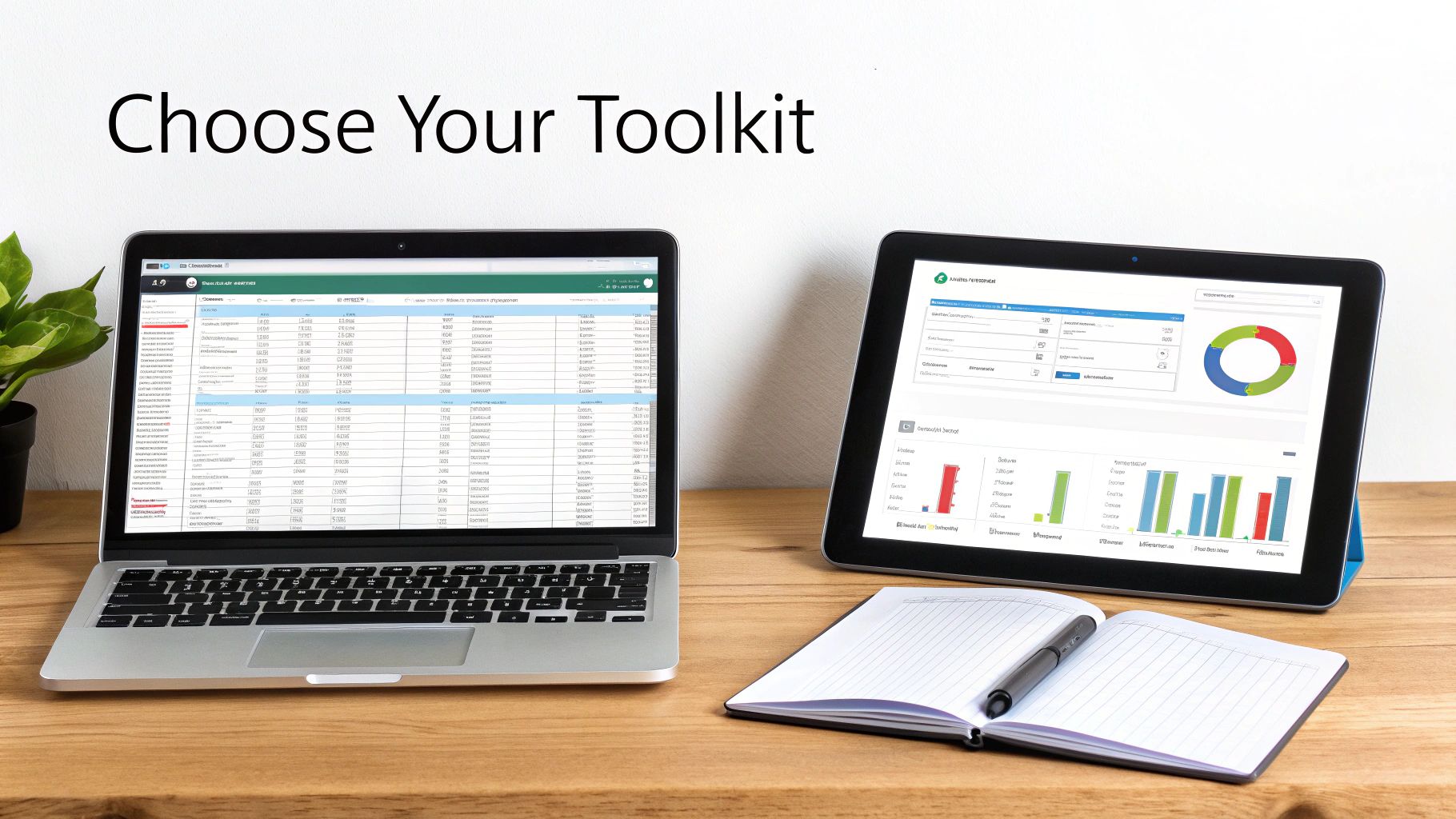
Every landlord needs a system to track income and expenses. But the right tool for the job really depends on how big and complex your portfolio is. Picking the best bookkeeping method is a cornerstone of your accounting and tax solutions strategy, whether you own a single property in Mentone or a handful spread across Redlands and Beaumont. The real goal is to find a system that gives you clarity without creating a mountain of extra work.
Think of it like choosing between a hammer and a power drill. A basic spreadsheet is your hammer—it's reliable, straightforward, and perfect for small jobs. If you have just one rental home, a well-organized Excel or Google Sheet is a perfectly fine and cost-effective way to track your finances. You can manually log every rent payment and categorize each expense without much fuss.
But as soon as you add a second or third unit, that hammer starts to feel pretty inefficient. Trying to track expenses for each property separately becomes a real chore, and it’s way too easy for mistakes to creep in. This is where dedicated landlord software—the power drill—makes all the difference.
The Leap from DIY Spreadsheets to Dedicated Software
When you're juggling multiple properties in communities like Yucaipa or Highland, the shortcomings of a simple spreadsheet become glaringly obvious. You need a system that does more than just list transactions; you need something that gives you real, actionable insights.
This is exactly what dedicated landlord software is built for. Platforms like Stessa and Buildium are designed to solve the specific problems property owners face every day. They don’t just record data—they organize it in ways that actually mean something.
- Property-Specific Tracking: These tools let you assign every single expense to a specific unit. This way, you know exactly which property is your cash cow and which one is eating up your profits with repairs.
- Automated Reporting: With just a few clicks, you can generate professional-looking reports like a Profit & Loss statement or a Cash Flow summary. It’s an instant health check for your entire portfolio.
- Document Management: Most platforms include features for storing receipts, leases, and invoices digitally. No more shoeboxes full of paper—just a clean, organized trail ready for tax season.
The true power of dedicated software isn't just about saving time; it's about scalability. As your portfolio grows, these tools grow right along with you, keeping your financial management sharp and accurate without adding hours to your plate.
The AIM Property Management Advantage: A Done-for-You System
While DIY software offers some powerful tools, it still demands your time and has a learning curve. For busy investors in Loma Linda, Calimesa, and Banning whose time is their most valuable asset, there’s a much better way. At AIM Property Management, our integrated system is your "done-for-you" solution.
We handle all the day-to-day financial legwork—from collecting rent to paying vendors—and that data flows directly into our professional accounting system. You get all the perks of sophisticated software without any of the headaches of setup or ongoing management. Every month, you receive clear, accurate financial statements that give you the insights you need to make smart, informed decisions.
For a deeper dive into how different tools stack up, our guide on property management software comparison provides even more context.
Our approach combines the best of modern technology with expert oversight, delivering professional-grade financial management that fits perfectly into your tax planning. It’s the ultimate toolkit for investors who want to focus on growing their portfolio, not on bookkeeping.
How Professional Management Powers Your Financial Strategy
Great property management is about much more than just fixing leaky faucets or finding new tenants. It's about actively protecting and growing your investment's financial performance. The day-to-day operations we handle feed directly into your bottom line, creating a powerful foundation for your accounting and tax solutions. This transforms property management from an operational expense into a strategic financial partnership.
By working with a team that understands the nuances of local markets from Redlands to Calimesa, you gain a partner dedicated to making your investment both seamless and more profitable. It’s all about building a system where your financial data is as well-maintained as your physical property.
Creating a Flawless Data Trail for Tax Time
Picture this: It’s April, and instead of frantically digging through a shoebox of faded receipts, your accountant receives a clean, detailed set of financial statements. This is the reality when professional management is at the core of your strategy. Our systematic approach to rent collection and expense tracking creates a flawless data trail that makes tax preparation simple.
Every single transaction is meticulously recorded and categorized the moment it happens. This means every repair, management fee, and utility payment is already sorted, taking all the guesswork out of tax time.
When tax season arrives, your Schedule E is effectively 90% complete before you even speak to your CPA. This level of organization not only saves you a ton of time and stress but also ensures you capture every single possible deduction, maximizing your return.
The global property management sector is projected to hit USD 31.87 billion by 2029, which shows just how valuable expert financial oversight has become. For investors searching for property management near me or looking to hire a property manager, AIM's ability to deliver clean financials that simplify Schedule E filings is a massive advantage. This is even more important as 54% of renters now look for smart homes, which can open up opportunities like 30% solar tax credits. You can dive deeper into these industry trends on ResearchAndMarkets.com.
Proactive Compliance as a Financial Shield
Beyond just tracking the numbers, a huge part of our job is ensuring unwavering compliance with local and state regulations. California’s rental laws are notoriously complex and always changing. One small misstep in areas like Beaumont or Banning can lead to steep fines, legal battles, and lost income—all of which directly hammer your financial standing.
Our proactive approach to legal compliance acts as a financial shield for your investment. We stay on top of all requirements, from tenant screening laws to habitability standards, preventing costly penalties before they ever become a threat. This is a crucial, and often overlooked, piece of your financial strategy.
- Vendor Management: We coordinate with licensed and insured vendors, making sure all work is properly documented. This is essential for both liability protection and for issuing correct 1099s, which helps you avoid IRS penalties.
- Lease Enforcement: We enforce lease terms, including late fees, consistently and legally. This protects your income stream and minimizes frustrating disputes.
- Regulatory Knowledge: Our deep expertise in the specific ordinances of cities like Yucaipa and Loma Linda means your property operates smoothly and stays on the right side of the law.
Ultimately, professional property management weaves daily operations into a high-level financial strategy. It positions your investment for success by ensuring every dollar is tracked, every regulation is met, and every tax advantage is captured. At AIM, we aren't just managing your property; we are safeguarding its financial future.
Your Local Advantage in Beaumont and Yucaipa
When you own a rental in the Inland Empire, grabbing some generic, one-size-fits-all advice on accounting and tax solutions just won’t cut it. The truth is, managing a rental property in Beaumont brings a completely different set of challenges—and opportunities—than managing one in Yucaipa. Real financial success doesn’t come from basic bookkeeping; it comes from having an expert on the ground who gets the local market.
Think about it. Local trends have a direct impact on your bottom line, from the going rental rates and what tenants in a specific neighborhood expect, to the city's unique permit requirements. What works like a charm in one town could be a costly mistake just a few miles down the road.
This is where having deep community knowledge becomes your biggest financial advantage. It’s about more than just knowing the streets; it’s about feeling the pulse of the local economy and knowing how to navigate it for your benefit.
Mastering Local Nuances for Greater Profitability
A property manager with a strong local footprint offers so much more than just day-to-day support; they give you a strategic edge. For effective Yucaipa property management, this means tapping into a trusted network of affordable local vendors who show up fast. This keeps your repair costs down, your tenants happy, and prevents small issues from snowballing into expensive disasters.
Over in a community like Beaumont, it means having an intimate grasp of zoning laws and city-specific regulations that can affect your property's value and compliance. Getting these local rules right from the start saves you from hefty fines and legal headaches. For owners looking for top-tier Property Management Beaumont, this kind of local expertise is non-negotiable. To see how we put this into practice, you can learn more about our dedicated approach to property management in Beaumont.
A deep knowledge of local rental markets allows for optimized rent setting—pricing your property competitively to attract quality tenants quickly, thereby minimizing vacancy costs which are a major drain on profitability.
Case Study: Navigating AB 1482 in Yucaipa
Let's look at a real-world example: California's Tenant Protection Act (AB 1482), which brought in statewide rent control and "just cause" eviction rules. Even though the law is statewide, how it plays out—and how tenants react—can differ from one community to the next. We had a landlord in Yucaipa who was struggling with how to issue a rent increase for a long-term tenant without running afoul of the complex new caps.
This is where our hyper-local experience made all the difference. We ran a targeted rental analysis for their specific neighborhood. This allowed us to craft an increase that was not only 100% compliant with AB 1482’s strict percentage limits but also perfectly aligned with current local market rates.
The result? The owner was able to fairly and legally increase their revenue, sidestepping potential disputes and staying profitable without the legal stress. This is the kind of tangible, financial benefit that truly localized management delivers.
Common Landlord Tax and Accounting Questions
When you own a rental property, you're running a business. And like any business owner, you've probably got questions about the finances. Having solid accounting and tax solutions isn't just about compliance—it's about making smart, profitable decisions. We hear a lot of the same questions from landlords across the communities we serve—including Redlands, Beaumont, Calimesa, Yucaipa, Loma Linda, Mentone, Highland, and Banning—so let's clear up a few of the most common ones.
Can I Deduct My Mortgage Principal Payments?
This is easily one of the most frequent points of confusion, especially for new landlords. The short answer is no, you can't deduct the principal portion of your mortgage payment.
Think of it this way: that principal payment isn't an "expense" in the eyes of the IRS. It’s you paying down a debt and building equity in your asset. It reduces your loan liability, which is a balance sheet transaction, not an operating cost.
But don't worry—you absolutely can and should deduct the interest you pay on the loan. For most landlords, this is one of the single largest deductions you'll claim all year. Your lender makes it easy by sending you a Form 1098 each year, which spells out exactly how much mortgage interest you paid.
Do I Need an LLC for My Rental Property?
Setting up a Limited Liability Company (LLC) is a strategic move, but it’s definitely not a one-size-fits-all requirement. The number one reason landlords form an LLC is for liability protection. It builds a legal wall between your personal assets (your home, car, and savings) and your business assets (the rental property).
Here’s how to think about it:
- Asset Protection: If a tenant sues you over an issue at the rental, an LLC can shield your personal finances from being targeted in the lawsuit. The legal action is against the business, not you personally.
- Cost and Complexity: There's a trade-off. In California, setting up an LLC comes with filing fees and a minimum annual franchise tax of $800. It adds a layer of administrative work.
- Insurance as an Alternative: Don't underestimate the power of a great landlord insurance policy. A robust policy, often paired with an umbrella policy, can provide a significant amount of liability coverage on its own.
Many landlords in Loma Linda and Mentone start out as sole proprietors and then decide to form an LLC as their portfolio of properties grows. It’s a big decision, and the best move is to chat with a legal and financial advisor who can look at your specific situation.
What is the Difference Between a Repair and an Improvement?
Getting this distinction right is absolutely crucial for your tax strategy. The IRS treats repairs and improvements very differently, and mixing them up can be a costly mistake.
Here’s a simple way to look at it:
- A repair simply keeps the property in its current working condition. Think fixing a leaky pipe under the sink, patching a hole in the drywall, or replacing a single broken window. These costs are considered operating expenses and are fully deductible in the same year you pay for them.
- An improvement makes the property better, adapts it for a new use, or significantly extends its life. We're talking about big-ticket items like replacing the entire roof, adding a deck, or installing a brand-new HVAC system. These costs have to be capitalized and then depreciated over several years.
Correctly categorizing your expenses is a fundamental part of rental property accounting. A repair gives you an immediate tax benefit, while an improvement provides a smaller, long-term deduction through depreciation.
As you navigate these rules, it's also worth understanding the tax implications for short term rentals, especially the key differences between filing a Schedule E versus a Schedule C. This is particularly vital for property owners in vacation-friendly areas like Highland and Banning. Getting these details right ensures you’re not just staying compliant, but truly making the most of your investment's financial potential year after year.
Managing the financial complexities of a rental property requires expertise and diligence. At AIM PROPERTY MANAGEMENT COMPANY, we provide the professional oversight needed to protect your investment and optimize your returns. Let us handle the details so you can focus on what matters most. Discover how our services can benefit you by visiting https://aim-properties.com.