
Let's be honest, property management is so much more than just sticking a "For Rent" sign in the yard and collecting a check. It’s the strategic oversight of your entire real estate investment. Think of a good property manager as the CEO of your rental property—a true partner responsible for every single detail that contributes to its performance, from financial health and legal compliance to tenant happiness and physical upkeep.
What is Professional Property Management, Really?
At its core, professional property management is a service designed to turn the often stressful, hands-on job of being a landlord into a genuinely passive investment. For property owners in communities we serve, such as Redlands, Beaumont, Calimesa, Yucaipa, Loma Linda, Mentone, Highland, and Banning, hiring a professional firm means you get to hand off all the day-to-day operational headaches. This frees you up to focus on your career or actually enjoy your free time, knowing your asset is being protected and optimized by people who do this for a living.
Instead of fielding late-night emergency calls about a broken water heater or trying to navigate California's complex eviction laws on your own, you have a dedicated partner handling everything. A great property manager acts as the essential buffer between you and your tenants, making sure a professional, respectful relationship is maintained at all times. This structure is absolutely key to long-term profitability and keeping your property in great shape.
The True Role of a Property Manager
A helpful way to think about it is that a property manager is like a ship’s captain. As the owner, you chart the destination (your investment goals), but it's the captain who navigates the ship through both calm and stormy seas. They manage the crew (tenants and vendors), maintain the vessel (the property itself), and ensure it reaches its destination safely and profitably.
Their responsibilities are broad, and each one is vital to the success of your investment.
Core Functions of a Property Manager at a Glance
To give you a clearer picture, we've broken down the essential duties that a professional property management company like AIM handles. This table offers a quick snapshot of the services that protect your investment and make your life easier.
| Core Function | Key Responsibilities | Primary Benefit for Owners |
|---|---|---|
| Marketing and Leasing | Creating compelling listings, professional showings, and securing qualified tenants quickly. | Minimizes costly vacancies and ensures a steady rental income stream. |
| Tenant Relations | Serving as the main point of contact for all communications, requests, and issues. | Frees up your time and maintains a professional boundary with tenants. |
| Maintenance Coordination | Managing routine upkeep, emergency repairs, and property inspections to maintain value. | Protects the physical asset, prevents small issues from becoming expensive problems. |
| Financial Administration | Handling rent collection, paying property-related bills, and providing detailed financial reports. | Provides clear financial oversight and simplifies your bookkeeping and tax preparation. |
Ultimately, a professional property manager's role is to ensure your property runs like a well-oiled machine, so you can enjoy the financial benefits without the operational burden.
The ultimate goal of property management is to maximize your return on investment by preserving the property's value, reducing vacancies, and managing operating costs efficiently.
A Growing Industry of Experts
The demand for these specialized services isn't just a local trend in the Inland Empire; it's happening everywhere. The property management market is expanding rapidly, showing a major shift in how smart investors approach their rental properties. In the U.S. alone, industry revenues are projected to climb from $81.52 billion in 2025 to $98.88 billion by 2029. You can read the full research on property management market trends to see just how significant this growth is.
This data highlights a crucial insight: successful real estate investing today increasingly relies on expert management to navigate modern complexities. For owners in Highland, Loma Linda, or Mentone, this means accessing a higher level of professional service is easier—and more important—than ever before.
The Pillars of Professional Property Management
So, what does a property manager actually do all day? It's not just one thing. Great property management is a delicate balance of several critical, ongoing jobs that all work together to protect your investment and help it grow. Think of it as resting on five foundational pillars, with each one handling a key part of the rental lifecycle. When a professional gets this right, you end up with a stable, profitable asset instead of a constant headache.
This diagram gives you a bird's-eye view of how these jobs are typically grouped, zeroing in on the three core areas: finance, tenant relations, and property upkeep.
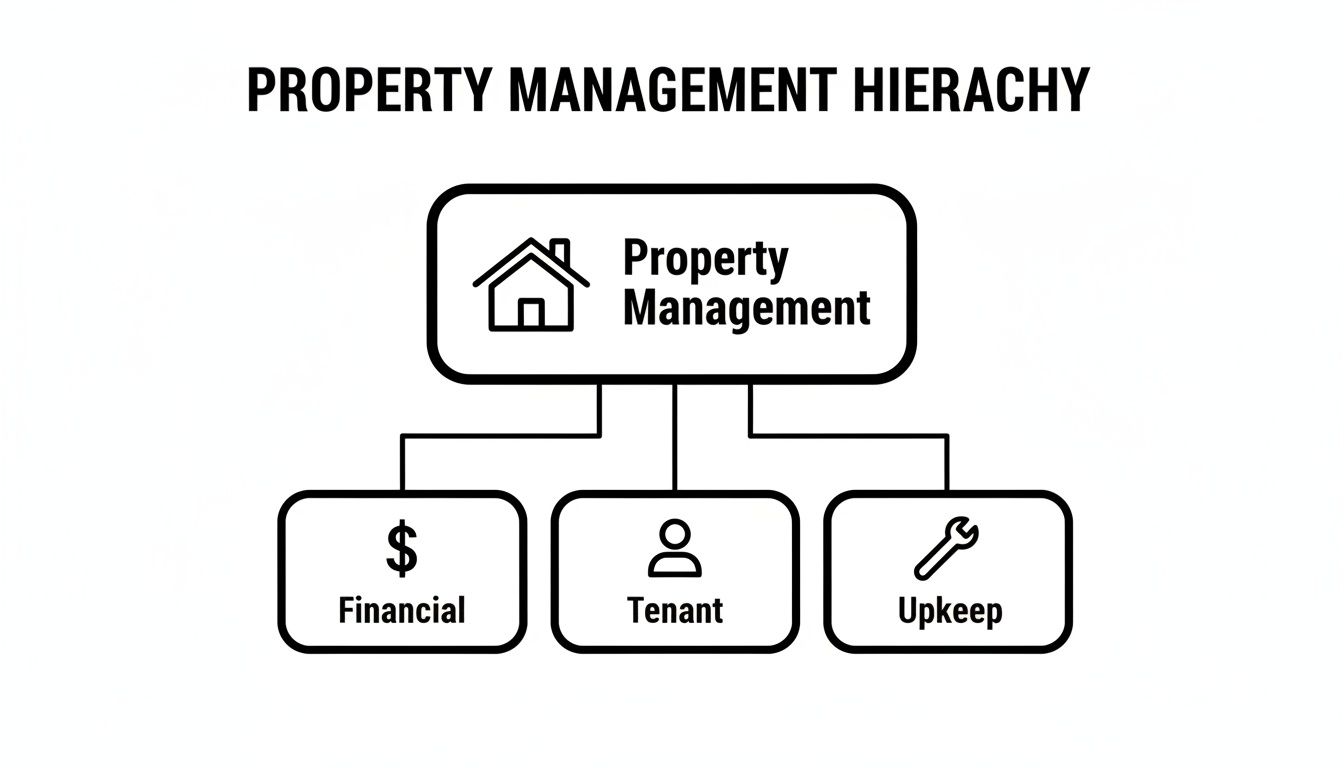
As you can see, every core responsibility flows back to one of these main categories. It's a holistic approach that ensures nothing falls through the cracks. Now, let’s dig into the five pillars that make this whole structure work.
1. Tenant Screening and Placement
If there's one secret to a successful rental experience, it's finding the right tenant from the start. This is where a professional, ironclad screening process becomes your best friend. It’s so much more than just taking an application and shaking a hand.
A thorough screening acts as a protective shield for your investment. It’s a multi-layered investigation to confirm an applicant is not only financially stable but also has a proven history of being a responsible renter.
This process typically includes:
- Comprehensive Credit Checks: To see how they handle their financial obligations.
- National Criminal Background Screenings: To ensure the safety of your property and the neighborhood.
- Income and Employment Verification: To confirm they can actually afford the rent without stretching themselves thin.
- Past Landlord References: To get the real story on their rental history directly from the source.
When you have a detailed process like this in place, you dramatically slash the risk of late payments, property damage, and the nightmare of an eviction.
2. Rent Collection and Financial Oversight
Consistent cash flow is the lifeblood of your rental investment. The second pillar is all about building a reliable system to collect rent on time and manage every dollar with precision. Honestly, this is the very core of what property management is all about.
These days, good property managers offer easy online payment portals that make it simple for tenants to pay on time, which significantly cuts down on late payments.
A professional property manager's job is to enforce the lease terms strictly but fairly. That means dealing with late payments right away with clear communication and, if it comes to it, starting the legal process for collection or eviction according to California law.
This pillar also covers detailed financial oversight. Your manager pays all the property-related bills, like HOA dues or repair invoices, and gives you clean, easy-to-read monthly statements. It makes your own bookkeeping a breeze and takes the stress out of tax season. To get a better feel for everything this involves, you can check out our guide on a property management company's responsibilities.
3. Proactive Maintenance and Inspections
Your rental property is a physical asset, and like any asset, it needs constant care to hold its value. This pillar—proactive maintenance—is what stops your property from falling apart. It’s about catching small issues before they snowball into huge, expensive disasters.
It doesn’t matter if your property is in a newer community like Beaumont or a more established area like Redlands; preventative care is non-negotiable. This means scheduling routine inspections to check for leaks, test smoke detectors, and just get a feel for the overall condition of the home.
A big part of this pillar is also overseeing the property’s assets to reduce potential risks. This can even include knowing when to call in experts for specialized tasks like commercial tree maintenance. A manager’s network of vetted, insured vendors in places like Yucaipa and Highland is invaluable, ensuring any repair is done right and for a fair price.
4. Legal Compliance and Documentation
The web of landlord-tenant laws in California is notoriously tricky. This fourth pillar is all about keeping your property fully compliant with every local, state, and federal rule, shielding you from massive legal and financial risks.
This involves:
- Drafting and using legally solid lease agreements.
- Handling security deposits according to California's strict guidelines.
- Following Fair Housing laws to the letter to avoid discrimination lawsuits.
- Properly serving all legal notices, from a 24-hour notice to enter to a pay-or-quit demand.
For property owners in places like Banning or Calimesa, having a local expert who knows the specific city ordinances adds a crucial layer of protection. This legal diligence is a cornerstone of professional Redlands property management and services in all the surrounding cities.
5. Strategic Financial Reporting
The last pillar ties everything together. It’s all about giving you the clear data you need to make smart decisions about your investment. Strategic financial reporting goes way beyond a simple spreadsheet of income and expenses.
You’ll get regular, easy-to-understand reports that break down your property's financial health. This data lets you spot trends, plan for big-ticket expenses down the road, and accurately measure your return on investment. The property management industry is a huge part of the U.S. economy, supporting 335,000 businesses as of 2025 and projected to hit $136.9 billion by 2026. This level of reporting shows why.
Put them all together, and these five pillars form the unshakeable foundation of successful property management. They're what turn a potentially stressful asset into a predictable, hands-off source of income.
How Professional Management Boosts Your Bottom Line
While the services of a property manager are extensive, the ultimate question for any investor is simple: what’s the financial return? A professional manager is far more than just a line item on your expense sheet; they are a strategic asset actively working to increase your revenue and protect your property’s long-term value.
Their work directly translates into a stronger bottom line in several measurable ways. Instead of just maintaining the status quo, an expert manager identifies and acts on opportunities to improve profitability at every turn.
This means moving beyond reactive problem-solving to proactive financial optimization. Every decision, from marketing a vacant unit to negotiating a repair, is made with your financial goals in mind. The result is a more resilient and profitable investment.
Minimizing Costly Vacancy Periods
An empty property isn't just missing out on rent; it's actively costing you money in utilities, maintenance, and risk. A key advantage of professional Yucaipa property management is the ability to drastically reduce these expensive vacancy periods.
This is achieved through a multi-faceted approach:
- Strategic Marketing: Professionals use high-quality photos, compelling descriptions, and broad-reach listings to attract a large pool of qualified applicants.
- Efficient Turnovers: The moment a tenant gives notice, a manager has a system in place to inspect, clean, and repair the unit, getting it back on the market in record time.
- Responsive Showings: Managers have the flexibility to show your property to prospective tenants quickly, increasing the chances of securing a lease without delay.
By minimizing the time your property sits empty, a manager keeps the income flowing, directly impacting your annual returns.
For a property in Beaumont renting for $2,500 a month, reducing the vacancy period by just one month adds $2,500 directly back to your annual income. This alone can offset a significant portion of management fees.
This efficiency is a cornerstone of smart investment management, ensuring your asset is always working for you.
Setting Optimal Rental Rates
One of the most common mistakes self-managing landlords make is underpricing their properties. Without access to real-time market data, it’s easy to leave hundreds of dollars on the table every month.
A professional property manager conducts in-depth market analysis for communities like Beaumont and Redlands to determine the highest possible rent your property can command. This isn't guesswork; it's a data-driven process that considers comparable properties, neighborhood trends, and current demand. Setting the rent just $100 too low costs you $1,200 per year in lost revenue.
This expertise ensures you are maximizing your income potential without pricing your property out of the market. It's a delicate balance that professionals are equipped to handle. To see how this impacts your overall earnings, you can explore our resources for a deeper dive into maximizing your rental property cash flow.
Leveraging Technology for Efficiency
The property management industry has been transformed by powerful software platforms that play a huge role in optimizing operations and, by extension, your bottom line. Globally, the market for this technology is projected to grow from USD 26.49 billion in 2024 to USD 42.78 billion by 2030. This rapid adoption of cloud-based, AI-driven tools helps managers oversee large portfolios and provide real-time analytics to owners. You can discover more insights about the property management software market and how it’s shaping the industry.
This technological edge means your property is managed more efficiently, from maintenance tracking to financial reporting, ultimately saving time and reducing costs.
Local Expertise Matters in Yucaipa and Beaumont
You can’t manage a rental property with a generic, one-size-fits-all playbook. It just doesn't work. A single-family home in a quiet, established Yucaipa neighborhood needs a completely different approach than a property in the booming community of Beaumont. That's why having a team with hyper-local expertise isn’t a luxury—it’s non-negotiable.

Think of it like this: a national restaurant chain serves the exact same burger everywhere, but a great local chef knows what the community really wants to eat. We’re that local chef for the Inland Empire’s rental market. We know the unique flavor of each community we serve—Redlands, Beaumont, Calimesa, Yucaipa, Loma Linda, Mentone, Highland, and Banning—and understand what local tenants are looking for and, crucially, what they’re willing to pay.
Understanding Unique Community Dynamics
Every city we serve has its own personality, which shapes everything from who your tenants are to how much rent you can charge. Having a deep, boots-on-the-ground understanding of these local nuances is absolutely critical for effective Yucaipa property management and success in the surrounding areas.
- Yucaipa: This is an established, family-friendly community. Tenants here are often looking for long-term stability and access to good schools. Your marketing and screening have to speak directly to that audience.
- Beaumont: As one of the region’s faster-growing cities, Beaumont is a magnet for commuters and young families. A manager here needs to know the appeal of the newer developments and how to price a property competitively in a constantly shifting market.
- Redlands: Home to a historic downtown and a university, Redlands boasts a really diverse rental pool. A true local expert knows how to market the same property to students, professionals, or families, depending on its specific location and features.
This granular knowledge means your property gets positioned perfectly to attract the best possible tenants, fast. For a closer look at one of these markets, check out our guide to property management in Beaumont for more specific insights.
A property manager with genuine local expertise doesn't just know the streets; they know the market trends, the reliable vendors, and the specific expectations of tenants in communities from Loma Linda to Highland.
The Advantage of a Local Vendor Network
It’s 2 AM, and a pipe just burst in your Calimesa rental. Who are you calling? A local property manager doesn’t just jump on Google to find a plumber. We have a trusted, pre-vetted network of contractors on speed dial who we know will show up and do the job right.
This network is one of the most underrated assets a local manager brings to the table. Because we give these vendors consistent business, we often get priority service and better pricing—and those savings are passed directly on to you. It means faster response times for your tenants and lower costs on everything from routine landscaping in Mentone to emergency electrical work in Banning. It's a critical piece of the puzzle that protects both your investment and your bottom line.
Understanding Property Management Fees
Any good partnership starts with transparency, especially when it comes to money. When you hire a property manager, you're not just paying for a service; you're investing in your asset's protection and performance. The key is to understand exactly where that investment is going.

Think of management fees as having a professional team on call 24/7. They're there to handle late-night emergencies, navigate California's tricky rental laws, and ultimately keep your property profitable. Let’s pull back the curtain on how it all works.
Common Fee Models
Most property management companies, whether in Redlands or Yucaipa, stick to one of two main pricing models. While they're structured differently, the goal is always the same: clear, predictable costs for the services you receive.
- Percentage-of-Rent Model: This is the industry standard. The management fee is simply a percentage of the monthly rent we collect for you, usually somewhere between 8% and 12%. This model is great because it means our success is tied directly to yours—if your property is empty, we don't get paid.
- Flat-Fee Model: Some firms prefer to charge a set monthly fee, no matter what the rent is. This can be an attractive option for owners with higher-end properties because it keeps your monthly costs perfectly consistent.
A quick tip: Always ask what "rent collected" actually means. Does it just cover the base rent, or does it include things like pet fees or late charges? Getting that cleared up from the start prevents any surprises down the road.
Standard One-Time Charges
On top of the monthly fee, there are a few one-time charges that cover specific, high-effort tasks. The most common one you'll see is the leasing fee, sometimes called a tenant placement fee.
This fee, which is often a portion of the first month's rent, covers the entire A-to-Z process of getting a high-quality tenant into your property. That means handling all the marketing, hosting showings, processing applications, and running comprehensive background and credit checks.
You might also see one-time fees for things like lease renewals or for overseeing a major renovation project. These costs cover the significant time and resources needed to get these big jobs done right. Whether it's finding a reliable tenant for your home in Banning or coordinating updates on a Beaumont property, these fees are an investment in quality and your own peace of mind.
For a more detailed breakdown, learn more about our property management fee structure and the value it provides.
Choosing the Right Management Partner for Your Property
Picking a property manager is the last—and most important—step in turning your real estate from a second job into a true passive investment. This isn't just about hiring someone to collect rent. You're choosing a partner who will protect your property's value and make sure it’s performing at its peak financially. This is the decision that ultimately buys back your time and peace of mind.
Let's be honest, the real cost of managing a property yourself isn't just about money; it’s the constant mental load. Those late-night calls about a leaky faucet, the scramble to find a reliable plumber, and trying to keep up with California's ever-changing rental laws can feel like a full-time job. A great property manager lifts that entire weight off your shoulders.
A Simple Framework for Evaluation
When you’re looking at different management companies for your property in Loma Linda, Mentone, or Highland, it really boils down to three things. These are the pillars that separate the average managers from the great ones and ensure you're on the same page from day one.
- Proven Local Expertise: Do they actually know the rental markets in places like Yucaipa and Beaumont? A manager with boots-on-the-ground knowledge will price your property right, attract better tenants, and fill vacancies faster.
- Transparent Communication: How will you know what’s going on? You want a company that provides clear, easy-to-read financial statements and keeps you in the loop on any big decisions without overwhelming you with tiny details.
- A Strong Track Record: Don't be afraid to ask for references or look at their current portfolio. A reputable firm should have plenty of happy clients who can vouch for their results and professionalism.
Choosing the right property manager is one of the most impactful decisions you'll make as a real estate investor. It determines whether your property becomes a source of passive income or a source of persistent headaches.
For a deeper dive into the exact questions you should be asking and the red flags to watch out for, check out our guide on how to choose the right property management company.
Ultimately, the right partner acts as the CEO for your property, making smart decisions to protect and grow your investment. If you're ready to hit your investment goals with a local expert you can trust, let's connect for a personalized consultation.
Got Questions? We’ve Got Answers.
Owning rental property in the Inland Empire often comes with a lot of questions. We hear them all the time from landlords who are thinking about getting professional help. Here are some of the most common ones, with straight-up answers.
How Do I Know If I Really Need a Property Manager?
If you’re starting to feel like your "passive investment" is turning into a second job, that's your first clue. It’s a smart move if you live out of the area, own several properties, or simply don't have the time—or the desire—to deal with late-night maintenance calls and tenant disputes.
Honestly, if you find yourself typing "property management near me" into Google while sitting in Redlands or Beaumont, you already know the answer. When the stress of being a landlord starts to outweigh the benefits, it’s time to bring in a partner.
What Kind of Legal Stuff Does a Property Manager Handle?
Think of a good property manager as your shield against legal headaches. In a state like California, with its notoriously complex landlord-tenant laws, this isn't just a convenience—it's critical.
We handle all the legal heavy lifting, which includes:
- Crafting ironclad, state-compliant lease agreements that protect you.
- Managing security deposits exactly as California law demands.
- Ensuring you're always in line with fair housing laws to avoid discrimination claims.
- Properly serving legal notices and, if it ever comes to it, managing the eviction process correctly from start to finish.
For property owners in places like Banning and Loma Linda, our expertise at AIM Property Management is what keeps you out of court and protects your investment from expensive missteps.
How Much Does Property Management Cost in California?
In California, you can generally expect to pay a fee between 8% and 12% of the monthly rent we collect. Some companies might use a flat-fee model instead. You might also see a one-time fee for getting a new tenant in place, which covers all the marketing, showings, and intensive screening.
It's easy to get hung up on the fee, but the real question is about value. A great manager doesn't just cost you money; they often make you money by securing higher rents, slashing vacancy times, and sidestepping costly mistakes. The fee becomes a strategic investment, not just another bill.
Will I Still Have a Say in What Happens with My Property?
Absolutely. You're hiring us to handle the day-to-day grind, not signing over the deed to your property. A solid management agreement makes it crystal clear how we'll communicate and how involved you want to be.
At AIM Property Management, we're the ones taking the tenant calls, scheduling repairs, and wrangling the paperwork. But when it comes to the big decisions—like approving a new tenant, deciding on the rent price, or authorizing a major repair—you always have the final word. It’s your property; we’re just the experts running the show for you.
Ready to turn your property into a high-performing, stress-free asset? The team at AIM PROPERTY MANAGEMENT COMPANY has the local know-how and proven systems to protect your investment and boost your returns. We proudly serve Redlands, Beaumont, Calimesa, Yucaipa, Loma Linda, Mentone, Highland, and Banning, California. Contact us today for a personalized consultation and discover the peace of mind that comes with professional management.