

If you’re a property owner, you’ve probably heard the term “Fair Market Rent,” but what does it actually mean for your bottom line? Let’s cut through the jargon.
Fair Market Rent (FMR) is the government's best guess at what a person can expect to pay for a decent, but not luxurious, rental home in a specific area. It's a benchmark number set by the U.S. Department of Housing and Urban Development (HUD) to help guide federal housing programs.
Think of it as a starting point, not a non-negotiable price tag.
Understanding Fair Market Rent for Your Investment Property
For any landlord in California, getting a handle on FMR is your first step toward pricing your property intelligently. It’s a foundational piece of data, kind of like a baseline measurement. It gives you a standardized reference for your local market, whether you own property in Redlands, Beaumont, Calimesa, Yucaipa, Loma Linda, Mentone, Highland, or Banning, but it doesn’t capture the full picture of your unit's unique value.
While "market rent" is the real-world price a property can actually get based on supply, demand, and its specific features, FMR is a specific government calculation. HUD arrives at its FMR figures by targeting the 40th percentile of gross rents for standard-quality homes in an area.
In simple terms, this means 40% of the local rental units are priced at or below the FMR, while the other 60% are priced above it. This approach deliberately filters out high-end luxury properties to give a more realistic snapshot of typical housing costs.
Why FMR Is More Than Just a Number
For landlords, FMR is a powerful reality check and a strategic tool that goes far beyond government programs. Knowing this benchmark helps you:
- Price Competitively: Understanding the FMR for your city prevents you from overpricing your rental and dealing with long, costly vacancies. It also stops you from underpricing and leaving money on the table each month.
- Attract a Wider Tenant Pool: When you price your rental near the FMR, you open the door to a larger group of potential applicants. This often includes tenants participating in housing assistance programs, which can offer a very reliable income stream.
- Make Informed Decisions: FMR data provides an objective starting point for your own market analysis, grounding your pricing strategy in solid data instead of just guesswork.
By understanding the FMR, property owners gain a crucial piece of the pricing puzzle. It's not the final price, but it’s an indispensable guidepost for navigating the rental landscape in communities from Banning to Loma Linda.
To help you get a quick handle on these concepts, here’s a simple breakdown of what goes into Fair Market Rent and why it's so important for California landlords.
Fair Market Rent Core Concepts at a Glance
This table offers a quick summary of the essential components that define and influence Fair Market Rent for California property owners.
| Component | What It Is | Why It Matters for Your Property |
|---|---|---|
| HUD Benchmark | A government-calculated figure representing modest rental costs in a specific metro area or county. | It's your official starting point for pricing, especially if you plan to accept tenants with housing vouchers. |
| 40th Percentile | The rent level below which 40% of standard rental units fall. It excludes the priciest properties. | This ensures the FMR reflects affordable housing options, not just luxury apartments, giving you a realistic baseline. |
| Gross Rent | The total cost of rent plus essential utilities (like water, gas, and electricity). | FMR includes utilities, so you must factor this in when comparing it to your property's rent, which may not. |
| Local Market Data | FMR is based on local surveys and census data, making it specific to areas like Redlands, Beaumont, or Yucaipa. | This makes it a relevant, localized tool that reflects the economic conditions right where your property is located. |
| Not Market Rent | FMR is a statistical benchmark, not what the highest bidder would pay for a renovated unit with premium features. | It helps you set a competitive floor, but you still need to conduct your own analysis to find the optimal rent price. |
Ultimately, understanding FMR is a key part of a much larger valuation strategy for your investment.
When you're weighing the FMR for your investment, it’s also smart to familiarize yourself with the various professional methods for calculating property value. This gives you a broader context for your property's true worth. This knowledge, combined with a solid grasp of rental income, is fundamental to your financial success. You can dive deeper into how this works in our guide on what is cash flow in real estate.
How HUD Calculates Fair Market Rent
So where does the Fair Market Rent (FMR) number actually come from? It’s not just pulled out of thin air. The U.S. Department of Housing and Urban Development (HUD) uses a deliberate, data-driven process to figure it out. Understanding how they get to that final number helps landlords see why FMR is a solid starting point, but not the final word on what your specific property is worth.
The whole goal is to land on a reasonable, middle-of-the-road rental price that reflects what typical housing costs, without getting skewed by the luxury condos and high-end homes.
At its heart, the calculation all starts with a mountain of data.
The Foundation of FMR Data
The main source for all this is the American Community Survey (ACS), a massive annual survey run by the U.S. Census Bureau. Think of it as a detailed check-in with households all over the country. It asks about all sorts of things, including what people pay in gross rent—a figure that covers not just the rent itself but also essential utilities. The ACS gives HUD a comprehensive, nationwide snapshot of housing costs.
But here’s the thing: raw data from last year isn't good enough to set rental rates for today. This is where HUD’s method gets smarter to make sure the numbers are fair and actually relevant to what’s happening in the market right now.
Targeting the 40th Percentile
Instead of just taking a simple average of all rental prices, which would be thrown off by expensive properties, HUD zeros in on the 40th percentile rent.
What does that mean? Imagine you lined up every standard rental unit in an area like Redlands or Beaumont, from the cheapest to the most expensive. The 40th percentile is the sweet spot where 40% of the properties are cheaper, and 60% are more expensive.
This is a really important strategic move. By intentionally ignoring the top 60% of the rental market, HUD cuts out the high-end and luxury properties from its calculation. The aim is to set a benchmark that represents modest, decent housing—not the brand-new apartment building with a rooftop pool that commands a premium.
This 40th percentile approach ensures FMR reflects affordability and serves as a realistic benchmark for housing assistance programs, rather than being inflated by the luxury market.
To see how HUD gets from broad data to a specific pricing benchmark, you can think of it like this:
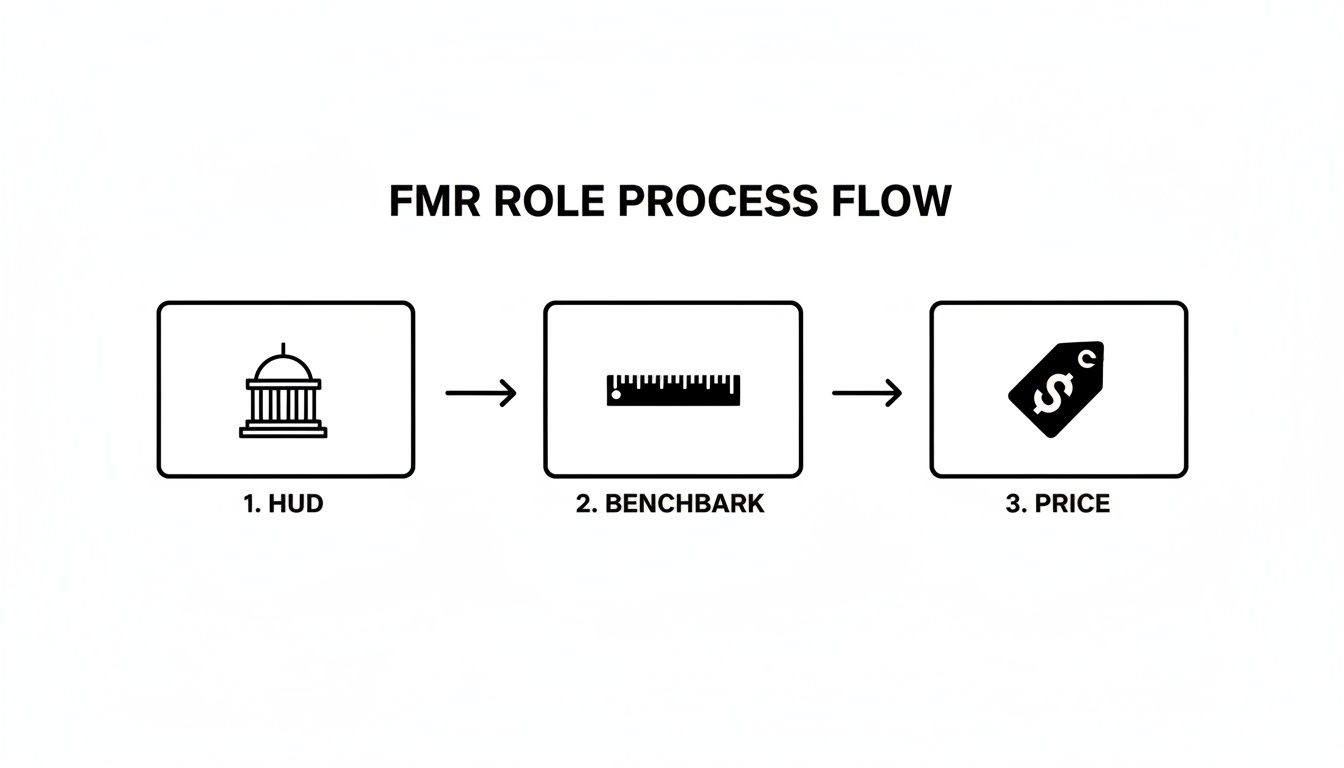
As the graphic shows, HUD acts as the main authority, using data to set a benchmark that local markets then use to guide their pricing.
Adjusting for Today’s Market
Census data is great, but it always has a bit of a time lag. To get these historical numbers up to speed, HUD applies inflation adjustments. It looks at more recent economic signals, like the Consumer Price Index (CPI), to predict how much rents have likely climbed since the original ACS data was collected.
This is a critical step for keeping FMR figures from becoming outdated, especially in fast-moving rental markets. Without it, the FMR would always be a step behind real-world rent prices.
On top of that, if HUD suspects that data for a certain area is a little thin or that rents have spiked recently, they can run local rent surveys. These surveys act as a real-world fact-check, making sure the calculated FMR actually matches what's happening on the ground in specific communities.
This government-calculated figure gives us an essential starting point—a foundational piece of the puzzle. From here, an expert Yucaipa property management firm can dig deeper. We take this baseline and sharpen it with hyper-local data, comparing your specific property to others just rented down the street in Yucaipa, Beaumont, or Redlands. This is how we pinpoint its true earning potential and set a competitive, profitable rent.
The Real-World Impact of FMR on Landlords and Tenants

Fair Market Rent is much more than just a statistic you find on a government website. It's a number that carries real weight and has tangible consequences for both property owners and renters. For landlords, understanding the FMR in your area is the cornerstone of a smart investment strategy. It’s your guidepost for pricing a rental to attract the biggest—and best—pool of qualified applicants.
This includes dependable tenants who use housing vouchers, which can dramatically slash your vacancy time and create a reliable income stream. A smart FMR strategy can be the difference between a property that sits empty for months and one that generates consistent returns.
For tenants in assistance programs, FMR is just as critical. It sets the "payment standard," defining the maximum housing assistance they can receive. That number directly impacts their housing options and determines what they can realistically afford in a tight rental market.
A Landlord’s Story From Beaumont
Let's look at a real-world scenario we handled for a landlord in Beaumont. He had a great single-family home, well-maintained and in a nice area, but it sat vacant for months. The lost rent and carrying costs were draining his finances, and despite plenty of showings, he wasn't getting any serious applications.
He was frustrated and couldn't figure out what he was doing wrong. The house was perfect, so what was the problem?
When we looked at his listing, the issue was clear: his asking rent was completely out of sync with the local market and the FMR. It was priced too high to attract voucher holders, and it was even pushing away renters paying out-of-pocket. With a little guidance from our Beaumont property management team, he adjusted the price to a competitive, data-backed number.
The change was immediate. Within just a few weeks, he secured a stable, long-term tenant. It was a perfect example of how a strategy guided by FMR and local market knowledge helps everyone win.
Why National Averages Don't Tell the Whole Story
Relying on broad national trends is a huge mistake for property owners in communities like Yucaipa or Redlands. Recent HUD data shows just how wide the gap has become between national averages and local realities.
While the national weighted-average rent saw a modest 2.8% increase, one-bedroom FMRs in the 50 largest metro areas shot up by an average of 40.7%—or $457—in just a few years. In fact, every single one of those metro areas saw increases, with some East Coast cities seeing jumps of over $850 for a one-bedroom unit. This just goes to show why you have to focus on local data for accurate pricing.
A landlord in Yucaipa needs to know what’s happening in San Bernardino County, not the national average. This hyper-local focus is what prevents costly pricing mistakes and maximizes your investment’s potential.
The Landlord and Tenant Connection
At the end of the day, FMR creates a bridge between a landlord's profitability and a tenant's ability to afford a home. When landlords use FMR as a guidepost for pricing, they hit several key goals:
- Minimized Vacancy: A competitively priced property rents faster, saving you from the financial drain of an empty unit.
- Expanded Applicant Pool: You attract a much broader range of prospective tenants, which boosts your chances of finding a great match.
- Stable Tenancy: Fair pricing leads to happier tenants, which often translates to longer leases and less turnover.
For tenants, this data-driven approach gives them better access to quality housing. It's also important for them to understand their rights and responsibilities in the rental process. To learn more, check out our guide on tenant rights and responsibilities. This knowledge empowers both parties to navigate the rental world with confidence.
Navigating Local Rent Trends in the Inland Empire
While HUD’s Fair Market Rent (FMR) gives you a solid baseline, it’s really just the starting point. The true rental value of your property is ultimately decided by powerful local forces. For property owners across the Inland Empire, understanding the unique rental landscapes of communities like Beaumont, Yucaipa, and Redlands is the only way to set a rent that’s both profitable and competitive.
National statistics are interesting, but they don't tell you what a tenant will actually pay for a home in Banning or Loma Linda. Your property exists in its own specific micro-market—a small bubble shaped by factors that broad government data just can't capture. Things like population growth, new housing developments, and local economic shifts create completely different rental values from one town to the next.
Why Hyper-Local Knowledge Matters
Think about two nearly identical three-bedroom homes. One is in Calimesa, and the other is just a few miles down the road in Highland. On paper, they might seem to have the same value. But what if the Highland property is zoned for a top-tier school district, shaves ten minutes off the commute to a major employer, or sits closer to popular shopping centers?
Those subtle differences create a big gap in what tenants are willing to pay. This is exactly where the concept of FMR ends and the real work of market analysis begins. Factors that create these hyper-local variations include:
- School District Reputation: Families will consistently pay a premium to live within the boundaries of a highly-rated school district.
- Proximity to Amenities: Easy access to parks, shopping, dining, and healthcare facilities in areas like Mentone can seriously boost a property's appeal.
- Commute Times: A location with convenient freeway access can command higher rent than one that adds a chunk of time to a daily commute.
- Neighborhood Character: Factors like walkability, safety, and a sense of community all influence how desirable—and valuable—a rental property is.
The Impact of Economic Shifts on Local Rents
The rental market isn’t static; it breathes and moves with economic pressures. Officially, Fair Market Rent is the 40th percentile of gross rents in an area, a standard HUD uses for its housing programs. But recent data shows just how dramatically rental costs can surge, underscoring how quickly markets can change.
Nationwide, one-bedroom FMRs in major U.S. metros have jumped an average of $457 (40.7%) since 2021, with two-bedroom units climbing $505 (37.3%). These sharp increases reflect ongoing rental inflation and highlight the economic pressures squeezing housing affordability everywhere.
This is precisely why relying on a yearly FMR figure is so risky. A professional property manager translates this broad data into a precise, profitable pricing strategy for your specific property, accounting for the real-time dynamics of your neighborhood.
Turning Local Data into a Pricing Strategy
This is where the expertise of a local property manager becomes invaluable. While anyone can look up the FMR for San Bernardino County, it takes on-the-ground experience to know how a new business opening in Beaumont is driving up rental demand or how a new park in Yucaipa just increased the value of every property nearby.
A professional Beaumont property management firm doesn't just glance at the FMR. They perform a comprehensive comparative market analysis, pitting your home against similar rentals that have just been leased in your immediate vicinity. This process considers every detail—from the age of the kitchen appliances to the quality of the landscaping—to pinpoint the highest possible rent that will still attract a qualified tenant fast.
This granular approach ensures you aren’t leaving money on the table or pricing yourself out of the market. To see how these local dynamics are shaping our area, you might want to read our article on 5 must-know trends in single-family rentals in Redlands, Yucaipa, and Beaumont. In the end, successful property management is about blending the science of data with the art of local knowledge.
Using Professional Management to Set Your Optimal Rent

Simply looking up the government's Fair Market Rent (FMR) number isn't enough to get the most out of your investment property. It's a useful starting point, for sure. But treating it as the final price for your rental in Redlands, Mentone, or Banning often means leaving serious money on the table.
That’s where a professional property manager comes in. We move far beyond that baseline number, using a strategic, data-driven approach to pricing. It’s about turning a generic statistic into a precise, competitive, and profitable rental rate that’s custom-fit for your specific property. This is how we find that sweet spot that attracts great tenants fast without undercutting your income—and it’s where expertise in property management in Beaumont really pays off.
Beyond The Baseline: A Data-Driven Approach
Our process starts with the FMR but immediately goes much deeper. We perform a comprehensive comparative market analysis (CMA), which is a detailed look at similar properties that have rented recently in your immediate area. Think of it like a real estate appraisal, but hyper-focused on the rental market.
This analysis goes way beyond just counting bedrooms and bathrooms. We meticulously compare your property against others on a whole range of critical factors:
- Exact Location: We look at the specific street, how close it is to popular amenities, and which school district it's in.
- Property Condition: We factor in the age of the home, any recent renovations, and the quality of the finishes.
- Unique Features: Does it have a fenced yard, a two-car garage, or central air? We identify and price these premium features accordingly.
- Current Demand: We analyze how quickly similar homes are renting to get a real-time pulse on the demand in your specific neighborhood.
This is a level of detail a simple FMR lookup could never give you. Our deep, hands-on knowledge of local markets from Beaumont to Yucaipa lets us pinpoint the highest possible rent that will still get a qualified tenant placed without costly delays.
The Impact of A Dynamic Market
Rental markets are always shifting, pushed and pulled by economic trends and housing demand. The climb in Fair Market Rents since 2021 has been huge in major U.S. markets. One-bedroom units in the top 50 metros have shot up by 40.7% to an average of $1,578, while two-bedroom FMRs have jumped 37.3% to $1,858.
This is exactly why a "set it and forget it" pricing strategy just doesn't work. A professional property manager constantly watches these market shifts to make sure your rent stays both competitive and profitable, year after year.
A Holistic System To Protect Your Asset
Setting the right rent is just one piece of the puzzle. Our pricing expertise is woven into a complete suite of services designed to protect your investment and help it grow. Landlords looking to fine-tune their operations often find the best property management apps can be a big help in streamlining tasks.
Our integrated system includes:
- Rigorous Tenant Screening: We attract top-tier applicants with competitive pricing, then we put them through thorough background and credit checks.
- 24/7 Maintenance Coordination: Keeping your property's value up means handling repairs quickly. We manage this around the clock.
- Streamlined Rent Collection: Our systems are built to make sure you get paid on time, every single month.
By combining an expert pricing strategy with exceptional day-to-day management, we create a seamless experience that cuts down your stress while boosting your returns. If you're thinking about getting professional help, our guide on how to find a property manager is a great place to start. In the end, it’s all about turning your property into a high-performing, worry-free asset.
Frequently Asked Questions About Fair Market Rent
Navigating the world of rental properties brings up a lot of questions, especially around pricing. To help property owners make confident, informed decisions, we've gathered and answered some of the most common questions we hear about Fair Market Rent (FMR) and setting rental rates in California.
Am I Required to Set My Yucaipa Rent at the Exact FMR Level?
No, you are not legally required to charge the FMR unless you are participating in a government housing program like Section 8. For private landlords, FMR is best used as a key data point, not a price tag.
Think of it this way: FMR represents the 40th percentile of local rents, meaning 60% of properties actually rent for more. A skilled Yucaipa property management firm uses FMR as a starting point for a deeper market analysis. We then factor in your property's unique features to set a competitive price that maximizes your income while attracting a great tenant. This blend of data and local insight is crucial for success.
How Do You Determine the Right Rent for My Property in Beaumont?
Setting the right rent is part science, part art. As your property management partner in Beaumont, we start with the local FMR data but we never stop there. The next crucial step is a detailed comparative market analysis (CMA).
We conduct a CMA by looking at similar properties that have recently rented in your specific Beaumont neighborhood. We assess a whole range of factors to determine your property's true value:
- Property Specifics: Square footage, number of bedrooms and bathrooms, and overall condition.
- Amenities and Upgrades: Modern kitchens, updated bathrooms, a fenced yard, or a two-car garage.
- Hyper-Local Factors: The reputation of the local school district and proximity to parks or shopping centers.
This blend of HUD data and real-time, hyper-local intelligence allows us to price your property for the sweet spot—attracting high-quality tenants quickly while achieving the highest possible return on your investment.
"A property’s true market value is a story told by local data, not national averages. The FMR is the first chapter, but the unique features of the home and the neighborhood complete the narrative."
This detailed process ensures your rental is priced perfectly for the current market conditions in communities like Beaumont, Calimesa, or Mentone. We take the guesswork out of the equation so you can have confidence in your pricing strategy.
Is FMR the Only Thing That Matters for Pricing a Rental in Redlands?
Absolutely not. While FMR is an important baseline, so many other factors influence a property's true market value in Redlands. A generic FMR number just can't capture the subtle but significant details that make a property more or less desirable to prospective tenants.
These are the nuances that can justify a higher rental price. For instance, being close to major employers like Loma Linda University Medical Center or the University of Redlands can be a huge draw. Easy access to freeways for commuters is another major selling point.
That's why professional Redlands property management is so valuable—we analyze all these variables to create a customized pricing strategy. Our deep understanding of the local market, from Highland to Loma Linda, means we can reflect what tenants are actually willing to pay for a property like yours, right now. For more detailed information, you can always check out our frequently asked questions, which cover a wide range of property management topics. Check out our guide on: FAQs.
Does Accepting Section 8 Mean I Have to Lower My Rent to the FMR?
Not necessarily. The Fair Market Rent determines the maximum subsidy the housing authority will pay through the Housing Choice Voucher program. This amount is known as the "payment standard."
If your property's market rent is higher than the FMR, a tenant using a voucher might still be able to rent it. They can do this by paying the difference out of their own pocket, as long as it aligns with program rules and their income. Typically, their total housing cost can't exceed a certain percentage of their monthly income.
Understanding these regulations is key to successfully working within the program. We help landlords in areas like Banning navigate the complexities of housing assistance programs. This can open up a wider pool of prospective tenants while still helping you aim for your target rental income. It's about finding a solution that works for both you and the tenant, and our expertise ensures a smooth process for everyone involved.
Are you ready to stop guessing and start maximizing your rental property's potential? The team at AIM PROPERTY MANAGEMENT COMPANY has the local expertise and data-driven strategies to set the optimal rent, find qualified tenants, and manage your property with care. Contact us today to learn how our professional management services can help you achieve your investment goals.