
When you're jumping into real estate investing, there's one number that cuts through all the noise: the rental yield. It's the vital sign of your investment's health, telling you exactly how hard your property is working for you.
So, what’s a good rental yield? In most markets, a gross rental yield between 6% and 8% is considered solid, while anything higher than that is often seen as a home run.
Understanding Your Investment Return

Think of rental yield like the interest rate you'd earn on a savings account. It’s a simple, powerful way to measure the annual return you're getting from your property compared to what you paid for it. This single metric lets you quickly compare the performance of different properties, which is invaluable whether you're a seasoned investor or a first-time landlord.
A higher percentage means the property is kicking off more income relative to its value—and that’s exactly what you want. It’s a clear snapshot of profitability and cash flow potential before you even start subtracting expenses.
Why Rental Yield Matters So Much
Calculating your yield helps you get straight to the point and evaluate a property based on its core financial performance. It answers the most important question of all: "Is this property making me enough money?" Without this key performance indicator, you're essentially flying blind.
This percentage is crucial for a few key reasons:
- It benchmarks performance: You can easily compare a property in Redlands against one in Beaumont or even one clear across the country.
- It informs your strategy: A low yield might tell you it's time to raise the rent or that you need to negotiate a lower purchase price. A high yield confirms you’ve found a winner.
- It clarifies cash flow: Long before you even think about appreciation, the yield reveals the property's power to generate immediate, consistent income.
Getting a handle on this concept is the first real step toward building a successful and profitable real estate portfolio.
The National Benchmark for Good Rental Yields
While every local market has its quirks, national data gives us a solid baseline. Across the United States, a healthy gross rental yield often falls in the 6% to 8% range. For instance, some markets like Philadelphia can see impressive averages around 8.42%, while the national average tends to hover near 6.56%. This shows how much yields can differ by market, but also proves that investors are consistently rewarded in affordable, high-demand areas. You can dig deeper into national rental yield trends in this comprehensive guide.
A strong rental yield isn't just a number—it's a measure of efficiency. It tells you how effectively your capital is working to generate income, which is the cornerstone of successful property investment.
By understanding these benchmarks, you can better contextualize the performance of your own properties right here in communities like Yucaipa and Calimesa.
Rental Yield Performance Tiers
To make things even simpler, we can break down yields into performance tiers. This quick-reference guide helps you instantly size up a potential property.
It's a great starting point for any analysis. Keep in mind that a 6% yield in a rapidly growing area might be just as valuable as an 8% yield somewhere else, but this table provides a general framework for your evaluation.
| Yield Tier | Gross Yield Percentage | What It Means for Your Investment |
|---|---|---|
| Poor | Below 4% | Low cash flow potential; may rely heavily on appreciation for returns. |
| Fair | 4% – 6% | An acceptable return, common in high-demand or high-appreciation areas. |
| Good | 6% – 8% | A solid, healthy return that indicates strong cash flow and a sound investment. |
| Excellent | Above 8% | An exceptional return, often found in high-demand, affordable markets. |
This simple breakdown removes the guesswork and helps you quickly spot whether an investment is a dud, a decent performer, or a true gem.
How to Calculate Gross vs Net Rental Yield

To really figure out what a good rental yield looks like for your property, you have to look beyond the monthly rent check and learn to run the numbers yourself. Every property owner needs to master two key calculations: gross yield and net yield. They might sound similar, but they tell two completely different stories about your investment's health.
Gross yield gives you a quick, high-level snapshot of your property's earning potential. Net yield, on the other hand, shows you the real-world picture of your actual profit. Let's break down how to calculate both.
Calculating Gross Rental Yield
Think of gross yield as the 30,000-foot view of your investment. It’s a simple calculation that ignores all the day-to-day operating costs and focuses only on the income your property generates compared to what you paid for it. This makes it a great tool for quickly sizing up different properties when you're first hunting for a new investment.
The formula is super straightforward:
(Annual Rental Income / Property Value) x 100 = Gross Rental Yield (%)
Let’s plug in some real numbers. Imagine you buy a single-family home in Yucaipa for $500,000 and rent it out for $3,000 a month.
- Find the Annual Rental Income: $3,000/month x 12 months = $36,000
- Divide by the Property Value: $36,000 / $500,000 = 0.072
- Turn it into a Percentage: 0.072 x 100 = 7.2%
Your gross rental yield for this Yucaipa property is 7.2%. On paper, this number looks great! It suggests you have a strong, income-generating asset. But this is only half the story.
The Importance of Net Rental Yield
This is where the rubber meets the road. Net rental yield reveals your actual profit by subtracting all your annual operating expenses from your rental income. This is the number that truly matters because it's the money that ends up in your pocket.
The formula for net yield is a bit more involved, but it gives you a much clearer financial picture:
([Annual Rental Income – Annual Expenses] / Property Value) x 100 = Net Rental Yield (%)
Let's go back to our Yucaipa property. To get an honest net yield, we need to account for all the costs of owning and maintaining it. Believe me, these expenses can add up fast and will absolutely impact your bottom line.
Factoring in Annual Expenses
To calculate your net yield, you first have to tally up all your annual operating costs. If you forget even one of these, you'll end up with a number that's misleadingly high.
Here are the most common expenses you need to include:
- Property Taxes: A significant and unavoidable cost that varies by location.
- Homeowners Insurance: Absolutely essential for protecting your investment.
- Routine Maintenance and Repairs: You have to budget for everything from leaky faucets to appliance failures. A good rule of thumb is to set aside 1% of the property's value each year.
- Vacancy Reserves: It's rare for a property to stay occupied 100% of the time. It's smart to budget for at least 5-10% of the annual rent to cover those empty months between tenants.
- Property Management Fees: If you hire a professional service like ours, these fees (typically 8-12% of monthly rent) are a key operational expense.
Let’s calculate the annual expenses for our Yucaipa home:
- Property Taxes: ~$6,250 (approx. 1.25% of property value)
- Insurance: ~$1,500
- Maintenance Fund (1% of value): $5,000
- Vacancy Reserve (5% of rent): $1,800
- Property Management (8% of rent): $2,880
Now, let's add them up:
Total Annual Expenses: $17,430
Putting It All Together for Net Yield
With our total expenses calculated, we can finally figure out the true net rental yield.
- Calculate Net Annual Income: $36,000 (Annual Rent) – $17,430 (Annual Expenses) = $18,570
- Divide by the Property Value: $18,570 / $500,000 = 0.03714
- Turn it into a Percentage: 0.03714 x 100 = 3.71%
After accounting for all the real-world costs, the net rental yield is 3.71%. That's a huge drop from the 7.2% gross yield, and it perfectly illustrates why the net calculation is so critical for making smart investment decisions. It’s the most accurate measure of how your investment is actually performing.
For a more detailed walkthrough, check out our guide on how to calculate rental yield for a deeper dive into the numbers.
Key Factors That Influence Your Rental Yield
Your rental yield isn't a number that gets locked in the day you close on a property. Far from it. Think of it more as a living metric, constantly shaped by powerful forces—some you can control, and others that are simply part of the market. Getting a handle on these factors is the real secret to understanding what a "good" rental yield actually looks like for your specific investment.
Just like a chef tweaking a recipe based on the quality of their ingredients, a smart investor knows how to adapt their strategy to these five critical elements. Each one has the power to either boost your profitability or quietly drain your bank account, turning a promising property into a financial headache.
The Power of Location
You’ve heard it a thousand times: "location, location, location." It's a cliché for a reason. A property's address dictates everything from how many potential tenants you'll have to the maximum rent you can realistically charge. A home on a quiet, tree-lined street in Redlands near top-rated schools will naturally attract long-term family tenants and command a higher rent than a similar house in a less desirable area.
Proximity to amenities is a huge piece of the puzzle. For instance, a condo in Highland that's just a short walk from shopping centers and public transit is going to have a much lower vacancy rate than one where every errand requires a car. Likewise, new business developments popping up in Calimesa can lift an entire neighborhood, driving up rental demand and, you guessed it, your yield.
Property Type and Condition
The kind of property you own plays a massive role. A single-family home in Yucaipa often attracts stable, long-term tenants, which means lower turnover costs and a more predictable income stream. On the flip side, a multi-unit building might bring in a higher gross income, but it can also come with more frequent maintenance calls and management headaches.
The condition of the property is just as critical. A modern, well-kept home with updated appliances and nice curb appeal can easily justify a premium rent. Even small, strategic upgrades can lead to a significant bump in your rental income, directly improving your yield. A dated property, however, might sit on the market longer or force you to lower the rent just to get someone in the door, slowly eating away at your returns. If you want a better sense of what tenants are looking for, check out our guide on what makes a good rental property.
Key Takeaway: A property’s physical state is a direct reflection of its income potential. Proactive maintenance and strategic upgrades aren't just expenses—they are investments in a higher, more consistent rental yield.
Market Demand and Economic Health
The local economy is the engine that drives rental demand. When the job market is strong—like the one we see in the Inland Empire, fueled by logistics and healthcare—it brings a steady flow of new people looking for a place to live. This high demand keeps vacancy rates low and gives landlords more leverage to set competitive rents.
But when the economy slows down, so does demand. This can lead to higher vacancies and put downward pressure on rent prices. Staying informed about the economic forecast for communities like Beaumont and Banning is crucial for predicting how your property will perform and making smart adjustments to your strategy.
Ongoing Operational Expenses
While gross yield gives you a quick, back-of-the-napkin number, your net yield is what actually hits your bank account. And that figure is heavily influenced by your operating expenses. These ongoing costs are the silent partners in your investment, and keeping them in check is absolutely essential for maximizing your profit.
Property taxes are one of the biggest ongoing expenses that directly impact your net yield. It's vital to understand your annual property tax assessment, as this determines how much you'll owe and directly affects your overall returns. Other key expenses include:
- Insurance Premiums: These can vary widely depending on the property's location and type.
- Maintenance and Repairs: You have to budget for both the routine stuff and the unexpected emergencies. They will happen.
- HOA Fees: If your property is in a community with an HOA, these fees can take a significant bite out of your monthly income.
- Mortgage Costs: Your interest rate and loan terms are a huge factor in your monthly cash flow and net yield.
Effectively managing these costs through smart financial planning and proactive maintenance is a cornerstone of achieving a good rental yield. This is where professional property management really shines—helping investors navigate these factors and turn potential liabilities into a stable, predictable return.
Rental Yields in the Inland Empire: A Local Analysis
While national averages offer a decent starting point, real estate is all about location, location, location. What flies as a great rental yield in a big coastal city is a completely different ballgame here in the Inland Empire. To make smart investment decisions, you need boots-on-the-ground insight that reflects our unique market.
This section gets specific. We're zeroing in on what a "good" rental yield actually looks like in communities like Redlands, Beaumont, Yucaipa, and Banning. We'll go beyond generic numbers to show how typical home prices and current rents in our area translate into real-world returns.
Local Market Nuances and Strategic Trade-Offs
In the Inland Empire, a good rental yield isn't just about chasing the highest percentage. It's about striking the right balance between monthly cash flow, long-term appreciation, and overall stability.
Think of it this way: a steady 6% yield in a highly desirable area like Loma Linda—known for its stable tenant base from the medical community—might be a much smarter long-term play than a riskier 8% yield in a more volatile market.
This is the strategic trade-off every investor needs to weigh. Sure, a higher-yield property might look fantastic on paper, but it could come with baggage like older housing stock, more frequent tenant turnover, or slower appreciation. On the flip side, a slightly lower yield in a community like Mentone or Highland could be attached to a newer home with huge growth potential, offering a more balanced return over the years. The "best" yield really depends on what you're trying to achieve with your investment.
The infographic below shows how factors like location, property type, and condition all work together to influence potential yields.
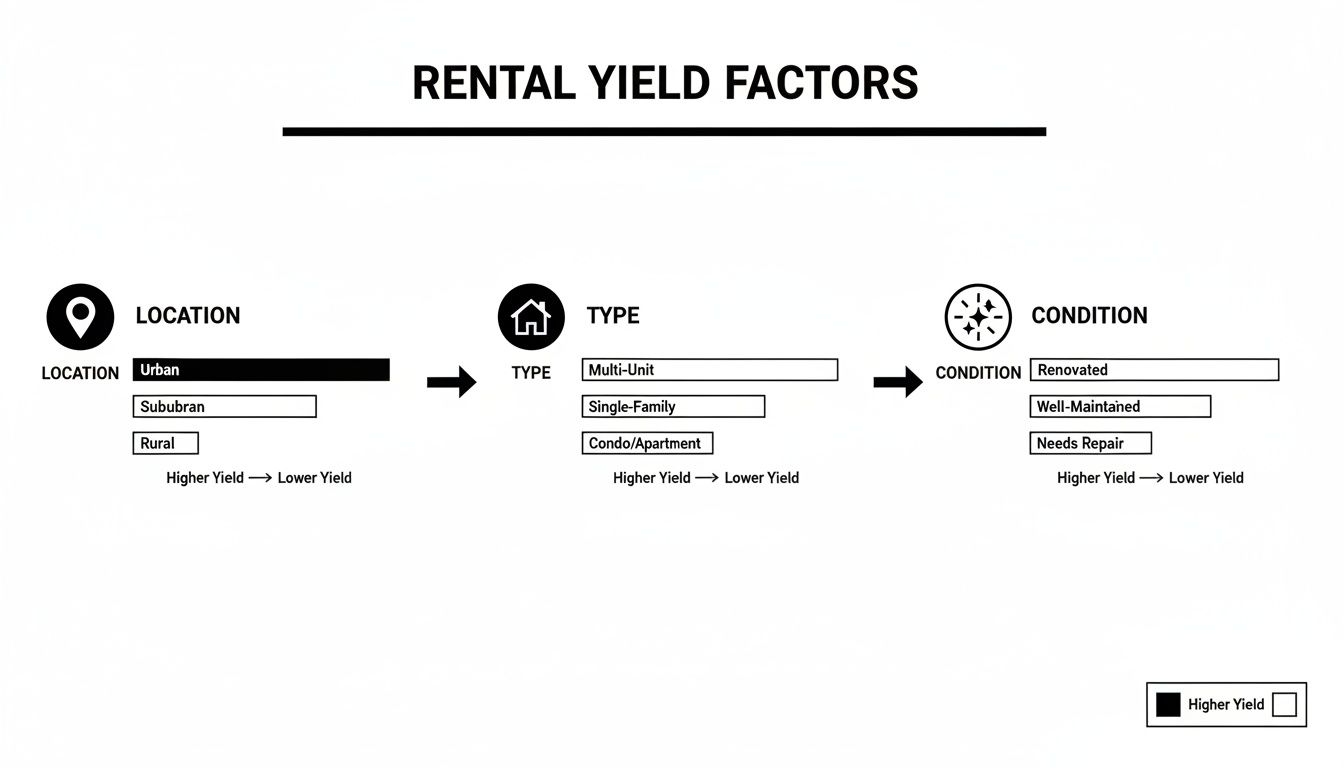
As you can see, properties in prime spots or in excellent shape will naturally fetch higher rents and, as a result, deliver better returns for their owners.
Comparing Beaumont and Yucaipa: A Tale of Two Yields
To really drive home how these local nuances impact your bottom line, let's put two hypothetical investment properties under the microscope. We’ll look at a standard 3-bedroom, 2-bathroom single-family home in two of our key service areas: Beaumont and Yucaipa.
This side-by-side comparison shows exactly why a one-size-fits-all approach just doesn't work when you're evaluating investments across the Inland Empire.
Investor Insight: Even in neighboring towns, small differences in property values, local demand, and typical rental rates can create a significant gap in net rental yield. This underscores the importance of granular, local market analysis before making any investment decision.
Let's run the numbers and see how these two markets stack up.
Hypothetical Rental Yield Comparison: Beaumont vs Yucaipa
| Metric | Beaumont Example | Yucaipa Example |
|---|---|---|
| Purchase Price | $525,000 | $500,000 |
| Monthly Rent | $2,950 | $3,000 |
| Annual Gross Rent | $35,400 | $36,000 |
| Gross Yield | 6.74% | 7.20% |
| Annual Expenses | ~$17,000 | ~$17,430 |
| Net Annual Income | $18,400 | $18,570 |
| Net Yield | 3.50% | 3.71% |
The table makes it clear: the Yucaipa property, with its slightly lower purchase price and higher rent, delivers a stronger yield on both a gross and net basis. While the Beaumont property still offers a solid return, this example proves how critical it is to crunch the numbers for each specific property and location.
Remember, other factors like property taxes, insurance rates, and HOA fees in communities from Calimesa to Banning can also move the needle on these outcomes.
Understanding these subtle but powerful differences is the key to maximizing your returns. For a broader look at our service areas, you can learn more about our approach to property management in the Inland Empire. This is the kind of targeted analysis that gives investors the edge they need to succeed in our region.
How Professional Management Maximizes Your Rental Yield
Hiring a property manager can feel like just another expense on your spreadsheet. But experienced investors know the truth: it's not a cost, it's a strategic move to protect and grow your net income. Think of a professional manager as a yield-maximization engine, connecting all the moving parts of smart operations to boost your bottom line.
Their work goes way beyond just cashing rent checks. They bring proven systems to the table that directly translate into higher returns, turning a good investment into a great one. The difference is real—professionally managed properties often see a net yield increase of 1.5% to 2% over self-managed ones.
Reducing Costly Vacancies and Turnover
One of the biggest silent killers of rental yield is vacancy. Every single month your property sits empty, you’re not just losing rent; you're still on the hook for the mortgage, taxes, and insurance. This is where a property manager’s expertise really shines.
They attack vacancies with a three-pronged strategy to keep your property consistently occupied:
- Expert Market Analysis: They pinpoint the perfect rent price—not so high that it scares away good tenants, but not so low that you're leaving money on the table. Hitting this sweet spot brings in a larger pool of qualified applicants, fast.
- Rigorous Tenant Screening: A thorough screening process that digs into credit, background, and rental history is your best defense against future headaches. Placing a reliable, long-term tenant from the start is infinitely more profitable than dealing with evictions and constant turnover.
- Proactive Tenant Retention: It's much cheaper to keep great tenants than to find new ones. Professional managers are pros at this. They provide responsive communication and handle maintenance promptly, creating a positive living experience that encourages tenants to renew their lease year after year.
Streamlining Operations and Protecting Cash Flow
Smooth, efficient day-to-day management is absolutely critical for protecting your net yield. A professional property manager puts systems in place that plug profit leaks and ensure your cash flow stays consistent and predictable. They take on the tedious but vital tasks of rent collection, lease enforcement, and financial record-keeping.
This operational discipline directly shields your income. No more chasing down late payments or having those awkward conversations. Instead, you get a reliable monthly deposit and clean financial statements, giving you a crystal-clear picture of how your investment is performing.
So what's a "good" yield? Historically, anything over 6-7% gross is considered strong. Major European markets saw gross yields average 6.9% in Paris (1809-1943) and a robust 9.9% in Amsterdam (1900-1979), with net yields settling at 3.9% and 5.4% respectively after expenses. For property owners in growing areas like Banning, Loma Linda, Beaumont, and Redlands, hitting that range means your annual rent should cover at least 6-7% of the property's purchase price. That's exactly where expert Property Management Beaumont and Beaumont property management services make a difference—handling everything from tenant screening to maintenance to maximize your take-home returns. Explore the historical data on property returns.
Proactive Maintenance That Saves You Money
Smart maintenance isn't just about fixing things when they break. It’s about preventing small issues from snowballing into budget-destroying emergencies. A property manager brings a proactive approach to property care that saves you a significant amount of money in the long run.
They perform regular inspections to catch problems early—like that tiny leak under the sink before it floods the kitchen and requires a total remodel. They also have a trusted network of vetted, affordable vendors, so you get quality work done at a fair price without the headache of finding contractors yourself. This preventative strategy keeps your property in top shape, protecting its value while minimizing the unexpected, costly repairs that can wipe out your annual yield. To learn more, check out our guide on what a property manager does for you.
Common Questions About Rental Yield
Even once you've got the formulas down, real-world questions always pop up when you're staring at a potential investment property. This is where the theory behind rental yield bumps up against the reality of being a landlord. To help you sort through it all, we’ve put together some straight answers to the questions we hear most from property owners.
Our goal is simple: to bring clarity to these common sticking points, reinforce what we've covered, and help you make smarter, more confident decisions for your portfolio, whether it's in Redlands, Banning, or anywhere in between.
Should I Prioritize High Rental Yield or Capital Appreciation?
This is the classic tug-of-war for real estate investors, and honestly, the "right" answer comes down to what you want your money to do for you. Think of it as choosing between a steady paycheck now versus a big bonus down the road.
A high rental yield is all about generating consistent, predictable monthly cash flow. It’s the perfect strategy for investors who want immediate passive income to supplement their lifestyle or reinvest. On the flip side, capital appreciation is a long game. You're betting on the property's value growing over time, building your net worth for a future sale.
Ideally, you find a property that gives you a healthy mix of both. In many of the Inland Empire communities we serve, it's absolutely possible to find homes that generate strong cash flow while benefiting from steady market growth. An experienced Redlands property management team can run the numbers and help you spot properties that align with your financial goals, so you don't have to choose one over the other.
How Can I Increase My Current Property's Rental Yield?
You don't always have to buy a new property to get better returns. Sometimes the biggest opportunities are hiding in the properties you already own. The first and easiest step is to make sure your rent is actually in line with the current market. Even a small, justified rent increase can have a huge impact on your annual yield.
Next, look for simple, value-adding improvements. Things like modernizing old light fixtures, installing a smart thermostat, or freshening up the curb appeal can make the property more attractive and justify a higher rent. On the other side of the equation, trim your expenses without cutting corners. This could mean refinancing your mortgage for a better rate or making sure you're taking advantage of every possible tax break. For more on that, you might want to check out our guide on understanding rental property tax deductions.
Pro Tip: The single best way to protect your yield is to minimize vacancy. Keeping a great tenant is always more profitable than dealing with the costs of turnover—marketing, cleaning, and lost rent. This is where professional Yucaipa property management really shines, keeping your property occupied and your income flowing.
When Is the Right Time to Hire a Property Manager?
The tipping point usually comes when the time, stress, and hassle of self-management start costing you more than you're saving. If you're wondering when to hire a property manager, ask yourself if any of these situations sound familiar.
It’s probably time to call in a professional if you:
- Live too far away to handle issues quickly.
- Feel swamped managing multiple properties.
- Aren't confident in your knowledge of landlord-tenant law.
- Simply want your investment to be truly passive.
A local expert in a place like Beaumont or Banning does a lot more than just collect rent—they optimize your asset. When you search for "property management near me," you're looking for a partner who can keep your investment compliant, well-maintained, and consistently profitable. The right Beaumont property management team will often increase your net yield by enough to more than cover their fee, turning a good investment into a great one.
Ready to maximize your rental yield without the day-to-day headaches? The experts at AIM PROPERTY MANAGEMENT COMPANY are here to help. We provide specialized residential property management services in Redlands, Beaumont, Calimesa, Yucaipa, Loma Linda, Mentone, Highland, and Banning to ensure your investment performs at its peak.