
Thinking about renting out your house? It can be a fantastic way to build wealth, turning one of your biggest monthly expenses into a steady stream of income. In a market where selling might not get you top dollar, holding onto your property and letting a tenant's rent payments build your equity is a seriously smart move.
The Big Question: Should You Rent Out Your House?
Deciding whether to rent or sell is a major crossroads for any homeowner. On one hand, you’re opening the door to passive income and long-term appreciation. On the other, you’re stepping into the role of a landlord, which comes with a whole new set of responsibilities.
This guide is designed to be your personal roadmap. We'll walk you through everything—from the hard numbers on a spreadsheet to the real-world duties of owning a rental property—so you can make a confident, informed choice.
What This Guide Will Cover
To figure out if becoming a landlord is the right move, you need the full picture. We’re going to break down the key areas you need to consider:
- Is It Actually Profitable? We'll dive into how to calculate your potential cash flow and return on investment to see if the numbers even make sense.
- What's Happening Locally? We'll look at how market trends in communities like Redlands, Beaumont, Calimesa, Yucaipa, Loma Linda, Mentone, Highland, and Banning can impact your success as a landlord.
- What Does a Landlord Do? We'll cover your legal and practical obligations under California law. It's more than just collecting a check.
- DIY or Hire a Pro? Should you manage the property yourself, or is it smarter to hire a professional property manager to handle the day-to-day grind?
Understanding the Opportunity
Right now, the housing market presents a unique opportunity for homeowners thinking about renting. With many potential buyers priced out, the demand for quality rental homes is strong and growing. In fact, recent projections show single-family rent growth is expected to hit 2.3%, outpacing multifamily growth by a wide margin.
This trend makes single-family homes in areas like Loma Linda, Highland, Mentone, and Banning especially attractive for generating reliable rental income.
Becoming a landlord is like starting a small business. Your house is the product, your tenant is the customer, and your goal is to run a profitable operation that works for everyone involved.
And if you're just thinking about renting out a spare room? It's worth looking into options for tax-free income from letting a room, which can offer some nice financial perks.
To give you a quick overview, here’s a simple breakdown of the main factors to weigh when making your decision.
Key Factors At-a-Glance: Rent vs Sell Decision
| Consideration | Renting Your House | Selling Your House |
|---|---|---|
| Income Potential | Consistent monthly cash flow and long-term equity growth. | A large, one-time lump sum of cash. |
| Market Timing | Great for holding onto your asset during a slow or down market. | Best when home prices are high and demand is strong. |
| Ongoing Costs | You cover maintenance, repairs, taxes, and insurance. | All property-related expenses end at the closing table. |
| Personal Involvement | Requires ongoing management, either by you or a professional. | Once the sale is final, your involvement is over. |
| Long-Term Value | Your property continues to appreciate in value over time. | You cash out the current equity and lose future appreciation. |
| Flexibility | You can decide to sell it later or even move back in. | The decision is permanent; you can't get the property back. |
By the end of this guide, you’ll have the clarity you need to answer that big question and decide if the landlord life is the right path for you.
Calculating Your Potential Profit: A Financial Deep Dive
Alright, this is where the big question—"Should I rent out my house?"—gets real. We're moving past the idea and into the numbers. Before you make any moves, you need an honest, clear-eyed look at what you could actually make. Think of it like mapping out a road trip before you leave the driveway; you need to know your destination and exactly how much gas (and snacks) you'll need for the journey.
This financial breakdown is your map. We'll walk through how to figure out your potential income and, just as important, how to account for every single expense—especially the sneaky ones that are easy to forget.
Step 1: Estimate Your Monthly Rental Income
The first piece of the puzzle is figuring out what you can realistically charge for rent. This isn't just picking a number out of thin air. Price it too high, and your property will sit empty, costing you money. Price it too low, and you're leaving cash on the table every single month.
To hit that sweet spot, you need to dive into the local market and find comparable properties, or "comps." This means looking for homes similar to yours in neighborhoods across Yucaipa, Calimesa, and Beaumont.
- Property Type: Are you comparing your single-family home to other houses, or to condos and townhomes? Keep it apples-to-apples.
- Size: Look at places with similar square footage and the same number of bedrooms and bathrooms.
- Condition and Amenities: Do you have a newly renovated kitchen, a great backyard, or a two-car garage? Those features can justify a higher rent compared to a more dated property.
- Location: You know how it is—rent can change dramatically from one block to the next. Be specific.
Following this process gives you a realistic, data-driven rental rate. It ensures you’re competitive from day one and not just guessing.
Step 2: Tally Up All Your Expenses
This is where so many first-time landlords get tripped up. Your profit isn't simply the rent check minus your mortgage payment. It's the rent minus all your costs. Getting this list right is crucial for an accurate picture.
Core Fixed Expenses:
- Mortgage (P&I): Your straightforward principal and interest payment.
- Property Taxes: Take your annual bill and divide it by 12.
- Homeowners Insurance: This is a big one. You’ll need to switch to a landlord policy. It typically costs about 25% more than a standard policy, but it's absolutely essential for protecting you from liability.
- HOA Fees: If you're in a community with an HOA, don't forget these monthly or quarterly dues.
Critical Variable Expenses & Reserves:
These are the costs that can absolutely sink an unprepared landlord. The smart move is to set money aside for them every month, building up a reserve so you're never caught off guard.
- Vacancy Fund (5-10% of Rent): Let's be realistic—your property won't be occupied 100% of the time. To prepare for turnover, plan on saving 5-10% of the monthly rent to cover at least one month of vacancy per year.
- Maintenance & Repairs (1% Rule): A great rule of thumb is to budget 1% of your home's value annually for maintenance. For a $450,000 home, that's $4,500 a year, which breaks down to $375 per month set aside for everything from a leaky faucet to a busted water heater.
- Property Management Fees (8-12% of Rent): If you're planning to hire a professional manager to handle the headaches, make sure you factor their fee into your budget.
This visual guide lays out a simple process for figuring out if renting is the right financial move for you.
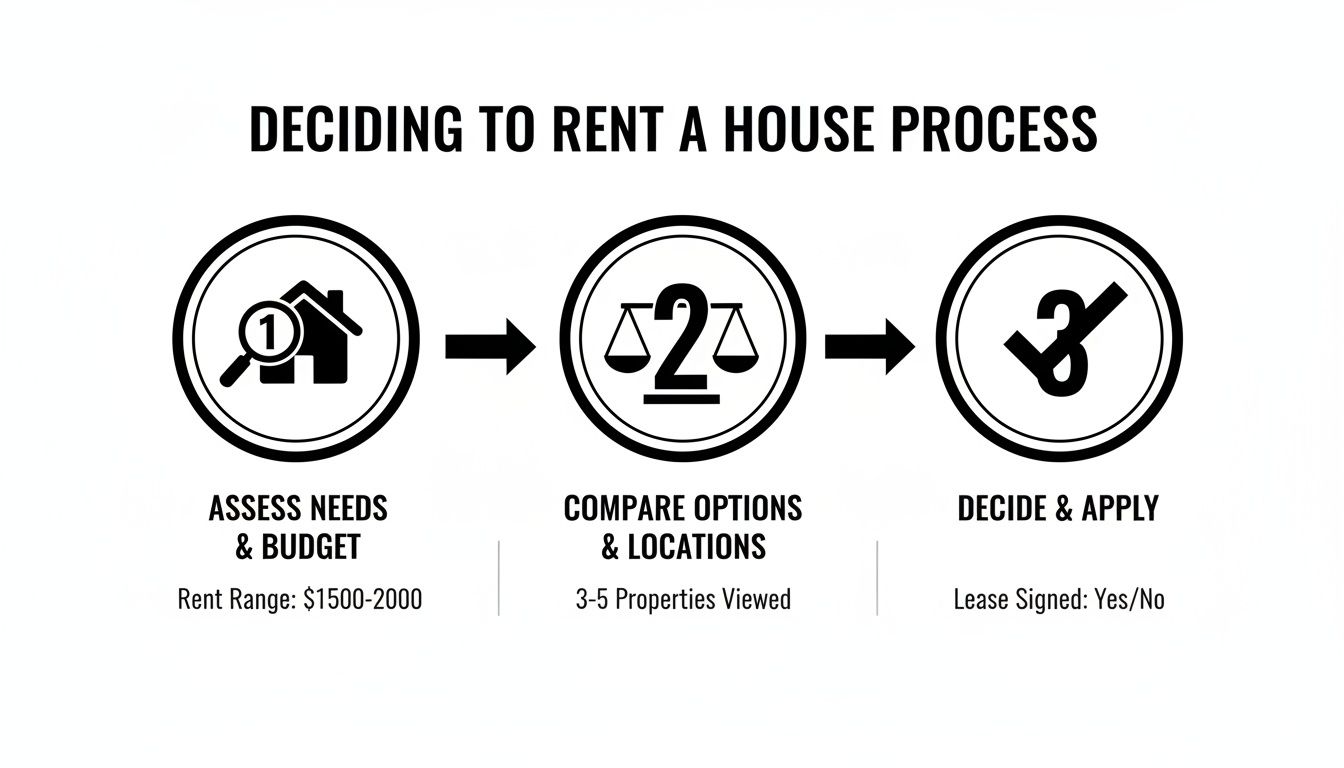
The bottom line is that a solid, structured financial assessment is the foundation of any successful rental property investment.
Step 3: Calculate Your Cash Flow
Now for the moment of truth. Let's put it all together to find your monthly cash flow—the actual money left in your pocket after every single bill is paid. It's the cleanest, simplest measure of whether your property is profitable.
Monthly Rental Income – Total Monthly Expenses = Monthly Cash Flow
If you end up with a positive number, congratulations! Your property is generating a profit each month. But if that number is negative, it’s a warning sign. It means you’ll be paying out of your own pocket just to keep the property running, and renting might not be a viable option right now.
For a deeper dive into this crucial metric, you can learn more about what cash flow in real estate really means in our guide. Getting a firm grip on this one concept is fundamental to making a smart decision.
Understanding the Inland Empire Rental Market
So, you're asking, "should I rent out my house?" That's a huge decision, and the answer has less to do with your mortgage payment and more to do with your local rental market. Real estate is intensely local. The exact same house could be a cash cow in one city and a money pit in another. Your very first step is to get a real feel for the unique dynamics right here in the Inland Empire.
Location isn't just a cliché real estate agents throw around—it’s the engine that drives everything. It determines demand, dictates how much you can charge for rent, and even influences the kind of tenants you’ll attract. Across our corner of Southern California, from Redlands and Loma Linda to Beaumont, Calimesa, and Banning, a unique blend of economic and demographic factors has created a surprisingly resilient and profitable environment for landlords. Let's break down what makes this area tick.
Why the Inland Empire Is a Landlord's Stronghold
The Inland Empire isn't just another sprawling suburb; it's a powerful economic hub with distinct advantages for anyone owning rental property. A few key ingredients make our market so strong:
- Steady Population Growth: Simply put, people are moving here. The Inland Empire offers a more affordable lifestyle than Los Angeles or Orange County, drawing in families and professionals who want more space without being disconnected from major job centers.
- Logistics and Healthcare Hubs: This isn't a sleepy bedroom community. With massive logistics centers and world-class medical facilities like Loma Linda University Medical Center, our region offers stable, high-quality employment. This translates directly into a consistent pool of qualified tenants, from nurses in Loma Linda to warehouse managers in Beaumont.
- The Desire for Space: The demand for single-family rentals is off the charts here. Tenants aren't just looking for a place to sleep; they want backyards, home offices, and the community feel you find in towns like Yucaipa, Mentone, and Highland.
This powerful mix of affordability, solid jobs, and lifestyle perks keeps rental demand high. For a well-maintained property, that means vacancies are much less of a worry.

Local Trends and Setting the Right Rent
It's great to know the big picture, but your success as a landlord lives in the details. Setting the right rent for a home in Mentone is a totally different game than pricing one in downtown Redlands. This is where having true, on-the-ground expertise becomes absolutely critical.
A landlord's greatest tool is market knowledge. Knowing that a specific school district in Yucaipa commands higher rent or that a new development in Banning will increase local demand is the difference between an average return and a maximized one.
A professional analysis goes way beyond a quick Zillow search. It means digging into the nitty-gritty of what comparable properties actually rented for recently. We're talking about factoring in specific amenities, the condition of the home, and hyper-local neighborhood trends. This detailed work ensures you price your rental perfectly—high enough to maximize your income but competitive enough to attract great applicants fast, minimizing the painful cost of an empty house. This deep understanding is the core of smart property management in the Inland Empire.
The national forecast backs this up, too. Across the U.S., single-family rentals are seen as a strong investment, scoring a 3.75 investment prospects rating for 2026 as people continue to prioritize having more space. Better yet, Sun Belt markets—which include hotspots like Yucaipa, Calimesa, and Redlands—are projected to see 1-2% rent growth after 2025. This reinforces the long-term value of holding onto your property and turning it into a rental.
Navigating Your Legal and Practical Duties as a Landlord
Deciding "should I rent out my house?" is much more than a financial calculation. It’s a commitment to a whole new role, and it comes with some serious responsibilities. When you hand over the keys, you're not just collecting rent—you're officially a landlord, a position governed by a web of California laws and practical, day-to-day duties.
This isn't just about being a good host; it's about legal compliance. California has some of the most stringent landlord-tenant laws in the country, and one simple mistake can quickly spiral into a costly dispute. From crafting a legally sound lease to handling security deposits the right way, every single action you take is regulated.

Core Legal Obligations for California Landlords
Stepping into the landlord role means you have to operate within a very specific legal framework. These aren't suggestions; they are requirements that protect both you and your tenant. Overlooking any of them can have significant financial and legal consequences.
A few of the most critical legal duties include:
- Fair Housing Compliance: You must follow the federal Fair Housing Act and California’s Fair Employment and Housing Act (FEHA). This means you cannot discriminate against potential tenants based on race, color, religion, sex, national origin, familial status, disability, or other protected characteristics.
- Legally Sound Lease Agreements: Your lease is a binding contract, and it has to be airtight. It must include all required disclosures and can't contain illegal clauses. That generic template you found online? It often isn't enough to protect you under California law.
- Security Deposit Management: California law is very specific about how much you can charge for a security deposit (generally two times the monthly rent for an unfurnished unit), where it must be held, and the exact timeline for returning it—along with an itemized list of deductions—after a tenant moves out.
Navigating these rules is completely non-negotiable. For a detailed breakdown, check out our guide covering the full scope of landlord responsibilities in California.
The Implied Warranty of Habitability
Beyond specific statutes, California law requires every rental unit to be "habitable." This fundamental duty is known as the implied warranty of habitability, and it means the property must meet basic living and safety standards for the entire time a tenant lives there.
This legal standard holds you responsible for ensuring your property has essentials like effective waterproofing, working plumbing and electrical systems, and is free from hazards. It is a continuous obligation that lasts for the entire duration of the lease.
Failing to maintain a habitable property can give a tenant legal grounds to withhold rent or even break their lease. This makes prompt and effective maintenance not just good customer service, but a legal imperative.
Practical Day-to-Day Responsibilities
The legal stuff is just the beginning. The real work of a landlord lies in the ongoing, practical management of the property and your relationship with the tenant. This is where many DIY landlords discover just how much time is truly involved.
Your daily and monthly to-do list will include:
- Responding to Maintenance Requests: When a dishwasher breaks or a pipe leaks at 10 p.m., it’s your job to get it fixed—and fast. This means having a network of reliable and affordable plumbers, electricians, and handymen you can call at a moment's notice.
- Conducting Property Inspections: You have a right to inspect your property, but you can't just show up. You must provide proper written notice (typically 24 hours in California) before entering, unless it's a true emergency.
- Ensuring Property Safety: This duty goes beyond fixing what's broken. As the property owner, you're responsible for maintaining a safe environment to prevent injuries. To really understand what's at stake, it's worth reading through a property owner's guide to premises liability.
These tasks transform your home from a personal asset into a small business operation. The question then becomes not just if you can do it, but if you have the time, expertise, and temperament to do it well. For many homeowners in Yucaipa, Highland, and Redlands, this is the exact point where hiring a professional property manager becomes an obvious and invaluable solution.
Choosing Your Path: DIY Landlord vs. Professional Management
After running the numbers and getting a handle on your legal duties, you’ve arrived at another major fork in the road. Now you have to decide how you’re going to manage this new venture. This isn't just a small detail; it's a fundamental choice that will shape your entire experience as a landlord and determine whether your property is a source of passive income or a demanding part-time job.
You really have two options on the table. The first is the hands-on, Do-It-Yourself (DIY) approach, where you’re the go-to person for everything. The second is to partner with a professional firm, like AIM Property Management, to handle all the heavy lifting for you. Ultimately, this decision comes down to a personal calculation of what your time, expertise, and peace of mind are truly worth.
The Appeal and Reality of Self-Management
Let's be honest—the main reason anyone considers managing a property themselves is to save money on management fees. By keeping that 8-12% of the monthly rent in your own pocket, you maximize your direct cash flow. For homeowners who live nearby, have a flexible schedule, and already have a good grasp of basic maintenance and California tenant law, this can seem like a no-brainer.
But the reality of being a DIY landlord is that you’re trading money for time—and often, a lot more time than you think. You instantly become the leasing agent, the rent collector, the maintenance coordinator, and the person who gets the call about a leaking toilet at 10 PM on a Saturday. That isn't something that can wait until Monday morning; it's on you to solve it, right now. Even worse, the risk of making a costly legal mistake, like mishandling a security deposit or using a generic lease you found online, is incredibly high. A single legal misstep can easily wipe out years of saved management fees.
The Value Proposition of Professional Management
Hiring a professional property manager is an investment in your freedom and your asset's security. While there's a direct cost, the value you get in return often far outweighs the expense. A professional firm brings established systems, deep local market knowledge, and legal expertise to the table, which dramatically de-risks your investment.
Deciding to rent out your house is a smart move, especially as global real estate investment turnover is forecasted to exceed $1 trillion—the highest it's been since 2022. With house prices stalling, holding onto your property and renting it out is a great way to preserve equity while generating income. However, self-managing is a gamble; statistics show that late payments can affect 10-15% of tenancies that don't have professional oversight. A seasoned manager ensures rent comes in on time and that you're always in strict legal compliance.
Partnering with a professional manager transforms your rental property from a demanding part-time job into a source of truly passive income. It's about buying back your time and offloading the stress.
With a team managing your property, you get access to expert tenant screening that drastically reduces the risk of placing a problem tenant in your home. Rent collection becomes systematic and reliable. Most importantly, you are completely freed from the day-to-day operational grind, allowing you to focus on your career, your family, or finding your next investment. If you're weighing your options, our guide on how to find a property manager who fits your needs can provide some valuable clarity.
A Side-by-Side Comparison
To make the choice crystal clear, let's break down exactly what each path entails. For homeowners in Beaumont, Yucaipa, Calimesa, and Redlands, this table highlights the key differences between going it alone and partnering with the experts at AIM Property Management.
DIY Landlord vs. Professional Property Manager
| Task | Self-Management (DIY) | Hiring AIM Property Management |
|---|---|---|
| Tenant Screening | You're on your own—handling marketing, applications, background checks, and reference calls yourself. | We use a proven, multi-point screening process to find reliable, high-quality tenants who pay on time. |
| Rent Collection | Your responsibility. You have to personally collect rent and chase down any late payments. | We manage all collections through a streamlined, professional system to ensure consistent cash flow for you. |
| Maintenance | You're the 24/7 contact. You have to field all tenant calls and find your own trusted vendors for every repair. | We provide a 24/7 maintenance line and coordinate all repairs with our network of vetted, affordable contractors. |
| Legal Compliance | You must stay current on all complex and ever-changing California landlord-tenant laws on your own. | Our team ensures your property remains fully compliant with all local, state, and federal regulations, protecting you from risk. |
| Time Commitment | Significant and unpredictable. It’s an ongoing, active role that demands your constant attention. | Minimal. You review statements and make major decisions while we handle all the daily operations. |
Choosing between these two paths is one of the most important decisions you'll make as a property owner. One path saves you a management fee but costs you time and exposes you to risk. The other costs a fee but buys you professional expertise, peace of mind, and your time back.
Your Next Steps to Becoming a Successful Landlord
Deciding to rent out your house is a huge step. You're not just a homeowner anymore; you're turning a personal space into a powerful, income-generating asset.
This guide has walked you through the entire thought process, from running the initial numbers to understanding the complex legal duties of being a California landlord. By now, you should have a solid framework for answering the big question: "Should I really rent out my house?"
We've covered how to calculate your real-world cash flow, explored the unique strengths of the Inland Empire rental market, and tackled the critical choice between going it alone or partnering with a professional. The road to becoming a successful landlord is a rewarding one, but it absolutely requires a clear plan and a realistic view of what’s involved.
Turning Your Plan Into Profit
The information you have now is your foundation. You know how to size up your property’s potential in communities like Redlands, Beaumont, Mentone, and Yucaipa. You’ve weighed the time and effort of a DIY approach against the peace of mind that comes with expert oversight. Now, it’s time to put that plan into action.
The most successful landlords don't just own property; they run a business. They rely on proven systems, local expertise, and a commitment to protecting their investment and providing a quality home for their tenants.
If you’re ready to unlock your home's income potential without the stress of late-night maintenance calls and trying to decipher dense legal codes, professional management is your clearest path to success. The right partner can transform a potentially overwhelming job into a source of consistent, worry-free income.
For homeowners in Loma Linda, Highland, Banning, Calimesa, and the surrounding areas, our team at AIM Property Management is here to provide that expertise. We already have the systems in place to handle every detail, from meticulous tenant screening to efficient rent collection and maintenance coordination.
Let us manage the complexities so you can simply enjoy the rewards. Contact us to learn how we can make your rental property a seamless, profitable success.
Frequently Asked Questions
Even after you’ve weighed all the pros and cons, it's natural to have a few last-minute questions before you jump into being a landlord. We get it. Here are some of the most common things we hear from property owners here in the Inland Empire, answered to give you that final bit of clarity.
How Much Rent Can I Get For My House in Beaumont or Yucaipa?
Figuring out the right rent is all about a hyper-local market analysis. It’s more than just plugging numbers into an online calculator. Things like your home's exact size, its current condition, the amenities you offer, and what similar homes are renting for right down the street all play a huge role.
Those online estimators can give you a ballpark idea, but they often miss the tiny details that make a big difference in local demand.
A professional specializing in Beaumont property management or Yucaipa property management, like our team here at AIM, can give you a precise, competitive rental price analysis. We use real-time data to attract the best tenants quickly and make sure you're not leaving money on the table.
What Are the Biggest Risks of Renting Out My Property Myself?
Honestly, the biggest risks for DIY landlords usually come from not knowing the ins and outs of California's dense and complex tenant laws. Simple, honest mistakes can turn into incredibly expensive headaches.
We've seen it all, but some of the most common pitfalls include:
- Non-Compliant Leases: Grabbing a generic lease template online that’s missing California-specific disclosures.
- Fair Housing Violations: Accidentally saying something in an ad or during a showing that could be interpreted as discriminatory.
- Improper Security Deposit Handling: Not following the strict rules for deductions and the tight timelines for returning a deposit.
- Incorrect Eviction Procedures: Trying to remove a non-paying tenant without following every single legal step to the letter.
Any one of these errors can land you in a costly lawsuit. A professional property manager is your best defense, using proven systems and up-to-date legal knowledge to protect you and your investment.
Do I Need to Change My Homeowners Insurance?
Yes, you almost certainly do. Your standard homeowners insurance is for a home you live in. The moment you have a tenant, it's considered a business activity, which your current policy likely won't cover. You'll need to switch to a landlord insurance policy.
This is non-negotiable. A landlord policy provides critical liability protection if a tenant or their guest gets hurt on the property. It also often includes fair rental value coverage, which replaces lost income if your home becomes unlivable after something like a fire. Expect it to cost about 25% more than your old policy, but it’s an absolute necessity.
Have more questions like this? You can find a lot more answers on our detailed FAQs about property management page.
Is Hiring a Property Manager Worth It For Just One House?
Absolutely. In fact, for many owners with a single property, it’s even more valuable. It’s your ticket to earning passive income without sinking dozens of hours a month into a job you're not trained for. Think of it as buying back your time and your peace of mind.
A good manager handles everything—from marketing your home and screening applicants to dealing with late-night emergency calls and navigating tricky legal waters. When people in the Inland Empire start searching for "property management near me," it's usually because they realize that having a pro in their corner prevents costly errors, slashes stress, and ultimately puts more money in their pocket.
How Does AIM Property Management Screen Potential Tenants?
At AIM, we run a tight ship. Our tenant screening process is incredibly thorough because we know that finding the right person for your home is the single most important thing we do. It’s the foundation of protecting your asset.
Our multi-step process doesn't cut any corners:
- Comprehensive background checks
- Detailed credit report analysis
- Employment history and income verification
- Past rental history and reference checks
This rigorous approach helps us find qualified tenants who are likely to pay on time, take good care of your property, and be great neighbors—protecting your investment for the long haul.
Ready to turn your property into a source of consistent, stress-free income? The team at AIM PROPERTY MANAGEMENT COMPANY has the local expertise and proven systems to make your rental a success. We proudly serve Redlands, Beaumont, Calimesa, Yucaipa, Loma Linda, Mentone, Highland and Banning California. Contact us today to get started.