

A rental property ROI calculator is a strategic tool that does more than just estimate potential rent—it forecasts a property's true profitability by stacking up all your income against all your expenses. It's the key to moving beyond simple guesswork to see what your real net return will be, making it an absolutely essential tool for smart investing.
Why an ROI Calculator Is Your Most Powerful Investment Tool

Jumping into the real estate market without a clear financial picture is like driving blind. A good rental property ROI calculator is your roadmap, giving you a data-driven path toward confident, sound investment decisions. It’s so much more than a simple spreadsheet; think of it as a forecasting engine that helps you see past the sticker price and gross rent to what actually matters: your net profit.
Seasoned investors in communities like Redlands, Loma Linda, and Highland know that success is found in the details. A reliable calculator forces you to look at every single expense, both the obvious and the hidden, that can eat into your bottom line.
Moving Beyond Guesswork
Relying on rough rent estimates while ignoring operational costs is a recipe for disappointment. An effective ROI calculation gives you a realistic preview of how your investment will perform by forcing you to factor in all the necessary variables.
These are the inputs you can't afford to ignore:
- Property Taxes: A significant and recurring expense that can vary wildly depending on the city and county.
- Landlord Insurance: Absolutely critical for protecting your asset from unexpected damages or liability.
- Maintenance and Repairs: You have to budget for both routine upkeep and those inevitable emergency fixes.
- Vacancy Periods: No property stays occupied 100% of the time. Factoring in some downtime is vital for a realistic forecast.
- Property Management Fees: If you plan to hire a professional service to handle the day-to-day, this needs to be in your calculation from the start.
By putting a number to these costs, you turn a vague idea of "profitability" into a hard figure. This data empowers you to compare different opportunities on a true apples-to-apples basis. You can objectively weigh a single-family home in Beaumont against a condo in Yucaipa, making your final choice based on solid numbers, not just a gut feeling. For a great primer on the fundamentals, check out this guide on how to calculate Return on Investment.
The Ultimate Metric for Comparison
Understanding ROI isn't just about one property; it’s about building a strong, profitable portfolio. While some markets might boast impressive numbers—like Texas leading the U.S. with a 6.3% gross rental yield and 7.1% price growth projected for 2025—those figures are just the beginning. The real magic happens when you calculate the net picture by plugging in local costs.
For owners here in California, a solid Yucaipa property management service ensures your ROI calculator stays in the green by expertly handling everything from inspections to legal compliance. Professional management can turn a modest 5-7% yield into reliable, hands-off passive income, which is a key reason so many high-income earners seek out these services.
This data-driven approach is the definitive way to validate an investment. It answers the most critical question: "Will this property actually make me money?" Before we dive into the "how" of the calculations, establishing this "why" is the first step toward building sustainable wealth through real estate.
Gathering Your Data for an Accurate ROI Calculation

Any good rental property ROI calculator is only as smart as the numbers you feed it. As the old saying goes, "garbage in, garbage out." To get a truly reliable forecast of your investment's potential, you have to roll up your sleeves and do a bit of detective work.
Tracking down every last figure that impacts your bottom line is non-negotiable. Let’s break down exactly what you need to find.
The Initial Investment Numbers
First things first, we need to nail down your total cash investment. This starts with the obvious one: the purchase price of the property. Simple enough.
But your out-of-pocket costs don't stop there. You also have to account for all the associated closing costs, which typically run between 2% and 5% of the purchase price. These can include appraisal fees, title insurance, loan origination fees, and inspection costs.
Finally, did the property need some work before a tenant could move in? Add any immediate renovation or repair costs to your total. Combining these three—purchase price, closing costs, and upfront repairs—gives you a clear picture of your initial investment.
Estimating Your Ongoing Operational Expenses
With your initial investment tallied, it's time to project the recurring costs of actually owning the place. This is where so many new investors stumble, either by lowballing their estimates or forgetting key expenses entirely.
Getting these numbers right is crucial because they directly eat into your rental income and determine your property's real performance. Before you plug anything into a calculator, make sure you've researched the following:
- Property Taxes: Don't just guess. Tax assessments can vary significantly between areas like Calimesa and Banning, so check the specific county assessor’s website for the most accurate rates.
- Landlord Insurance: This isn't the same as your standard homeowner's policy. Get specific quotes for a landlord policy that protects your asset from liability and property damage.
- HOA Fees: If your property is in a homeowners' association, these monthly or annual fees are a fixed expense you absolutely must include.
- Utilities: Will you be covering water, trash, or sewer for your tenants? Make sure to factor those costs into your monthly budget.
Before we go any further, here's a quick checklist to help you gather all the necessary data.
Essential Inputs for Your Rental Property ROI Calculator
| Input Category | Description | Example (Beaumont/Yucaipa) |
|---|---|---|
| Purchase Price | The final agreed-upon sale price of the property. | $450,000 |
| Closing Costs | Fees associated with finalizing the purchase (2-5% of price). | $9,000 – $22,500 |
| Initial Repairs | Immediate costs to get the property rent-ready. | $5,000 |
| Down Payment | The cash you put down for the loan. | $90,000 (20%) |
| Monthly Rent | Your projected gross monthly rental income. | $2,800 |
| Property Taxes | Annual taxes, often paid monthly via escrow. | ~$470/month |
| Insurance | Annual landlord insurance policy premium. | ~$100/month |
| HOA Fees | If applicable, the monthly homeowners' association dues. | $0 – $150/month |
| Maintenance | Budget for ongoing repairs (e.g., 1% of property value annually). | ~$375/month |
| CapEx | Savings for major replacements (roof, HVAC). | ~$375/month |
| Vacancy Rate | Percentage of annual rent set aside for empty periods (5-8%). | $140 – $224/month |
| Property Management | Fees for professional management services (if applicable). | ~7.9% of rent |
Having these figures on hand will give your calculations the accuracy they need to be truly useful for decision-making.
Budgeting for the Unpredictable: Vacancy and Repairs
Here’s a hard truth: no property is occupied 100% of the time, and things will inevitably break. Prudent investors build these realities into their calculations from day one.
Assuming 100% occupancy is one of the most common and costly mistakes an investor can make. Every property will experience vacancies between tenants, so budgeting for this downtime is essential for a realistic financial projection.
For vacancy rates, a good rule of thumb is to budget 5% to 8% of your gross annual rent. This is like assuming the property will be empty for about one month each year—a financial safety net you'll be glad to have.
Likewise, you need a separate budget for routine maintenance (a leaky faucet) and capital expenditures (CapEx), which are the big-ticket replacements like a new roof or HVAC system. A smart practice is to set aside 1% of the property’s value annually for maintenance and another 1-2% for CapEx. This ensures you have the cash ready when those large, inevitable expenses pop up.
Understanding how all these costs affect your net income is the key to mastering your financial picture. Our guide on calculating rental property cash flow can help you dive even deeper. Once you've gathered this comprehensive data, your ROI calculator transforms from a simple tool into a powerful forecasting engine for your investment journey.
Decoding the Formulas: Cash on Cash Return and Cap Rate
Once you've gathered all your numbers, it's time to make them talk. The real magic of a rental property ROI calculator is how it translates raw data into clear, actionable insights. Two of the most critical metrics every real estate investor needs in their toolkit are Cash-on-Cash Return and Capitalization Rate (Cap Rate).
These aren't just industry buzzwords; they're different lenses for viewing a property's performance. Understanding both is absolutely essential for making a smart, well-rounded investment decision.
Cash on Cash Return: The Investor's Perspective
For any investor using a mortgage to buy a property, the Cash-on-Cash Return is arguably the most important number. Why? It answers the one question that matters most: "For every dollar of my own money I put into this deal, what am I getting back each year?"
This formula cuts through the noise of the total purchase price and zooms in on the actual cash you invested out of pocket. That means your down payment, closing costs, and any cash you spent on initial repairs. It then pits that initial investment against the annual cash flow the property generates after all expenses, including the mortgage, have been paid.
The formula is straightforward:
Cash-on-Cash Return = (Annual Pre-Tax Cash Flow / Total Cash Invested) x 100
This metric tells you exactly how hard your personal capital is working for you. A higher Cash-on-Cash Return generally means you're getting more bang for your buck, especially when you're using a loan to your advantage.
A Beaumont Cash on Cash Return Example
Let's walk through a real-world scenario with a hypothetical single-family home in Beaumont, California.
- Purchase Price: $450,000
- Down Payment (20%): $90,000
- Closing Costs & Initial Repairs: $14,000
- Total Cash Invested: $90,000 + $14,000 = $104,000
Now, let's look at the income and expenses:
- Monthly Rent: $2,800 (or $33,600 annually)
- Monthly Mortgage (Principal & Interest): $1,900
- Other Monthly Expenses (Taxes, Insurance, Maintenance, etc.): $800
- Total Monthly Expenses: $1,900 + $800 = $2,700
- Monthly Cash Flow: $2,800 – $2,700 = $100
- Annual Cash Flow: $100 x 12 = $1,200
Plugging those numbers into our formula:
($1,200 / $104,000) x 100 = 1.15% Cash-on-Cash Return
That 1.15% tells you that your $104,000 investment is producing $1,200 in cash profits in the first year. A number this low might be a red flag, suggesting that the rent is too low for the purchase price, the expenses are eating up all the profit, or the deal required too much cash upfront.
Cap Rate: The Property's Perspective
While Cash-on-Cash focuses on your specific financing deal, the Capitalization Rate, or Cap Rate, evaluates the property's raw, unleveraged income potential. It completely ignores the mortgage.
This makes Cap Rate the perfect metric for an apples-to-apples comparison between different properties, no matter how an investor plans to buy them. It essentially measures the return you'd get if you bought the property with all cash.
Here's the formula:
Cap Rate = (Net Operating Income / Purchase Price) x 100
Your Net Operating Income (NOI) is simply the annual rental income minus all operating expenses, excluding the mortgage payment.
Cap Rate is fundamental for evaluating a property's intrinsic earning power. It helps you quickly gauge if a property is priced fairly based on the income it generates—an invaluable tool when you're scanning listings in Banning or Highland.
A Beaumont Cap Rate Example
Let's use the same Beaumont property to figure out its Cap Rate. First, we need the Net Operating Income (NOI).
- Annual Rental Income: $33,600
- Annual Operating Expenses (excluding mortgage): $800/month x 12 = $9,600
- Net Operating Income (NOI): $33,600 – $9,600 = $24,000
Now, we just plug that into the Cap Rate formula:
($24,000 / $450,000) x 100 = 5.33% Cap Rate
This 5.33% figure gives you a benchmark. If another property in nearby Loma Linda is listed with a 4% Cap Rate, this Beaumont home looks like a better deal from a pure income perspective. For a more detailed breakdown, you can explore our guide on how to calculate cap rate on rental property. You can also delve deeper by checking out this great resource on calculating cap rate for rental property.
By mastering both formulas, you gain a multi-dimensional view of any investment, arming your rental property ROI calculator with the power to reveal a property's true potential.
Putting It All Together: A Local Case Study in Yucaipa
Formulas and theory are great, but the rubber really meets the road with a real-world example. Let’s walk through a detailed case study using a hypothetical—but totally realistic—rental property right here in Yucaipa, California. This will show you exactly how to put a rental property ROI calculator to work when analyzing a local investment.
Our subject is a 3-bedroom, 2-bathroom single-family home, a bread-and-butter rental type for the area.
Setting Up the Property Profile
First things first, we need to nail down the key financial details for our Yucaipa property. I’ve based these numbers on current market conditions to keep our example as grounded as possible.
- Purchase Price: $480,000
- Down Payment (20%): $96,000
- Closing Costs (3%): $14,400
- Initial Repairs (Fresh paint, minor fixes): $6,000
Add those up, and you get your Total Cash Invested. For this property, that’s $96,000 + $14,400 + $6,000 = $116,400 out of pocket.
Next, we have to project our monthly income and expenses. This is where many investors get tripped up by underestimating costs.
- Estimated Monthly Rent: $2,900
- Monthly Mortgage (P&I on a $384,000 loan at 6.5%): ~$2,427
- Monthly Property Taxes (~1.25% annually): $500
- Monthly Landlord Insurance: $120
- Monthly Maintenance Reserve (1% of value / 12): $400
- Monthly Vacancy Reserve (5% of rent): $145
With these numbers plugged in, we’re ready to see what the calculator tells us.
Calculating the Key ROI Metrics
Let's run these figures through the formulas we talked about earlier and see how this Yucaipa investment actually performs on paper.
We'll start with the Cash-on-Cash Return, which requires our annual cash flow.
Our total monthly expenses are the mortgage plus all the operational costs: $2,427 + $500 + $120 + $400 + $145 = $3,592.
Here's our first problem. With rent at only $2,900, our monthly cash flow is negative: $2,900 – $3,592 = -$692. Annually, that’s a loss of -$8,304.
The calculation looks like this: (-$8,304 / $116,400) x 100 = -7.13% Cash-on-Cash Return.
That negative return is a massive red flag. It tells us the property’s income doesn't even come close to covering its expenses, especially that hefty mortgage.
Now, let's look at the Cap Rate, which ignores financing and just focuses on the property's performance. First, we need the Net Operating Income (NOI).
- Annual Rent: $2,900 x 12 = $34,800
- Annual Operating Expenses: ($500 + $120 + $400 + $145) x 12 = $13,920
- NOI: $34,800 – $13,920 = $20,880
The Cap Rate is: ($20,880 / $480,000) x 100 = 4.35% Cap Rate.
A 4.35% Cap Rate is modest, but it shows the property itself has some decent income potential. The negative cash flow is clearly a result of the high financing costs in this particular scenario.
This diagram helps visualize the two core calculations we just ran.
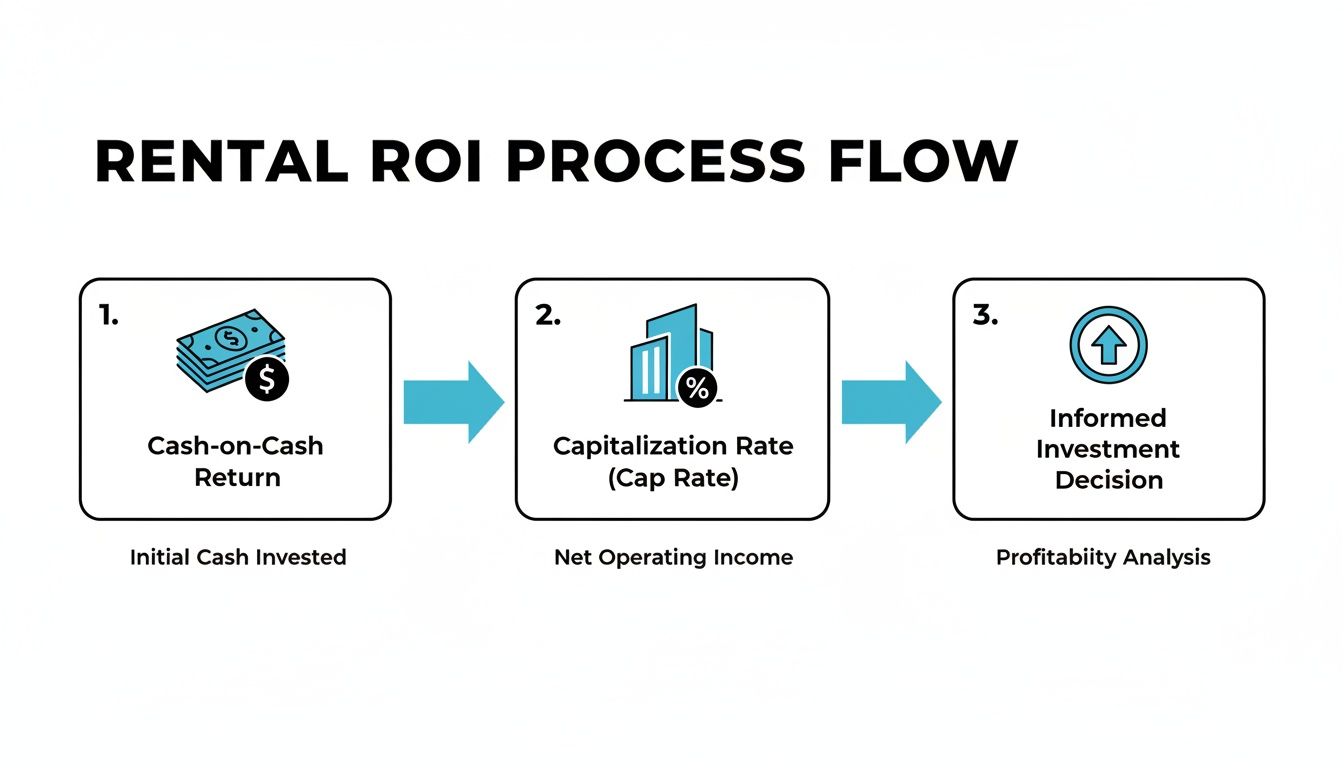
You can see how it separates the investor-focused Cash-on-Cash metric from the property-focused Cap Rate, reinforcing how they each tell a different part of the story.
What Is Sensitivity Analysis?
This is where a good ROI calculator becomes an invaluable tool. Sensitivity analysis is simply the process of tweaking one variable at a time to see how it impacts your bottom line. It’s all about answering those critical "what if" questions.
For example, what if the vacancy rate ends up being 8% instead of the 5% we planned for?
- Our monthly vacancy reserve jumps to $232.
- This pushes our negative monthly cash flow down to -$779.
- The Cash-on-Cash Return plummets to -8.03%.
On the flip side, what if we could get the rent up to $3,100 per month?
- Our monthly cash flow improves to -$492.
- The Cash-on-Cash Return gets a little better at -5.07%.
- The Cap Rate also nudges up to 4.85%.
By running these scenarios, you can identify which variables have the biggest impact on your returns and determine your risk tolerance. It transforms your calculator from a static tool into a dynamic decision-making dashboard.
This case study is a perfect example of how the numbers tell a story. While Yucaipa is a fantastic place to own rental property, this specific deal—under these specific financing terms—would be a poor choice for an investor focused on cash flow. For owners trying to improve their numbers, exploring professional Yucaipa property management services can be a game-changer for increasing rents and tightening control over costs.
How a Pro Property Manager Maximizes Your ROI
Running the numbers in a rental property ROI calculator is a great starting point, but let's be honest—those figures are just a forecast. Hitting, and hopefully beating, those projections is a whole different ballgame. This is exactly where professional property management stops being an expense and becomes your best strategy for boosting the bottom line.
Hiring an expert isn't just about handing off the annoying tasks. It's a strategic move to improve your asset's performance. Every single thing a good manager does directly influences the variables in your ROI formulas, often turning a decent investment into a fantastic one.
Keeping the Rent Coming In (and Vacancy Out)
Nothing kills your ROI faster than vacancy. An empty property isn't just sitting there making zero dollars; it's actively costing you money in utilities, maintenance, and taxes every single day. We attack this problem from every angle.
First, we know the local rental market—places like Redlands, Calimesa, and Mentone—inside and out. That means pricing your property just right to attract great applicants without leaving money on the table. Then comes our rigorous tenant screening process, which weeds out the high-risk applicants and locks in reliable tenants who pay on time and tend to stick around longer.
- Less Downtime: Minimizing the gap between tenants directly boosts your gross annual income.
- Lower Turnover Costs: Long-term tenants mean you're not constantly paying for fresh paint, deep cleaning, and marketing.
- Steady Rent Collection: Our streamlined systems make sure your cash flow stays strong and predictable.
By nailing these fundamentals, a manager directly pumps up the "income" side of your ROI equation.
Smart Maintenance and Protecting Your Asset
An unexpected disaster like a burst pipe or a dead HVAC unit can completely torpedo your financial projections for the year. Suddenly, months of positive cash flow are gone. That’s why proactive maintenance isn't just a good idea; it's the bedrock of maximizing your returns.
We schedule regular inspections to catch the little things before they become budget-breaking catastrophes. A minor roof leak fixed for a few hundred bucks is a whole lot better than waiting until it causes thousands in water damage. This approach doesn't just save you from emergency repair bills; it also protects the long-term value of your property, a critical part of your total ROI.
At the end of the day, a professional manager's job is to protect your asset. By handling routine upkeep and tenant repair calls efficiently, we keep your property in top shape, which helps with both tenant retention and future appreciation.
This preservation of value is a huge, often overlooked, benefit that pays off big time when you eventually decide to sell. To get a better feel for how we handle the day-to-day, check out our overview of professional property management in the Inland Empire.
Navigating the Maze of the Rental Market
Managing a property in California means dealing with a tangled web of local and state laws. One wrong move—even an unintentional one—can lead to huge fines or brutal eviction battles, both of which will absolutely crush your ROI.
If you look globally, rental yields are all over the map. Hot markets like Dubai might see yields of 8-10%, while established ones like London are often under 4%. It really shows why you need a precise rental property ROI calculator to compare your options. Here in the US, Texas might average 6.3% yields, but California's strict laws demand an expert touch to keep your net ROI healthy.
That's where professional management, especially in areas we serve like Beaumont and Yucaipa, is non-negotiable. We handle rent control, legal notices, and all compliance issues, making sure your investment is both profitable and secure. A good management firm stays on top of every change in landlord-tenant law, manages all the paperwork, and deals with any legal curveballs. This expertise is especially vital in communities like Highland and Banning, where local rules add another layer of complexity.
Ultimately, partnering with a firm like AIM Property Management isn't a cost—it's an investment in efficiency, legal protection, and a higher, more predictable return on your investment.
Answering Your Top ROI Questions
Even with the best rental property ROI calculator, some questions always come up. That’s a good thing. Smart investing is about digging into the details, so let's walk through some of the most common questions we hear from property owners right here in the Inland Empire.
What Is a Good ROI for a Rental Property in This Area?
There’s no single "magic number," because a good ROI really comes down to your personal goals and how much risk you're comfortable with.
That said, most investors we work with in our local communities are aiming for a Cash-on-Cash Return of 8% to 12% or better. Hitting that range is a strong sign that your initial investment is working hard for you.
When looking at Cap Rate, a number between 5% and 7% is generally considered healthy for places like Beaumont and Yucaipa. It shows a nice balance between what the property can earn and what it's worth on the market.
Keep in mind, these are just benchmarks. A brand-new, low-maintenance home in a hot market like Redlands might make sense with a lower initial cash flow because you're banking on appreciation. On the other hand, an older property out in Mentone might need a higher return to make up for potential repairs down the road.
How Does a Property Management Fee Affect My ROI?
It's a fair question. On paper, a property management fee is an operating expense that you'll plug into your ROI calculator, and yes, it technically lowers your net operating income. But looking at it as just a cost is missing the bigger picture. The reality is, what a professional manager brings to the table often leads to a much higher and more stable ROI in the long run.
Here’s how that fee is often offset by real-world financial gains:
- Less Vacancy Time: We know how to market properties and screen tenants to get high-quality renters in faster. Every day a property sits empty is lost income.
- Lower Maintenance Bills: Proactive upkeep and our network of vetted, affordable contractors stop small problems from turning into budget-busting disasters.
- Consistent Rent Collection: Our streamlined systems mean you get paid on time, every single month, without the hassle of chasing down payments.
So while the fee is a line item on your spreadsheet, the strategic management behind it actively boosts your revenue and cuts down on expensive surprises, directly helping your bottom line.
When Does It Make Sense to Hire a Property Manager?
Hiring a property manager becomes a no-brainer the moment the value they provide is greater than the fee they charge. For most busy professionals, out-of-state investors, or anyone trying to grow their portfolio without taking on a second full-time job, that moment comes pretty quickly.
Just ask yourself:
- Do you really have the time and expertise to keep up with California's ever-changing, complex landlord-tenant laws?
- Are you the person who wants to get the call about a broken water heater at 2 a.m.?
- Do you want your investment to be a source of passive income, or a source of active stress?
From a pure numbers standpoint, if our Yucaipa property management team can reduce your vacancy period by just one week, that saved rent could easily cover several months of our management fees. And when you factor in other financial wins, like understanding all the available rental property tax deductions, the value becomes even clearer. Ultimately, if you want to turn your property into a high-performing, hands-off asset, bringing in a professional is the surest way to get there.
Ready to see how professional management can maximize your property's potential in Redlands, Beaumont, Calimesa, Yucaipa, Loma Linda, Mentone, Highland, or Banning? Let AIM PROPERTY MANAGEMENT COMPANY handle the details so you can enjoy the returns. Contact us today for a free consultation!