
Depreciation is one of the most powerful—and misunderstood—tax deductions available to real estate investors. Many landlords find the rules confusing, but the concept is simpler than it sounds.
Think of it this way: even if your property's market value is climbing, the IRS lets you deduct a portion of its cost each year as a business expense. This powerful 'on-paper' loss reduces your taxable income without touching your actual cash flow, making it a critical tool for building wealth. We proudly serve property owners in Redlands, Beaumont, Calimesa, Yucaipa, Loma Linda, Mentone, Highland, and Banning, California, helping them navigate these complex but rewarding rules.
Your Guide to Rental Property Depreciation

For property owners in communities from Redlands to Banning, understanding the rules of rental property depreciation isn't just about compliance—it's about maximizing your investment's potential. This guide will demystify the entire process, starting with the system the IRS uses: the Modified Accelerated Cost Recovery System (MACRS). We'll explain how it all works in plain English so you can apply it to your portfolio with confidence.
This deduction is a game-changer because it allows you to recover the cost of your income-producing property over its useful life. The IRS views buildings as assets that wear out, and depreciation is the annual deduction that accounts for this theoretical decline. Grasping this concept is the first real step toward significant tax savings.
Why Depreciation Matters for Landlords
Mastering depreciation is essential. It directly impacts your bottom line and your long-term financial strategy, and for property owners, the benefits are clear and substantial.
- Lowers Your Taxable Income: Each year, the depreciation deduction shrinks the amount of rental income you pay taxes on. Those savings can really add up.
- Improves Your Cash Flow: By cutting your annual tax bill, depreciation leaves more cash in your pocket. That's money you can reinvest into your properties or use for other financial goals.
- A "Non-Cash" Expense: Here's the best part. Unlike mortgage interest or a new roof, you don't actually spend money to claim depreciation. It's a "paper" deduction based on a calculated formula.
The key is the depreciation deduction — a tax benefit you can take for a percentage of your cost basis in rental buildings each year. This is a valuable tax benefit, allowing you to offset taxable net income generated by your rental property.
Connecting Depreciation to Other Deductions
Depreciation doesn't exist in a vacuum; it’s a core piece of a much larger tax strategy. While it's often one of the biggest deductions you can take, it works alongside many other write-offs to reduce your overall tax burden.
For a complete picture of your financial advantages, check out our guide on rental property tax deductions, which covers everything from mortgage interest to repair costs. Understanding how all these pieces fit together helps landlords in areas like Yucaipa and Beaumont develop a complete and effective financial plan. This guide, however, is all about the powerful tool of depreciation.
Understanding MACRS and the 27.5-Year Rule
Let's dive into the single most powerful tax tool for rental property owners: depreciation. The system that governs it is called the Modified Accelerated Cost Recovery System (MACRS), which is the IRS's official method for recovering the cost of your investment property over time. The name sounds like a mouthful, but the concept for residential real estate is surprisingly simple and incredibly valuable.
At the core of MACRS is the magic number for landlords: 27.5 years. The IRS views this as the official "useful life" of a residential rental building. This rule lets you take the total cost of your building—not the land, just the structure—and spread it out into equal deductions over two and a half decades.
Each year, you get to subtract one of those portions from your rental income. This is a "phantom" expense, meaning no actual money leaves your bank account, but it still lowers your taxable income. It’s a game-changer for your bottom line.
Breaking Down the 27.5-Year Calculation
So, how does this turn into real money? The math is straightforward. You simply take the depreciable basis of your building (its cost basis) and divide it by 27.5. That number is your annual depreciation deduction.
Another way to look at it is as a percentage. If you divide 100% by 27.5 years, you get an annual depreciation rate of about 3.636%. This means every year, you can write off roughly 3.636% of your building's value against your income. For property owners in places like Yucaipa and Beaumont, mastering this simple calculation is the key to unlocking consistent, year-after-year tax savings.
This standardized schedule has been a pillar of real estate tax strategy for decades, remaining unchanged since 1987. For every $100,000 of your property’s value that's attributed to the building, you can deduct about $3,636 annually. On a $750,000 property where $600,000 is for the structure, that’s a massive annual deduction of about $21,818. To dig deeper into this, you can read more about depreciation in real estate and its financial impact.
The crucial first step is always separating the value of your structure from the non-depreciable land it sits on. Only the building wears out in the eyes of the IRS, so only its value can be claimed as a depreciation expense.
The Financial Impact on Local Properties
To see just how powerful the 27.5-year rule is, let's look at some real-world examples for property owners in Redlands, Loma Linda, Mentone, Highland, Calimesa, Banning, and our other neighboring communities. The table below shows the potential annual tax deduction on different property values, assuming a standard 80% building-to-land value split.
Annual Depreciation Deduction at 27.5 Years (MACRS)
This table illustrates the potential annual tax deduction on different residential rental property building values based on the standard 27.5-year MACRS schedule.
| Total Property Value | Building Basis (80% Allocation) | Annual Depreciation Deduction (~3.636%) |
|---|---|---|
| $500,000 | $400,000 | $14,544 |
| $650,000 | $520,000 | $18,907 |
| $800,000 | $640,000 | $23,270 |
| $950,000 | $760,000 | $27,634 |
As you can see, the annual savings add up fast. A landlord in Highland with an $800,000 rental property could slash their taxable income by over $23,000 every single year. That’s real cash flow freed up for maintenance, upgrades, or your next investment.
This consistent deduction is precisely why mastering rental property depreciation isn't just a good idea—it's a non-negotiable skill for any serious investor. It's how you turn a good rental into a highly efficient financial asset.
How to Calculate Your Property's Depreciation Basis
To get the most out of your rental's tax benefits, you have to start with the right foundation: your property's depreciation basis. This is the magic number that kicks off all your future calculations, and a lot of new landlords get it wrong. It’s easy to assume the basis is just what you paid for the house, but it’s actually a bit more than that.
Your basis really begins with the purchase price, but it also includes certain closing costs and settlement fees—the extra money you had to spend just to get the keys. Think of them as part of your total investment to get the property up and running.
This flowchart breaks down the process, showing how you get from the total price you paid to the final number you can actually depreciate.
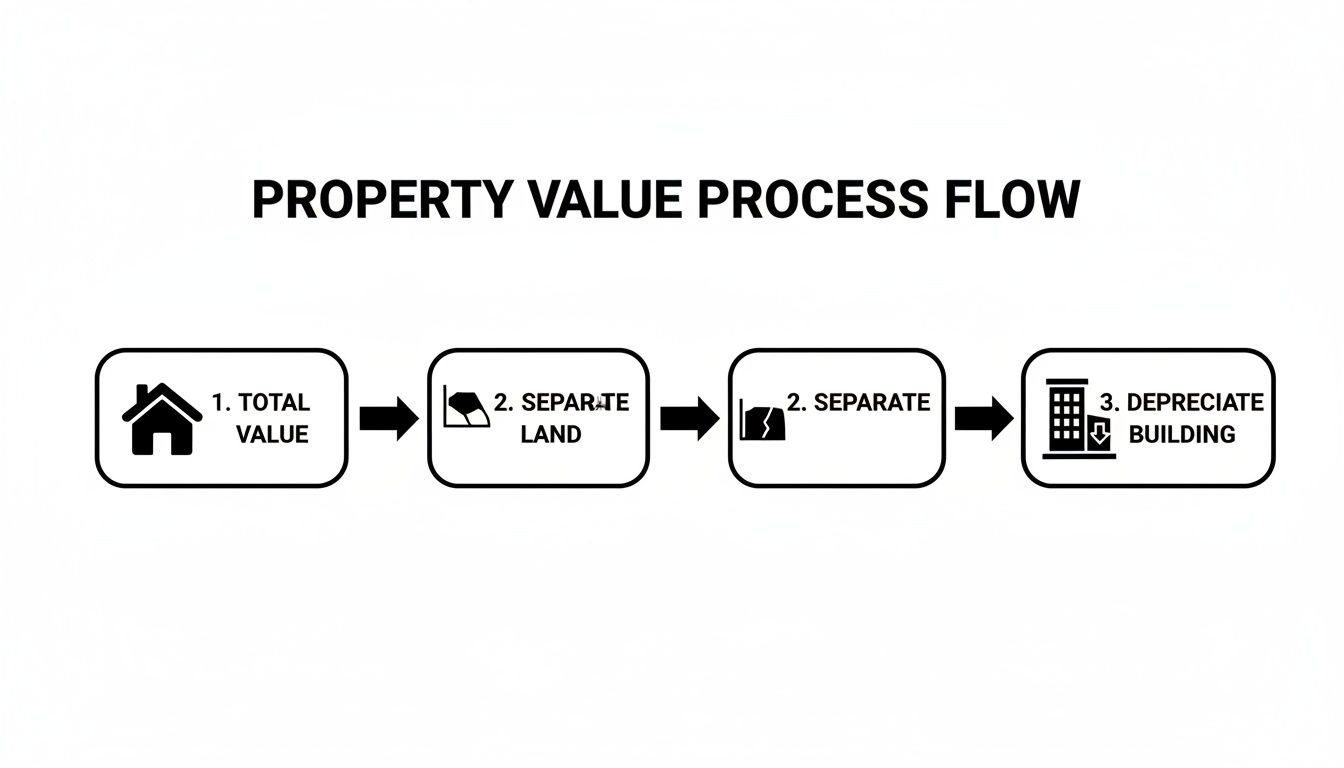
As you can see, the path is straightforward: figure out your total investment, pull out the value of the land (which you can't depreciate), and what's left is the building's value you can write off over time.
Establishing Your Initial Cost Basis
Your initial cost basis is the total cash you have sunk into the property right at the moment of purchase. For property owners in places like Highland or Mentone, getting this right from day one is absolutely crucial.
To nail down your basis, start with the contract purchase price. Then, add in specific settlement costs—the expenses that were necessary to close the deal.
Common costs you can roll into your basis include:
- Legal and recording fees
- Abstract fees
- Surveys
- Title insurance
- Transfer taxes
- Owner's title insurance
Heads up, though: not all closing costs make the cut. Things like mortgage insurance premiums, loan application fees, or points you paid to get your loan are typically not added to your basis.
Key Takeaway: Your property’s basis is its purchase price plus any capital costs needed to acquire it. Keeping meticulous records of these initial expenses is the first step toward accurate depreciation and can seriously boost your total deductions over the years.
Separating Land Value from Building Value
Once you've got your total cost basis, it’s time for a critical split. The IRS only lets you depreciate assets that wear out over time, and in their eyes, land is forever. Because of that, you have to separate the value of the land from the value of the building itself.
Let's say you buy a single-family home in Beaumont for $500,000. After adding $10,000 in qualifying closing costs, your total basis is $510,000. You can't start depreciating that entire amount.
You'll need a reasonable way to allocate that value. The most common method is to use the assessed values from your local property tax authority, which almost always splits out the value for the land and the improvements (the building).
If the tax assessor says the land is worth 20% of the total property value, you simply apply that same percentage to your basis. In our example, $102,000 (20% of $510,000) would be the land's value, leaving you with a depreciable basis of $408,000 for the building.
Distinguishing Repairs from Improvements
Finally, you need to get crystal clear on the difference between a repair and an improvement. This distinction is huge because it determines whether you can deduct an expense immediately or if you have to add it to your basis and depreciate it over many years.
- Repairs: These are the routine costs that keep your property in good, working order but don't really add to its value. Think fixing a leaky faucet, patching a hole in the drywall, or replacing a single broken windowpane. You can expense these in the year you pay for them.
- Improvements: These are the big-ticket items that add real value, extend the property's life, or adapt it for a new use. We're talking about a new roof, a full kitchen remodel, or adding a brand-new deck. These costs are capitalized—meaning they get added to your basis—and depreciated over 27.5 years.
Getting every dollar into the right category ensures you’re getting the maximum tax advantage. For landlords trying to forecast their tax situation, our free rental income tax calculator can give you some valuable insights into how all these deductions really impact your bottom line.
Accelerating Deductions with Advanced Strategies
While the standard 27.5-year depreciation schedule is a reliable workhorse for long-term tax benefits, some investors are looking to get more out of their deductions—and faster. This is where you can supercharge your write-offs and seriously boost your cash flow in the early years of ownership.
For savvy property owners in communities like Loma Linda or Calimesa, these tactics can completely change the financial game. Instead of a slow, steady trickle of deductions, you can front-load your tax savings. This frees up significant capital that you can put right back to work, reinvesting it or using it to expand your portfolio. Two of the most powerful tools for this are cost segregation and bonus depreciation.
Unlocking Faster Write-Offs with Cost Segregation
Try to think of your rental property not as a single, big asset, but as a collection of many smaller pieces. The building's structure is built to last, but what about the carpet, the kitchen appliances, or the fence in the backyard? These things wear out much faster.
A cost segregation study is a detailed, engineering-based analysis that does exactly that. It breaks down your property into its individual components and reclassifies them into shorter, more aggressive depreciation schedules. Instead of lumping everything into that long 27.5-year timeline, a specialist identifies assets that can be depreciated over much faster periods—usually 5, 7, or 15 years.
This is a game-changer for maximizing tax savings. A good cost segregation study can shift about 20% of a residential property’s eligible assets to a 5-year schedule, with another 5% reclassified to a 15-year schedule. This leaves only about 75% of the property's basis on the standard 27.5-year track. This reclassification creates a massive shift in your tax strategy, turning future deductions into immediate savings.
Examples of Reclassified Assets
To see how this works in the real world, here are some common items a cost segregation study might pull out for accelerated depreciation:
- 5-Year Property: Carpeting, appliances like refrigerators and dishwashers, window treatments, and even some types of cabinetry.
- 15-Year Property: Land improvements such as landscaping, fencing, driveways, and outdoor swimming pools.
By moving a chunk of your property’s cost basis into these shorter recovery periods, you dramatically pump up your depreciation deductions in the first few years of owning the property.
Supercharging Deductions with Bonus Depreciation
Now, let's pair cost segregation with another incredibly powerful tax tool: bonus depreciation. This rule lets you deduct a massive percentage—sometimes up to 100%—of an asset's cost in the very first year it’s placed in service. But there's a catch: the bonus only applies to assets with a recovery period of 20 years or less.
This is where the magic happens. After a cost segregation study reclassifies assets into 5, 7, and 15-year categories, those same assets often become eligible for bonus depreciation.
Let's say your cost segregation study identified $50,000 worth of 5-year and 15-year assets in your rental. Depending on the bonus depreciation percentage for the current year, you could potentially write off a huge portion of that $50,000 immediately instead of spreading it out. This gives you an incredible injection of cash flow right when you need it most—at the start of your investment.
These advanced strategies work hand-in-hand with many other deductions. For a broader look at how to reduce your tax burden, you can explore our comprehensive list of landlord tax write-offs that every investor should know. Combining these strategies is key to a truly optimized financial approach. Just be sure to consult with a tax professional who specializes in real estate to make sure you're applying these powerful rules correctly.
Navigating Depreciation Recapture When You Sell
Depreciation is a fantastic tax benefit during the years you own a rental property, but it’s not a free lunch. The IRS essentially lets you get a tax discount upfront, and when you eventually sell the property, it’s time to settle up. This process is called depreciation recapture, and understanding it is absolutely critical for a smart exit strategy.
This isn’t some surprise penalty; it’s a predictable tax on the total depreciation you’ve claimed (or were entitled to claim) over your years of ownership. While it sounds a bit complicated, it’s really just a way to prevent property owners from getting a double tax benefit—once through annual deductions and a second time through a lower capital gains bill. For landlords in communities like Redlands, Banning, or Beaumont, getting this right is key to accurately projecting your profits from a sale.
How Depreciation Recapture Is Calculated
At the heart of the recapture calculation is your property’s adjusted basis. Your starting point is the original basis—what you paid for the property plus certain buying costs. Each year you claim a depreciation deduction, you subtract that amount from your basis, creating a new, lower "adjusted basis."
When you sell, the gap between your sale price and this adjusted basis is your total gain. Here's where it gets interesting: the IRS splits this gain into two different buckets for tax purposes.
- Depreciation Recapture: The part of your gain that equals the total depreciation you took is taxed at a special recapture rate. This rate matches your ordinary income tax rate but is capped at a maximum of 25%.
- Capital Gain: Any profit left over after accounting for the recaptured amount is treated as a long-term capital gain. This is good news, as it’s typically taxed at much lower rates (0%, 15%, or 20%).
Think of it like this: For years, depreciation lowered your taxable rental income. Recapture simply "pays back" the tax you saved on those deductions when you sell. It ensures the benefit was a deferral, not a permanent write-off.
Let’s walk through a quick example. Imagine you bought a rental in Yucaipa for $500,000. Over ten years, you claimed $100,000 in depreciation deductions. This brings your adjusted basis down to $400,000.
Now, you sell the property for $700,000. Your total gain is $300,000 ($700,000 – $400,000). Here’s how the IRS will tax it:
- The first $100,000 (your total depreciation) is subject to recapture, taxed at your ordinary rate up to a max of 25%.
- The remaining $200,000 of profit is taxed at the more favorable long-term capital gains rate.
Deferring the Tax with a 1031 Exchange
The good news? You don’t always have to write that check to the IRS right away. A powerful strategy known as a 1031 exchange allows you to kick the can down the road, deferring both depreciation recapture and capital gains taxes. This IRS code section lets you sell an investment property and roll the entire proceeds into a new "like-kind" property without triggering an immediate tax bill.
This is an invaluable tool for investors looking to grow their portfolios, allowing them to move equity from one asset to another while pushing the tax liability further into the future. When it does come time to sell for good, understanding the broader tax implications of selling your business, beyond just depreciation recapture, is essential. Planning your exit strategy well in advance ensures you keep as much of your hard-earned profit as possible.
How Professional Management Simplifies Your Tax Season
Successfully navigating the world of rental property depreciation boils down to one thing: meticulous recordkeeping. Every single deduction you claim has to be backed up with clear, solid proof. This is exactly where a professional property manager becomes a busy landlord’s secret weapon.
Think of us as your organizational partner, totally focused on creating the clean, audit-proof financial records your CPA will love. For property owners from Beaumont and Calimesa to Redlands and Yucaipa, the daily grind of managing a rental makes it tough to track every single expense with the detail the IRS demands.
At AIM Property Management, we’ve built our financial reporting system to lift that entire burden from your shoulders. We handle everything—from paying invoices and collecting rent to delivering detailed monthly and annual statements. This system ensures every penny is accounted for, giving you a crystal-clear paper trail when tax season rolls around.
The Power of Clean Documentation
One of the biggest headaches for landlords is figuring out how to classify expenses. Was that new water heater a capital improvement that you need to depreciate over time? Or was it just a simple repair? Guessing wrong can lead to some seriously expensive tax mistakes.
Our process makes this easy. We clearly separate routine maintenance from capital improvements on your financial statements. This gives you and your tax advisor the exact data needed to apply the right depreciation schedules and legally maximize your deductions.
While we are not tax advisors, our main job is to provide the pristine, organized documentation you need to confidently handle complex tax rules. We turn a messy, chaotic process into something simple and manageable.
Staying Ahead of Changing Tax Laws
Tax codes are always in motion, and keeping up is non-negotiable. For example, understanding how bonus depreciation rules are changing is vital for anyone planning to acquire new property. Having a professional team managing your records means you're always positioned to adapt to changes like these.
Our detailed reporting helps your CPA spot opportunities without having to scramble for last-minute information. Properly using rental property depreciation is a cornerstone of smart tax planning. For a wider view on the subject, you might find a comprehensive guide on how to prepare for tax season useful.
Ultimately, great documentation is your best defense in an audit and your best tool for maximizing returns. Our dedicated property management services are designed to give landlords in communities like Yucaipa and Loma Linda total peace of mind, knowing their financial records are accurate, detailed, and ready for tax time.
Frequently Asked Questions About Depreciation Rules
When you get into the weeds of rental property depreciation, a lot of real-world questions pop up for landlords. Here are some clear, straightforward answers to the scenarios we see most often with property owners in Redlands, Beaumont, Yucaipa, Loma Linda, Highland, Mentone, Calimesa, and Banning. Getting these details right can make a huge difference in your long-term returns.
Can I Start Depreciating a Property I Previously Used as My Primary Home?
Yes, you absolutely can. The moment you convert your primary residence into a rental property, it becomes eligible for depreciation deductions. The key, however, is figuring out your starting point for the calculation.
Your depreciable basis will be the lower of two numbers on the exact day you convert it:
- Your adjusted cost basis (what you paid for the home, plus the cost of improvements, minus any casualty losses).
- The property's fair market value (FMV) at that time.
It's critical to get this number right from the start. It sets the foundation for all future depreciation calculations and ensures you’re maximizing your deductions legally.
What Happens If I Forget to Claim Depreciation for a Few Years?
This is a common slip-up, but unfortunately, it can be a costly one. The IRS follows a strict "allowed or allowable" rule. This means the IRS reduces your property's basis by the amount of depreciation you were entitled to claim, even if you never actually took the deduction on your tax return.
So, when you sell the property, the depreciation recapture tax will be calculated based on the deductions you should have taken all along. The good news is you may be able to file Form 3115, Application for Change in Accounting Method, to catch up on those missed deductions without having to amend years of old tax returns. For tricky situations like this, you can find more answers in our complete FAQ section.
The takeaway is simple: you can't choose to skip depreciation to avoid recapture tax later. The IRS will adjust your basis as if you took the deduction every year, whether you did or not.
Do I Have to Stop Claiming Depreciation After 27.5 Years?
Yes, you do—but only for the original building. Once a residential rental property has been fully depreciated over its 27.5-year recovery period, you can't claim any more annual deductions on that original cost. Your basis in that part of the asset effectively drops to zero.
However, this doesn't mean the tax benefits stop completely. Any new capital improvements you make after that 27.5-year period—like installing a new HVAC system or remodeling a kitchen—are treated as brand-new assets. Each of those improvements gets its own depreciation schedule, allowing you to keep generating valuable tax deductions for years to come.
Navigating these rules is crucial for maximizing your returns. AIM PROPERTY MANAGEMENT COMPANY provides the detailed financial reporting and documentation you need to stay compliant and make tax season stress-free. We serve landlords in Redlands, Beaumont, Calimesa, Yucaipa, Loma Linda, Mentone, Highland, Banning, and the surrounding California communities. Let us handle the details so you can focus on your investments. Learn more at https://aim-properties.com.