
If you own a rental in Beaumont, Yucaipa, Redlands, or a nearby Inland Empire community, you’ve probably felt the shift from “this should be manageable” to “this is eating my time.” It usually starts small. A late rent payment. A repair request that turns out to be bigger than expected. A tenant disagreement that lands on your phone at the wrong hour.
That’s when property ownership stops feeling passive.
For owners with demanding careers, family obligations, or multiple investments, property management beaumont isn’t just about offloading tasks. It’s about putting systems around an asset that needs steady oversight, legal discipline, and local judgment. The right manager protects income, protects the property, and protects you from making expensive decisions in a rushed moment.
Owners looking into Beaumont property management, Yucaipa property management, property management Yucaipa, Redlands property management, and property management Redlands usually ask the same question in different ways. “Is the fee worth it?” The better question is this. “What does unmanaged risk cost me over a year?”
Why Hiring a Property Manager in Beaumont Is a Smart Move
A lot of owners wait too long.
They self-manage while the property is occupied, rent is coming in, and nothing major is breaking. Then the first vacancy stretches longer than expected, the wrong applicant looks acceptable on paper, or a maintenance issue turns into a habitability problem. By then, they’re no longer choosing management from a position of control. They’re reacting.

Local conditions change the math
In Beaumont, the rental market is affordable enough to attract a broad tenant pool, but that doesn’t mean it’s easy to operate well. Average rent is $945 per month as of April 2026, which is 42% below the national average, and the area also has a 12.8% vacancy rate according to Apartments.com rent trends for Beaumont. That combination matters.
Affordable rent creates demand from many applicant types. High vacancy means owners can still lose money if they market poorly, screen loosely, or drag their feet on turns and repairs.
Practical rule: In a market with broad renter demand and meaningful vacancy, speed alone won’t save you. You need speed plus judgment.
That’s why professional management is a business decision, not a convenience purchase. A manager should know how to price competitively, respond to leads, qualify applicants, coordinate vendors, document the file, and keep the tenancy stable after move-in. Those are separate skills. Many DIY landlords handle one or two well, but not all of them consistently.
Time is part of your return
Owners often focus on rent collected and overlook decision fatigue. If you’re earning at a high level in your primary work, every hour spent chasing contractors, handling notices, or sorting out lease misunderstandings has an opportunity cost.
A strong local operator also sees things that remote or generic firms miss. Tenant expectations differ by submarket. Vendor response times vary by city. Turn strategy for a condo isn’t the same as for a single-family home. The manager who works these communities every week usually makes better judgment calls than the owner trying to coordinate everything from a distance.
If you’re comparing options, it helps to start with a provider that already works across nearby service areas and understands local operating differences. This overview of hometown property management is useful because it frames management as local execution, not just rent collection.
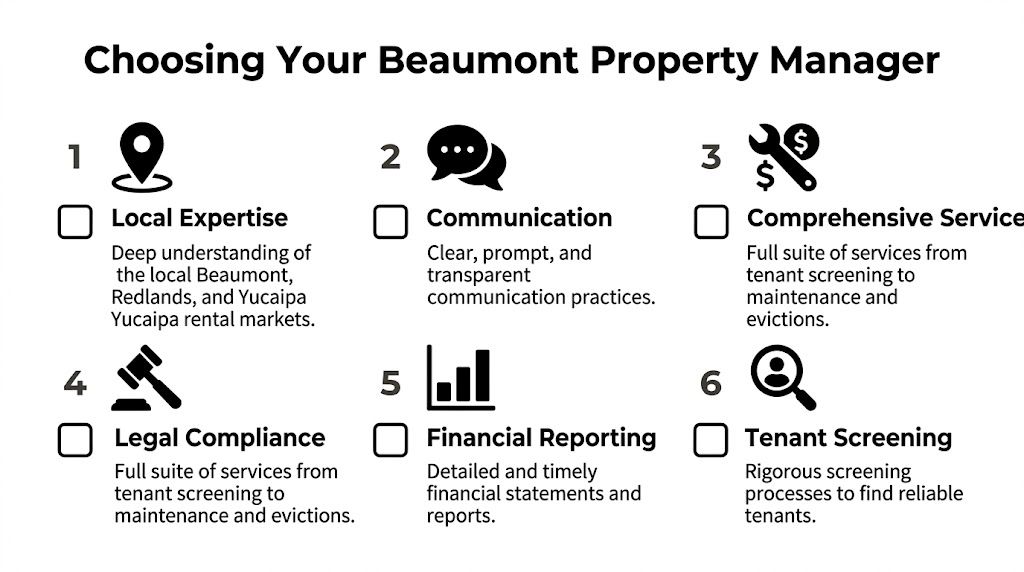
What to Look For in a Beaumont Property Management Partner
The wrong way to hire a manager is to ask only about fees.
The right way is to ask how they prevent avoidable losses. Every management company says it communicates well and handles maintenance. That tells you almost nothing. You need to know how they screen, how they document, how they escalate problems, and how they operate when a tenancy gets complicated.
Screening quality comes first
One bad placement can wipe out months of income. In practice, that’s why screening deserves more attention than glossy marketing.
According to HUD research on lease success and placement outcomes, a step-by-step screening process can achieve lease fulfillment success rates exceeding 80%. The process described in the verified data includes income verification at 3x rent, credit checks with FICO above 650 as an ideal mark, plus national criminal and eviction history reviews, and this approach has been associated with delinquency reduction of as much as 12%.
A serious manager should be able to explain:
- Income standards that aren’t vague. If they can’t state how they verify earnings and documents, keep looking.
- Credit review that goes beyond a raw score and looks at payment behavior and current obligations.
- Eviction and background checks that are documented and applied consistently.
- Application judgment that balances risk control with fair, lawful, consistent criteria.
Local knowledge needs to be operational
“Local” shouldn’t just mean they have an office nearby. It should mean they know how the leasing process works in Beaumont, Yucaipa, Redlands, Calimesa, Banning, Highland, Loma Linda, and Mentone.
Ask them what changes from one area to another. A real operator will talk about response times, renter expectations, showing logistics, maintenance vendor coverage, and turnover planning. A weak one will answer with generic marketing lines.
A property manager earns trust by explaining process, not by repeating slogans.
Reporting and communication should be boring
That’s a compliment.
The best managers make owner communication predictable. You shouldn’t have to chase monthly statements, wonder if repair approvals were documented, or guess where a delinquency issue stands. Good reporting isn’t flashy. It’s consistent, readable, and timely.
Look for a company that can clearly describe:
| Area | What you want to hear |
|---|---|
| Owner reporting | Monthly statements, repair records, and lease documentation |
| Maintenance workflow | Clear intake, vendor dispatch, approval process, and follow-up |
| Tenant communication | Defined channels for routine issues and emergencies |
| Lease administration | Signed documents, renewals, notices, and compliance tracking |
Ask better interview questions
Instead of “What do you charge?” ask questions that reveal how they think.
- “What’s your screening sequence?” You want order, standards, and consistency.
- “How do you handle maintenance after hours?” Listen for process, not improvisation.
- “How do you decide whether to renew, increase rent, or replace a tenant?” That answer reveals whether they manage by policy or by instinct.
- “What documentation do owners receive?” If the answer is fuzzy, the service probably is too.
If you want a useful benchmark for that conversation, this guide on how to choose a property management company gives owners a practical starting point.
A Practical Guide to Hiring Your Property Manager
Hiring a manager should feel closer to hiring an operations partner than buying a subscription. The firms that look similar online can operate very differently once your property is vacant, a repair gets urgent, or a resident dispute needs documented follow-through.
Start with a short list, not a broad search
A search for “property management near me” is fine as a first pass. It isn’t enough for a decision.
Build a short list of companies that serve your type of property and your exact area. Some firms do well with single-family homes and condos. Others are set up more for associations or larger multifamily. Those aren’t interchangeable skill sets.
A practical first filter is this:
- Service area fit if they actively manage in Beaumont and nearby communities you care about
- Property type fit if they regularly handle individually owned homes, townhomes, and condos
- Responsiveness based on how they handle the first inquiry
- Clarity in how they explain process, not just pricing
Read reviews for patterns
Most owners read reviews backward. They look for praise first. I’d rather look for operational clues.
Focus on whether reviewers mention communication, follow-through, leasing speed, maintenance coordination, and problem resolution. Those details matter more than generic compliments. Also pay attention to how the company replies when a review is critical. Defensive responses usually point to weak internal process.
Interview with your worst month in mind
Don’t interview a manager based on the month when everything is quiet. Interview them based on the month when three things go wrong at once.
Ask what happens when:
- A tenant stops paying on time
- A repair request comes in late at night
- A move-out reveals damage or cleaning issues
- A lease renewal becomes uncertain
- An owner wants to sell or change strategy midstream
The right company won’t make those situations sound easy. They’ll explain the procedure.
Owner test: If a manager can’t explain their process under pressure, they probably don’t have one.
One practical option owners can review is how to find a property manager, especially if you’re comparing companies across Beaumont, Redlands, Yucaipa, Banning, Calimesa, Highland, Loma Linda, and Mentone.
Review the management agreement slowly
Most mistakes happen here.
Owners skim the agreement because they assume the important part is the fee schedule. It isn’t. The most important sections are usually authority, approvals, disbursements, termination, and responsibility boundaries.
Read for these points:
Repair authorization
What can the manager approve without calling you first? The answer affects speed and control.
Leasing authority
Who sets final pricing and who approves applicants? A good agreement makes that clear.
Reserve requirements
Many managers hold funds in reserve for repairs and recurring expenses. You need to know how that works before the first invoice hits.
Termination terms
If the relationship isn’t a fit, how cleanly can you exit? Watch notice periods and transfer obligations.
Notice handling and legal paperwork
The agreement should explain who serves what, who documents it, and what the owner must still approve.
Match the manager to your investment strategy
Not every owner wants the same thing. One owner wants fewer calls and stable occupancy. Another wants tighter oversight on maintenance spending. Another may be deciding whether a long-term rental should stay long term.
That difference matters. In the article body, AIM Property Management Company is one example of a firm that handles screening, rent collection, maintenance coordination, inspections, and document management for individually owned residential rentals in nearby Inland Empire communities. Whether you choose that route or another local operator, the key is alignment between your goals and their operating model.
If you’re planning to hire a property manager, don’t choose the company with the simplest sales pitch. Choose the one whose process still makes sense when the property is vacant, the tenant is frustrated, and the repair invoice is real.
Analyzing Costs vs Returns for Your Rental Property
Owners get stuck on the management fee because it’s visible. The more expensive costs are usually the ones they don’t see coming.
A rushed placement, a neglected repair, an avoidable turnover, or a preventable habitability issue can hurt returns more than the monthly management line item. That’s why the fee conversation only makes sense when you place it next to operating results.
The return comes from loss prevention
According to the verified maintenance data, professional Beaumont property management services can cut emergency repair costs by up to 35%, reduce capital expenditures by 28%, and boost tenant retention to 85% through proactive coordination, inspections, and technology-supported maintenance systems, as summarized in this real estate analytics guide.
Those gains don’t happen because a manager “cares more.” They happen because process beats improvisation.
A disciplined manager usually does the following better than a DIY owner:
- Schedules inspections before minor problems become larger repair tickets
- Coordinates vendors with enough consistency to reduce delay and rework
- Documents maintenance history so recurring issues are easier to diagnose
- Protects tenant satisfaction by responding in a structured way instead of reactively
If you self-manage, a practical tool for building your own preventive routine is this rental property maintenance checklist. It’s useful because it forces owners to think beyond emergency calls and into recurring property care.
DIY versus professional management
The exact dollars depend on the property, tenant profile, and condition. So the better comparison is operational, not numerical.
| Expense Category | DIY Management (Estimated Cost) | AIM Professional Management (Estimated Cost) |
|---|---|---|
| Vacancy exposure | Higher if marketing, showing, and follow-up are inconsistent | More controlled through consistent leasing process |
| Emergency repairs | Often higher because issues get handled after failure | Lower when maintenance is proactive and tracked |
| Turnover cost | Can rise if tenant communication and renewals are weak | Often more stable when renewals and service are managed well |
| Legal risk | Higher if notices, entry, screening, or documentation are mishandled | Lower when compliance systems are part of daily operations |
| Owner time | High and unpredictable | More predictable, with fewer direct interruptions |
| Financial reporting | Often manual or fragmented | Structured statements and records |
Good management doesn’t erase cost. It converts volatile cost into planned cost.
Fee structure matters less than scope
Some companies charge a percentage. Some use flat fees. Some layer on leasing, renewal, inspection, and maintenance coordination charges. None of those models is automatically right or wrong.
What matters is whether the service scope matches the fee.
If a lower-cost manager leaves you handling after-hours calls, legal notices, or vendor disputes, the “cheaper” option may not be cheaper at all. Owners who want a clearer view of what’s usually included should review property management services cost and compare scope line by line, not just fee by fee.
That’s the practical way to evaluate Property Management Beaumont services. Not “What do I pay?” but “What losses does this operating system help me avoid?”
Navigating California's Complex Rental Laws
California is where casual landlording gets expensive.
A lot of owners can handle screening, rent collection, and basic repairs. Where they get into trouble is documentation, notices, entry rules, fair housing consistency, and the timing of decisions when a tenancy starts going sideways.

Compliance is part of asset protection
One overlooked point is that legal compliance and housing quality work together. Verified data notes that an estimated 9% of households are cost-burdened in areas like Beaumont, which makes proactive anti-displacement strategy and strong housing quality important for reducing turnover and legal exposure. That point is discussed in the source on affordability strategy and housing stability.
For owners, the practical takeaway is simple. Deferred maintenance and sloppy paperwork don’t just create inconvenience. They can create resident instability, conflict, complaints, and liability.
Where owners usually make mistakes
Most legal problems don’t start with dramatic disputes. They start with routine actions handled loosely.
Common pressure points include:
- Screening consistency so criteria are applied the same way to every applicant
- Entry and notice practices so access is lawful and documented
- Lease and addenda control so obligations are written clearly
- Security deposit handling so move-in and move-out records support the file
- Eviction procedure discipline so owners don’t act outside the required process
A helpful general primer for owners who want background reading is this guide to California real estate law. It’s useful because it frames compliance as a daily operating issue, not just a courtroom issue.
Why managers matter here
A solid manager earns their keep. They keep the file clean. They handle notices correctly. They coordinate inspections, track lease paperwork, and keep communication documented.
For owners who want a grounded explanation of the compliance side, this overview of landlord tenant laws in California is a practical reference.
A short video can also help owners understand how quickly routine legal issues can become expensive if handled casually.
A well-run rental file is often the difference between a manageable problem and an expensive one.
Your Next Steps to Smarter Property Management
If you’re deciding whether to hire a property manager, keep the decision simple.
First, define what you need. That might be full-service leasing and management, tighter maintenance control, better reporting, or stronger legal compliance. Then vet companies based on process, not promises. Ask how they screen, how they document, how they handle repairs, and how they protect your time.
Also think beyond standard long-term leasing. Verified market data shows Beaumont’s short-term rental segment has 61% average occupancy and $114 average daily rates according to AirDNA’s Beaumont overview. That doesn’t mean every property should shift strategy, but it does mean an experienced local manager should be able to help you evaluate whether a long-term, short-term, or hybrid approach fits your property and risk tolerance.
If you own in the Inland Empire and want a smarter operating plan, start with the relevant local pages for Property Management Beaumont and Yucaipa Property Management. That’s the practical next step if you want less guesswork and more control over the return from your rental.
Frequently Asked Questions
When should I hire a property manager
Usually sooner than you think. If the property is taking too much time, if you live outside the area, if maintenance is becoming reactive, or if legal compliance feels unclear, it’s time to hire a property manager. Owners often wait until a vacancy or tenant dispute forces the decision.
What should I look for when searching property management near me
Look for actual local operating knowledge, not just a nearby address. Ask whether they manage homes in Beaumont, Yucaipa, Redlands, Calimesa, Banning, Highland, Loma Linda, and Mentone. Then ask how they screen tenants, handle repairs, document notices, and report financially.
Do property managers only help with rent collection
No. Rent collection is one part of the job. Good Beaumont property management also includes leasing, screening, maintenance coordination, inspections, documentation, renewals, and compliance support.
Is a local company better for owners in Yucaipa and Redlands
Often, yes. Yucaipa property management, property management Yucaipa, Redlands property management, and property management Redlands all benefit from local vendor relationships, area-specific leasing judgment, and faster operational follow-through.
If you want a clearer plan for your rental, contact AIM PROPERTY MANAGEMENT COMPANY . We help owners in Beaumont, Yucaipa, Redlands, Calimesa, Loma Linda, Mentone, Highland, and Banning manage individually owned homes, condos, townhomes, and investment properties with practical systems for screening, rent collection, maintenance, inspections, and compliance.