If you're reading this, there's a good chance your rental no longer feels passive. The rent might come in, but so do maintenance calls, lease questions, scheduling issues, contractor follow-up, accounting tasks, and the steady pressure of staying compliant with California rules. For many owners in Redlands, Beaumont, Yucaipa, Highland, Loma Linda, Mentone, Calimesa, and Banning, the question isn't whether the property can cash flow. It's whether managing it yourself still makes sense.
That decision usually gets serious when the property starts competing with your career, family time, or sleep. Owners with demanding schedules often reach the same conclusion. A rental can be a strong asset and still be a poor do-it-yourself project.
Is a Property Manager a Cost or an Investment
Most owners first look at management through the wrong lens. They see a monthly fee and compare it against doing the work themselves for “free.” But self-management is never free. You pay in time, interruptions, avoidable mistakes, slower leasing, and stress that keeps following you after work.
That matters more in the Inland Empire than many owners expect. Local rentals don't manage themselves just because demand is healthy. Good tenants still need to be found, screened, onboarded, communicated with, and retained. Repairs still need to be coordinated correctly. Notices and documentation still need to be handled carefully.
What owners usually underestimate
The hidden cost isn't only labor. It's distraction.
A late-night plumbing call is one thing. A poorly handled maintenance issue that turns into tenant friction, bad documentation, or a larger repair bill is another. The same goes for leasing. A vacant home in Redlands or Beaumont isn't only losing rent. It's also sitting exposed while you make pricing decisions, answer inquiries, schedule showings, and sort through applicants.
Practical rule: If your rental regularly interrupts your workweek, evenings, or weekends, you're already paying a management cost. You're just not itemizing it.
For many owners, especially high-income professionals, the better comparison is this: what is your time worth when it's pulled into tasks that require consistency, urgency, and legal awareness? A good manager gives that time back while protecting the asset itself.
Professional management also changes decision quality. Instead of reacting to each issue as it appears, you get systems. Screening standards. Rent collection procedures. Maintenance workflows. Inspection routines. Financial reporting. Those systems don't eliminate every problem, but they make problems smaller and easier to control.
Why this becomes an investment decision
An investment should protect income, limit downside, and preserve the long-term condition of the property. Good management does all three.
If you're weighing fees, study the full cost picture, not just the headline number. Owners often benefit from reviewing a breakdown of property management service costs before comparing firms. It's the easiest way to separate real value from vague promises.
The same thinking applies to tax treatment. Even though it's written for a different market, this checklist of 10 tax deductions UK landlords often miss is a useful reminder that rental performance is shaped by details owners often overlook.
A property manager is a cost when the firm is weak, unresponsive, or sloppy. A property manager is an investment when the firm reduces friction, protects your lease-up process, keeps documentation organized, and helps you make better operating decisions month after month.
The Tipping Point When You Should Hire a Manager
Most owners don't decide to hire a property manager on a calm Tuesday afternoon. They decide after a problem. A vacancy lasts longer than expected. A tenant stops paying. A repair request gets tangled between vendors. A lease question turns into a compliance concern. That's why the better move is to recognize the tipping point before the property starts running you.

The scale of the profession tells you this isn't a niche service. The U.S. property management industry generates over $130 billion annually, and employment for managers is projected to grow 4% through 2034, with roughly 39,000 job openings each year. The same data notes that rents have risen 32% in five years while insurance costs are up 26%, which helps explain why owners increasingly rely on professional help for screening, maintenance, and compliance in markets such as Beaumont and Yucaipa, according to TenantCloud's property management industry statistics.
Signs you've outgrown DIY management
Some signals are obvious. Others are quieter, but just as important.
- You don't live near the property. Distance turns simple tasks into delayed tasks. Showings, inspections, contractor access, and tenant communication all become slower and more expensive to coordinate.
- You own more than one rental. Even a small portfolio changes the workload. One late payment and one repair at the same time can consume your week.
- You're tired of being on call. Emergency requests don't care about your meetings, family plans, or travel schedule.
- You aren't confident in your paperwork. Lease language, notices, documentation standards, and fair housing practices need consistency.
- Your leasing process feels improvised. If advertising, inquiry handling, screening, and move-in coordination vary each time, results usually vary too.
A lot of owners searching for property management near me are not failing. They're hitting the point where the property needs a business process, not spare-time attention.
Local situations that push owners over the line
A Highland owner with a demanding job can usually handle one good tenant. That same owner starts looking for help when a lease renewal, a repair issue, and a late payment happen in the same month. The problem isn't effort. The problem is bandwidth.
A Loma Linda investor may think marketing a vacancy will be straightforward, then realize that responding quickly, qualifying prospects, scheduling showings, and screening applicants properly requires a system. Without one, the home sits, applicants drift, and decisions get rushed.
When owners wait until a crisis, they usually choose a manager in a hurry. Hurry is expensive.
The same pattern shows up in Property Management Beaumont, Beaumont property management, Yucaipa property management, property management Yucaipa, Redlands property management, and property management Redlands searches. Owners often aren't asking for luxury service. They're asking for control, consistency, and less chaos.
A quick self-check
If several of these sound familiar, it's probably time to hire a property manager.
| Situation | What it usually means |
|---|---|
| You're screening tenants at night after work | The rental is competing with your primary job |
| Vendors text you directly for every approval | You don't have an operating system, only a reaction chain |
| You avoid reading legal updates | Compliance risk is building quietly |
| Vacancies feel stressful instead of routine | Leasing is being managed manually, not strategically |
| Tenant communication drains you | Boundaries and response procedures need structure |
Owners often hold off because they think hiring a manager means giving up control. In practice, the opposite is true. The right setup gives you clearer approvals, better reporting, cleaner records, and fewer surprises.
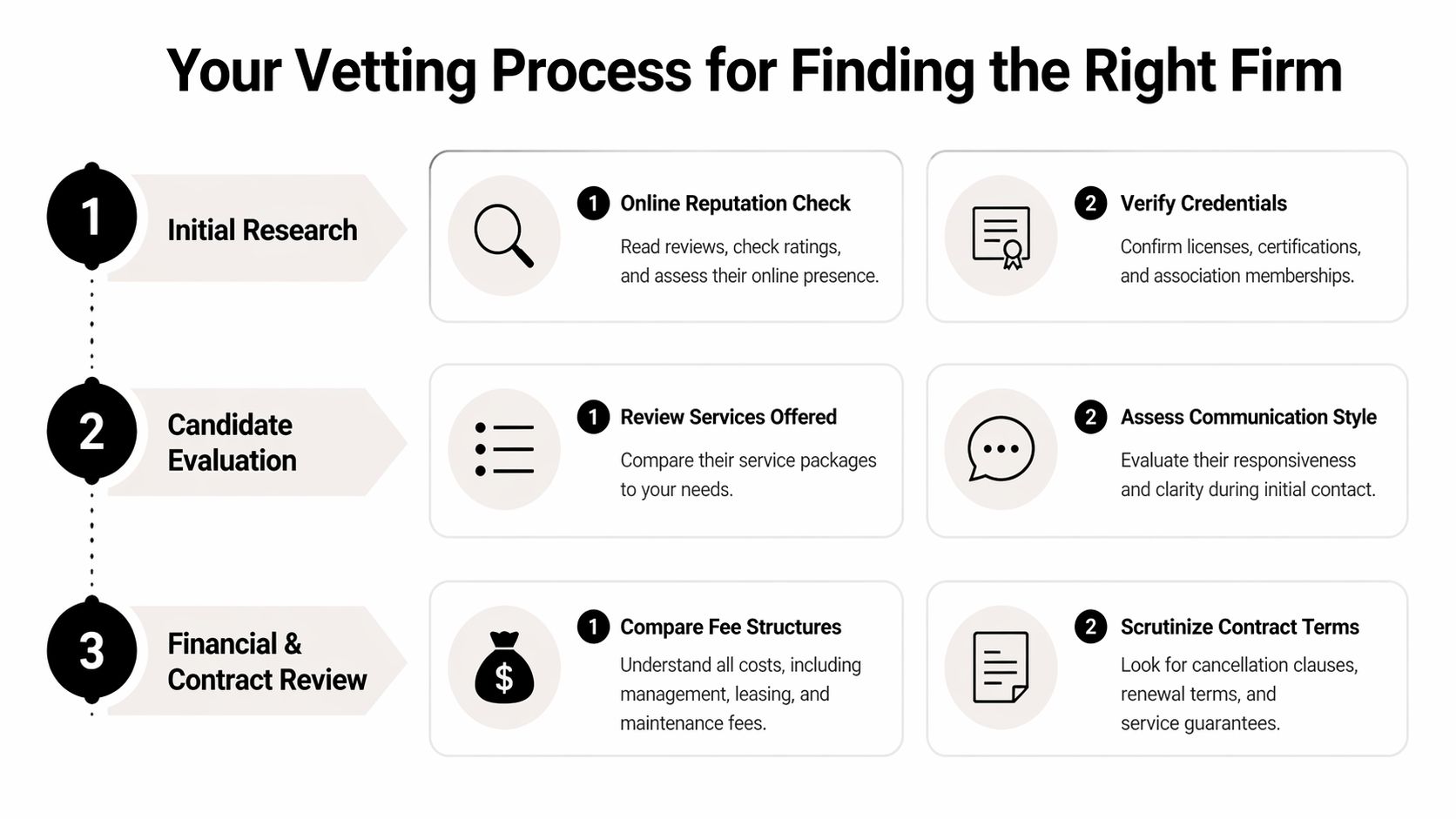
Your Vetting Process for Finding the Right Firm
Choosing a property manager shouldn't start with price. It should start with fit, competence, and evidence. The wrong firm can create the same headaches you already have, just with invoices attached. The right one runs the property with discipline and keeps you informed without dragging you into daily noise.
Start with a short list, not a long one. Three to five serious candidates is enough if you vet them properly.
Start earlier than most owners do
The best hiring decisions happen before you're under pressure. The interview process should begin 75-90 days before you need a manager. Firms that specialize in your property type are worth prioritizing, while general realtors can lead to 15-25% longer vacancy periods. A manager who offers detailed financial projections and standardized maintenance procedures is associated with occupancy above 90%, and rushing the hire can correlate with a 20-30% higher vacancy risk because tenant placement suffers, according to this evaluation guide on choosing a property manager.
That lead time matters in the Inland Empire. If your tenant has given notice, waiting until the last week to start calling companies is too late. You need time to compare process quality, communication style, and contract terms.
What to look for in the first pass
Your initial review should be simple and unforgiving.
- Check the website carefully. A serious firm explains what it does, how communication works, and what owners can expect.
- Confirm specialization. A company that mainly handles residential homes, condos, townhomes, and similar rentals will usually be a better fit than a broad real estate office treating management as a side service.
- Look for process, not slogans. Screening standards, maintenance coordination, inspection cadence, and reporting methods should be described clearly.
- Assess responsiveness. If the firm is hard to reach when trying to win your business, that usually won't improve after onboarding.
One practical way to sharpen your judgment is to borrow broader general vetting criteria for service providers. Even though it's written for another industry, the core ideas carry over well: evaluate clarity, consistency, responsiveness, and whether the firm can explain its process without hiding behind buzzwords.
The due diligence that actually matters
A polished first impression isn't enough. Dig deeper.
- Verify licensing and standing. In California, you want to confirm the company is operating appropriately and can lawfully perform the services it offers.
- Read reviews for patterns. Ignore one-off drama and look for repeat themes. Communication problems, accounting confusion, and repair disputes tend to show up repeatedly when they're real.
- Ask what property types they manage most often. A single-family rental in Yucaipa isn't the same assignment as a small multi-unit property in Redlands.
- Review owner reporting. Monthly statements, maintenance records, and lease documentation should be organized and accessible.
- Examine how they handle vendors. You want structure. Who authorizes work, how updates are communicated, and what happens after hours.
Some owners also benefit from reading a local overview on how to find a property manager before interviewing firms. It helps narrow the right questions for Inland Empire rentals instead of relying on generic advice.
Here's a useful benchmark. If a firm can't explain its leasing workflow from pricing to move-in in a clear sequence, it probably doesn't have one.
A visual walkthrough can also help when you're comparing process quality between firms:
What a strong candidate sounds like
Good firms answer directly. They don't get vague when you ask about screening, maintenance, or owner approvals. They can tell you how inquiries are handled, how applicants are qualified, what the reporting timeline looks like, and what happens when a tenant reports an urgent issue.
Weak firms usually lean on personality. Strong firms lean on procedure.
Ask every candidate to walk through one full vacancy cycle from notice to new move-in. If the answer wanders, the operation probably does too.
One local example is AIM PROPERTY MANAGEMENT COMPANY, which states that it handles residential management for individually owned condominiums, townhomes, single-family homes, and investment properties while offering screening, rent collection, inspections, maintenance coordination, and legal documentation support. That's the type of specificity you want to see from any firm you consider.
Key Interview Questions and Contract Red Flags
A good interview doesn't sound like a sales call. It sounds like an operations review. By this stage, you're no longer asking whether the company is friendly. You're testing whether it can protect your property, your cash flow, and your time.
The biggest mistake owners make here is asking broad questions and accepting broad answers. “How do you screen tenants?” is a start. It isn't enough. You want details, thresholds, decision criteria, and examples of how the process works in practice.

Questions that reveal the real operation
Use questions that force specificity.
- Describe your screening process step by step. Listen for credit review, income verification, background checks, landlord references, and how exceptions are handled.
- What rent qualification standard do you use? A firm should be able to explain its income expectations and how it verifies them.
- How do you handle after-hours maintenance? You want a clear emergency workflow, not “tenants can call us anytime.”
- Who approves repairs, and at what point does owner authorization kick in? This tells you whether the company respects your budget and your boundaries.
- How often do you inspect occupied properties, and what gets documented? Inspection frequency and reporting quality matter.
- How do you market a vacancy? Ask where the property is listed, how inquiries are tracked, and how quickly prospects are contacted.
- What does owner reporting look like each month? If they can't show the reporting structure, don't assume it's solid.
- How do you handle lease renewals and rent increase recommendations? This reveals whether the firm is passive or proactive.
If you want a good model for asking sharper hiring questions in general, this list of essential questions to ask when hiring any contractor is helpful because the logic is the same. You are checking process, accountability, communication, and what happens when something goes wrong.
What screening standards should sound like
This is one area where specifics matter a lot. A multi-layered screening process that includes credit reports, income verification at 3x rent, background checks, and landlord references can reduce evictions by 70%. Professional managers using those methods typically maintain 5-7% vacancy rates, compared with 12-15% for DIY landlords. The same guidance notes that 24/7 maintenance coordination with pre-qualified vendors can boost tenant retention to 85%, according to this property management guide on tenant screening and maintenance systems.
Those numbers don't mean every property will perform the same way. They do tell you what serious process looks like. If a manager talks about “going with their gut” or relying too heavily on one metric, that's a warning sign.
Good screening isn't one report. It's a layered decision with documentation.
Owners comparing local companies can also use this Inland Empire-focused resource on how to choose a property management company to organize interviews and compare terms more clearly.
Contract terms that deserve a hard look
The management agreement matters as much as the interview. Sometimes more.
Look closely at these areas:
| Contract area | What to look for |
|---|---|
| Termination clause | Can you exit reasonably if service is poor? |
| Leasing fees | Are they stated clearly, or buried in definitions? |
| Maintenance markups | Is there a markup policy, and is it disclosed? |
| Repair authorization | What dollar threshold allows work without owner approval? |
| Renewal terms | Does the agreement auto-renew, and how is notice handled? |
| Scope of authority | What can the manager sign or approve on your behalf? |
A lot of frustration comes from owners who thought they were paying for one service and later discovered add-on charges tied to leasing, notices, inspections, renewals, or repair coordination. The issue isn't that firms charge differently. The issue is whether the agreement is transparent.
Red flags you shouldn't rationalize
Some red flags are obvious. Others get ignored because the company seems personable.
- Vague answers about screening
- No clear maintenance approval policy
- Slow follow-up during the sales process
- Heavy pressure to sign quickly
- A contract that makes cancellation difficult
- Confusing language around extra fees
- No structured owner reporting sample
If you're about to hire a property manager, this is not the moment to be optimistic. Be precise. A solid firm won't mind detailed questions. In fact, a solid firm usually expects them.
A Hyperlocal Look at Beaumont and Yucaipa Markets
Generic management advice breaks down fast when it meets local reality. The Inland Empire isn't one uniform rental market, and owners who treat it that way often misprice their homes, market to the wrong audience, or miss what local tenants prioritize.
That matters in both Property Management Beaumont and Yucaipa property management. The homes may look similar on paper, but the leasing approach, presentation strategy, and tenant expectations can differ in ways that affect results.

Beaumont and what owners often miss
Beaumont owners often benefit from thinking in terms of commute practicality, household functionality, and condition-sensitive marketing. Prospects pay attention to layout, parking, yard use, storage, and whether the home feels easy to live in. A manager who knows the area usually positions those strengths better than a generic listing template can.
That local understanding matters because the broader industry is still expanding. The North American property management services market is projected to grow from $140.9 billion in 2025 to $214.5 billion by 2033, and the residential segment held a 59.8% revenue share in 2025, according to Grand View Research's North America property management market report. For owners evaluating Beaumont property management or property management Yucaipa, that growth supports the case for specialized operators rather than improvised self-management.
A local service page on property management in Beaumont can also help owners compare whether a firm's on-the-ground approach matches their property type and neighborhood context.
Yucaipa and why nuance matters
In property management Yucaipa, presentation and tenant fit often matter just as much as pricing. Many owners focus only on the rent number and forget the bigger question: who is the ideal tenant for this specific home, and what will make that tenant choose it over nearby options?
For some homes, that means emphasizing quiet residential appeal and long-term livability. For others, it means highlighting practical features that reduce friction for the tenant. Strong management in Yucaipa usually looks less flashy and more disciplined. Good photos, accurate pricing, responsive follow-up, and a clean move-in process often beat overpromising.
Local knowledge doesn't mean guessing what renters want. It means knowing how people actually compare homes in that submarket.
The Inland Empire advantage of local management
The same principle carries into Redlands property management, property management Redlands, Calimesa, Highland, Mentone, Banning, and Loma Linda. Tenants don't rent a spreadsheet. They rent a home in a specific neighborhood with specific expectations.
That's why local management earns its keep when it gets the basics right:
- Pricing discipline that fits the immediate area, not just the city name
- Marketing language that reflects how renters shop locally
- Vendor coordination with contractors who can respond reliably in the region
- Communication habits that fit the owner's desired level of involvement
Many national or overly broad operators miss the mark in this respect. Scale matters less than local execution.
Your Top Questions on Hiring a Property Manager Answered
Owners usually get to the same handful of questions once they move from browsing to making a decision. Most of them aren't really about fees. They're about trust, control, and whether the handoff will make life easier or more complicated.
One issue that deserves more attention is lifestyle fit. Self-management is correlated with a 30% higher burnout rate among busy professionals, and proactive communication such as automated updates and owner portal access can act as a “mental health buffer” that boosts owner satisfaction by over 35%, according to this discussion of owner stress and communication fit. For owners with demanding jobs, that matters as much as rent collection.
Frequently Asked Questions
| Question | Answer |
|---|---|
| When should I hire a property manager? | Hire one when your rental starts competing with your work, personal time, or decision quality. Common triggers include distance from the property, repeated maintenance interruptions, leasing stress, and uncertainty around California compliance. |
| Is hiring a manager worth it for one rental? | It can be. One property can still create nonstop interruptions if the tenant turns over, repairs stack up, or communication gets messy. The real question isn't unit count. It's whether you have the time and systems to manage the home properly. |
| How do I find property management near me without wasting time? | Start with firms that specialize in residential rentals like yours, then compare process quality. Look at responsiveness, screening standards, reporting clarity, and contract transparency before you focus on price alone. |
| What should I ask before I hire a property manager? | Ask about screening criteria, maintenance approvals, emergency handling, inspection practices, rent collection, owner reporting, and contract cancellation terms. If the answers stay vague, keep looking. |
| What makes Beaumont property management different from other areas? | Local leasing depends on neighborhood context, renter expectations, property type, and how the home is positioned in the market. A manager who understands those details usually markets and qualifies prospects more effectively. |
| What should I expect from Yucaipa property management? | Expect a strong focus on pricing discipline, responsive leasing follow-up, clean documentation, and tenant placement that fits the home. In many cases, steady execution matters more than flashy marketing. |
| Is Redlands property management the same as managing in Yucaipa or Beaumont? | No. The fundamentals are similar, but pricing, presentation, and tenant expectations vary by area. Good property management Redlands work reflects the local renter profile rather than relying on one standard approach everywhere. |
| Where can I review more owner questions before choosing a firm? | A focused FAQ page can help you compare services, expectations, and next steps before signing an agreement. Review the property management FAQs and bring those questions into your interviews. |
If you're ready to hire a property manager, keep the standard simple. Choose the firm that communicates clearly, screens thoroughly, documents consistently, and makes your rental feel more controlled, not more complicated.
If you'd like a local conversation about managing a home in Redlands, Beaumont, Calimesa, Yucaipa, Loma Linda, Mentone, Highland, or Banning, AIM PROPERTY MANAGEMENT COMPANY offers residential property management for single-family homes, condominiums, townhomes, and investment properties, including tenant screening, rent collection, maintenance coordination, inspections, and compliance support.