
Are you spending your nights and weekends juggling tenant calls, chasing down late rent, and trying to find a plumber for an emergency leak? The moment your rental property starts feeling less like an investment and more like a second job is the time to consider whether you should hire a property manager. For many landlords in the Inland Empire, that moment arrives a lot sooner than they expect.
When to Hire a Property Manager for Your IE Rental

The decision to bring in professional help usually isn’t triggered by a single event. It’s more often a slow burn—a steady increase in demands that turns a promising asset into a source of constant stress. Recognizing the signs it’s time to hand over the reins is the first step toward reclaiming your time and actually maximizing your investment.
You're Losing Your Personal Time
Let’s be honest, how much of your life does your rental property consume? Are you fielding maintenance calls during family dinners or spending your weekends showing a vacant unit in Yucaipa? That hands-on approach might feel productive, but it comes at a steep cost: your own time.
Many property owners in communities like Redlands and Beaumont hit a wall when they acquire a second or third property. What was once manageable suddenly becomes a complex web of tenants, maintenance schedules, and administrative duties that never seems to end.
Distance is another huge factor. If you live hours away from your rental in Loma Linda or Highland, you simply can't be there when it matters most. A middle-of-the-night plumbing emergency or a tenant lockout requires someone on the ground, immediately.
The True Cost of DIY Management
Going the "Do-It-Yourself" route might seem like it saves money upfront, but the hidden costs can quickly eat into your profits. Before you dismiss the idea of professional management, let's look at a quick comparison of what it really takes to manage a property.
DIY Landlord vs Professional Property Manager
| Task | The DIY Landlord Approach | The Professional Manager Solution |
|---|---|---|
| Marketing | Posting a listing on one or two sites and hoping for the best. | A professional marketing strategy across multiple platforms with high-quality photos to attract top-tier applicants. |
| Tenant Screening | Relying on a basic application and a gut feeling. | A thorough, legally compliant screening process including credit checks, eviction history, and income verification. |
| Rent Collection | Chasing tenants for late payments via texts and awkward phone calls. | Streamlined, automated rent collection with clear policies for late fees, ensuring consistent cash flow. |
| Maintenance | Scrambling to find a reliable vendor and likely paying full retail price for repairs. | Access to a network of vetted, affordable contractors who provide quality work at preferred rates. |
| Legal Issues | Trying to interpret complex California tenant laws, risking costly fines for simple mistakes. | Expert knowledge of all local and state regulations, ensuring every action from leases to evictions is fully compliant. |
As you can see, the "savings" from DIY management often disappear when you factor in longer vacancies, costly legal mistakes, and overpriced repairs. It's no wonder that a significant 51% of property owners now hire managers to oversee their rentals.
This isn't just a hunch; it's a clear trend. California leads the nation with over 79,000 residential property managers, showing a massive shift toward professional oversight as a standard business practice, not a luxury.
The decision to hire a property manager isn't an expense; it's an investment in efficiency, legal protection, and peace of mind. The ROI is measured not just in dollars, but in reclaimed time and reduced stress.
The Legal Shield a Professional Provides
California’s landlord-tenant laws are notoriously complex and are constantly being updated. For a busy, independent owner, just staying compliant can feel like a full-time job. One wrong step in the eviction process or an oversight on habitability standards can lead to severe financial penalties and legal battles.
Think about an investor in Beaumont trying to handle late rent payments and navigate the specific notice requirements on their own. The process is a minefield of potential errors. A professional property management company, on the other hand, deals with these exact scenarios every single day.
They ensure every notice, every lease, and every interaction is fully compliant, protecting you from the legal pitfalls that can turn a great investment sour. This expertise is what transforms a volatile property into a predictable, passive income stream. If you're ready to make that change, our guide on how to find the right property manager can help you take the next step.
What Great Property Management Actually Looks Like
When you first decide to hire a property manager, you might think it's just about collecting rent and fielding the occasional tenant call. But the difference between an average manager and a truly great one is massive. It's the difference between simply plugging a leak and overhauling the entire plumbing system to prevent it from ever happening again.
Exceptional property management isn’t just reactive. It’s a proactive system designed to protect your investment, maximize your returns, and, most importantly, give you your time back. Let’s get into what this level of service really involves.
Thorough Tenant Screening Beyond the Basics
Finding the right tenant is the single most important part of a successful rental. A basic check might just scratch the surface with a quick credit report. A professional firm, especially one that lives and breathes the Yucaipa property management market, goes much, much deeper.
Imagine you own a rental in Yucaipa. A great manager isn't just looking for any tenant; they're looking for the right tenant for your specific home and community. This means:
- Comprehensive Background Analysis: We're talking a nationwide criminal check and a full eviction history search, not just a quick local database query.
- Rigorous Income and Employment Verification: They don't just glance at a pay stub. They call the employer to confirm stable employment and ensure income is at least three times the monthly rent.
- Detailed Rental History Review: This involves actual conversations with past landlords, asking the tough questions about on-time payments, property upkeep, and whether they followed the lease.
This meticulous approach weeds out potential problems from the start, dramatically reducing your risk of late payments, property damage, and the nightmare of eviction.
Consistent Rent Collection and Financial Transparency
"Rent collection" sounds simple enough, but any landlord who has done it themselves knows it can be a constant source of frustration. A top-tier manager makes consistent cash flow a reality, not a headache. This starts with giving tenants easy, online payment options, which cuts down on late payments immediately.
But their job isn't done once the rent is paid. You shouldn't need an accounting degree to figure out how your investment is performing. Great management provides:
- Detailed Monthly Statements: Clean, simple reports that clearly break down every dollar of income and every expense. No surprises.
- Direct Deposits: Your profits land directly in your bank account each month, hassle-free.
- Year-End Financial Summaries: A complete financial package that makes tax time a breeze.
This level of financial clarity gives you a real-time view of your property's performance so you can make smart decisions. To learn more about what a manager handles, check out our deep dive into a property management manager's responsibilities.
Proactive Maintenance Coordination
Here’s a scenario we see all the time. It’s 9 PM on a Friday, and your tenant in Loma Linda calls with water pouring from a burst pipe. If you’re self-managing, your weekend is officially over. You’re now scrambling to find a plumber who will answer their phone, won't charge an insane emergency fee, and can actually fix the problem.
A great property manager handles this completely differently. They already have a list of trusted, licensed, and insured vendors for communities like Loma Linda, Banning, and Mentone.
When that emergency call comes in, your manager makes one phone call. A reliable, pre-vetted plumber is dispatched at a fair, pre-negotiated rate. The issue gets fixed fast, minimizing damage and keeping your tenant happy.
This proactive network saves you time, money, and a world of stress. It also includes regular property inspections to catch small things—a small roof leak, an aging water heater—before they turn into budget-busting catastrophes.
Beyond maintenance, a great manager also handles the critical details, like ensuring your property is covered with the proper mandatory home insurance. It's another layer of protection that shields your asset from the unexpected.
The value of this professional oversight is clear. As of 2026, the property management industry employs 466,100 professionals in the U.S. alone. With a projected 4% growth rate creating nearly 39,000 new jobs each year, it's a testament to how crucial this role is for property owners, especially in competitive markets like Beaumont and Highland. You can see more about these property management industry stats on doorloop.com.
How Property Management Fees and Contracts Work
When you’re thinking about hiring a property manager, one of the first things that comes to mind is the cost. It’s natural to wonder about the numbers, but it's more helpful to think of it as an investment in your property’s health and your own peace of mind.
After all, the financial hit from just one difficult tenant or a couple of months of vacancy can easily cost you more than a full year of management fees. It’s about playing the long game.
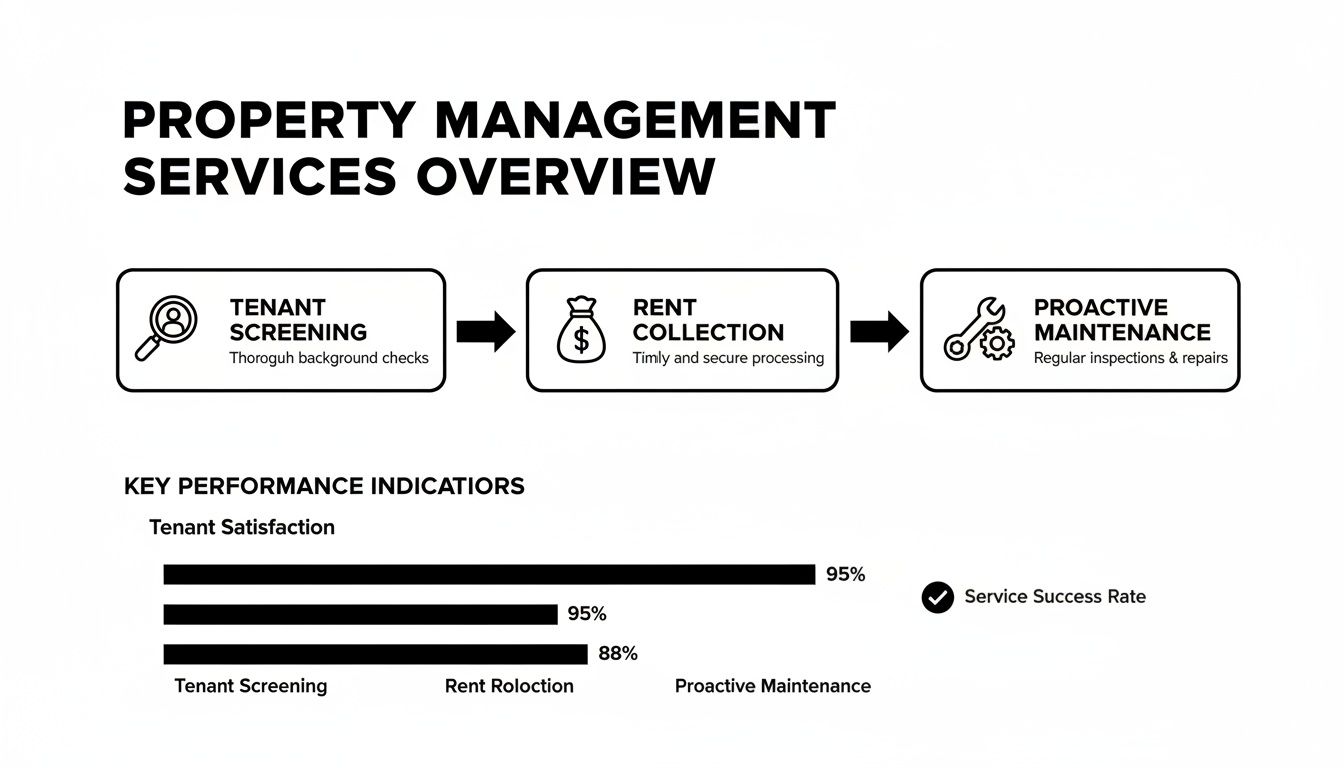
As you can see, professional management is a system of interlocking services designed to protect your asset and keep the rent checks coming in. That’s the real goal here.
Decoding Common Fee Structures
Property management fees can vary, but most reputable companies follow a few standard models. The one you'll see most often is the monthly management fee, which covers all the day-to-day work of looking after your property.
This is almost always a percentage of the monthly rent that's actually collected. Across the industry, expect to see fees in the 8-12% range, with the national average hovering around 10%. For a rental that brings in $2,000 per month, you’re looking at a fee of $160 to $240. This is especially true here in the Inland Empire, where rising costs for insurance (up 26%) and maintenance (up 12%) make professional oversight more valuable than ever. You can get more insights on what to know about property management companies on amerisave.com.
Beyond that monthly fee, you might also run into a few other standard charges:
- Tenant Placement Fee: This is a one-time charge for the heavy lifting of finding and placing a quality tenant. It usually costs around 50% of the first month's rent and covers all the marketing, showings, and deep-dive screening.
- Lease Renewal Fee: A much smaller fee charged when a great tenant decides to stay for another year. This rewards the manager for keeping good tenants, which saves you a ton of money on turnover.
- Maintenance Markup: Some firms add a small percentage to vendor invoices to cover the time and effort of coordinating repairs. Any transparent company will have this clearly spelled out in the contract.
ROI in Action: A single-family rental in Redlands brings in $2,800/month. A 10% management fee costs $3,360 annually. However, if that manager prevents just one two-month vacancy, they've saved you $5,600—a clear positive return on your investment.
Reviewing the Management Contract
The property management agreement is the most important document you'll sign. It's a legally binding contract that lays out the entire relationship, and reading the fine print is absolutely non-negotiable.
Don't just give it a quick scan. A good contract protects both you and the manager by setting crystal-clear expectations from day one. For a more detailed breakdown, check out our guide on understanding the property management fee structure.
Grab a highlighter and make sure you understand these key clauses before signing anything:
- Termination Clause: How do you get out of the contract if you're not happy? Look for the required notice period and any fees for early termination. You should never feel trapped in a long-term agreement without a fair exit path.
- Repair Spending Limits: The agreement should set a dollar limit that the manager can spend on a repair without needing your sign-off first (a common amount is $300). This lets them fix small problems fast while ensuring you’re in the loop for bigger expenses.
- Owner Responsibilities: What's expected of you? This section usually covers things like maintaining proper insurance, keeping a reserve fund for repairs, and responding promptly when a major decision is needed.
- Fee Guarantees: Does the company only get paid when you do? The best property managers tie their fee to rent collected, not just rent due. This simple detail ensures their goals are perfectly aligned with yours: keeping the property occupied and the rent flowing.
Key Questions to Ask Potential Property Managers
Once you've narrowed down your list of potential property managers, it's time for the most important part: the interview. This is your chance to really see who you’re dealing with and separate the true professionals from the rest. When you decide to hire a property manager, showing up with a sharp list of questions is non-negotiable.
This isn’t just a formality. It’s a deep dive to uncover their real-world expertise and make sure their approach aligns with your investment goals. You need to get past the generic sales pitch about fees and services. To find a manager who truly gets the Inland Empire market, you have to dig a little deeper. Their answers will tell you everything.
Gauging Their Local Market Expertise
A manager's knowledge of the specific community your rental is in can make or break your investment. A generic, one-size-fits-all strategy simply doesn't cut it in the diverse rental markets across the Inland Empire. You need someone who speaks with authority about your city.
Come to the interview ready to test their on-the-ground knowledge:
- "How would you set a competitive rent for my single-family home in Highland compared to a similar one in Calimesa? What data do you use?"
- "What are your go-to marketing strategies for filling a vacancy quickly in a competitive area like Beaumont?"
- "Can you walk me through your experience with local city ordinances and inspection programs in Redlands?"
Listen closely. Are their answers vague, or do they give you specific, data-driven insights? A true local pro will be talking about recent rental comps, neighborhood trends, and what makes each community tick.
Understanding Their Operational Processes
Beyond knowing the area, you need to understand exactly how they run their business day in and day out. This is where you get a feel for their communication, maintenance procedures, and how they manage tenants. Smooth, established processes are the key to a stress-free experience for you as the owner.
The right property manager doesn’t just solve problems; they have systems in place to prevent them from happening in the first place. Their answers should reflect proactive strategies, not just reactive fixes.
Try asking these practical, process-focused questions:
- Financials: "What kind of financial statements do I get each month, and how soon after rent is collected can I expect them?"
- Maintenance: "What’s your protocol for a tenant's after-hours emergency call? How do you vet the vendors you use in towns like Yucaipa and Banning?"
- Tenant Issues: "How do you handle a tenant who is constantly late on rent? At what point do you start the formal notice process?"
Their responses should give you confidence, not create more questions. They should be able to walk you through their standard procedures without missing a beat. If they seem unsure or their process sounds chaotic, that’s a major red flag. For even more guidance, check out our detailed article on how to choose the right property management company.
Assessing Their Legal and Compliance Knowledge
In California, following landlord-tenant law isn't just a good idea—it's everything. One small mistake can snowball into a massive legal and financial headache. A top-tier manager acts as your shield, ensuring every single part of your rental operation is fully compliant.
Put their expertise to the test with these pointed questions:
- The Lease: "Is your lease agreement drafted and reviewed by a real estate attorney? How often do you update it to keep up with new California laws?"
- Fair Housing: "What kind of training on state and federal Fair Housing laws does your team receive?"
- Evictions: "If an eviction ever becomes necessary, do you handle the entire legal process, or do you work with a specialized attorney?"
- Security Deposits: "Describe your exact process for handling security deposit deductions and returns. How do you ensure it follows California's strict timelines and documentation rules?"
A confident, detailed answer shows they take their legal responsibilities seriously. A company that invests in ongoing training and has established relationships with legal experts is far better prepared to protect you. This is one area where you absolutely can't afford to compromise when you hire a property manager in California.
The Unfair Advantage of Hyperlocal Expertise

When you’re ready to hire a property manager, it’s easy to get drawn in by a large national firm with a slick website. But when it comes to managing rental properties in the Inland Empire, bigger is rarely better. The most valuable tool a manager can have isn’t a massive portfolio—it’s deep, genuine knowledge of our local communities.
This goes way beyond just knowing street names. It's about understanding the subtle differences that separate one neighborhood from another. That’s the kind of on-the-ground insight a manager operating from a corporate office hundreds of miles away simply can’t offer.
A true local expert knows our rental market isn't one-size-fits-all. They understand the specific qualities that make a home in a certain Redlands neighborhood more attractive than a similar one just down the road. They can tell you what renters near Loma Linda University are looking for versus what appeals to families in a quiet Calimesa subdivision.
Faster Repairs and Lower Costs
One of the first things you’ll notice when working with a local pro is their network of vendors. When the AC gives out in your Banning rental during a summer heatwave, you don’t have time to scroll through online directories. A hyperlocal manager already has a trusted, affordable HVAC tech on speed dial.
These aren’t just random names pulled from a search. They are professional relationships built over years of consistent, reliable work.
- Cost Savings: These vendors often give preferred pricing to managers who provide them with steady business, and those savings get passed right on to you.
- Faster Service: A manager with a strong relationship with a local electrician means your property jumps to the front of the line, especially in an emergency.
- Quality Work: A local manager’s reputation is on the line. They only work with contractors in Mentone or Highland who they know will do the job right the first time.
This network turns stressful, expensive maintenance headaches into routine, efficiently managed tasks. It’s a core part of what makes a local professional so valuable.
Setting Optimal Rents and Attracting Quality Tenants
How can you be sure you’re not leaving money on the table by charging too little for rent? Or losing great tenants by charging too much? A local property manager doesn't have to guess. They rely on their in-depth market knowledge to pinpoint the perfect rental price.
A hyperlocal manager leverages real-time, on-the-ground data to price your property. They know what a two-bedroom in a specific Yucaipa school district is renting for this week, not what a national algorithm estimated last month.
This expertise also shapes their marketing strategy. They know exactly where to advertise to attract the right people for your specific property. Whether that means marketing a family home to residents in Beaumont or a condo to medical professionals in Loma Linda, their approach is targeted and effective, which drastically cuts down on vacancy time. To see what makes each community so different, you can learn more about the Inland Empire and its surrounding areas.
This targeted approach ensures your property doesn't just get a tenant; it gets a high-quality tenant who is a great fit for the home and the community. This leads to longer tenancies, less turnover, and a more stable, predictable income for you. Choosing a manager who is truly part of the local fabric isn't just a preference—it's a strategic move that gives your investment a powerful edge.
Common Questions About Hiring a Property Manager
Even when you know hiring a property manager is the right move, it's natural to have questions. It’s a big step for your investment, and as a property owner in the Inland Empire, you want to be sure you're making the best choice. We get these questions all the time, so let’s walk through the most common ones we hear from owners just like you.
We believe in being upfront and transparent, so here are the straightforward answers you need to feel confident about partnering with a management team.
How Do I Choose the Right Manager for My IE Property?
Finding the right partner comes down to one thing: genuine local expertise. You don't just want a company that serves the Inland Empire; you need one that lives and breathes it. Start by checking their specific service areas. Do they have a solid footing and a portfolio of happy clients in your city, whether that’s Redlands, Beaumont, or Yucaipa?
Then, dig into their services. A great management firm should be your all-in-one solution, offering 24/7 emergency maintenance, an ironclad tenant screening process, and crystal-clear financial reports. You should never have to wonder how your property is performing.
Don't just rely on their website, either. Check their online reviews and ask for references from other property owners in nearby communities like Highland or Loma Linda. A company that’s proud of its work will happily connect you. The interview is your final gut check. Ask them how they handle specific local challenges, like managing AC units during a Banning heatwave or attracting premium tenants in a competitive Mentone market. A true expert will have answers ready to go.
Is the Management Fee Really Worth the Cost?
Without a doubt, but you have to think of the fee—usually 8-12% of the collected monthly rent—as an investment in your asset's health, not just another bill. That fee buys you professional oversight that protects your property and boosts your bottom line in ways that aren't always obvious at first glance.
Think about it this way:
- Fewer Vacancies: An expert marketing strategy means your property isn't sitting empty, losing you money every day.
- Lower Turnover: Finding high-quality, reliable tenants means they stay longer, saving you the costs associated with finding new ones.
- Legal Shield: They navigate California's tricky landlord-tenant laws, helping you avoid costly compliance mistakes or lawsuits.
- Maintenance Savings: Their established network of vetted local vendors means you get better prices on repairs than you could ever find on your own.
When you add up the time you get back, the headaches you dodge, and the optimized rental income, the fee to hire a property manager pays for itself. It’s about shifting your focus from cutting costs to maximizing profit.
What Happens if a Tenant Stops Paying Rent?
This is precisely the kind of stressful situation where a professional manager proves their worth. As soon as a rent payment is late, their established, legally-compliant process kicks in. It always starts with professional and direct communication with the tenant.
From there, they handle all required legal notices, making sure every step follows California’s constantly changing landlord-tenant laws. This is a minefield for DIY landlords, where one small mistake can force you to start the whole process over.
If the tenant still doesn’t pay and an eviction is the only option, your property manager takes the lead. They coordinate with legal counsel and manage the entire filing and court process on your behalf, shielding you from the stress and legal complexities. While our goal is always to prevent this with rigorous screening, you have an expert in your corner if it ever happens.
How Involved Will I Need to Be?
Honestly, as involved as you want to be. A good property management partnership is designed to give you back your freedom. We handle the day-to-day operations while making sure you’re always in the loop. You’ll get detailed financial statements each month and regular updates on your property.
Of course, we'll always come to you for the big decisions, like approving a new tenant or authorizing a major repair over a pre-set limit. The goal, however, is to free you from the late-night tenant calls, the back-and-forth with handymen, and the hassle of chasing down rent.
This is what transforms your property from a demanding second job into a true investment. It gives you the freedom to scout your next property, travel, or simply enjoy the life you’ve built.
Ready to turn your rental property into a truly passive investment? The team at AIM PROPERTY MANAGEMENT COMPANY has the hyperlocal expertise to protect your asset and maximize your returns in communities like Redlands, Beaumont, Calimesa, Yucaipa, Loma Linda, Mentone, Highland and Banning. Learn how our personalized services can help you by visiting us at https://aim-properties.com.