
If you're renting out a home in Beaumont, Redlands, Yucaipa, or nearby Inland Empire communities, you already know the problem. The property looked like a solid investment on paper. Then the texts started. A late rent excuse. A leaking water heater on a Sunday. A lease question that turned into a legal question.
That’s when a rental stops feeling passive.
Owners looking for beaumont property management usually aren't looking for someone to collect rent. They want a local operator who can protect the house, keep the tenant relationship professional, and handle the daily work without creating bigger problems. The same is true for Property Management Beaumont, Yucaipa property management, property management Yucaipa, Redlands property management, and property management Redlands. The label matters less than the execution.
In the Inland Empire, that execution has to be local. A manager who understands leasing in Beaumont but has no feel for Yucaipa or Redlands will miss the neighborhood differences that affect tenant quality, repair speed, and owner expectations. A manager who sounds polished but can't explain their inspection process, documentation standards, or maintenance controls is giving you sales language, not operations.
Is Your Rental Property Becoming a Second Job?
A lot of owners reach out at the same point. They're still technically self-managing, but the property is already managing them.
It usually starts small. You answer one maintenance call after dinner. You send one more reminder about rent. You try to coordinate a vendor while you're at work, then follow up again because the tenant says nobody showed up. A month later, you're screening applicants at night and reading lease language on the weekend.

That pattern is common with owners who have one home in Beaumont, a condo in Redlands, or a former primary residence in Yucaipa they decided to keep as a rental. At first, self-management feels efficient. Then the hidden work shows up. Vendor coordination. Documentation. Follow-through. Compliance. Tenant communication that has to stay firm without becoming sloppy.
What changes when management is handled properly
A professional manager doesn't remove every issue. Rentals still need repairs, tenants still move, and laws still change.
What a good manager does is create a repeatable system. Screening is consistent. Lease paperwork is organized. Maintenance requests go through one channel. Inspections happen on schedule. Financial reporting arrives without the owner chasing it. That’s the difference between stress and control.
Practical rule: If your rental decisions are being made reactively, you're not managing an asset. You're putting out fires.
For many owners, hiring a manager is less about convenience and more about protecting time and judgment. If you want a useful breakdown of that side of the decision, this guide on how property management saves you money in 2025 covers the operational side well.
The before and after is usually obvious
Before professional management, owners tend to deal with:
- Interrupted time: Nights, weekends, and workdays get pulled into tenant issues.
- Uneven enforcement: One tenant gets flexibility, another gets stricter handling, and that inconsistency creates risk.
- Vendor guesswork: Repairs depend on who answers the phone first, not who does the job right.
- Thin records: Receipts, notices, photos, and lease files end up scattered.
After a solid management handoff, the property becomes what it should have been from the beginning. A business asset with process, oversight, and clear accountability.
That’s why owners searching property management near me or trying to hire a property manager aren't just buying a service. They're buying back structure.
Defining Your Needs Before You Hire a Property Manager
Most owners start their search too early. They look up companies before they’ve decided what they want the manager to do.
That leads to bad fit. You hire a firm that’s built for volume when you wanted careful oversight. Or you hire a lightweight shop when you needed stronger systems.
Start with the outcome, not the company
Ask yourself four direct questions:
- Do you want maximum monthly cash flow, or less involvement?
- Is this a long-term hold, or a property you may sell later?
- Do you care most about tenant stability, speed of leasing, or property condition?
- Are you comfortable approving repairs as they arise, or do you want tighter delegation?
Those answers shape everything. A single-family rental in Beaumont often needs a different management style than a condo with stricter association expectations or a home in Redlands where owner standards are especially high.
The local market context matters too. In Beaumont, the median home sale price was $179,000 as of February 2026, single-family homes made up 42% of occupied rental stock from 2018 to 2022, and homes averaged 92 days on market according to Redfin’s Beaumont housing market data. That combination tells you tenant placement and pricing discipline matter. Lingering too long with the wrong leasing strategy can hurt returns fast.
Match the manager to the property type
A useful self-check is to define the property in operational terms, not emotional terms.
- Former family home: You may be attached to the condition and want closer inspection oversight.
- Pure investment property: You may prioritize efficiency, clean reporting, and rent collection discipline.
- Higher-end rental: Communication quality, vendor presentation, and resident experience usually matter more.
- Aging property: Maintenance planning and contractor management become central.
Owners who choose well usually know their own tolerance for involvement before they start interviews.
Decide what full-service means for you
Some owners say they want full-service, but they only want help with leasing. Others want complete day-to-day handling. You need to be precise.
Write down what you expect in these categories:
| Management Area | What to Decide Before You Search |
|---|---|
| Leasing | Do you want help with pricing, marketing, showings, screening, and move-in coordination? |
| Rent handling | Do you want the manager to collect, post, enforce, and report on all payments? |
| Repairs | Do you want emergency-only coordination or full maintenance oversight? |
| Inspections | How often do you expect interior condition checks? |
| Compliance | Do you want notice handling, lease enforcement, and documentation support? |
That exercise makes interviews sharper. It also helps you compare firms on actual fit instead of personality.
A practical next step is reviewing this checklist on how to choose a property management company. It’s a good filter before you start calling around.
Local nuance matters more than most owners think
Inland Empire owners often own in more than one nearby city and assume management should be interchangeable. It isn't.
Beaumont, Yucaipa, Highland, Banning, and Redlands may sit in the same regional conversation, but the tenant pool, commute patterns, property age, and owner expectations can vary enough that your manager needs range. A company that understands only one pocket of the map can create blind spots.
That’s why defining your needs first is so useful. It helps you find a manager whose operating style matches the asset.
The Pillars of Full-Service Property Management
“Full-service” gets thrown around too easily. Some companies mean they’ll advertise the unit and collect rent. Others run the property from leasing through documentation, repair coordination, inspections, and lawful enforcement.
If you’re comparing Beaumont property management, Yucaipa property management, or property management Redlands options, you need a checklist that goes beyond the brochure.
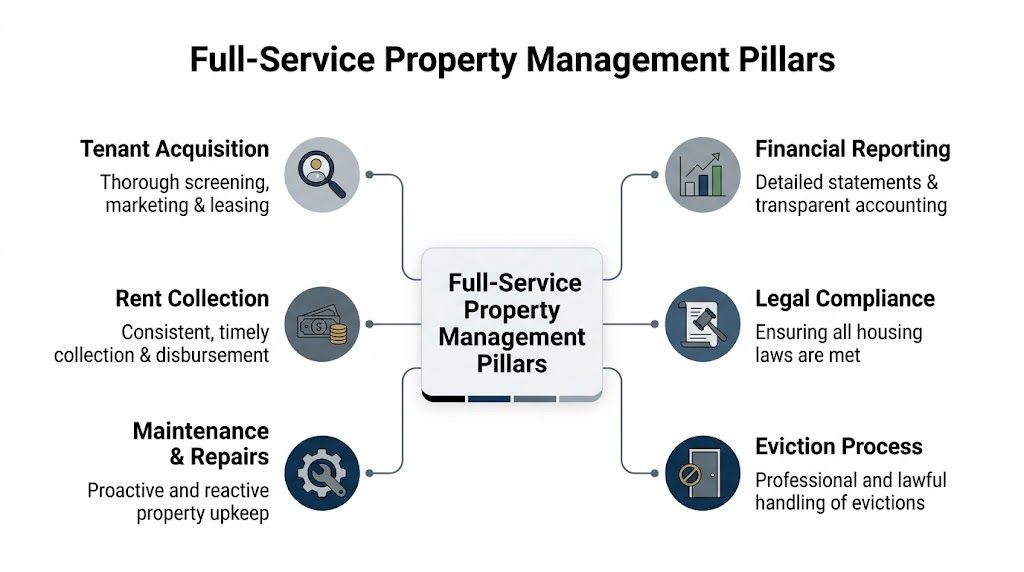
Tenant acquisition is more than filling a vacancy
A weak manager focuses on speed. A strong one focuses on fit.
That means marketing the property clearly, responding quickly to qualified prospects, applying screening standards consistently, and documenting every step. A rigorous screening and placement process can reduce delinquency to under 5%, and automated financial systems often achieve over 95% on-time payments, according to Dream Big Property Management’s Beaumont property management page.
That doesn't mean every applicant who looks acceptable on paper is a good resident. In practice, the strongest screening process checks whether the tenant can pay, will pay, and is likely to respect the property.
Rent collection should be routine, not personal
Owners get into trouble when rent collection becomes a series of informal conversations.
Good systems remove that. Tenants pay through a secure process. Late fees are handled according to policy and lease terms. Owners get consistent records. If a resident falls behind, the file already shows what happened, when notices went out, and what communication occurred.
The best rent collection system is one that doesn't depend on the owner's mood, memory, or availability.
Maintenance separates serious managers from casual ones
Any company can say it handles repairs. The difference is in triage, vendor quality, communication, and follow-through.
A real maintenance operation includes:
- Emergency response: Tenants need a channel that works after hours.
- Vendor standards: Contractors should be reliable, appropriate for the job, and documented.
- Owner communication: Major repairs should come with clear context, not panic.
- Repair history: Good records help identify repeat issues and deferred maintenance.
This matters in older homes throughout the Inland Empire, where small leaks, HVAC issues, and neglected exterior items can snowball if the manager waits too long or sends the wrong vendor.
Inspections protect the property and the file
Inspections are where “hands-on” becomes real. If a manager doesn’t inspect well, they’re managing blind.
Look for a company that handles:
- Move-in documentation
- Periodic interior reviews
- Move-out condition assessment
- Photo-based reporting
- Lease compliance follow-up
Some owners only think about inspections after damage appears. By then, the manager is reacting. Strong operators create records before problems become disputes.
Financial reporting should be clear enough to review quickly
Owners with one property and owners with several both need the same thing. Clean books and timely statements.
Monthly reporting should show income, expenses, and supporting detail in a format you can use. If you have to ask what a charge means every month, the system isn't working.
For a practical overview of what should sit inside a manager’s scope, this summary of property management company responsibilities is worth reviewing.
Compliance and enforcement can't be an afterthought
Inexperienced managers often cause significant damage.
A lease is only useful if the manager knows how to enforce it properly. Notices need to be accurate. Documentation needs to be organized. Communication has to stay professional. If a tenancy goes bad, sloppiness early in the file makes every later step harder.
A full-service operation should be able to explain, in plain language, how they handle lease violations, documentation, repair records, and owner approvals.
| Pillar | What good looks like |
|---|---|
| Leasing | Strong marketing, consistent screening, organized move-in process |
| Collections | Reliable systems, documentation, prompt follow-up |
| Maintenance | 24/7 intake, solid vendors, tracked repairs |
| Inspections | Scheduled reviews with usable reporting |
| Accounting | Clear owner statements and expense visibility |
| Compliance | Proper paperwork, lease enforcement, documented processes |
If a company can’t walk you through these pillars in detail, it’s not full-service. It’s partial service with better branding.
Vetting and Interviewing Your Future Property Manager
Most owners spend more time reviewing a kitchen remodel bid than they spend vetting the company that will control rent flow, tenant communication, repair decisions, and lease enforcement.
That’s backwards.
A manager can improve a decent property. A bad manager can damage a strong one within a single lease cycle. The interview process needs to test operations, not charm.
Start with their public footprint
Before you call, review the basics closely.
Look at their website. Not for polish alone, but for clarity. Can you tell what they do? Do they explain inspections, maintenance handling, rent collection, and legal process in plain language? Or is it all generic claims?
Then review how they present their service areas. A company covering Beaumont, Yucaipa, Redlands, Banning, Highland, and Loma Linda should sound like it knows those markets. If every city page says the same thing with the city name swapped, that tells you something.
Red flags show up early
You don't need a dramatic failure to spot a weak firm. Small signs are enough.
Watch for these:
- Slow replies: If they drag during the sales process, owner support won't improve later.
- Vague fees: If they won't explain charges clearly, expect billing frustration.
- Thin process language: “We handle everything” is not a process.
- No inspection detail: That usually means inspections are inconsistent.
- Informal maintenance answers: If they can't explain who approves what, costs can drift.
A manager who can't explain their process during an interview probably doesn't have one when the property gets difficult.
Ask questions that force operational answers
Avoid softball questions like “How long have you been in business?” unless you're pairing them with process questions.
Use questions that reveal how they work.
| Question Category | Sample Question | What a Great Answer Sounds Like |
|---|---|---|
| Leasing | How do you decide rental pricing and adjust if interest is weak? | They explain a market-based pricing process, response monitoring, and a willingness to adjust strategy instead of waiting passively. |
| Screening | What standards do you apply to every applicant? | They describe a consistent screening workflow, income verification, background review, and fair application of criteria. |
| Inspections | When do you inspect and what do owners receive after? | They explain move-in, routine, and move-out inspections with written or photo documentation. |
| Maintenance | How are after-hours calls handled? | They describe a real intake process, triage, vendor dispatch, and owner communication for major items. |
| Accounting | When do owner statements go out and what do they include? | They give a clear schedule and explain statement detail, not just “we send reports monthly.” |
| Compliance | How do you document lease violations and notices? | They talk about written records, standardized forms, timelines, and file discipline. |
| Communication | How quickly do you respond to owners and tenants? | They set realistic communication expectations and explain who handles what. |
| Retention | What do you do to reduce turnover? | They discuss responsiveness, maintenance follow-through, and resident communication, not just rent increases. |
Ask one question about technology
This matters more now than it used to. An emerging trend in the business is AI-driven predictive maintenance and tenant retention analytics, which has been shown to reduce vacancy rates by up to 25% and maintenance costs by 15% for firms that adopt it, as noted in this industry discussion on AI in property management.
You don't need a futuristic sales pitch. You do want to know whether the company uses technology to spot patterns, improve maintenance handling, or support resident retention.
A good question is simple: What technology do you use that changes outcomes for owners, not just convenience for staff?
The better answers usually mention maintenance tracking, organized owner portals, communication logs, and data-backed decision-making. Weak answers mention only online payments.
Compare how they think, not just what they charge
By the time you've spoken with a few managers, most fee sheets start sounding similar. Their thinking won’t.
One manager will talk mostly about filling vacancies fast. Another will talk about lease quality, inspection cadence, and repair controls. The second one is usually operating at a higher level.
If you want a local example of a company scope to compare against, AIM Property Management’s Beaumont service page outlines residential services such as tenant screening, rent collection, maintenance coordination, inspections, and documentation support. Use that as a benchmark alongside other local firms and compare process depth, not branding.
A short interview method that works
If you want to keep the search disciplined, use this sequence:
- Screen online presence first
- Shortlist only firms with clearly defined processes
- Interview at least two or three
- Ask the same core questions each time
- Review the management agreement after the call
- Choose the team you trust to operate under stress
That last point matters most. Things usually look fine when a property is occupied, the tenant pays on time, and repairs are minor. You’re hiring for the hard moments.
Understanding Beaumont Property Management Fees
Owners often focus on the headline management fee because it’s easy to compare. That’s rarely the source of significant value or major problems.
A lower fee can still cost more if the company leases poorly, handles maintenance loosely, or creates avoidable turnover. A higher fee can be worth it if the operation protects occupancy, documentation, and property condition.
Read the fee sheet like an operator
Most management agreements include some mix of these charges:
- Monthly management fee: Usually structured as a percentage of collected rent or a flat monthly amount.
- Leasing or placement fee: Charged when a new tenant is secured.
- Lease renewal fee: Charged when an existing tenant signs a renewal.
- Maintenance coordination markups or admin charges: Sometimes visible, sometimes buried.
- Notice, posting, or inspection-related charges: These need careful review.
The issue isn't that these fees exist. The issue is whether they’re clear, reasonable, and connected to real work.
The hidden cost is poor execution
In Beaumont, property taxes grew 192% between 2001 and 2024, a steep increase highlighted on Utopia Management’s Beaumont property management page. When owners are already carrying that kind of pressure, loose management becomes more expensive than a transparent fee schedule.
A sloppy leasing process can leave a property vacant longer than necessary. Weak tenant placement can produce missed payments, conflict, or turnover. Poor vendor control can turn ordinary repairs into bloated invoices.
Cheap management often becomes expensive in the places owners don't see on the first page of the agreement.
Questions to ask before you sign
Use the agreement to pin down specifics.
- What exactly is included in the monthly fee?
- Is there a separate charge for coordinating repairs?
- Who approves work, and at what threshold?
- Are inspections included or billed separately?
- What happens if a tenant renews?
- What happens if a tenant defaults or violates the lease?
If the answers are casual, keep looking.
A plain-English review of common setups is available in this guide to property management fee structure. It’s useful because it frames fees around service scope, which is how owners should evaluate them.
Think in net outcome, not sticker price
The right question isn't “Who charges less?”
It’s “Which company is most likely to protect income, reduce avoidable mistakes, and keep the property professionally run?” That’s how experienced owners look at Property Management Beaumont, Redlands property management, and property management Yucaipa options. The fee matters. The net result matters more.
Your Local Partner in Beaumont and Yucaipa
Regional coverage sounds good in a sales pitch. Local command helps an owner.
A manager working in Beaumont and Yucaipa needs to understand more than zip codes. They need to know how tenant expectations shift by neighborhood, how owners in different submarkets define “good condition,” and where operations break down if communication isn’t tight.

Expert Beaumont property management services
Beaumont owners usually need disciplined basics done very well. Leasing, resident communication, repair coordination, documentation, and owner reporting all matter. But tenant placement and oversight stand out because even a solid house can underperform if the manager prices it wrong, reacts slowly, or treats follow-up casually.
Data-driven management helps here. Real-time dashboards can track occupancy rates with benchmarks in the 92% to 97% range and monitor rental yields for faster operational decisions, according to Beaumont Capital Markets on real estate asset management. The point for owners is simple. You want a manager who tracks the property as an asset, not as a stack of emails.
That local lens also matters for visibility. Owners searching online often judge a company by how clearly it serves specific areas. If you're curious how firms structure that kind of local presence, this article on Local SEO for Service Area Businesses is a practical read because it shows why city-level relevance matters for service companies with multiple communities.
Comprehensive Yucaipa property management solutions
Yucaipa requires a slightly different touch. Many owners want strong resident placement, steady communication, and a manager who understands that presentation and follow-through matter just as much as systems.
That’s why Yucaipa property management and property management Yucaipa often come down to execution quality. Does the company respond like a local operator? Do they know how to handle resident concerns without letting small issues drag? Can they maintain standards without creating unnecessary friction?
The same logic extends into Redlands property management and property management Redlands. Owners in these nearby cities often want more than generic coverage. They want a manager who can adapt to the property, neighborhood, and tenant profile.
A short video can help show how a local management approach is communicated in practice.
Why local coverage across the Inland Empire matters
A manager serving Beaumont, Yucaipa, Redlands, Calimesa, Loma Linda, Mentone, Highland, and Banning should be able to do three things well:
- Adjust by neighborhood: The same leasing message doesn't fit every property.
- Keep vendors moving: Repair delays hurt both resident trust and owner confidence.
- Communicate clearly with high-expectation owners: Owners with significant income and limited time usually want prompt facts, not vague reassurance.
That’s where local consistency matters most. Not in slogans, but in how quickly problems are handled and how little confusion reaches the owner.
Hiring a Property Manager Your Questions Answered
Is local experience really that important?
Yes. A local manager usually understands the differences between Beaumont, Yucaipa, Redlands, Highland, and Banning at the street level, not just the city-name level. That helps with pricing, vendor dispatch, tenant communication, and expectations around property condition.
If you're searching property management near me, you're usually trying to avoid a distant call-center model. That instinct is sound.
When should I hire a property manager?
Hire one when the property starts taking more attention than you want to give it, or when the cost of a mistake is rising.
Common triggers include a move out of the area, a growing portfolio, tenant conflict, recurring maintenance issues, or not wanting rent collection and compliance work on your plate anymore. Many owners wait too long and hire only after avoidable stress has already built up.
What should I expect from full-service management?
Expect day-to-day leasing and operations support, rent handling, maintenance coordination, inspection routines, tenant communication, financial reporting, and documentation that holds up when there’s a dispute.
You should also expect clarity. If the company can’t explain what it does, when it does it, and how it documents the work, that’s not full-service.
Good property management doesn't make ownership invisible. It makes ownership organized.
How do I know if a manager is the right fit for my property?
Ask whether their process fits your actual asset.
A single-family rental in Beaumont may need one style of oversight. A better-finished home in Yucaipa or a property with more demanding owner expectations in Redlands may need another. The right fit comes from matching the company’s operating habits to your goals, not choosing the one with the flashiest pitch.
Is now a good time to hire a property manager?
If you're spending too much time coordinating repairs, answering tenant messages, worrying about compliance, or trying to fill a vacancy without a clear plan, yes.
Owners often search hire a property manager only after the property has already become disruptive. It’s better to bring in help while the asset is still stable and the handoff can be done cleanly.
If you want help evaluating whether professional management fits your property in Beaumont, Yucaipa, Redlands, Calimesa, Loma Linda, Mentone, Highland, or Banning, contact AIM PROPERTY MANAGEMENT COMPANY . A good first conversation should clarify your goals, your property’s operating needs, and whether a full-service handoff makes sense for your situation.