You usually start looking for a property manager after something has already gone wrong.
A tenant stops responding. A repair turns into a weekend emergency. Your current manager sends a vague statement, misses a follow-up, or fills a vacancy with the first applicant who can sign. At that point, the question is no longer whether you need help. The question is whether you need a better property management partner.
In the Inland Empire, that difference shows up fast. Owners in Redlands, Beaumont, Yucaipa, Calimesa, Highland, Loma Linda, Mentone, and Banning are not just hiring someone to collect rent. They are handing over leasing risk, maintenance decisions, compliance exposure, tenant communication, and a meaningful part of the property’s financial performance. If the manager cuts corners, the owner pays for it.
The hard truth is simple. Cheap management often costs more than professional management. The extra cost does not always appear as a line item on a fee sheet. It shows up in vacancy, avoidable repairs, poor tenant fit, legal friction, and the slow decline of an asset that should have been protected.
Beyond Rent Collection Defining Your Need for Better Management
A lot of owners begin the search with the wrong question. They ask, “What do you charge?” before they ask, “What problems are you solving for me?”
That mistake leads people straight into low-cost management arrangements that look efficient at first and get expensive later. One of the most overlooked risks in Property Management Beaumont is hiring a low-cost manager who cuts corners on screening and maintenance, which can lead to higher vacancy, property damage, and costly evictions that often involve thousands in legal fees, according to this review of the risks of cutting corners on property management.
Start with your actual pain points
Most owners do not need “full service” in the abstract. They need relief from specific pressure points.
Ask yourself where the current setup is failing:
- Leasing risk: Are you tired of weak applicants, slow turnovers, or tenants who looked fine on paper and quickly became a problem?
- Maintenance stress: Are late-night calls, delayed vendors, and repeated repairs eating your time and money?
- Compliance concerns: Are you confident your notices, lease documents, and operating procedures fit California requirements?
- Financial visibility: Do you get statements that help you make decisions, or just paperwork that confirms money moved around?
- Communication quality: Do you know what is happening at the property without having to chase updates?
If you answer yes to more than one of those, you are not looking for a rent collector. You are looking for operating discipline.
Better means measurable protection
A better manager protects four things at once. Cash flow, condition, compliance, and tenant quality.
That sounds basic, but many owners settle for less because they compare managers by monthly fee alone. A lower fee is not savings if it comes with weak follow-through, rushed placements, and reactive repairs. In Beaumont property management, that trade-off can be especially costly because growth markets punish slow response and sloppy execution.
Tip: The right scorecard is not “What is the management fee?” It is “How does this company prevent bad tenancy, extended vacancy, and repair escalation?”
Build a short owner scorecard
Before you search “property management near me” or decide to hire a property manager, write down your own essential requirements.
Use a simple list like this:
| Priority | What good looks like |
|---|---|
| Tenant placement | Consistent screening criteria and documented verification |
| Repairs | Clear process for emergencies, routine requests, and vendor oversight |
| Reporting | Clean monthly statements and visible expense tracking |
| Compliance | Up-to-date forms, notices, and lease handling |
| Communication | Defined response times and one accountable point of contact |
If a manager cannot explain their responsibilities in operational terms, keep moving. This overview of property management company responsibilities is a useful baseline because it helps owners separate real management from a stripped-down fee-based service.
The owners who make strong hiring decisions usually do one thing differently. They define “better” before they compare companies. That keeps them from being distracted by a low headline fee that hides much larger downstream costs.
The Four Pillars of Exceptional Property Management
Not every management company fails in the same way. Some market well but screen poorly. Some lease quickly but lose control of maintenance. Others keep books but cannot manage people.
In practice, strong Redlands property management, Property Management Beaumont, and property management Yucaipa all rest on the same four pillars.
Tenant screening that goes beyond a credit score
A serious screening process is layered, not casual. It should include credit checks, criminal background verification, eviction history review, and income verification at 3x rent. When managers use that full process instead of basic checks, eviction rates can fall by up to 40%, and screened tenants reach 95% on-time rent payments, based on industry benchmarks summarized by DoorLoop’s property management industry stats.
That matters because weak screening hurts in several directions at once. You do not just risk nonpayment. You risk turnover, legal expense, neighbor complaints, and avoidable wear on the home.
What does this look like in the field?
- Documents must match the story: Pay stubs, bank records, employment claims, and prior housing history should line up.
- Criteria must be consistent: Good managers do not improvise standards from applicant to applicant.
- Rental behavior matters: Credit alone is not enough. Prior landlord performance often tells you more about future tenancy.
In Yucaipa property management, this is especially important for owners who want stable households rather than fast placements. The wrong tenant can erase months of apparent savings from a discounted management fee.
Maintenance systems that prevent small issues from becoming large ones
Maintenance quality is where a manager’s operating standard becomes visible.
Average managers wait for things to break, send whoever is available, and hope the invoice solves the issue. Better managers run a process. They accept requests in a structured way, prioritize urgency, dispatch vetted vendors, document the work, and confirm the repair resolved the problem.
A useful way to evaluate this is by looking at systems, not promises. Owners comparing platforms may find resources like this guide to the best software for property managers helpful because software often reveals how organized a company really is. If a firm cannot show how requests are logged, tracked, approved, and closed, the process is probably weaker than the sales presentation.
For landlords who want a practical overview from the ownership side, this breakdown of best property management software for landlords is also worth reviewing.
Financial management that is clean enough to act on
Many owners think they have decent reporting until they switch managers and realize how little they knew before.
Good financial management is not just monthly rent minus bills. It is timely collection, owner statements that are readable, repair charges with context, and records that let you spot patterns. You should be able to answer basic questions quickly:
- Which properties are producing stable cash flow?
- Which units are generating repeat repair costs?
- Are turnover expenses becoming routine?
- Are delinquencies isolated or recurring?
If your current manager makes those questions hard to answer, the problem is not formatting. The problem is operational visibility.
Compliance that is built into daily operations
California does not forgive sloppy process.
The strongest managers build compliance into leasing, notices, renewals, documentation, and vendor handling. They do not treat legal issues as rare events. They treat them as part of daily operations. That is the difference between a company that helps you avoid problems and one that reacts after the problem is already expensive.
Key takeaway: A better property management partner is not defined by one impressive service. The standard is whether screening, maintenance, reporting, and compliance work together without gaps.
AIM PROPERTY MANAGEMENT COMPANY is one example of a firm that offers tenant screening, rent collection, maintenance coordination, annual inspections, and document management across Inland Empire service areas. That kind of bundled structure is often more reliable than piecing those functions together across separate vendors.
Finding and Shortlisting Managers in Redlands and Beyond
The search process matters more than most owners expect. If you start with a broad search and call the first few names that appear, you usually end up interviewing good marketers rather than good operators.
A stronger approach is narrower and more local.
Search for evidence, not slogans
Begin with city-specific searches tied to your property type and location. An owner with a single-family home should not evaluate firms the same way an owner with a small multifamily building would.
Look for companies that clearly serve communities such as Redlands, Beaumont, Yucaipa, Highland, Banning, Calimesa, Loma Linda, and Mentone. In Redlands property management, local familiarity often shows up in the details. Neighborhood-specific marketing language, realistic leasing expectations, and vendor relationships are all easier to verify than generic claims about “full service.”
A company website should answer practical questions quickly:
- What property types do they manage?
- Which cities do they actively serve?
- How do they describe screening, maintenance, and reporting?
- Do they show a real operating model or just sales language?
This guide on how to find a property manager is a useful checklist for narrowing your list before you start interviews.
Build a shortlist from multiple channels
Do not rely on search alone.
Use at least three inputs:
- Investor referrals: Other owners can tell you how a manager performs after the contract is signed.
- Agent and broker referrals: Local real estate professionals often know who communicates well and who causes repeated transaction issues.
- Business community feedback: Insurance contacts, contractors, and escrow officers often see which firms are organized.
The goal is not to collect a long list. It is to identify a short list worth serious time.
Verify before you call
A polished website is not proof of competence. Before interviewing anyone, verify the basics.
Check for a valid California real estate broker relationship where applicable. Review whether the company appears established, responsive, and consistent in public-facing information. Read reviews carefully, not just for star count but for patterns. Late communication, surprise fees, and poor maintenance follow-up tend to appear more than once when they are real.
Tip: Shortlist only companies that already look credible on paper. Interviews should refine your choice, not rescue weak candidates.
For most owners, three to five candidates is enough. More than that creates noise. Less than that usually means you have not tested the market properly.
The Manager Interview A Checklist for Hiring the Best
Once you have a shortlist, the interview tells you what the website cannot. You are listening for process, accountability, and local judgment.
A good manager should be able to answer detailed questions without drifting into vague assurances.
Early in the interview, use a structured checklist like the one below.
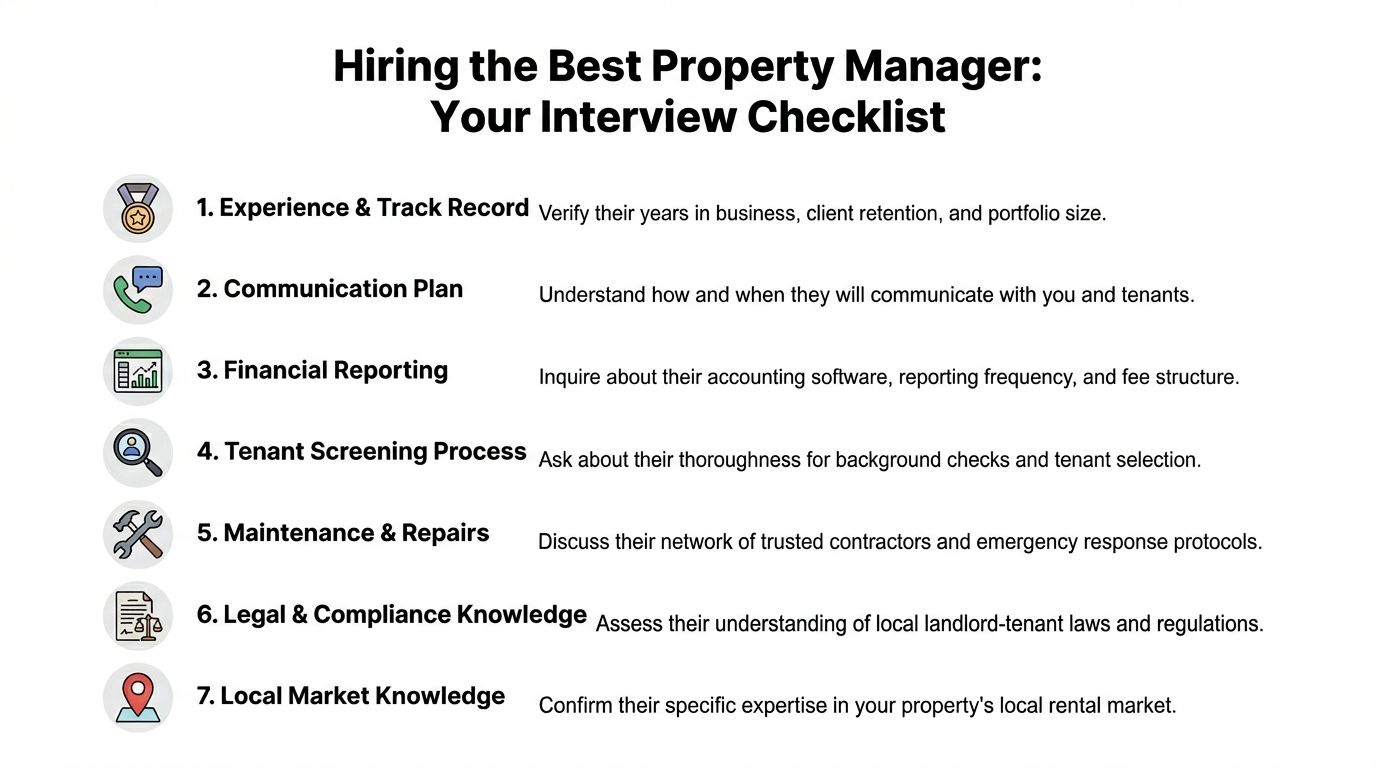
Ask for process, not philosophy
Start with how they run the property.
Questions that reveal substance:
- Screening standards: What documents do you require, and who verifies them?
- Leasing workflow: How do you market, show, approve, and onboard tenants?
- Maintenance handling: How are work orders submitted, triaged, assigned, and closed?
- Owner approvals: What repair decisions require owner authorization?
- Statements and records: What do monthly reports include?
- Compliance handling: Who prepares notices and tracks deadlines?
If the answers stay broad, that is useful information. Strong operators usually speak in sequence. Weak ones speak in slogans.
Drill into maintenance discipline
Maintenance is one of the clearest separators between average and excellent management. Data-driven maintenance workflows that use 24/7 ticketing apps and AI-driven triage can reduce tenant turnover from unresolved repairs by 75%, and firms that track ticket response times under 24 hours and maintenance costs under 8% of revenue tend to produce stronger tenant satisfaction and retention, according to this analysis of property management challenges and how to solve them.
That does not mean every company needs the same software stack. It does mean they need a system.
Ask questions like these:
| Interview topic | Strong answer sounds like | Weak answer sounds like |
|---|---|---|
| Emergency requests | Clear intake process, triage steps, vendor dispatch rules | “Tenants can call us anytime” |
| Vendor network | Vetted contractors, documentation, follow-up process | “We know a few guys” |
| Cost control | Approval thresholds and invoice transparency | “We handle it as needed” |
| Quality control | Photos, notes, and confirmation after work | “If the tenant doesn’t complain, it’s fine” |
A manager who cannot explain maintenance in sequence usually manages repairs by interruption, not by system.
Here is a useful video if you want a quick visual walkthrough before interviews:
Watch for red flags in the room
Owners often focus so much on asking questions that they miss what the interview itself reveals.
Pay attention to these signs:
- Disorganized materials: If they cannot present their own business clearly, your property records may look the same.
- Vague local knowledge: A manager serving property management Redlands or Beaumont property management work should speak comfortably about local leasing realities, tenant expectations, and city-specific operating issues.
- Overconfidence about problem tenants: Good managers respect risk. They do not talk as if screening removes all uncertainty.
- Fee-first selling: If the main pitch is low price, the service model usually has gaps somewhere.
This owner-focused guide on how to choose property management company is a good companion when you are comparing interview notes afterward.
Key takeaway: The interview should leave you with a clear picture of how work gets done on an ordinary Tuesday, not just how the company performs in a sales meeting.
Local Expertise Property Management in Beaumont and Yucaipa
A manager can be competent and still be the wrong fit for your property.
That happens when the company treats every Inland Empire location the same. It is a mistake. Property Management Beaumont and property management Yucaipa require different local instincts, even when the service menu looks identical on paper.
Beaumont rewards disciplined occupancy management
Beaumont has grown quickly, and owners often underestimate how much execution matters in a market that attracts a wide mix of renters. In high-performing Property Management Beaumont, 95-96% occupancy rates are a foundational benchmark for success, according to Buildium’s review of property management KPIs to track.
That number matters because occupancy is not just a leasing metric. It is a management metric. It reflects pricing judgment, response speed, property condition, showing quality, and screening discipline working together.
Professional management also tends to outperform self-management. The same source notes that professionally managed properties can see 5-10% higher occupancy than self-managed ones. For a 20-unit property at $2,000 monthly rent, a 1% occupancy increase yields $48,000 annually.
For owners in Beaumont, that changes the conversation. A manager’s fee is only one number. The more important number is what their operating quality does to occupancy and income.
Yucaipa calls for a different operating posture
In Yucaipa property management, curb appeal, property presentation, and resident fit often carry extra weight. The market is not just about filling a vacancy. It is about matching the property to the right tenant profile and preserving standards that support long-term rental performance.
That is where one-size-fits-all management breaks down.
A local operator will usually understand:
- How to position the listing: The same advertising language that works in one city may miss in another.
- Which vendors respond reliably: Speed matters, but consistency matters more.
- What tenants notice first: Exterior condition, communication quality, and move-in readiness all influence leasing momentum.
Owners evaluating Property Management Beaumont services should look for signs that the company understands adjacent markets too. A firm handling Beaumont property management well should also be able to explain what changes when the property sits in Yucaipa, Redlands, or Calimesa.
Local knowledge shows up in small decisions
Most of the value of local expertise is not dramatic. It appears in dozens of ordinary choices.
A local manager prices renewals with better judgment. They know which repair vendors repeatedly solve problems and which ones create callbacks. They understand what tenants compare your property against. They know when a listing needs better photos, fresher presentation, or a different leasing approach.
Tip: Ask every candidate for one example of how they would market, maintain, or position your specific property differently in Beaumont than in Yucaipa. The answer will tell you whether their “local expertise” is real.
That is why strong Redlands property management, property management Redlands, Yucaipa property management, and Beaumont property management should never be treated as interchangeable labels. Local coverage only matters when local judgment comes with it.
Making the Final Choice and Ensuring a Smooth Transition
The final decision usually comes down to two or three companies that all sound capable. Owners often make another common mistake at this stage. They compare fees one last time and choose the lowest one.
A better method is to compare operating models.
An important trend in Redlands property management is the move toward integrated service models that consolidate screening, rent collection, maintenance, compliance, and reporting under one provider. According to EisnerAmper’s discussion of real estate service models, unified platforms reduce the inefficiencies that come from disconnected services, which can inflate costs and limit portfolio visibility.
Read the agreement like an operating document
When you review the management agreement, focus on these clauses:
- Termination terms: How do you exit if service slips?
- Repair authorization limits: When can the manager spend without approval?
- Leasing authority: Who decides on applicant exceptions, concessions, or renewals?
- Owner responsibilities: What must you provide or maintain for the relationship to function properly?
- Reserve handling: How much cash stays on account for repairs and recurring costs?
The best agreement is not the shortest. It is the clearest.
Handle the handoff carefully
A smooth transition depends on details.
Make sure the incoming manager receives all current leases, tenant ledgers, deposit records, keys, vendor history, and open maintenance items. Notify tenants clearly and early. Keep communication calm and procedural. Tenants do not need a dramatic explanation. They need to know where to pay rent, how to request repairs, and who their contact is.
A fragmented handoff creates confusion that can trigger late payments, missed work orders, and distrust. An organized handoff does the opposite. It establishes control from day one.
The strongest final choice is usually the company that combines process, communication, and integration into one consistent operating system.
Frequently Asked Questions About Hiring a Property Manager
When should I hire a property manager instead of self-managing?
You should consider it when the property is taking too much time, decisions are becoming reactive, or you no longer trust that leasing, maintenance, and compliance are being handled with enough care. Many owners wait until there is a crisis. It is usually smarter to act when you first see recurring friction.
Is the cheapest company ever the best value?
Sometimes a lower fee can make sense. But low cost is not the same as value. If the manager cuts corners on screening, delays repairs, or communicates poorly, the savings disappear quickly through vacancy, tenant issues, and asset deterioration.
What should I search for online?
Start with city-specific terms that reflect your location and property type. Many owners begin with “property management near me,” which is fine as a starting point, but you should then narrow the list to companies that clearly serve your area and explain how they operate.
How do I know if a manager understands my market?
Ask how they would position your property in your exact city. A qualified local company should speak comfortably about neighborhoods, renter expectations, leasing presentation, maintenance response, and what drives demand in places like Redlands, Beaumont, Yucaipa, Highland, Banning, Calimesa, Loma Linda, and Mentone.
What documents should transfer when I switch managers?
At minimum, transfer active leases, tenant contact information, payment ledgers, security deposit records, keys, inspection notes, maintenance history, and any open vendor invoices or pending work orders. A clean file transfer prevents confusion for both owner and tenant.
What makes a better property management experience?
Clarity and consistency. You should know how tenants are screened, how repairs are handled, how money is reported, and how compliance is managed. If those answers are fuzzy before you sign, the experience after signing will usually be worse.
What if I am ready to hire a property manager now?
Use your shortlist, interview notes, and agreement review to make a value-based decision. If one company gives you clear process, local knowledge, solid reporting, and disciplined maintenance handling, that is usually the stronger long-term choice than a company that mainly competes on fee.
If you are ready to hire a property manager in Redlands, Beaumont, Yucaipa, Calimesa, Highland, Loma Linda, Mentone, or Banning, AIM PROPERTY MANAGEMENT COMPANY offers residential property management for single-family homes, condos, townhomes, and investment properties with tenant screening, rent collection, maintenance coordination, inspections, and compliance support.