Think of a lease agreement as the official rulebook for a rental property. It’s far more than just a piece of paper; it’s a legally binding contract that lays out the terms and conditions for both a landlord and a tenant. This is the foundational document that protects everyone involved by clearly defining rights and responsibilities from day one.
Understanding The Purpose Of A Lease Agreement
A lease agreement is essentially the game plan for a successful tenancy. It’s your first line of defense in property management, setting the stage for a transparent and respectful landlord-tenant relationship.
For property owners here in communities like Redlands, Beaumont, Yucaipa, and Loma Linda, a well-drafted lease is absolutely critical. It turns a verbal understanding or a handshake deal into an enforceable contract, giving you a clear roadmap for handling everything from rent collection to maintenance calls. Without a solid written agreement, you’re leaving your investment wide open to misunderstandings and legal disputes that can drain your time and money.
Why A Solid Lease Matters
A strong lease provides structure and, just as importantly, security. It cuts through the gray areas by spelling out all the critical details, which helps head off conflicts before they can even start and gives you a legal framework to solve any issues that do pop up.
A good lease agreement clearly establishes:
- Financial Terms: It locks in the monthly rent, the exact due date, and what happens if a payment is late.
- Occupancy Rules: It defines who is allowed to live in the property and sets clear guidelines for guests.
- Property Use: It outlines how the property can and cannot be used, specifying any restrictions on things like pets or making alterations.
- Maintenance Duties: The agreement clarifies which repairs are the tenant's job and which ones fall to the landlord.
A lease is the cornerstone of any successful rental. It creates a predictable, stable environment for the tenant while giving the landlord a reliable way to protect their property and ensure a steady return on their investment.
At the end of the day, understanding what is a lease agreement is the first step toward professional and effective property management. It’s the single most important tool for protecting your asset, securing your income, and building a positive relationship with your tenants.
While there are many types of rental contracts out there, the core principles remain the same. As we go through this guide, you’ll see what makes a lease legally sound in California and learn more about the fundamental tenant rights and responsibilities that every fair agreement is built on.
Must-Have Clauses for Every California Lease
Think of your lease agreement as the rulebook for your rental property. It’s more than just a piece of paper—it's the blueprint that defines the relationship between you and your tenant. For property owners in California, especially in communities like Redlands, Yucaipa, Highland, and Beaumont, getting these clauses right isn't just good practice; it's essential for protecting your investment.
A solid lease anticipates problems before they happen. It lays out clear expectations and provides a roadmap for handling common issues. Without these core components, you’re essentially winging it, which can open the door to misunderstandings, disputes, and costly legal headaches. Let’s break down the clauses that absolutely must be in every California lease.
Rent Terms and Conditions
This is the financial heart of your agreement, and it needs to be crystal clear. Simply stating the monthly rent amount isn't enough. A vague rent clause is one of the quickest ways to create friction with a tenant.
To avoid any confusion, this section should spell out:
- The exact rent amount due every month.
- The specific due date (e.g., the 1st of the month).
- How you’ll accept payment (online portal, check, etc.).
- Any grace period you offer before a payment is officially late.
- The specific late fee that will be charged, which has to comply with California law.
When everything is laid out in black and white from day one, tenants know exactly what’s expected, and you have a clear, enforceable process for collecting rent.
Security Deposit Specifics
In California, the security deposit is one of the most regulated parts of the landlord-tenant relationship. If you handle it wrong, you can land in serious legal trouble. This makes the security deposit clause absolutely critical.
A common mistake landlords make is treating the security deposit like their own money. In California, it’s the tenant's money held in trust, and the rules for handling it are strict and non-negotiable.
Your lease must detail:
- The total amount of the security deposit. Remember, in California, it's capped at two months' rent for an unfurnished unit or three months' for a furnished one.
- What you can deduct for, like unpaid rent, cleaning costs to return the unit to its original state (minus normal wear and tear), and repairing damage caused by the tenant.
- The timeline for returning the deposit, which in California is 21 calendar days after the tenant moves out.
Failing to follow these rules can lead to hefty penalties, sometimes forcing you to return the entire deposit, even if the tenant left the place a mess. To dive deeper, you can learn more about the specifics of California's tenant security deposit laws in our dedicated guide.
Maintenance and Repair Responsibilities
"Who's responsible for fixing the leaky faucet?" This is a question that should never be up for debate. A well-drafted lease draws a clear line, separating landlord and tenant duties for maintenance and repairs. This clarity is a cornerstone of effective Redlands property management.
As the landlord, you’re responsible for keeping the property habitable—that means ensuring the plumbing, heating, and electrical systems are all in good working order. The tenant, in turn, is generally responsible for keeping the place clean and fixing anything they or their guests break.
Your lease should specify:
- How tenants should request repairs (e.g., through an online portal).
- The expected timeframe for you to address major versus minor issues.
- Simple tenant duties, like changing burnt-out light bulbs or swapping batteries in smoke detectors.
Right of Entry
Even though you own the property, your tenant has a legal right to privacy. California law is very clear on this: landlords must provide "reasonable" notice before entering a rental unit. This is legally presumed to be 24 hours in writing, except in true emergencies like a fire or flood.
This clause protects everyone. It respects the tenant's right to quiet enjoyment of their home while giving you the legal pathway to conduct inspections, make necessary repairs, or show the property to prospective buyers. Without this clause, any unannounced entry could be seen as a serious violation of your tenant's rights.
Choosing The Right Type Of Lease Agreement
Not all rental properties are the same, and your lease agreement shouldn't be a one-size-fits-all document either. The structure you choose has a real impact on your flexibility, your tenant's stability, and the day-to-day management of your investment. Picking the right lease is a strategic move that helps landlords in communities like Banning, Calimesa, and Loma Linda match their agreement to their specific financial goals.
Think of it like a contractor choosing the right tool for the job. You need to select the lease type that fits your rental scenario perfectly. This choice defines how long the tenancy lasts and sets the ground rules for how and when it can end—a critical piece of the puzzle. Let's break down the most common structures to help you make the right call.
Fixed-Term Leases For Stability
A fixed-term lease is what most people picture when they think of a rental agreement. It runs for a set period, usually one year, and is the foundation of stability for both landlords and tenants. For property owners, it means guaranteed rental income for the entire term, which makes financial planning a whole lot easier.
This predictability is a game-changer for owners who want a steady, reliable return on their investment. It cuts down on turnover, reduces the costs of finding new tenants, and gives the renter a stable home. If you're managing a property from a distance or just prefer a hands-off approach, the stability of a fixed-term lease is a huge plus. It’s a popular choice for Redlands property management strategies that are focused on long-term growth.
Month-To-Month Leases For Flexibility
On the flip side, a month-to-month lease offers maximum flexibility. This agreement renews automatically each month and can be ended by either the landlord or the tenant with proper written notice—typically 30 days here in California. It's the perfect option when a long-term commitment just doesn't make sense for either party.
This lease type is ideal for landlords who might be thinking about selling the property soon or want the option to do major renovations without a long-term tenant in the way. It’s also great for tenants in a transitional phase, like those moving for a new job. Of course, this flexibility comes at the cost of stability, but it's a valuable tool for certain situations. To dive deeper into this balancing act, check out our guide on short-term vs. long-term rentals in Redlands.
The lease agreement basically acts as a decision tree for handling different tenant actions, whether it's paying rent, asking for entry, or wanting a pet.
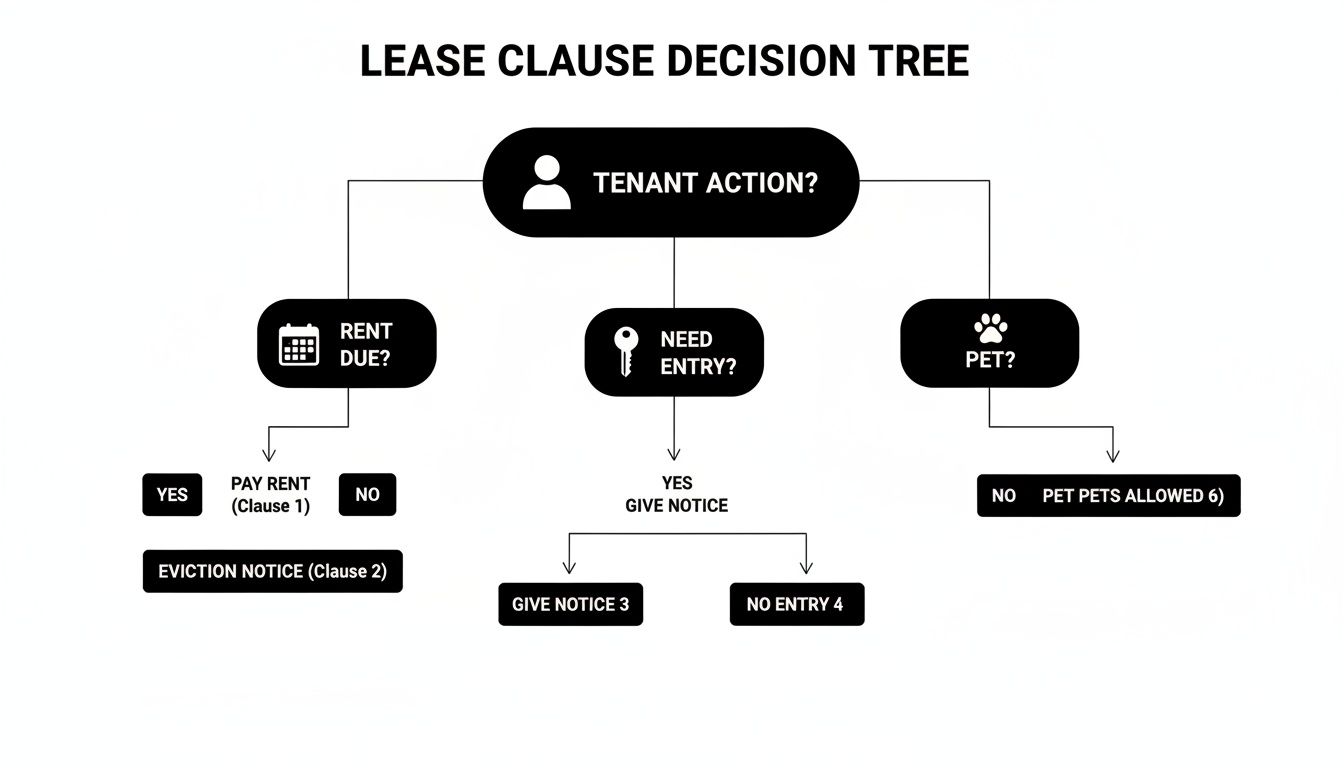
This visual shows how clear clauses in the lease create a straightforward path for handling common issues, so everyone knows exactly what to do.
Sublease Agreements For Controlled Occupancy
A sublease agreement is a separate rental contract where the original tenant rents out some or all of the property to a new person, called a subtenant. This usually happens when the original tenant needs to move out for a while but doesn't want to break their fixed-term lease. But be careful—it adds another person to the mix, and that requires careful handling.
As the landlord, you should always insist that you approve any sublease agreement in writing. This lets you screen the subtenant just like you did the original one, keeping you in control of who lives in your property.
If you don't include a sublease clause in your main lease, you could end up with unauthorized people living in your unit and lose control completely. By clearly defining the rules around subletting, you protect your property and ensure every occupant meets your standards—a vital part of successful Beaumont property management.
Comparing Common Lease Agreement Types
Here's a side-by-side comparison to help you decide which lease structure is best for your property.
| Lease Type | Best For | Pros | Cons |
|---|---|---|---|
| Fixed-Term Lease | Landlords seeking stable, long-term income and tenants who want housing security for a set period (e.g., a year). | – Consistent rental income – Lower turnover costs – Predictable financials – Tenant stability |
– Less flexibility to remove a problem tenant – Harder to adjust rent to market rates – Potential for lost income if tenant breaks lease early |
| Month-to-Month Lease | Landlords planning to sell or renovate, or tenants needing temporary housing without a long-term commitment. | – Maximum flexibility for both parties – Ability to adjust rent more frequently – Easier to end the tenancy |
– Less stable income – Higher tenant turnover – More frequent marketing and screening |
| Sublease Agreement | Original tenants who need to move temporarily without breaking their lease, with landlord approval. | – Tenant avoids lease-breaking penalties – Landlord continues to receive rent – Property remains occupied |
– Adds complexity with a third party – Original tenant is still responsible for rent/damages – Requires careful landlord oversight and approval |
Choosing the right lease comes down to weighing your need for stable income against your desire for flexibility. Each type has its place, and understanding them is key to smart property management.
Navigating California's Landlord-Tenant Laws
When you own rental property in California, you're operating in one of the most detailed and tenant-friendly legal environments in the country. Understanding what is a lease agreement is just the starting line. The real challenge is making sure that lease—and every action you take—complies with a dense web of state and local laws.
These regulations aren't just suggestions; they are strict requirements built to ensure fair housing for everyone. Ignoring them, even by accident, can lead to serious financial and legal trouble. Think of these laws less as obstacles and more as the official rulebook for creating a safe and balanced housing market. Still, the complexity means a simple oversight can quickly snowball into a costly dispute.
Mandatory Disclosures Landlords Must Provide
In California, transparency isn't just good practice—it's the law. Before a tenant ever puts pen to paper, you are legally required to provide them with a handful of specific disclosures. These are non-negotiable.
Here are a few of the big ones:
- Lead-Based Paint: If your property was built before 1978, federal law mandates you give tenants an EPA-approved pamphlet on lead hazards and disclose any known issues.
- Pest Control: Do you use a regular pest control service? If so, you have to provide new tenants with a copy of the notice from that company.
- Demolition Permits: If you've already applied for a permit to demolish the unit, you must inform prospective tenants before you accept a single dollar from them.
- Registered Sex Offender Database: Your lease must include a specific clause notifying tenants that information about registered sex offenders is publicly available on the Megan's Law website.
Missing any of these can potentially invalidate your lease and open you up to legal action. It’s that serious.
Understanding Statewide Rent Control And Eviction Rules
California's Tenant Protection Act (AB 1482) was a game-changer, establishing statewide rent control and "just cause" eviction rules for many properties. This law limits how much you can raise the rent each year (generally 5% plus inflation, with a 10% total cap) and, crucially, prevents you from ending a tenancy after 12 months without a legally valid reason.
Just cause eviction rules fundamentally change how tenancies are managed. You can no longer simply give a 30-day notice without cause; you must have a documented, valid reason, such as non-payment of rent or a material lease violation.
This is where professional oversight becomes invaluable. The sheer complexity of compliance is why so many property owners in our area turn to expert property management in Yucaipa. A professional manager ensures every step, from a rent increase notice to an eviction filing, is handled perfectly according to the law, protecting you and your investment. To dive deeper, you can explore the nuances of California's landlord-tenant laws in our guide.
Navigating these legal requirements also means staying on top of your finances. A solid landlord's guide to taxes on rental income is essential for understanding your financial obligations. The need for precise compliance and documentation isn't just a local trend; it's driving growth worldwide. The global lease management market was valued at USD 4.97 billion in 2024 and is projected to hit USD 7.62 billion by 2032, with North America leading the charge due to its focus on regulatory adherence. This growth just goes to show that managing leases effectively is a specialized skill—one that’s critical for safeguarding your asset from risk.
How We Create Ironclad Lease Agreements
Knowing what goes into a lease agreement is one thing. Actually crafting a protective, legally sound document that holds up under pressure? That’s a whole different ballgame. This is where professional expertise turns a lease from a potential liability into your most powerful asset.
At AIM Property Management, we don’t just download generic templates. We build our lease agreements from the ground up, starting long before a tenant even lays eyes on the contract.

Our process is meticulous, designed to safeguard your investment and foster a clear, respectful relationship with your tenants in communities like Highland, Calimesa, and Mentone. And it all starts with finding the right people.
Rigorous Tenant Screening
The strongest lease in the world doesn’t mean much if the person signing it isn't reliable. That's why our process kicks off with a comprehensive screening of every single applicant.
We go far beyond a basic credit check to get a complete picture of who might be living in your property. Our screening digs into:
- Detailed Background Checks: We review criminal history to ensure the safety of your property and the community.
- Credit Report Analysis: This gives us a clear look at their financial responsibility and track record of paying bills on time.
- Income and Employment Verification: We confirm that applicants have a stable, sufficient income to comfortably afford the rent.
- Past Landlord References: Nothing beats a direct conversation with previous landlords to get real insight into how an applicant behaves as a tenant.
This tough vetting process is the first and most critical step in protecting your asset. It ensures we only place qualified, trustworthy people in your home.
Customized and Compliant Lease Drafting
Once we have an approved applicant, we get to work drafting a lease agreement specifically for your property. We know every rental is different, and a one-size-fits-all approach just leaves you exposed.
Our team creates customized, attorney-vetted leases that address the specific needs of your property while staying in full compliance with California's notoriously complex landlord-tenant laws. This includes all state-mandated disclosures and clauses tailored to your property, like specific rules for using a shared pool or assigned parking spots. This attention to detail is a cornerstone of professional Redlands property management and nips potential disputes in the bud.
A proactive, well-drafted lease does more than just outline rules; it anticipates potential issues and provides a clear, legal framework for resolving them, saving you time, money, and stress.
This deep knowledge of state and local laws is non-negotiable. The rental market is always changing, and a professional manager ensures your agreements stay current. Staying on top of trends is part of the job. For example, recent JLL reports on global market perspectives show a tightening demand for quality rentals. In a competitive market like this, it's crucial to have a manager who can position your property effectively. You can learn more about how we handle these and other property management company responsibilities in our detailed guide.
Streamlined Execution and Management
A signed lease is just the beginning of the journey. We manage the entire lifecycle of the tenancy to make sure the terms we worked so hard to establish are actually followed.
Our streamlined process covers everything:
- Digital Lease Signing: We use secure and convenient digital platforms, making the signing process a breeze for everyone.
- Secure Online Rent Collection: Our tenant portal ensures rent is paid on time, every time, and gives you transparent financial statements.
- Proactive Inspections: We conduct regular inspections to confirm the property is being cared for and the lease terms are being met.
- Maintenance Coordination: We handle all maintenance requests promptly, which keeps tenants happy and protects your property’s value.
By managing every detail from screening to move-out, we provide real, tangible value and peace of mind. Our expertise in Yucaipa property management and Beaumont property management guarantees your investment is always protected by a strong, compliant, and professionally managed lease.
Local Lease Expertise in Beaumont and Yucaipa
Knowing California's state laws is a great start, but it's only half the battle when it comes to crafting a rock-solid lease agreement. Real expertise comes from knowing the lay of the land—understanding the unique rental markets in communities like Beaumont and Yucaipa. This is where a generic, downloaded-from-the-internet lease will always fall flat.
Deep local knowledge gives you a serious advantage. It means setting rental rates that are both profitable for you and competitive enough to attract the best tenants in town. It's knowing that renters in Beaumont might care more about different amenities than those in Yucaipa. These hyper-local details, from the reputation of a school district to the commute time to major employers, have a direct impact on lease terms and who wants to rent your property.
Crafting Leases That Fit the Community
Effective Property Management Beaumont is about much more than filling in the blanks on a standard form. It’s about building a lease that reflects the local reality. For example, if a specific neighborhood has strict HOA rules or quirky parking regulations, those details need to be woven directly into the agreement to head off problems before they even start.
This commitment to local detail shows we're not just another faceless service; we're your partner on the ground. We get the subtle differences that make the rental markets in our service areas tick, including:
- Local Rent Trends: We're constantly analyzing real-time data to make sure your property is priced right.
- Tenant Expectations: We know what local renters are looking for, whether it’s a pet-friendly policy or specific clauses about yard care.
- Community Quirks: We factor in everything from local zoning laws to specific utility providers and unique community guidelines.
This isn’t just about ticking boxes; it’s a strategic approach that helps our clients find and keep fantastic, long-term tenants.
Navigating the Market with a Professional Guide
The bigger real estate picture also plays a role in how lease agreements get negotiated. For instance, the U.S. industrial real estate market went through a major shift in 2025, which changed the power dynamic between landlords and tenants. Even when rent growth cooled off, renewals still meant big cost jumps for tenants, proving just how crucial expert negotiation is. For property management companies serving the Redlands property management area, these kinds of market shifts show why you need someone who understands the entire landscape when structuring a lease. You can learn more about these industrial leasing trends and tenant opportunities.
Having a local expert who understands both state law and neighborhood specifics is the key to creating a lease that protects your investment while attracting the right tenants.
At the end of the day, our deep roots in property management Yucaipa and Beaumont mean your lease is more than just a legally sound document. It becomes a strategic tool, fine-tuned for your specific community. We turn that local knowledge into a real-world advantage for your rental property.
Common Questions About California Lease Agreements
Even with a perfect lease in hand, real life has a way of throwing curveballs. When you're managing a property day-to-day, you need quick, clear answers to the challenges that pop up.
Here are a few of the most common questions we hear from property owners in California. Think of this as your quick-reference guide for those tricky "what if" scenarios that every landlord eventually faces.
What Happens If a Tenant Breaks Their Lease Early?
This is a big one, and a major source of anxiety for many landlords. If a tenant skips out on a fixed-term lease without a legally sound reason (like a military deployment or if the unit becomes uninhabitable), they are still on the hook for the rent. Their obligation continues until the lease term officially ends or until you find a replacement tenant.
Here’s the catch: California law requires landlords to mitigate damages. You can't just let the property sit empty and send a bill to the old tenant. You have a duty to make a reasonable effort to re-rent the unit. Once a new, qualified tenant starts paying rent, the original tenant's responsibility is over.
How Should I Handle Unauthorized Occupants?
It can be unsettling to discover someone living in your property who isn't on the lease. This is precisely why your lease agreement needs a rock-solid clause defining who is an authorized tenant and setting clear limits on long-term guests.
If you find an unauthorized occupant, you need to act immediately. The first move is to send a formal written notice to your tenant, informing them that they are violating their lease. This notice should give them a clear deadline to fix the problem—either by having the extra person leave or by having them formally apply to be added to the lease. If they don't comply, you may have grounds to start the eviction process.
Ignoring an unauthorized occupant is a mistake that can create huge liabilities down the road. It essentially weakens your lease agreement and can make it much harder to remove that person later, as they could gain certain tenant rights over time.
Can I Change the Terms of an Existing Lease?
Thinking of changing the rules mid-game? For a fixed-term lease, any changes require agreement from both you and your tenant. You can't just decide on your own to raise the rent or ban pets if the lease is already in effect. To make it official, both parties must sign a written lease addendum.
Things are a bit more flexible with a month-to-month tenancy. You can change the terms, including the rent, as long as you provide proper written notice. In California, that’s typically 30 days. However, for any rent increase over 10%, you’re required to give a 90-day notice.
Navigating these complexities is what we do best every single day. If you're looking for an expert partner to protect your investment and ensure your lease agreements are ironclad, AIM PROPERTY MANAGEMENT COMPANY is here to help. Learn how our professional property management services can give you peace of mind.