Knowing your rights and responsibilities as a tenant is the bedrock of a smooth, stress-free rental experience. These aren't just rules on a piece of paper; they’re the framework for a fair relationship between you and your landlord, spelling out what you can expect from your home and what’s expected of you in return. It's all about creating a balanced agreement where everyone has clear duties and protections.
Your Fundamental Rights as a Renter
Think of your lease agreement as more than just a contract—it's like a warranty for your home. It guarantees certain fundamental standards and protections that make a house a home. A great rental experience isn't just about finding the perfect location; it's about feeling secure and protected where you live. This is especially true for long-term rentals, which offer the stability people need to truly put down roots in communities like Redlands, Yucaipa, or Loma Linda.
Since 1997, AIM Property Management has focused exclusively on long-term leases of six months or more because we know that stability benefits everyone. We believe that when you commit to making a place your home, you deserve a genuine commitment to your well-being in return. We proudly serve the communities of Redlands, Beaumont, Calimesa, Yucaipa, Loma Linda, Mentone, Highland, and Banning, California.
Here’s a quick overview of the three key pillars of your rights as a tenant.
Your Fundamental Tenant Rights at a Glance
| Right | What It Means for You | Example Scenario |
|---|---|---|
| Habitability | Your landlord must provide a safe, clean, and livable home with essential utilities. | If your heater breaks in the middle of winter, your landlord is required to fix it promptly. |
| Privacy | Your landlord cannot enter your home without providing reasonable notice, except in an emergency. | Your landlord must give you 24-hour written notice before scheduling a routine inspection. |
| Anti-Discrimination | You cannot be denied housing based on your race, religion, gender, family status, or disability. | A landlord cannot refuse to rent to you simply because you have children. |
Let's break these down a bit further.
The Right to a Safe and Livable Home
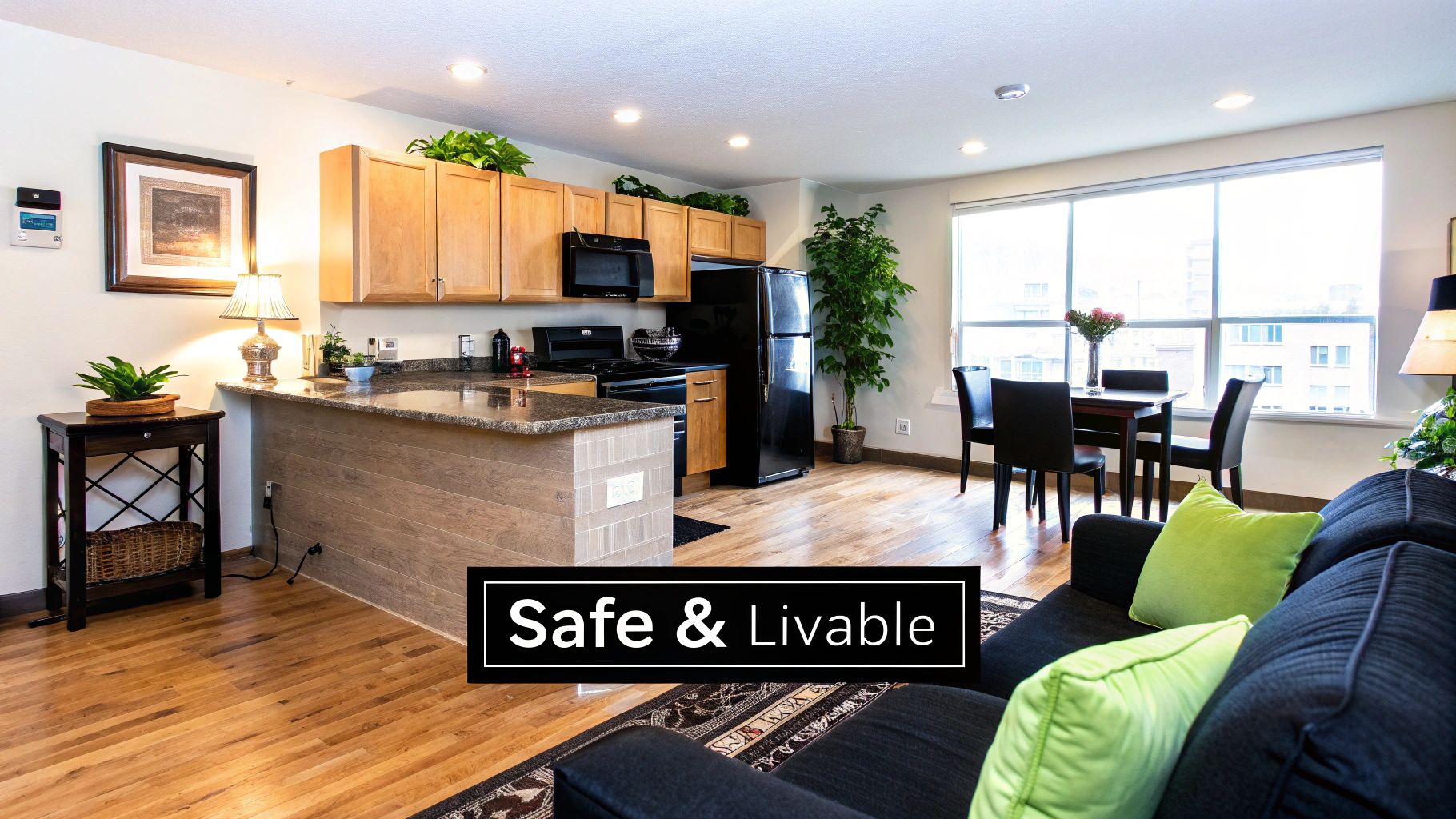
Your most basic protection is something called the implied warranty of habitability. That might sound like dense legal jargon, but it’s really just a promise: your rental unit must be safe, clean, and livable from the day you move in. It’s the landlord’s duty to ensure you have essential services and that the property is structurally sound.
What does a "habitable" home actually look like? It includes:
- Functional Utilities: This means working plumbing, access to hot and cold water, and a reliable heating system.
- Structural Integrity: A roof that doesn't leak, walls that are intact, and floors that are safe to walk on. No major structural issues.
- A Safe Environment: Your home should be free from serious hazards like pest infestations, dangerous mold, or faulty electrical wiring.
- Secure Premises: You need functioning locks on all outside doors and windows to ensure your personal safety.
Getting a handle on these basics is critical. For a deeper dive into the specific rules, you can learn more about landlord-tenant laws in California to see exactly how these protections are enforced at the state level.
Your Right to Privacy
Your rental is your private sanctuary, and the law fully respects that. A landlord can't just show up and walk into your home whenever they feel like it. They are legally required to provide reasonable notice—typically 24 hours in writing—before entering for non-emergency reasons. This includes things like routine inspections, making repairs, or showing the property to prospective new tenants. This rule is in place to make sure your peace and privacy aren't disturbed without a valid reason and your consent.
The feeling of security in one's own home is an absolute cornerstone of well-being. A recent global housing survey found that while 73% of people aspire to own a home, many renters feel vulnerable, believing it's too easy for landlords to take advantage of them without strong legal protections in place.
Protecting these rights is essential for building the trust needed for a positive, long-term tenancy. It’s exactly the kind of stable housing relationship we aim to foster in the communities we serve, from Beaumont to Banning.
Your Key Responsibilities as a Tenant
A great rental experience is a two-way street. Think of it as a partnership built on mutual respect between you and your property owner. While it's vital to know your rights, understanding your end of the bargain is just as important for building a positive, long-term relationship.
Fulfilling your responsibilities isn't just about following rules; it's the surest way to get your full security deposit back when you move out.

This balance is what keeps the landlord-tenant relationship healthy and stable for everyone. Let’s dive into the key duties that come with being a tenant.
Paying Rent On Time
This one is the foundation of the entire agreement. Your most fundamental responsibility is paying your rent on time and in full. It’s what allows the property owner to maintain the building, pay mortgages, and handle all the other costs of keeping your home in good shape.
Consistent, timely payments build a massive amount of trust and goodwill. On the flip side, a missed payment can lead to late fees and, in serious cases, even eviction proceedings. It's vital to know exactly when your rent is due and what the grace period is. For more clarity, we've outlined everything you need to know about when rent is due and when it's considered late to help you stay on track.
Maintaining the Property
Beyond rent, you’re expected to care for the property as if it were your own. This means keeping it clean, safe, and free from damage that goes beyond normal wear and tear. But what’s the difference? It’s a common point of confusion.
- Normal Wear and Tear: These are the minor things that happen over time from just living in a space. Think faded paint, small scuffs on the walls from furniture, or carpet that's a bit worn down from foot traffic.
- Damage: This is different. It’s harm caused by negligence, accidents, or intentional acts. Big holes in the walls, a broken window, or deep stains on the carpet from a spill would all fall under this category.
You are financially responsible for repairing any damage you or your guests cause. A huge part of this responsibility is also reporting maintenance issues right away—like a small leak under the sink—before a minor problem turns into a major, costly repair for everyone.
To avoid arguments over the security deposit, leaving the property clean is essential. For a detailed checklist, this helpful end of lease cleaning guide is a great resource to make sure you leave the place in excellent condition.
Following Lease Agreement Rules
Your lease is the official rulebook for your tenancy. It’s a legally binding contract that outlines the specific policies you’ve agreed to follow, covering everything from pets and noise levels to guest policies and making alterations to the property.
Following these terms is non-negotiable. It shows respect for your neighbors and the property owner. If you violate the lease, it can result in warnings, fines, or in serious cases, eviction. It's always a good idea to keep a copy handy and review it if you ever have a question.
Decoding Your Lease Agreement
Think of your lease agreement as the official rulebook for your tenancy. It’s easily the most important document you’ll handle during your renting journey, but it doesn't have to be intimidating. We’re here to help you break down that wall of legal text into a clear, actionable roadmap, making sure you know your tenant rights and responsibilities from the moment you get the keys.
Getting a handle on this document is non-negotiable, especially when you’re committing to a long-term rental. At AIM Property Management, we exclusively manage long-term leases of six months or more. We do not deal with short-term rentals. Why? Because we believe in building stable, clear, and lasting relationships in the communities we serve, from Redlands to Banning.
Key Clauses You Must Understand
Before you even think about signing, slow down and pay close attention to a few critical sections. These clauses spell out the core terms of your tenancy and can save you from major headaches down the road.
- Lease Term: This defines the exact start and end dates of your rental period. Is it a fixed term, like one year, or does it roll over into a month-to-month agreement? This single detail impacts everything from potential rent increases to how much notice you need to give before moving out.
- Security Deposit: Your lease must state the exact amount of the security deposit and, just as importantly, the conditions for getting it back in full. Look for specific language on what the property owner considers "damage" versus normal, everyday wear and tear.
- Subletting and Guests: Thinking about getting a roommate later on? Have a friend who might need to crash for a few weeks? Your lease should have clear policies on subletting your space or having long-term visitors. Don't assume—clarify.
Understanding the lease isn't just about what you have to do; it's also about knowing what the property owner is required to provide for you. A well-written lease protects both parties and sets crystal-clear expectations for the entire tenancy.
Red Flags and Confusing Jargon
A good lease is straightforward and easy to understand. Be on the lookout for vague language or clauses that feel way too restrictive. If you run into a term that makes you scratch your head, always ask for clarification—and get that explanation in writing—before you sign.
It’s also crucial to remember that a lease is a two-way street. While it lays out your responsibilities as a tenant, it's just as binding on the property owner's legal duties. To get a better sense of the other side of the equation, you can learn more about the specific landlord responsibilities in California that every owner must follow.
By taking the time to decode your lease, you’re empowering yourself to ask the right questions. You'll walk into your new home with confidence, ready for a positive and predictable rental experience.
Why Long-Term Rentals Offer More Stability
When you're figuring out your tenant rights and responsibilities, the kind of lease you sign is one of the biggest factors in your experience. Short-term rentals have their place, but if you're looking for something more substantial, a long-term lease of six months or more provides what really matters: stability.
That stability is what allows you to truly put down roots in a community, whether you're in Redlands, Beaumont, or Yucaipa.
A long-term rental isn't just a place to sleep—it becomes your home. You get to know your neighbors, enroll your kids in local schools, and actually become part of the neighborhood. It's tough to build that sense of belonging when you're packing up and moving every few months, constantly dealing with the stress and cost of finding another place.
The Value of a Stable Foundation
Let's be honest, short-term rentals often come with higher monthly costs and less privacy because of the constant turnover. A long-term lease, on the other hand, locks in your rent and guarantees your housing for a fixed period. That kind of financial predictability and peace of mind is invaluable.
This is exactly why AIM Property Management, which has been part of the local community since 1997, focuses only on long-term rentals. We do not provide services for short-term rentals.
It’s an approach that just works better for everyone. Property owners get consistent income and reliable tenants who treat the home like their own. And for you, the tenant, it means having a secure place where your rights are protected and you can actually build a life. This chart really drives home the financial and practical perks of a long-term tenancy.
As you can see, staying put isn't just less disruptive—it's also easier on your wallet.
Aligning With What Modern Renters Want
This shift toward stability isn't just a hunch; the numbers back it up. Heading into 2025, renter preferences are leaning heavily toward longer leases. In fact, nearly 40% of renters are prioritizing affordability and stability above everything else. People want security in their living situation, now more than ever.
Choosing a long-term lease is an investment in your quality of life. It provides the security to plan for the future without the constant worry of where you'll be living in a few months.
At AIM, we don't manage short-term rentals because we’re committed to building these stable, positive relationships in the communities we serve, from Loma Linda all the way to Banning. Our competitive 7.9% monthly management fee and low $750 placement fee with no add-on fees are designed to make that kind of long-term stability accessible for everyone.
To help you weigh the options, we've put together a simple table breaking down the key differences between long-term and short-term rentals.
Long-Term Leases vs Short-Term Rentals
| Feature | Long-Term Rental (6+ Months) | Short-Term Rental |
|---|---|---|
| Lease Duration | Fixed term, typically 6-12 months or longer | Flexible, from days to a few months |
| Monthly Cost | Generally lower and more predictable | Often higher due to demand and turnover |
| Stability | High; provides a stable home environment | Low; constant uncertainty and moving |
| Community | Easy to build relationships and feel settled | Difficult to connect with the local community |
| Furnishings | Usually unfurnished, allowing for personalization | Typically furnished, less personal space |
| Privacy | High; your space is your own | Lower due to frequent guest/cleaner turnover |
| Tenant Rights | Strong protections under state/local laws | Fewer legal protections in many areas |
Ultimately, the choice comes down to your personal needs. But if building a stable, predictable life is your goal, a long-term lease is almost always the smarter path.
You can dive deeper into the pros and cons by checking out our complete guide to short-term vs. long-term rentals.
The Advantage of Professional Property Management
Navigating the world of tenant rights and responsibilities can feel like a maze, but having a professional property manager in your corner makes all the difference. Think of an experienced firm as a vital, neutral bridge between you and the property owner. Their job is to make sure your rights are always respected and the terms of your lease are upheld fairly.
This professional buffer is especially valuable in long-term rentals, where a stable, positive relationship is key. Instead of dealing with the unpredictability of an inexperienced landlord, you get clear, reliable systems for everything from maintenance requests to rent payments.
Why Experience Matters in Property Management
An established company with deep roots in the community brings more than just organized processes—it brings years of hands-on experience. AIM Property Management has been serving communities like Redlands, Beaumont, Calimesa, Yucaipa, Loma Linda, Mentone, Highland, and Banning, California since 1997. That long history means we've built solid, mature relationships with trusted local vendors and have a deep understanding of local and state housing laws.
What does that mean for you? It means issues get handled professionally and efficiently, every time.
Having a professional manager means there is a dedicated system for addressing problems. You’re not just hoping the owner checks their texts; you have a clear, accountable process for getting things done.
This level of organization is powered by modern tools. Understanding the essential technology for property management shows just how today’s top firms create a seamless, stress-free experience for tenants.
The Financial Benefits of a Well-Managed Property
Beyond clear communication, professional management often translates to significant financial transparency and value. At AIM Property Management, for example, we focus exclusively on long-term leases of six months or more because they offer stability for both tenants and owners. Our competitive 7.9% monthly management fee is low compared to many other companies, keeping things affordable.
We also believe in straightforward pricing. Our $750 placement fee has no other add-on fees, ensuring total clarity from the start. This approach fosters a fair and predictable environment where you can feel confident and secure in your home.
When you choose a professionally managed property in areas like Loma Linda, Mentone, Highland, or Banning, you're not just renting a space—you're investing in a well-run and responsive living experience. And if you're a property owner curious about these benefits from the other side, you can explore the advantages of hiring a property manager to protect your investment and better serve your tenants.
How to Handle Common Rental Disputes
Even the best landlord-tenant relationships can hit a snag. Sooner or later, a disagreement is bound to come up. Knowing how to handle these common rental disputes calmly and effectively is a huge part of being a smart, empowered renter. The key is to keep a level head and focus on two things: clear communication and solid documentation.
Whether you're dealing with a slow maintenance response or a security deposit disagreement, a written record is your best friend. It creates a factual timeline of events that can stop a simple misunderstanding from spiraling into a major conflict.
Steps for Effective Dispute Resolution
When a problem pops up, it’s easy to get frustrated. But letting emotions take over won’t solve anything. Instead, follow a structured process to address the issue like a pro. This not only shows you’re serious but also builds a paper trail in case things get more complicated down the line.
- Put It in Writing: The very first step is always to notify your landlord or property manager in writing. Clearly describe the problem—a leaky faucet, a broken heater, whatever it may be—and explain how it's affecting your use of the home. An email or a certified letter works perfectly.
- Give Them Reasonable Time to Act: After you’ve sent the notice, you have to allow a reasonable amount of time for a response. What’s "reasonable" often depends on state law and how urgent the issue is. A broken furnace in winter needs a much faster fix than a cracked tile.
- Follow Up (Again, in Writing): If you don’t hear back or see any action, send another polite but firm message. Refer to your original notice, restate the problem, and make it clear you're still waiting for a resolution.
- Know Your Options: If the landlord still isn’t responding, it’s time to understand your legal options. These vary a lot from state to state, but they might include things like mediation services or, for more serious issues, filing a claim in small claims court.
This is where having a professional property manager like AIM Property Management really makes a difference. Since 1997, our experience has given tenants from Redlands to Highland a straightforward, reliable system for reporting issues. It ensures problems get addressed promptly and fairly, without the runaround.
Navigating Security Deposit and Eviction Issues
Disagreements over security deposits are, unfortunately, one of the most common disputes. The best way to protect yourself is to be proactive. Take detailed photos and notes of the property’s condition when you move in and when you move out. This creates a clear before-and-after picture.
If a landlord does withhold part or all of your deposit, they are legally required to give you an itemized list of deductions. If you don't agree with the charges, you have the right to contest them in writing.
Getting an eviction notice is one of the most stressful things a renter can experience, but it’s critical not to panic. An eviction notice is the start of a legal process, not an immediate command to pack your bags. Read the notice carefully to understand the reason and the timeline, and don't hesitate to seek legal advice if you think it's unfair or incorrect.
The stress of these situations is often amplified by what's happening in the wider world. As of 2025, the global housing market is tight, with limited availability and soaring costs putting a financial squeeze on many renters. This climate makes clear tenant protections and fair dispute processes more important than ever. You can learn more about these global housing trends and takeaways on weichertworkforcemobility.com.
Common Questions About Your Rights and Responsibilities
Renting a home can sometimes feel like navigating a maze of rules and expectations. But when you understand the basics of your rights and responsibilities, you can handle almost any situation with confidence. Let's clear up some of the most common questions renters ask.
Getting these fundamentals right is the key to a stable, positive rental experience—the kind we’ve been helping create here at AIM Property Management since 1997.
Your Habitability and Privacy Rights
What is the 'implied warranty of habitability'?
Think of this as a legal promise that your rental home is safe and livable from day one. It’s not something you have to ask for; it's automatically part of your lease. This covers the absolute essentials: working plumbing and heat, secure doors and windows, and a building that's structurally sound. If a landlord isn't providing these basics, they're not holding up their end of the deal, and you have legal options to get things fixed.
How much notice does my landlord have to give before entering my home?
Your home is your private space, and the law respects that. For routine visits like inspections or non-urgent repairs, landlords typically must give you "reasonable" notice. In most places, this means at least 24 hours in writing. Of course, true emergencies are different. If there's a fire or a major pipe bursts, they can enter immediately to prevent further damage and ensure everyone's safety.
Addressing Repairs and Rent Increases
What should I do if my landlord won't make necessary repairs?
The first step is always to put your request in writing. An email or a formal letter creates a paper trail that you can reference later. Be clear about the problem and how it's affecting you. If you still get no response, it’s time to check your local tenant laws. Some areas allow renters to "repair and deduct"—meaning you can fix the issue and subtract the cost from your rent—but this requires following a very strict legal process. Don't just go for it without knowing the rules.
A professional property manager is your direct line of communication, making sure maintenance issues are addressed quickly and correctly. This keeps small problems from turning into big, frustrating disputes.
Can my landlord raise my rent whenever they want?
Absolutely not. If you’re in a fixed-term lease (like a one-year agreement), your rent is locked in for that entire period. Once you're on a month-to-month tenancy, the landlord can raise the rent, but they must give you proper written notice. This is usually 30 to 60 days ahead of time, depending on your state's laws. They can't just surprise you with a higher bill.
Navigating your rental journey is easier with an experienced partner. At AIM PROPERTY MANAGEMENT COMPANY, we’ve provided professional, reliable management with mature relationships in the Redlands, Beaumont, Calimesa, Yucaipa, Loma Linda, Mentone, Highland, and Banning, California communities since 1997. With our low 7.9% monthly management fee and a straightforward $750 placement fee with no add-on fees, we focus exclusively on stable, long-term rentals of over 6 months to ensure a positive experience for both owners and tenants. Let us handle the details so you can enjoy your home with peace of mind. Learn more about our property management services today!