
You're probably looking at two properties right now. One is an older house in a solid neighborhood with known issues, dated systems, and a lower entry price. The other is a shiny new build in Redlands, Beaumont, Yucaipa, or one of the surrounding Inland Empire communities, with clean lines, modern finishes, and the promise of fewer headaches.
That second option is seductive. It should be. A well-bought new construction rental can give you strong tenant appeal, cleaner maintenance in the early years, and a product that fits what today's renters want. It can also hand you delays, builder headaches, HOA friction, and a lease-up problem if you overpay and assume the property will rent itself.
High-income investors make the same mistake all the time. They treat a new home like a passive trophy asset instead of an operating business. If you want better returns, you need to evaluate single family home new construction the way an investor should. By build type, by timing, by warranty exposure, by local absorption, and by how fast the home can stabilize as a rental.
Is New Construction the Right Investment for You
A client recently faced a familiar Inland Empire decision. He could buy an older home in an established neighborhood and budget for repairs, or he could lock up a brand-new single-family house in a master-planned community and hope the premium tenant profile justified the higher basis. His first instinct was emotional. Brand new feels safer.
Sometimes it is. Sometimes it isn't.
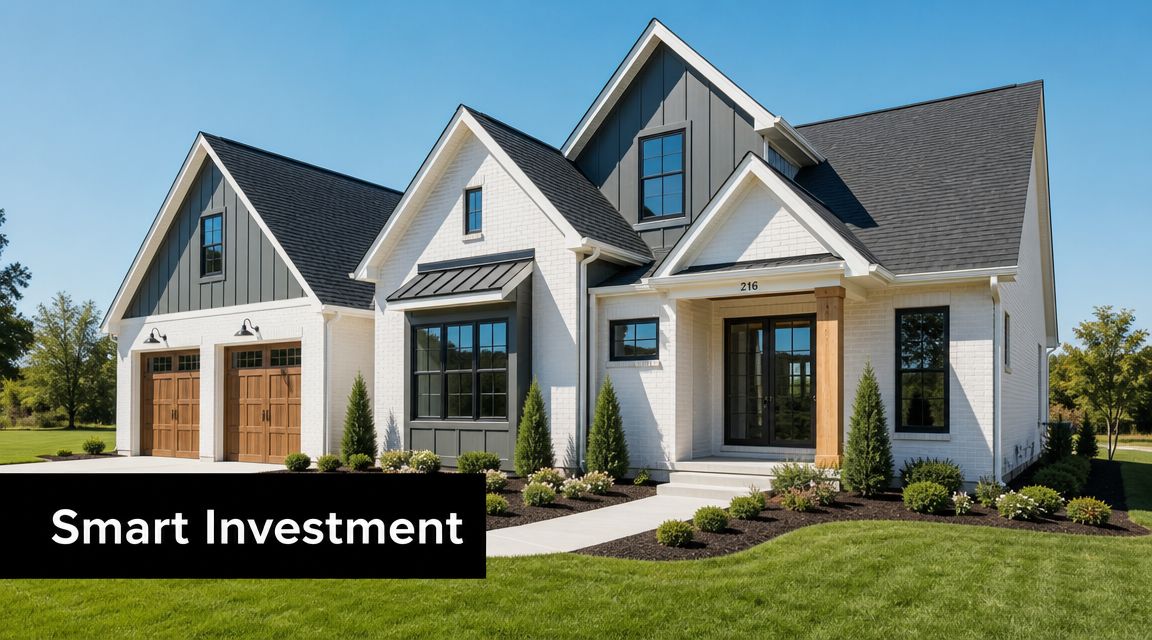
The right answer depends on what kind of investor you are. If you value predictable early ownership, clean tenant appeal, and modern systems, new construction deserves serious attention. If you need immediate upside through forced appreciation, cosmetic repositioning, or discounted acquisition, an older property may give you more room to work.
When new construction fits
A new build works best when you want:
- Cleaner operations early on: Less inherited deferred maintenance, fewer immediate capital surprises, and a property that shows well from day one.
- Tenant appeal that feels current: Open layouts, new appliances, efficient systems, and finishes that reduce marketing friction.
- Straightforward ownership: New homes can be simpler to standardize, inspect, and hand off to professional management.
If you're still sorting out what makes a property perform as a rental, review the fundamentals of what makes a good rental property. Newness helps, but location, layout, parking, school draw, and operating costs still drive the result.
Practical rule: Don't buy a new build because it's beautiful. Buy it because the numbers still work after HOA fees, vacancy assumptions, make-ready costs, and realistic rent.
When it doesn't
New construction is the wrong play if you're stretching on price, relying on optimistic rent, or assuming there won't be defects because the home is new. Builders deliver houses. They don't deliver guaranteed investment performance.
If you're buying in Redlands, Beaumont, Calimesa, Yucaipa, Loma Linda, Mentone, Highland, or Banning, treat the property like a business asset from the first deposit. That's how you avoid paying premium pricing for average returns.
Defining Single-Family New Construction
Investors use the phrase loosely, and that creates bad decisions. Single-family home new construction isn't one thing. It's several different acquisition models, and each one carries a different risk profile.
The three versions investors actually buy
The process is similar to buying a car. You can buy off the lot, order from a menu, or build to your exact preferences. Homes work the same way.
| Type | What it is | Investor takeaway |
|---|---|---|
| Spec home | Builder chooses the plan, finishes, and timeline before the buyer appears | Fastest path to delivery, least customization |
| Semi-custom | Buyer gets limited design and finish choices within a builder framework | Better product control, more decision risk |
| Fully custom | Buyer starts with land, plans, consultants, and a full construction process | Highest control, highest complexity |
Most rental investors should stay focused on spec and semi-custom product. Fully custom homes can work, but they often become vanity projects. That's fine if you're building a personal residence. It's dangerous if you're trying to protect yield.
Why new construction commands attention
Buying existing housing stock means you inherit someone else's decisions. Old roofs, patched plumbing, amateur remodels, outdated panels, and mystery water intrusion all come with the house. New construction removes much of that legacy risk and usually gives you current code compliance, newer systems, and builder warranty coverage.
The supply side matters too. Historical housing-market data show that the U.S. authorized approximately 1.5 million new housing units in 2024, which was close to the pre-2008 average but still short of the estimated national housing shortfall of 2.5 million to 5.5 million units, according to Construction Coverage's housing supply analysis. That gap helps explain why newly built homes often command a premium.
A new home isn't just a nicer product. It's a newer product in a supply-constrained category.
How investors should define the asset
Don't ask, “Is this a nice house?” Ask better questions.
- Will tenants understand the value immediately?
- Can you lease it without overspending on upgrades after closing?
- Is the floor plan practical for families, professionals, or relocation tenants?
- Will the finish package still look current a few years from now?
If you're comparing asset types, this is also a good time to revisit the tradeoffs between housing formats in this condo versus house investor comparison. For most Inland Empire investors, detached single-family product remains the easier story to tell tenants and the cleaner long-term hold.
New construction should be judged as an income property first and a housing product second.
Pros and Cons for California Investors
You reserve a lot in a new Inland Empire tract, lock up capital for months, then close on a house that still needs blinds, backyard work, and a leasing plan. That deal can become a low-headache rental with strong tenant appeal, or an expensive lesson in basis creep. The difference is how you underwrite the full hold, not how polished the model home looks on day one.

Why investors buy them anyway
For a California landlord, new construction solves several early-cycle problems at once. You start with a product that photographs well, shows cleanly, and usually attracts renters who will pay for condition, efficiency, and layout. In the Inland Empire, that matters because many qualified tenants are comparing a new detached home in Beaumont, Yucaipa, or Redlands against older resale stock with dated interiors and higher utility bills.
Operations are usually simpler in the first few years too. Fewer repair calls, fewer surprise replacements, and less time spent fixing old-owner deferred maintenance means a smoother lease-up and cleaner first renewals. That gives you a better chance to stabilize the asset quickly and protect your time.
There is also a management advantage. Property Management Beaumont teams, Beaumont property management firms, Yucaipa property management companies, and property management Yucaipa operators can market a well-selected new home aggressively because the value proposition is obvious to tenants. Clean floor plan. Modern kitchen. Attached garage. Lower expected maintenance disruption.
Where investors get punished
You pay for that convenience up front.
The builder's price is only the starting point. Lot premiums, finish upgrades, appliance gaps, window coverings, landscaping, HOA dues, and post-close rent-ready work can push your all-in basis far above the number that got your attention. Investors who skip a full underwriting pass often buy a house that looks strong on paper and underperforms once every check clears.
Timing is another risk, especially if you are trying to place 1031 money, coordinate financing, or hit a seasonal leasing window. Delays happen. Builder schedules shift. Final utility work can drag. Municipal signoffs can take longer than expected. During that period, your cash is tied up and producing nothing.
You also give up some upside that resale investors like to create. A new build usually leaves less room for forced appreciation through renovation because the renovation has already been baked into the sale price.
The core investor trade-off
Here is the clean comparison:
- Lower near-term repair exposure versus a higher acquisition basis
- Stronger first impression with tenants versus less room to add value through rehab
- Current design and efficiency versus uncertainty around how the neighborhood will mature
- Builder warranties and newer systems versus HOA rules that can affect leasing flexibility
New construction works best for investors who want a cleaner long hold, steady tenant demand, and fewer early maintenance surprises. It works poorly for buyers who need a discounted basis or immediate outsized cash flow.
My advice for Inland Empire buyers
Use a scorecard and be ruthless. Grade each property on total basis, expected rent, HOA burden, backyard completion cost, school draw, commute access, and how easily a professional manager can lease it within your target timeline. Then run the numbers through a rental property ROI calculator for new construction deals.
You should also study the mechanics of navigating the new build process before you commit. Process mistakes cost money.
Redlands property management and property management Redlands experience matter here. A local manager can tell you whether the premium you are paying will show up in leasing speed, renewal strength, and lower turnover, or whether you are buying the newest house on the block at the wrong basis.
Breaking Down New Construction Costs and Timelines
The purchase price is the visible part of the iceberg. The expensive part sits underneath it.
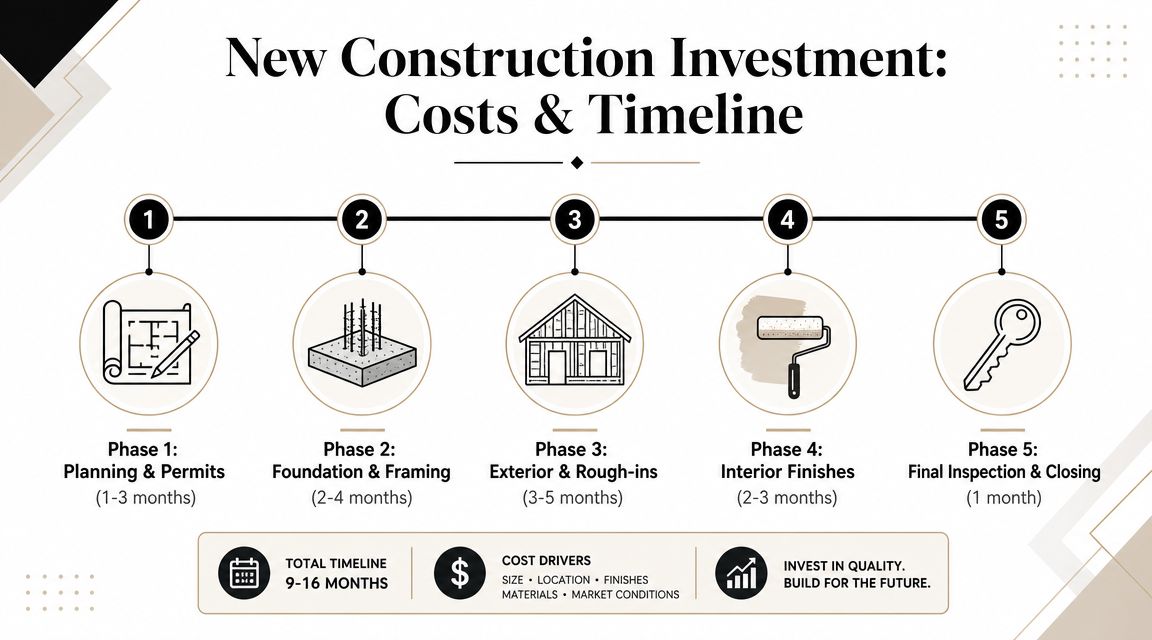
If you're buying from a production builder, some costs are bundled and some are hidden in upgrades, lot premiums, and closing adjustments. If you're building more directly, you'll see them more clearly. Either way, the categories are the same.
What actually drives cost
Your total investment usually includes:
- Land or lot positioning: Interior lot, corner lot, cul-de-sac lot, or premium location near open space.
- Hard construction costs: Labor and materials embedded in the home price.
- Soft costs: Permits, approvals, design work, lender fees, insurance, and consultant costs where applicable.
- Finish and turnover costs: Appliances, blinds, backyard work, storage systems, and rental-ready setup items.
- Carrying costs: Interest, taxes, insurance, and HOA obligations before lease-up.
Before you commit, run the deal through a realistic rental property ROI calculator. Don't use aspirational rent. Use rent you can defend.
The timeline that matters
The construction sequence matters because inspection timing matters. According to NewHomeSource's step-by-step home building guide, after permits and site or grading approvals, builders complete foundation work, waterproof foundation walls, install drains and utility rough-ins, and the home is only considered “dried in” after the roof and exterior shell are complete. That dried-in stage is when inspections of plumbing, electrical wiring, ductwork, and HVAC rough-in are most valuable because defects are easiest to correct before walls are closed.
That isn't trivia. That's risk control.
A useful outside perspective on navigating the new build process can also help investors understand where delays and buyer responsibilities tend to show up, even though the financing and legal details differ from California.
For a visual walkthrough of the process, this video gives a helpful overview:
The mistakes that cost investors money
Most owners don't lose money because they can't read a builder timeline. They lose money because they fail to react correctly when the timeline moves.
| Problem | What investors do wrong | Better move |
|---|---|---|
| Delay in completion | Assume lease start will slide neatly | Build extra reserve time into your plan |
| Upgrade creep | Add cosmetic options that don't move rent | Spend on durability and tenant-visible function |
| Weak inspection discipline | Rely on builder walkthrough only | Bring in your own inspector at key stages |
| Lease-up lag | Start marketing after closing | Prepare pricing and listing strategy before keys |
If you want single family home new construction to perform, you need discipline before the home is finished, not after.
California Legal and Maintenance Essentials
California is not a forgiving state for sloppy landlords. That's especially true with new homes, where owners assume the builder handled everything and the property will coast for the first few years.
It won't.
Why legal discipline matters more with a new home
A new property often comes with warranties, builder procedures, HOA rules, energy-efficiency systems, and documentation requirements that need active management. If you don't keep records, report issues correctly, and respond to tenant concerns fast, you can lose time, lose your advantage, and create preventable disputes.
In the U.S., single-family housing starts were at an annualized rate of 930,000 in April 2026, and the largest share of single-family building activity was in large metro suburban counties at 24.7% and small metro core counties at 29.1%, according to the U.S. Census new residential construction report. That matters in places like the Inland Empire, where suburban and smaller metro growth keeps feeding new detached-home inventory into the market.
More new homes means more landlords dealing with the same legal and maintenance blind spots.
What owners need to stay on top of
Start with documentation. Keep every warranty, appliance manual, finish specification, builder contact, paint code, and service record organized from day one. When a tenant reports a problem, you need to know whether it's a landlord repair, a builder warranty item, or an HOA issue.
Then focus on operations:
- Track builder obligations: Don't rely on memory or emails buried in your inbox.
- Inspect early and often: New homes settle. Caulking separates, doors shift, irrigation leaks, and drainage issues show up after occupancy.
- Understand landlord duties: Habitability and repair response rules still apply, even when the property is fresh from the builder.
- Manage systems correctly: Smart thermostats, low-flow fixtures, new HVAC equipment, and efficient irrigation still require tenant education and oversight.
If you need a refresher on your obligations, review these core California landlord responsibilities. A new house doesn't reduce your compliance burden. In some ways, it increases it.
A new build isn't a hands-off asset. It's an asset that gives you a narrower margin for administrative mistakes because everyone assumes the property should be perfect.
My position on management
If you own in growth corridors around Beaumont, Yucaipa, Highland, Loma Linda, or Redlands, expert oversight isn't optional. You need someone watching warranty windows, documenting conditions, managing vendor access, and making sure tenant use doesn't void protections or accelerate wear.
That's not bureaucracy. That's asset protection.
Your New Construction Rental Management Checklist
Once you get the keys, the investment phase starts. During this phase, many owners relax too early and leave money on the table.
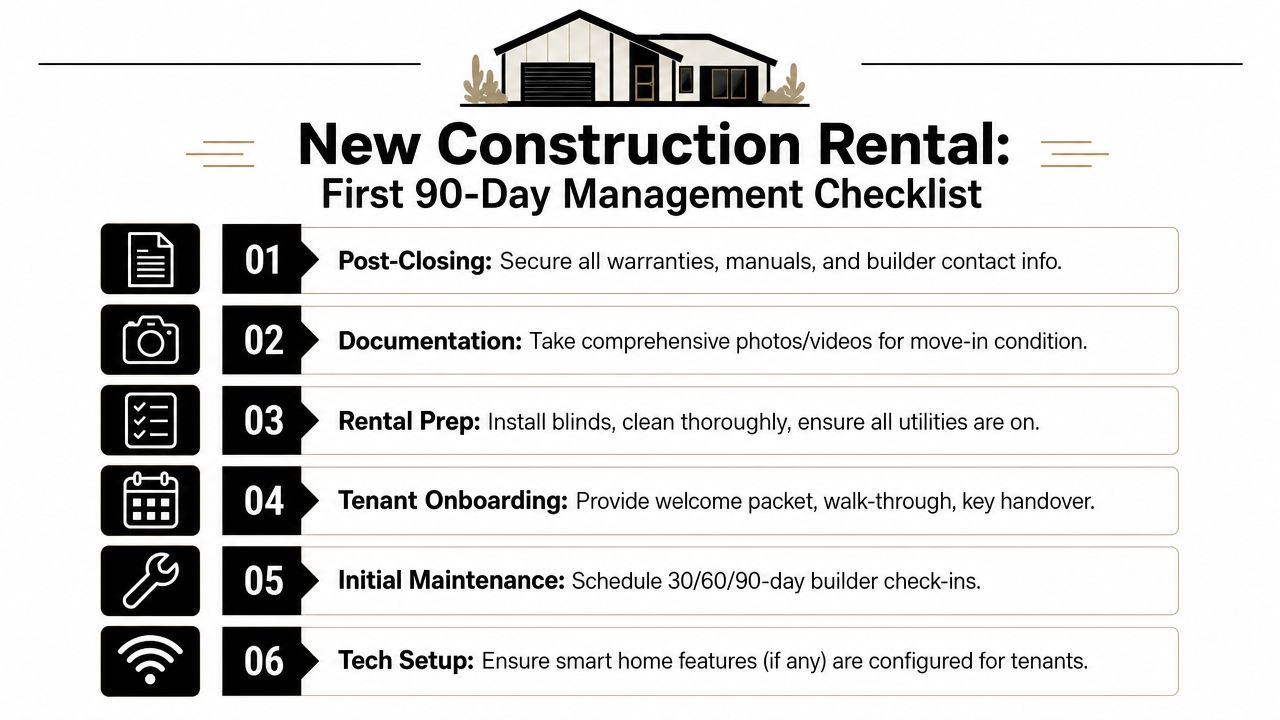
The first moves after closing
Your first job is to create a paper trail and a condition baseline.
- Complete your own punch walk. Don't assume the builder's final walkthrough caught everything. Test doors, windows, outlets, drains, locks, irrigation, garage components, appliances, and smart devices.
- Photograph everything. Take detailed photos and video before tenant occupancy. New homes lose their “brand-new” condition fast, and you need proof of original condition.
- Collect every document. Store warranties, manuals, vendor information, paint details, flooring specs, and builder service contacts in one system.
Getting the house rent-ready
A “new” house often isn't rental-ready. Builders regularly leave out practical items tenants expect.
Make sure you address:
- Window coverings: Many new homes need blinds installed before marketing.
- Backyard and exterior usability: Dirt yards don't support premium rent.
- Utility activation: Turn everything on before showings and inspections.
- Deep cleaning: Construction dust and debris are common, even at closing.
- Pricing strategy: Competing new builds in the same tract can undercut you if you price emotionally.
Often, owners decide to hire a property manager for single-family homes. Firms such as AIM PROPERTY MANAGEMENT COMPANY handle tenant screening, rent collection, maintenance coordination, inspections, and legal documentation for residential rentals, including single-family homes in Inland Empire communities.
New construction lease-ups fail when owners market a house like a purchase listing. Rental marketing needs speed, clarity, and operational readiness.
The first 90 days of tenancy
The first tenant sets the tone. If onboarding is sloppy, the property starts aging faster immediately.
Use a tight first-90-day process:
- Explain the systems: Show tenants how to use HVAC controls, irrigation timers, garage safety features, and any smart home tools.
- Schedule early follow-up: New homes produce small issues after occupancy. Catch them before they become disputes.
- Document every service item: Separate builder warranty requests from tenant-caused issues.
- Inspect for pattern problems: Water runoff, minor cracking, door alignment, and appliance adjustments tend to show up early.
For owners searching “property management near me,” the right answer isn't the closest office. It's the manager who understands builder coordination, lease-up pricing in new developments, and the tenant expectations that come with a fresh home.
Property Management Beaumont, Beaumont property management, Yucaipa property management, property management Yucaipa, Redlands property management, and property management Redlands all sound similar online. In practice, local execution is what protects the asset.
Frequently Asked Questions for New Build Investors
How does renting a new build differ from an older home
A new Inland Empire rental attracts higher expectations from day one. Tenants notice everything. A sticky window, garage door sensor issue, hairline drywall crack, or irrigation problem that would be tolerated in an older home becomes a service call in a brand-new house.
Rent strategy also changes. New construction often enters the market in clusters, not one property at a time. If a builder is still delivering homes in the same tract, your rental competes with other fresh inventory, builder incentives, and resale owners trying to exit early. Price to lease fast. Protecting one extra month of vacancy for an unrealistic rent target is a bad trade.
Can I find reliable property management near me that specializes in new homes
Yes. The better question is whether the manager understands the full new-build lifecycle, from punch-list follow-up to stabilized rental operations.
Ask direct questions. Do they coordinate builder warranty claims? Do they document condition in a way that separates construction defects from tenant damage? Do they know how to lease around HOA rules, tract-level competition, and delivery schedules in places like Beaumont, Yucaipa, Redlands, Highland, Loma Linda, and Banning?
Local execution matters more in new construction than many investors expect. Two homes with the same floor plan can perform very differently based on school boundaries, commute patterns, solar setup, HOA restrictions, and how many nearby homes are still being released by the builder.
What is the biggest mistake to avoid with a new construction rental
Treating a new house like a passive asset.
That mistake costs money fast. Owners skip an independent inspection because the home is new. They lose track of warranty deadlines. They hand the keys to a tenant without a systems orientation. Then small defects turn into repair disputes, builder coverage gets missed, and the property starts operating below its potential in the first lease term.
Run the property like an investment from the day you take possession. Inspect it independently. Organize every warranty and vendor document. Set rent against competing inventory, not your pro forma. In the Inland Empire, single-family home new construction can produce strong returns, but only if you manage the build phase, lease-up phase, and long-term operations as one connected plan.
If you own a new rental home in Redlands, Beaumont, Calimesa, Yucaipa, Loma Linda, Mentone, Highland, or Banning and want help protecting the asset from day one, AIM PROPERTY MANAGEMENT COMPANY can step in with leasing, tenant screening, rent collection, inspections, maintenance coordination, and California compliance support so you're not managing builder issues and tenant expectations on your own.