
If you own a rental in Redlands, there’s a good chance the property looked simple on paper. Collect rent, handle the occasional repair, keep the place occupied, move on with your life. Then the demanding work starts. A tenant texts on a Sunday about a leak. A vendor gives you a repair window but never shows. Lease paperwork needs updating. Rent pricing feels off, but leaving money on the table is hard to spot until months have passed.
That’s where redlands property management stops being a convenience and starts becoming a risk-management decision. In Redlands, Beaumont, Yucaipa, and nearby Inland Empire communities, owners aren’t just managing doors. They’re managing legal exposure, cash flow, asset condition, and tenant quality across a market that keeps shifting.
Owners searching for Property Management Beaumont, Beaumont property management, Yucaipa property management, property management Yucaipa, Redlands property management, or property management Redlands usually want the same thing. Less stress, fewer expensive mistakes, and a property that performs like an investment instead of a second job.
Why Professional Management is Crucial in Redlands
A rental home can turn into daily operational work fast. One missed maintenance issue becomes a larger repair. One weak screening decision becomes months of collection problems. One sloppy notice or lease clause creates legal headaches that cost far more than the original issue.
That pressure matters more in a market where the underlying asset is worth protecting. As of September 2025, the median home sale price in Redlands reached approximately $665,000, up 8.9% year over year, and typical asking rents for 2 to 3 bedroom homes ranged from $2,600 to $3,100 per month, according to this Redlands market overview. That kind of pricing tells you two things. First, Redlands remains a serious investment market. Second, small management mistakes can have outsized financial consequences.

What owners usually underestimate
Most self-managing owners plan for visible tasks. They expect to advertise a vacancy, sign a lease, and call a plumber when needed. They usually underestimate the invisible work:
- Pricing discipline that avoids both under-renting and extended vacancy
- Documentation standards that hold up when a dispute starts
- Vendor coordination that keeps routine work from becoming emergency work
- Tenant communication that stays firm, prompt, and compliant
Professional management pays for itself when it prevents avoidable loss. A poor tenant costs more than missed rent. A delayed repair can expand into water damage, insurance friction, tenant dissatisfaction, and future turnover.
Practical rule: Owners rarely lose money from one dramatic event. They lose it through a series of manageable issues that no one handled early.
Why local execution matters
National advice doesn’t help much if your property sits in Redlands and your tenants compare it to nearby inventory in Yucaipa, Loma Linda, Highland, or Beaumont. Leasing pace, applicant expectations, repair response standards, and compliance habits all need local judgment.
Good management also gives owners something that doesn’t show up on a monthly statement. Time back. If you want your property to produce income without pulling you into every late-night text and repair approval, a manager is handling operations, not just collecting rent. That’s one reason owners keep looking closely at why clients renew year after year when they evaluate long-term management relationships.
Decoding Property Management Services
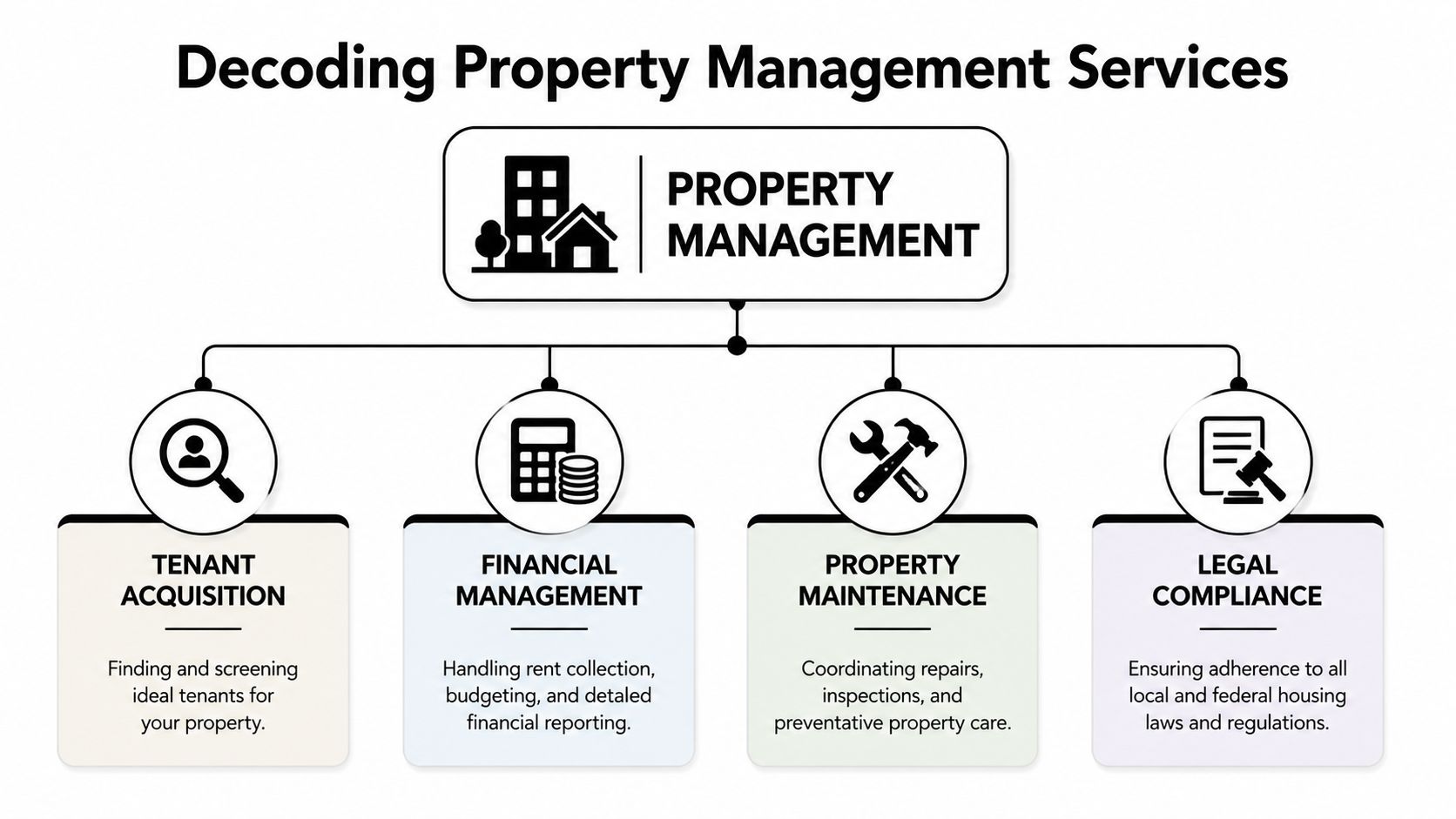
The phrase “full-service management” gets thrown around too loosely. Owners should break it down into four operating functions: placing the right tenant, protecting income, protecting the property, and staying compliant when situations get messy.
The service stack is easier to understand visually.
Tenant acquisition is more than filling a vacancy
A vacancy isn’t solved when someone applies. It’s solved when the right tenant signs, moves in, pays on time, and follows the lease. That difference is where professional screening earns its keep.
A rigorous, multi-source screening process can achieve 95% on-time rent collection versus a 78% industry average, and AI-driven models using more than 40 data points have been shown to reduce evictions by 40% compared with credit-only checks, according to this property management strategies analysis. In practice, that means managers should verify income from more than one source, review credit in context, check background and eviction history, and avoid making decisions based on one easy metric.
If a company says it “does screening,” ask what that means. There’s a major difference between pulling a basic report and applying a consistent, documented approval process.
A clear breakdown of property management company responsibilities helps owners see where screening ends and where rent collection, maintenance handling, and legal administration begin.
Financial management and maintenance need systems
Rent collection sounds simple until it isn’t. A good manager uses clear due dates, consistent notices, documented communication, and owner reporting that shows what happened each month without the owner needing to ask.
Maintenance also separates serious operators from part-timers. You need triage, not just a phone list. Emergency calls have to be identified correctly. Habitability issues need prompt action. Routine work should be scheduled before residents get frustrated or the problem worsens.
This short video gives a useful overview of how day-to-day management functions in practice.
Legal compliance and reputation affect results
Compliance work sits in the background until something goes wrong. Lease language, notices, fair housing practices, recordkeeping, and repair handling all need consistency. Owners who self-manage often think they’re saving money while inadvertently increasing exposure.
There’s also a marketing side to leasing that many owners ignore. A property listing is part operations and part positioning. The same thinking that goes into building an unforgettable real estate brand applies to rental marketing too. Photos, messaging, response speed, and professionalism influence applicant quality long before screening begins.
Used properly, a manager’s job is to make the operation less emotional and more repeatable. AIM Property Management Company is one example of a local firm that offers screening, rent collection, maintenance coordination, inspections, and compliance support for residential rentals in the Inland Empire.
Navigating Redlands Beaumont and Yucaipa Rental Markets
Redlands, Beaumont, and Yucaipa sit close enough that owners often treat them as one rental market. That’s a mistake. The tenant pool overlaps, but pricing pressure, neighborhood expectations, commute patterns, and inventory competition don’t play out exactly the same.
In redlands property management, a manager needs to understand how family-oriented neighborhoods, school-driven moves, and commuter demand affect showing activity and lease timing. In Property Management Beaumont and Beaumont property management, newer housing stock can shape tenant expectations around condition and amenities. In Yucaipa property management and property management Yucaipa, owners often see a slightly different mix of renter preferences tied to location, lifestyle, and nearby alternatives.
The short term rental shift matters
One of the more practical changes for Inland Empire owners is California’s AB 2536, which takes effect in 2025 and gives local jurisdictions stricter control over short-term rentals. That change is projected to shift 15% to 20% of short-term rental units in the Inland Empire into the long-term rental market, according to this Redlands property management discussion of the law’s expected impact.
That projection matters because added long-term inventory changes the competitive environment. If more former short-term rentals become conventional leases, owners can’t rely on weak photos, vague listing copy, or slow follow-up and still expect strong results. Tenant placement and marketing discipline become more important when renters have more choices.
The owner who reacts fastest with accurate pricing and clean operations usually protects occupancy better than the owner who simply waits for the market to “normalize.”
Compliance isn’t optional
Local expertise also means recognizing where state rules affect daily decisions. Rent cap issues, notice requirements, habitability obligations, fair housing concerns, and documentation standards all shape how a manager should operate in Redlands, Beaumont, and Yucaipa.
A manager should be able to explain, in plain English, how they handle:
- Pricing reviews based on current competing inventory
- Lease updates when state rules or local practices change
- Repair prioritization when a request affects habitability
- Resident communication when a dispute starts to escalate
Owners looking at rental property investment strategies for Inland Empire rentals should pay close attention to operational adaptability. The market doesn’t reward generic management. It rewards managers who know the difference between a stable long-term rental plan and a listing strategy that’s already outdated.
What works and what doesn’t
What works is local pricing, fast follow-up, and consistency. What doesn’t work is assuming Redlands, Beaumont, and Yucaipa behave the same, or that a vacancy can be solved with one listing and a few casual showings.
If you’re comparing property management Redlands options to firms serving nearby cities, ask them how they adjust by submarket. If the answer sounds interchangeable across every city they serve, that’s a warning sign.
Your Manager Interview Checklist and Key Questions
Most owners ask the wrong opening question. They ask, “What do you charge?” before they ask, “How do you operate when a file gets complicated?” Fees matter, but process matters first.
The interview should tell you whether a manager can protect income, reduce friction, and keep you out of preventable disputes. That takes more than a polished website and a short list of services.

The checklist I’d use
Bring a written checklist and take notes. If a company answers in broad slogans, press for specifics.
- Ask for screening standards. What documents do they require, how do they verify income, and how do they avoid making decisions based on one metric alone?
- Review communication habits. Who answers tenant calls, how are emergencies routed, and how quickly do owners receive updates when something material happens?
- Request sample reporting. You want to see owner statements, maintenance logs, and how repair charges are documented.
- Inspect maintenance process. Do they use vetted vendors, seek approvals at defined thresholds, and document before-and-after work?
- Probe legal handling. Ask how they manage notices, lease enforcement, fair housing concerns, and resident disputes.
Good interview question: “Tell me about a tenant problem that started small and could have become expensive. How did you handle it?”
That question reveals judgment. It tells you whether the manager waits, reacts, escalates properly, and documents the file.
Questions that uncover local competence
A manager serving Redlands, Mentone, Highland, Loma Linda, Banning, Beaumont, and Yucaipa should be able to talk in specifics, not generic county-wide language.
Try these:
- How do you price a home differently in Redlands versus Yucaipa or Beaumont?
- What happens in the first twenty-four hours after a habitability complaint comes in?
- How do you communicate with owners who want control without slowing down urgent decisions?
- What’s your process when a tenant’s payment pattern starts slipping but hasn’t become a formal default yet?
If you’re evaluating a company’s visibility and responsiveness online, it also helps to understand mastering local SEO for home service companies. Not because rankings equal competence, but because local search presentation often reflects whether the business pays attention to communication, service area clarity, and lead handling.
A practical owner guide on how to hire a property manager can help you compare interview answers against actual operating expectations.
Warning signs during the interview
Some red flags show up fast:
| Warning sign | Why it matters |
|---|---|
| Vague answers about screening | They may be inconsistent, which creates fairness and risk issues |
| No clear maintenance workflow | Repairs can become slow, expensive, and poorly documented |
| “We handle everything” with no examples | Broad promises usually hide weak process |
| Unclear reporting cadence | Owners end up chasing information |
| No local distinctions by city | They may not understand submarket differences |
A good manager sounds organized, not flashy. They answer operational questions without getting defensive.
Understanding Fees and Calculating Your ROI
Owners often fixate on the management fee because it’s visible. The larger costs of self-management are usually hidden. They show up as extra vacancy, weak tenant selection, delayed repairs, collection issues, and time pulled away from work or family.
That’s why the right way to evaluate property management Redlands isn’t “What’s the monthly fee?” It’s “What does the fee replace, prevent, and improve?”
Common fee structures
Most management agreements use a mix of recurring and event-based charges. The exact structure varies, but owners usually see some combination of:
- Monthly management fee tied to rent collection or active management
- Leasing or placement fee when a new tenant is secured
- Renewal or lease update fee when an existing resident stays
- Maintenance coordination terms for repair handling and approvals
Read the agreement slowly. The important issue isn’t just the number. It’s when the fee applies, what’s included, and what creates extra charges.
A practical ROI comparison
Use this framework to evaluate your own property.
| Cost Factor | Self-Managed Estimate | Professionally Managed (AIM) |
|---|---|---|
| Vacancy exposure | Higher if pricing, marketing, or follow-up is inconsistent | Lower when pricing and showings are handled systematically |
| Tenant quality risk | Depends heavily on owner experience and screening discipline | Reduced through formal screening and documented approval standards |
| Maintenance cost control | Can drift if using unknown vendors or reacting late | More structured when vendor coordination and repair triage are in place |
| Legal and documentation risk | Higher if notices, lease terms, or records are inconsistent | Lower when processes are standardized and compliance is monitored |
| Owner time | High. Calls, follow-up, bookkeeping, and disputes stay on your plate | Lower. Daily operations are delegated |
| Financial reporting clarity | Often manual or fragmented | Usually more consistent through owner reporting systems |
Paying a management fee can be cheaper than self-managing badly.
That’s the core trade-off. A low visible cost doesn’t help if the property underperforms unnoticed for months.
Owners comparing contracts should also review what it costs to hire a property manager and then calculate against their own likely pain points. If you travel often, don’t want tenant calls, own multiple properties, or don’t want to stay current on California compliance details, the ROI case usually gets stronger.
Where owners miscalculate
They assume they’ll only pay in money. In reality, self-management often costs in availability, decision fatigue, slower action, and inconsistency. Those aren’t abstract concerns. They affect leasing, tenant retention, repair severity, and your ability to treat the property like an asset instead of a constant interruption.
The Onboarding Process What to Expect
Once you decide to hire a manager, the transition should feel organized. If onboarding feels chaotic, that usually predicts future communication problems.
A clean handoff starts with documents. The manager should request the current lease, tenant ledger, security deposit records, repair history, utility details, keys, appliance information, and any current vendor contacts. If the property is occupied, they should also review open maintenance issues and any active tenant concerns before taking over.
The first steps after signing
The sequence usually looks like this:
- Management agreement is signed. Authority, responsibilities, and approval rules are established.
- Property records are transferred. This includes lease documents, payment history, and prior notices.
- Tenant communication is issued. Residents need clear instructions on where to pay, who to contact, and how maintenance requests will be handled.
- Initial inspection is scheduled. The manager documents current condition and identifies any immediate concerns.
That first inspection matters. It creates a baseline for future maintenance planning, tenant accountability, and owner budgeting.
What a smooth first month looks like
The first month should focus on clarity, not surprises. Owners should know how they’ll receive statements, when they’ll be contacted for approvals, and what kinds of decisions the manager handles without delay.
Expect the manager to establish:
- Owner communication channels for routine updates and urgent approvals
- Tenant service procedures for maintenance and after-hours issues
- File organization for leases, notices, and accounting records
- Property priorities such as deferred maintenance or lease cleanup items
If the property is vacant, onboarding also includes rent positioning, listing preparation, showing coordination, and screening setup. If it’s occupied, the first win is usually bringing communication and records under control.
A good onboarding process feels boring in the best way. Everything has a place, and everyone knows what happens next.
FAQs About Hiring a Property Manager in the Inland Empire
How do I choose the right property management near me
Don’t choose based on proximity alone. When owners search for property management near me, they should look for local operating knowledge, clear reporting, a documented screening process, and strong maintenance coordination across the cities they own in. A company that understands Redlands may also serve Beaumont, Calimesa, Yucaipa, Loma Linda, Mentone, Highland, and Banning well, but you should still ask how they adjust by area.
Should I hire a property manager if I only own one home
Often, yes. One home can still create the same screening risk, legal exposure, and maintenance workload as a larger portfolio. Owners with demanding jobs, out-of-area residences, or limited appetite for tenant issues usually benefit the most when they hire a property manager even for a single property.
How much control do I keep
You should keep control over major decisions. That usually includes approval thresholds, larger repairs, lease strategy, and broader financial direction. The manager should handle day-to-day execution without forcing you to answer routine questions that slow everything down.
How should a manager handle properties near changing housing developments
Local knowledge matters. When managing properties near new affordable housing, like the Liberty Lane development for veterans in Redlands, a property manager needs a strong understanding of fair housing law and the ability to verify tenant eligibility for supportive services so the tenancy stays compliant and stable, as discussed in this report on the Liberty Lane development. That’s not a niche issue. It’s a practical example of why generic leasing habits can create problems in changing neighborhoods.
Is there a difference between Redlands, Beaumont, and Yucaipa management
Yes. Owners looking for Redlands property management, Property Management Beaumont, Beaumont property management, Yucaipa property management, property management Yucaipa, or property management Redlands should expect local differences in pricing, marketing, tenant expectations, and leasing pace. A manager who treats every Inland Empire city the same is usually missing details that affect performance.
What should I prepare before I switch managers
Gather your lease, tenant ledger, security deposit records, past repair invoices, keys, appliance and system information, and any open tenant issues. The cleaner your records, the faster the new manager can stabilize the property and communicate confidently with the resident.
If you want a practical conversation about your rental, AIM PROPERTY MANAGEMENT COMPANY manages residential properties in Redlands, Beaumont, Calimesa, Yucaipa, Loma Linda, Mentone, Highland, and Banning. If you're weighing whether to keep self-managing or hire a professional, start by reviewing your screening process, maintenance response, and reporting. Those three areas usually tell you quickly whether your property is running efficiently or barely staying afloat.