If you own rentals in Redlands, you’ve probably looked at a property like pebblebrook apartments redlands ca and thought two things at once. First, that’s the kind of asset people want in their portfolio. Second, getting a property to perform like that probably takes more work than most owners see from the outside.
That instinct is usually right.
A high-performing apartment community doesn’t succeed by accident. Owners and managers make a series of practical decisions about location fit, unit finishes, maintenance standards, tenant selection, lease structure, and day-to-day operations. When those decisions line up, the property attracts better applicants, holds occupancy, and protects long-term value. When they don’t, even a well-located building can underperform.
Pebblebrook is a useful case study because it shows both sides of the equation. It has strong fundamentals, but those fundamentals only matter when someone manages them well. That’s the bigger lesson for owners across Redlands, Beaumont, Calimesa, Yucaipa, Loma Linda, Mentone, Highland, and Banning who are deciding whether to keep self-managing or hire a property manager.
Pebblebrook Apartments Redlands CA A Benchmark for Local Success
In Redlands, some properties become local reference points. Pebblebrook is one of them because it combines the things renters consistently respond to. Location, layout, livability, and a setting that feels more residential than generic.

At 631 Church St in Redlands, CA, Pebblebrook sits one block from the University of Redlands and close to downtown. That matters because it broadens the renter base. Students can value the walkable location, professionals can value access and convenience, and households that want North Redlands can see the neighborhood as part of the appeal.
Why local owners pay attention to it
Pebblebrook isn’t just recognizable. It has documented performance that gets an owner’s attention. It is a 52-unit multifamily property with a history of strong demand, including a 99% average occupancy rate, and it previously sold for $13,250,000. Those details are reflected in the Pebblebrook Apartments Redlands listing.
Those numbers tell a simple story. A well-positioned asset in Redlands can attract consistent demand when the product matches the market.
Owners often focus first on price or rent level. The better question is whether the property gives residents enough reasons to stay. Pebblebrook appears to do that through a mix of unit design, community amenities, and placement near major local anchors.
What gives it staying power
A property like this benefits from features renters use, not just brochure language.
- Unit mix that fits real demand: Pebblebrook offers 1 to 3 bedroom units with layouts ranging from 650 to 1,100 square feet in the same listing linked above.
- Lease flexibility: Public listing information notes 9 to 18 month lease terms, including short-term options.
- Practical add-ons: Garages are offered at $100 per month, which gives management a way to monetize a feature many renters already want.
- Community appeal: Pool, spa, basketball court, controlled access, walk-in closets, and large patios support a stronger day-to-day living experience.
Practical rule: Strong occupancy usually starts with boring fundamentals done well. Clean grounds, dependable systems, useful amenities, and a location renters can explain to friends in one sentence.
Owners trying to build visibility for smaller properties can also borrow a lesson from apartment communities with strong local recognition. Clear online presentation matters. If you’re working on local lead flow, this guide on how to optimize Google Business Profile for local success is worth reviewing.
For a broader view of the local rental market, the Redlands property management market gives helpful context on the area owners are operating in.
Decoding the Investment Value of a Prime Redlands Property
A property doesn’t become valuable because it has quartz countertops. It becomes valuable when the right improvements solve the right leasing problems.
That distinction matters.
Pebblebrook’s investment story is really about fit. The property’s location near the University of Redlands and downtown creates demand. Renovated interiors help convert that demand into signed leases. Amenities and livability help reduce turnover. The operational result is stronger performance than a comparable property that only has one of those advantages.
Renovations that affect leasing outcomes
The best upgrades are the ones residents notice every day.
At properties like Pebblebrook, recent remodels that included quartz countertops and continuous vinyl flooring have been associated with an estimated 25% reduction in tenant turnover and a 15% to 20% sale price premium over regional medians, according to the Redfin property reference for 631 Church St.
That’s the kind of trade-off owners should study closely. Some improvements photograph well but don’t change resident behavior much. Others make the unit easier to live in, easier to clean, and easier to re-rent. Quartz and durable flooring fall into that second category.
Location alone isn’t enough
A lot of owners in Redlands assume location can carry a property by itself. Sometimes it can cover mistakes for a while. It rarely protects the asset for long.
A building near the university still loses traction if unit condition is dated, maintenance drags, or move-ins feel disorganized. Renters compare everything. They compare photos, garage options, outdoor space, appliance quality, and whether the property feels worth the monthly rate.
Consider this simple comparison:
| Factor | What works | What doesn’t |
|---|---|---|
| Location | Near university, downtown, freeway access, schools, shopping | Assuming location excuses weak management |
| Interior finishes | Durable flooring, modern kitchens, updated baths | Cosmetic updates that leave old problems untouched |
| Amenities | Features residents use regularly | Amenity lists that aren’t maintained |
| Operations | Fast turns, clean common areas, responsive maintenance | Delays that create negative reviews and lease hesitancy |
Owners need to think like operators
The main shift is mental. Don’t treat a rental like a static possession. Treat it like an operating asset with moving parts.
That means asking better questions:
- Which upgrades reduce turnover instead of just increasing make-ready cost?
- Which amenities provide a rental advantage in this submarket?
- Which resident frustrations are driving avoidable vacancy?
- Which line items protect value even though tenants rarely notice them directly?
A useful starting point is learning how return is evaluated from the owner side. This overview of how to calculate cap rate on rental property helps frame the discussion the right way.
A good renovation plan isn’t a style exercise. It’s a retention plan, a leasing plan, and a resale plan tied together.
That’s why pebblebrook apartments redlands ca is worth studying. It shows how location, renovation choices, and resident appeal can reinforce each other when the property is managed as an investment instead of just maintained as a building.
The Hidden Workload Behind a High-Performing Rental Asset
Owners love the phrase passive income until the phone rings on a weekend.
The public sees a polished apartment community. They don’t see the maintenance scheduling, vendor follow-up, lease enforcement, inspection notes, repair triage, turnover coordination, compliance tracking, rent collection, and resident communication that keep the place from slipping.
What owners underestimate first
Most self-managing owners underestimate speed.
A maintenance issue that sits for too long usually stops being a repair problem and becomes a trust problem. Residents start wondering whether management follows through. Prospective renters hear about delays through reviews or word of mouth. The property’s image softens before the owner sees it in a spreadsheet.
Then there’s documentation. California rental housing doesn’t forgive loose processes. Owners need consistent records, clear notices, fair application handling, and systems that stand up when a dispute arises.
The part that isn’t visible from the curb
A property can look quiet from the street and still require constant management pressure.
Common recurring tasks include:
- Emergency response: After-hours calls about leaks, lockouts, HVAC issues, or safety concerns.
- Vendor coordination: Getting the right contractor, at the right price, on the right timeline.
- Turn management: Cleaning, repair scope, photos, marketing, showings, and move-in readiness.
- Resident communication: Answering questions, documenting issues, and keeping expectations clear.
- Compliance work: Handling leases, renewals, notices, and policy changes correctly.
Self-managing owners also run into a practical problem. Their attention gets pulled toward the urgent task of the day instead of the important work that protects the asset over time.
Why strong properties still drift
Even solid rentals can lose ground if nobody is actively steering them.
One weak lease-up decision can create months of avoidable friction. One deferred repair can become a larger expense. One inconsistent enforcement call can create confusion across the resident base.
The day-to-day job is larger than many owners expect. A good summary of those ongoing duties appears in this explanation of property management company responsibilities.
The difference between average and high-performing rentals usually isn’t one dramatic move. It’s whether someone handles hundreds of small decisions correctly and on time.
That’s the part many owners discover late. The income may feel passive on paper. The performance never is.
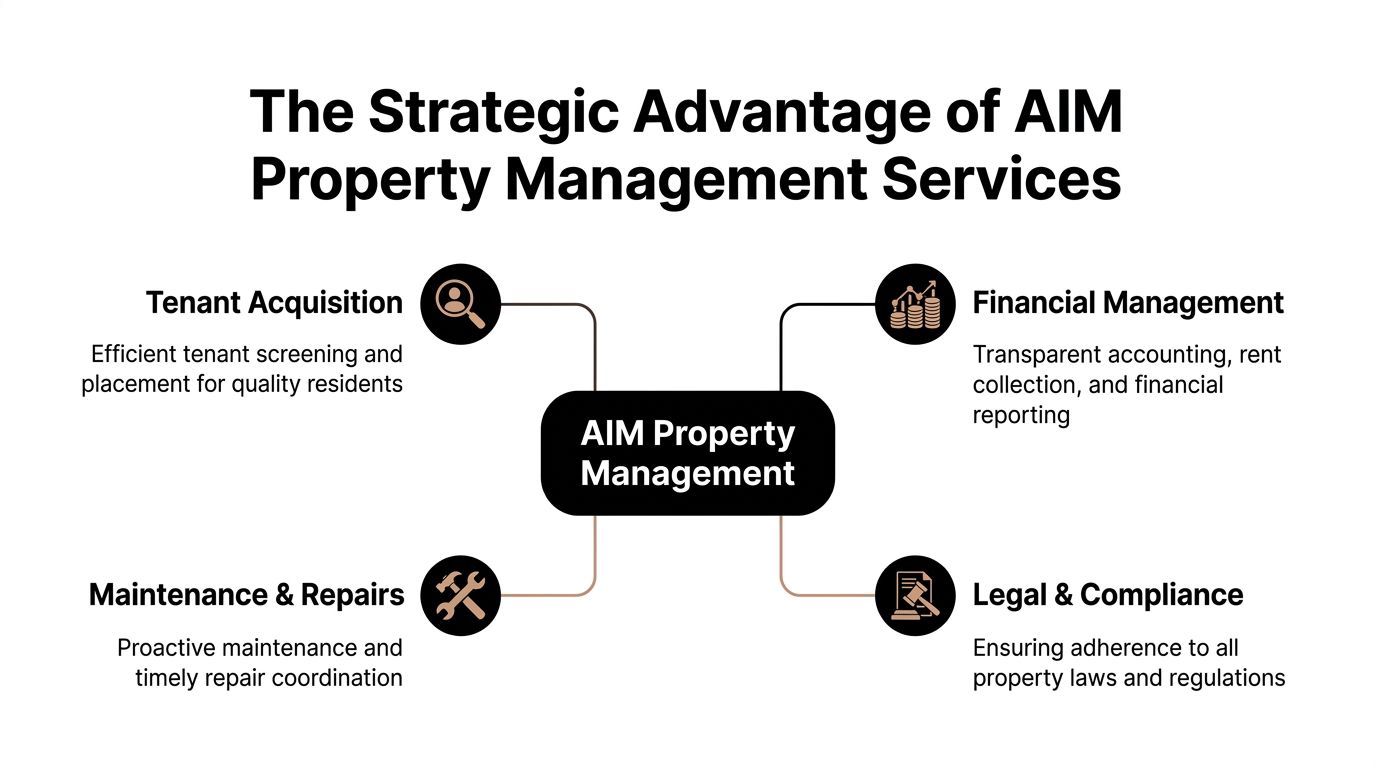
The Strategic Advantage of AIM Property Management Services
A vacancy in a Redlands property rarely turns on one question like credit score. The harder call is deciding whether an applicant will pay on time, follow the lease, report problems early, and fit the property over a full lease term. That is one of the clearest differences between owning a rental and operating it well.
Pebblebrook is a useful case study because properties in that tier depend on disciplined execution, not just a good address. Public listings can show general screening standards and amenities. They do not show how consistently applications are reviewed, how quickly issues are resolved, or how firmly lease terms are enforced. Those operating details usually decide whether a promising asset performs like one.
Screening that protects income, not just occupancy
A score on a report is only one part of the file.
An experienced manager reviews income reliability, rental history, background information, document accuracy, and signs that the application holds together under review. That process helps owners avoid two expensive mistakes. The first is filling a vacancy too fast with an applicant who creates payment or lease problems later. The second is making inconsistent approval decisions that expose the owner to fair housing and documentation risk.
Good screening is a repeatable standard applied the same way every time. At a property like Pebblebrook, that kind of discipline supports steadier collections and fewer avoidable disputes.
Maintenance decisions affect revenue
Owners often feel the cost of maintenance first. The larger issue is how maintenance decisions shape resident retention, property condition, and future turn cost.
A well-run management operation sets response standards, triages urgency correctly, tracks vendor performance, and keeps a record of what was found and fixed. That protects the physical asset, but it also protects the leasing position of the property. In Redlands, renters notice condition quickly. If a community presents well and service issues are handled cleanly, renewals get easier and turns are less disruptive.
Field note: Owners remember the invoice. Residents remember whether the problem was handled correctly the first time.
Financial control has to be boring and consistent
Reliable property performance usually comes from ordinary habits done well month after month.
Residents need clear payment expectations and consistent follow-through on late rent. Owners need organized statements, clean trust accounting, and reporting they can use to make decisions. A professional manager brings process to that work, which reduces friction and keeps small collection issues from turning into larger income problems.
For owners comparing self-management against full-service oversight, AIM Property Management's approach for homeowners shows what that operating structure looks like in practice.
Documentation reduces avoidable risk
California management mistakes are often paperwork mistakes first, legal problems second.
Lease files, notices, inspection records, resident communication, and maintenance documentation all need to be accurate and accessible. At a property operating near Pebblebrook's standard, that discipline is part of protecting value. Without it, an owner can have a decent property and still absorb unnecessary risk from inconsistent records or preventable process errors.
Why owners hire a manager even when they could do it themselves
For many investors, the question is not capability. It is whether their time is best spent screening applicants, tracking notices, monitoring rent collection, reviewing vendor work, and documenting every decision.
Professional management earns its fee by turning those moving parts into a system. That is the strategic advantage. Properties like Pebblebrook perform well when someone is actively protecting income, condition, resident experience, and compliance at the same time. Owners in Redlands, Beaumont, and Yucaipa usually do better when they treat management as an operating function with standards, accountability, and local judgment.
Local Expertise for Redlands Beaumont and Yucaipa Properties
The lesson from pebblebrook apartments redlands ca doesn’t stop at one address. It travels across nearby cities, but not in a copy-and-paste way.
Every local market asks for a different management style. The owner who ignores that usually ends up applying Redlands assumptions to Beaumont, or Beaumont assumptions to Yucaipa, and then wondering why the same playbook doesn’t produce the same result.

Redlands requires precision
Redlands renters often pay attention to neighborhood feel, school access, proximity to downtown, and whether a property feels maintained rather than merely functional.
That means Redlands property management and property management Redlands work often benefit from:
- Sharper presentation standards
- Faster turn completion
- Careful amenity upkeep
- Consistent communication with residents
Properties with updated mechanical systems and durable interiors can also gain an efficiency edge. Public listing information tied to Pebblebrook notes that energy-efficient features such as modern heat pumps, central AC with high SEER ratings, and vinyl flooring can reduce utility costs by 15% to 20%, and that proactive inspections help preserve value, according to the Zillow apartment reference.
Beaumont and Yucaipa call for different decisions
Beaumont property management often involves a different renter mindset. Newer housing stock, commuting patterns, and household priorities can shift which features matter most and how quickly maintenance concerns need to be framed and solved.
Yucaipa property management often rewards a more family-oriented operating style. Residents may focus heavily on stability, lease clarity, home condition, and whether the property is being maintained with long-term occupancy in mind.
Here’s the practical takeaway:
| Community | Management emphasis |
|---|---|
| Redlands | Presentation, maximizing location benefits, amenity condition |
| Beaumont | Process consistency, commute-conscious leasing, durable systems |
| Yucaipa | Stability, home care, preventative maintenance, resident retention |
For owners specifically comparing strategies in that market, the property management in Yucaipa page is a useful local reference point.
Good local management doesn’t force one market’s logic onto another. It adjusts the leasing message, maintenance priorities, and resident communication to fit the city and the property type.
That local adjustment is what separates generic management from useful management. It matters whether the home is in Redlands, Beaumont, Calimesa, Loma Linda, Mentone, Highland, or Banning. The same basic principles apply, but the execution should reflect the neighborhood, the renter pool, and the property itself.
Partner with AIM to Maximize Your Investment in 2026
A property like Pebblebrook shows what owners want. Strong demand, stable occupancy, attractive presentation, and an asset that holds its position in the local market.
What it also shows is that performance has to be managed.
For many owners, the key decision isn’t whether their property has potential. It’s whether they have the time, systems, and operational discipline to turn that potential into reliable results year after year. For busy homeowners and investors, especially those balancing multiple obligations, professional management is often the cleaner path.
That’s true whether you own a condo in Redlands, a single-family home in Yucaipa, or an investment property in Beaumont. Property performance improves when leasing, screening, maintenance, rent collection, inspections, and compliance are handled consistently.
If you’re planning for 2026, think about management as a value-protection decision, not just a convenience decision. The right manager helps preserve condition, reduce avoidable friction, and keep the property aligned with its market.
Owners searching property management near me usually aren’t looking for someone to do one task. They’re looking for someone who can remove uncertainty from the entire rental operation. That’s the standard worth using when you decide to hire a property manager.
Frequently Asked Questions About Property Management
A few questions come up in almost every owner conversation. The answers below are the practical version.
What should I look for in property management near me
Look for local knowledge first, but don’t stop there.
You want a manager who understands your city, your tenant pool, and your property type. You also want clear systems for screening, maintenance, collections, inspections, and documentation. If a company sounds polished but can’t explain how they handle those daily functions, keep looking.
A useful checklist includes:
- Local market familiarity: They should know Redlands property management issues are not identical to Property Management Beaumont or Yucaipa property management realities.
- Consistent communication: You shouldn’t have to chase updates.
- Documented processes: Good managers can explain how they screen, inspect, and respond to maintenance.
- Compliance awareness: California management requires more than casual recordkeeping.
Why should I hire a property manager instead of doing it myself
Because owning a rental and operating a rental are different jobs.
Self-managing can work for some owners, especially if they live nearby, have time available, and know how to handle screening, maintenance coordination, notices, and resident communication. But once your schedule gets tight or the property has recurring needs, self-management starts to create drag.
Professional management helps by reducing missed details, enforcing consistent standards, and keeping the asset moving without requiring your daily attention.
How does professional screening help
It helps owners avoid decisions based only on surface-level information.
Public listings may mention a recommended credit score, but they don’t tell you enough about how to evaluate the full applicant profile. Professional screening reviews the broader risk picture and applies standards consistently, which helps protect both income and property condition.
Does management really help with maintenance costs
It often helps with maintenance outcomes, which is what owners should focus on.
The point isn’t just to spend less. The point is to catch issues earlier, dispatch correctly, document work, and avoid letting small problems become large ones. That approach protects resident satisfaction and property condition at the same time.
Is professional management only for large apartment buildings
No. It’s useful for individually owned homes, condos, townhomes, and small multifamily properties too.
Many owners of smaller properties benefit the most because they don’t have in-house systems. A manager can bring process, vendor coordination, accounting structure, and legal discipline to an asset that otherwise depends on the owner’s spare time.
What if I own outside Redlands
That’s common.
Owners often need support across nearby cities, including Beaumont property management, property management Yucaipa, Highland, Loma Linda, Calimesa, and Banning. What matters is whether the manager understands how leasing and maintenance expectations shift by area and property type.
How should I decide whether to hire a property manager
Use a straightforward test.
Ask yourself these questions:
- Do I have time to respond quickly when issues come up?
- Can I screen applicants consistently and legally?
- Do I have vendors I trust for routine and urgent repairs?
- Will I stay on top of notices, records, inspections, and lease enforcement?
- Am I improving the property as an asset, or just reacting to problems?
If those answers feel uncertain, it may be time to hire a property manager.

If you want a more reliable way to run your rental, AIM PROPERTY MANAGEMENT COMPANY helps owners across Redlands, Beaumont, Yucaipa, Loma Linda, Highland, Banning, and nearby communities manage homes and investment properties with stronger screening, responsive maintenance coordination, regular inspections, organized financial handling, and legal compliance support. If you’re ready to reduce stress and improve day-to-day performance, now is a good time to start the conversation.