Being a landlord in California is about much more than just collecting rent—it's a commitment to providing a safe, livable home under a specific set of state laws. Your core responsibilities cover everything from property maintenance and handling security deposits to providing the right disclosures and following strict rules for rent control and evictions.
Your Core Duties as a California Landlord
Owning a rental property in the Golden State can be a fantastic investment, but it comes with real legal obligations designed to protect both you and your tenants. The best way to think about these duties isn't as a burden, but as the foundation of a successful, long-term rental business.
Getting them right from day one is the key to preventing expensive legal battles, building positive tenant relationships, and protecting your asset. This guide breaks down what you absolutely need to know. For landlords in communities like Redlands, Beaumont, Calimesa, Yucaipa, Loma Linda, Mentone, Highland and Banning California, mastering these rules is the first step toward true peace of mind.
To give you a quick overview, here are the main areas every landlord needs to manage.
Key Landlord Responsibilities in California
This table provides a snapshot of the primary legal duties that form the bedrock of compliant property management in the state.
| Responsibility Area | Key Obligation |
|---|---|
| Habitability | Provide and maintain a safe, livable home with functioning essential services (plumbing, heat, etc.). |
| Security Deposits | Collect, hold, and return tenant funds according to strict legal timelines and deduction rules. |
| Tenant Privacy | Give proper notice (24 hours is standard) before entering an occupied rental unit for non-emergencies. |
| Disclosures | Inform tenants about known property issues like lead paint, asbestos, or if the property is in a flood zone. |
| Rent Control | Abide by statewide and local ordinances that limit the amount and frequency of rent increases. |
| Eviction Process | Follow the legal "just cause" eviction procedures; self-help evictions are illegal. |
Think of this table as your starting checklist. Now, let’s dig a little deeper into what these commitments mean in practice.
The Landlord's Foundational Commitments
At its heart, being a compliant landlord means you're focused on a few key areas. These aren't just suggestions from a manual; they are legal requirements that shape the entire landlord-tenant relationship in California.
- Ensuring a Habitable Property: You're on the hook for providing a home that is safe and livable. That means essentials like effective waterproofing, plumbing and electrical systems that actually work, and reliable heat.
- Managing Tenant Funds Lawfully: Security deposits are not your money. You have to follow the rules, which means sticking to the 21-day deadline to return the deposit and providing a detailed, itemized list of any deductions you made.
- Respecting Tenant Privacy: You can't just show up unannounced. The law requires you to give proper notice—typically 24 hours—before entering a rental for non-emergency reasons like repairs or showings.
- Following Legal Processes: When it comes to raising the rent or, if necessary, evicting a tenant, you have to follow the letter of the law. This includes navigating California's "just cause" eviction rules, which are designed to prevent arbitrary lease terminations.
Why Long-Term Stability Matters More Than Ever
While the high nightly rates of short-term rentals might seem appealing, AIM exclusively focuses on long-term tenancies because they bring a level of stability and predictability that is unmatched. Building lasting relationships with good tenants slashes turnover costs, minimizes vacancies, and creates a far more consistent and reliable income stream. It’s a strategy built for sustainable investment, not the high-effort, high-volume churn of short-term lets.
Since 1997, our experience has proven that stable, long-term rentals are the cornerstone of a successful property investment in California. This approach doesn't just protect your asset; it helps build stronger community ties in areas like Loma Linda, Mentone, Highland, and Banning.
Working with an experienced property manager who shares this philosophy can make all the difference. With a low 7.9% monthly management fee and a simple $750 placement fee with no add-on fees, we ensure your investment is handled with professional care. This frees you up to enjoy the benefits of ownership without getting tangled in the day-to-day headaches.
Upholding the Implied Warranty of Habitability

Every single rental agreement in California—whether it's a formal document or a handshake deal—comes with an unwritten promise baked right in. It’s called the implied warranty of habitability, and it's one of the most fundamental landlord responsibilities in the state.
Think of it as the core promise you make when you hand over the keys. You’re not just providing four walls and a roof; you’re guaranteeing a home that meets basic health and safety standards. Dropping the ball on this can lead to some serious legal and financial headaches down the road.
What Does Habitable Actually Mean?
The law gets pretty specific about what makes a property "habitable." This isn't about luxury or modern aesthetics—it's about the non-negotiable fundamentals that make a place safe and livable. You can't ask a tenant to waive these rights in a lease, either.
To meet the standard, your property must have:
- Effective Waterproofing: The roof, walls, and windows need to keep the elements out. No one wants to deal with persistent leaks.
- Working Utilities: This means functional plumbing with both hot and cold running water, a working heating system, and safe electrical wiring.
- Sanitary Conditions: The property, including any common areas, must be clean and free from trash, rodents, and other pests when the tenant moves in and throughout their stay.
- Structural Safety: Floors, stairs, and railings have to be in good shape and sturdy enough for normal use.
- Secure Premises: Functioning locks on all doors and windows are an absolute must for tenant safety.
A huge piece of this puzzle is ensuring tenants have hot water. When a water heater goes out, it’s not just an inconvenience; it’s a habitability issue that demands prompt and reliable water heater repair services. Addressing these core needs quickly is essential.
Responding to Repair Requests
How you handle maintenance requests says everything about your commitment to providing a habitable home. California law gives landlords a "reasonable" amount of time—generally considered 30 days—to make necessary repairs. But for urgent problems like a broken heater in winter or a major plumbing leak, that clock ticks a whole lot faster.
Proactive communication is your best friend here. Acknowledge the request right away, give the tenant a clear timeline for the fix, and keep them in the loop. This simple process can prevent a small issue from spiraling into a major dispute.
When Landlords Fail to Make Repairs
If a landlord ignores their duty to maintain a habitable property, tenants have some powerful legal tools at their disposal. Knowing what they are is the best way to avoid costly conflicts.
The most well-known tenant remedy is "repair and deduct." If a landlord fails to fix a serious problem after being notified, a tenant can pay for the repair themselves and deduct the cost from their next rent payment. This action is legally protected but has strict limitations.
Other steps a tenant might take include:
- Withholding Rent: Tenants may stop paying rent until essential repairs are made, though this is a risky move for them without proper legal guidance.
- Abandoning the Property: In severe cases where a unit is truly unlivable, a tenant may be able to break the lease and move out with no penalty.
- Suing the Landlord: A tenant can take a landlord to court to seek damages caused by the failure to maintain the property.
Juggling these duties requires constant vigilance, especially for property owners in communities like Redlands, Yucaipa, or Loma Linda. Partnering with a management company that lives and breathes these legal nuances ensures your property stays compliant and your investment remains protected. Since 1997, AIM has built mature relationships with local vendors, allowing us to handle repairs efficiently and uphold the warranty of habitability for every property under our care.
Managing Security Deposits and Financial Disclosures

Let’s be honest—money matters are where most landlord-tenant relationships get rocky. But they don’t have to be. By strictly following California’s crystal-clear rules for security deposits and disclosures, you can build trust and sidestep expensive disputes. Think of these regulations not as hurdles, but as a proven playbook for transparent financial management.
Handling a tenant's security deposit the right way is a huge part of your landlord responsibilities in California. It’s crucial to remember that this isn't your money to spend; it’s a security fund you're holding in trust. Getting this process wrong can lead to serious penalties, often forcing you to return the entire deposit plus damages.
Security Deposit Limits and Rules
California law puts firm caps on how much you can charge for a security deposit. And as of 2024, the rules have become even more tenant-friendly, so staying current is non-negotiable.
- Maximum Deposit: For most rentals, you can now only charge a security deposit equal to one month's rent. This applies whether the unit is furnished or not.
- Small Landlord Exception: There's a carve-out for small landlords who own no more than two residential properties with a total of no more than four units. If this is you, you may charge up to two months' rent.
- Non-Refundable Deposits: This one is simple: they're illegal. California law strictly prohibits charging any non-refundable deposits. All money collected as security must be treated as refundable.
Sticking to these limits is your first step. The next—and arguably most important—is how you handle the return.
The 21-Day Return Deadline
The moment a tenancy ends, a clock starts ticking. California gives you a hard, non-negotiable 21-day deadline to deal with the security deposit. Within 21 calendar days of the tenant moving out, you must do one of two things:
- Return the tenant's full security deposit.
- Provide the tenant with an itemized statement explaining any deductions, include copies of receipts for the work done, and return the remaining balance.
Failing to meet this 21-day deadline can have severe consequences. A court might decide you acted in "bad faith," ordering you to return the entire deposit plus pay the tenant damages up to twice the amount of the original deposit.
What Are Legitimate Deductions?
You cannot deduct for "normal wear and tear." This is the natural decline a property experiences from everyday use—things like lightly faded paint or carpets that are worn down from being walked on. Valid deductions are for actual damage caused by abuse or neglect.
Here’s a quick checklist for valid deductions:
- Unpaid Rent: The most straightforward deduction. You can cover any rent the tenant still owes.
- Cleaning Costs: You can only deduct the cost to bring the unit back to the same level of cleanliness it was in when the tenant moved in.
- Damage Beyond Normal Wear and Tear: This covers things like big holes punched in the walls, broken tiles, or deep pet stains in the carpet.
- Replacing Lost Keys or Remotes: The cost to replace items the tenant didn't return is also a fair deduction.
Thorough documentation is your best friend here. Move-in and move-out photos and checklists provide the proof you need to justify any deductions. This evidence also helps you keep your property in top shape, which is a key factor in its overall value. For landlords thinking about smart upgrades, you can learn more about how to increase your property value with strategic improvements at https://aim-properties.com/how-to-increase-property-value/.
Navigating these financial duties requires precision and local know-how. For property owners in areas like Redlands, Banning, or Loma Linda, partnering with a management company that lives and breathes these rules is a smart investment. Since 1997, AIM has provided that expertise, ensuring our clients stay compliant while their properties thrive.
Navigating California Rent Control and Eviction Laws
https://www.youtube.com/embed/CYD_P-tTkfE
The laws around rent increases and evictions are easily the most intimidating part of being a landlord in California. Getting these rules right isn't just good practice—it's a legal shield that protects both you and your investment from incredibly costly disputes. These regulations are designed to create a framework for fair housing, but they demand your full attention.
At the heart of it all is the Tenant Protection Act of 2019 (AB 1482), which rolled out statewide protections for renters. This law fundamentally changed the game for landlords by introducing two critical concepts you absolutely must master: statewide rent caps and "just cause" eviction requirements.
One of the biggest shifts was the new limit on rent increases. The Act caps annual rent hikes at either 10% or 5% plus the local consumer price index (CPI)—whichever is lower. This applies to most residential properties that are over 15 years old. On the eviction front, landlords now need a valid 'just cause'—like not paying rent or breaking the lease—to remove a tenant, even after their lease is up.
Understanding Just Cause Eviction
Before AB 1482, if a lease ended, a landlord could simply choose not to renew it without giving a reason. Not anymore. For any tenant who has lived in your unit for 12 months or more, you must have a legally recognized "just cause" to end their tenancy. These reasons fall into two clear categories.
- At-Fault Just Cause: This is when the tenant has done something wrong. The most common examples are failing to pay rent, causing serious damage to the property, or conducting illegal activities on the premises.
- No-Fault Just Cause: This happens when you need the property back for reasons that have nothing to do with the tenant's behavior. Maybe you or a close family member plan to move in, you're planning a major remodel that requires the unit to be empty, or you're taking the property off the rental market entirely.
It's important to know that if you end a tenancy for a no-fault reason, you're generally required to provide the tenant with relocation assistance. This is typically equal to one month's rent and acknowledges the disruption you're causing through no fault of their own. For a deeper dive into these complex regulations, you can read our complete guide on California landlord-tenant laws.
To confidently handle these legal details, mastering legal research methods is an essential skill for ensuring you're always in compliance.
This visual guide breaks down the standard notice periods landlords must give before entering a property or ending a tenancy.
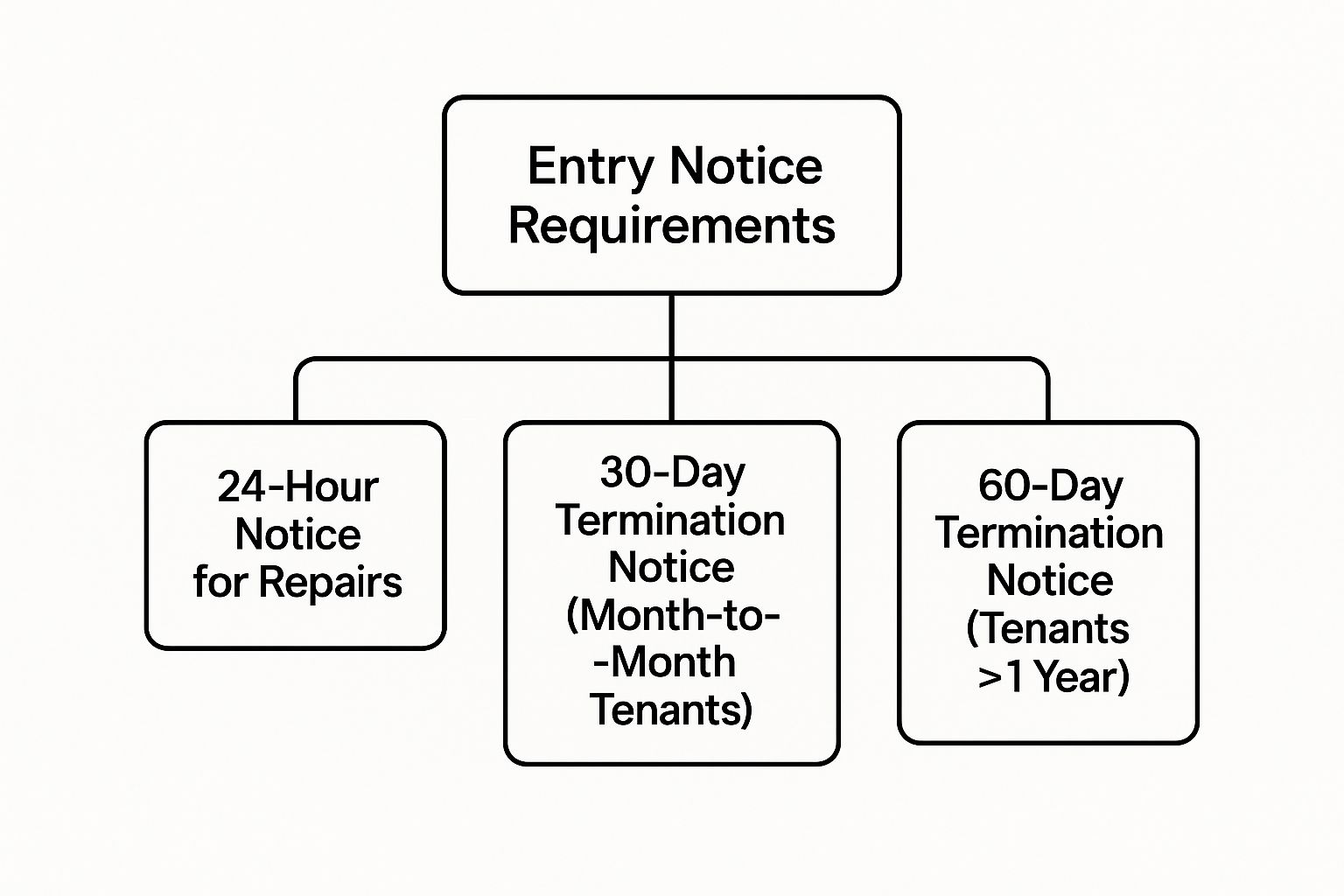
As you can see, the law sets different timelines depending on the reason for entry and how long the tenant has lived there.
The Superior Stability Of Long-Term Rentals
Navigating these intricate laws is much simpler when you have stable, long-term tenants. While short-term rentals might seem appealing, they often bring a revolving door of occupants, more wear and tear, and a constant need to find the next renter. This churn means you're bumping up against complex eviction and deposit laws far more often.
Thinking about the pros and cons? Here’s a quick breakdown of why we believe long-term rentals offer a far more stable foundation for your investment.
Long-Term Rentals vs Short-Term Rentals
| Feature | Long-Term Rentals (AIM's Focus) | Short-Term Rentals |
|---|---|---|
| Income Stability | Consistent, predictable monthly income | Fluctuates with seasonal demand |
| Tenant Turnover | Low, reducing vacancy costs | High, with constant marketing needs |
| Management Effort | Less hands-on once a good tenant is placed | Requires daily management and cleaning |
| Legal Complexity | Fewer interactions with eviction/deposit laws | Frequent exposure to complex regulations |
| Wear and Tear | Tenants treat it like their own home | Higher potential for damage from guests |
Ultimately, long-term rentals create a partnership with tenants who are invested in caring for your property, which is a win for everyone involved.
At AIM, we’ve learned a thing or two since 1997. Our experience has proven time and again that focusing on long-term rentals is the best strategy for property owners in communities like Redlands, Beaumont, and Loma Linda. It builds stability, slashes vacancy rates, and creates a predictable revenue stream you can count on.
That’s why we exclusively manage long-term rentals—we believe it’s the best way to protect your investment. By securing reliable, long-term tenants, we help you sidestep the legal gray areas and constant turnover that come with short-term leasing. Our straightforward $750 placement fee with no add-on fees and our low 7.9% monthly management fee reflect this stable, profitable approach that brings peace of mind in a very demanding market.
Finding a Partner in Property Management

Let's be honest: managing a rental property in California is a lot more than just finding a tenant and cashing a check. As we've covered, it demands a solid grasp of habitability laws, razor-sharp financial tracking, and staying on top of the constant shifts in rent control and eviction rules. This is exactly where a professional partner stops being an expense and becomes one of your most valuable assets.
An experienced property manager handles all the heavy lifting. They're the ones fielding late-night calls about a leaky faucet, making sure security deposits are handled by the book, and keeping your property compliant with a tangled web of local and state laws. For many owners, this partnership is what finally turns a stressful, hands-on job into a truly passive investment.
The Value of Experience and Local Knowledge
Choosing the right property manager isn’t just about outsourcing tasks; it's about gaining a strategic advantage on the ground. A team with deep roots in the community already knows the local market inside and out. They have trusted, reliable vendors on speed dial and understand the specific ordinances of cities like Redlands, Beaumont, Calimesa, Yucaipa, Loma Linda, Mentone, Highland and Banning.
Since 1997, AIM has been right here, serving property owners in these communities. That kind of history gives us more than just experience—it creates mature relationships with the community. We’ve watched the market evolve and have guided our clients through every up and down, making sure their investments stay secure and profitable.
The Superior Advantage of Long-Term Rentals
The modern rental market often presents landlords with a choice: short-term vacation rentals or traditional long-term tenancies. While the high nightly rates of short-term rentals look tempting, they come with serious downsides—namely, constant turnover, higher maintenance costs from frequent use, and a mountain of administrative work.
At AIM, we focus exclusively on long-term rentals for one simple reason: stability. A long-term tenant is far more likely to treat your property like their own home, which means less wear and tear. This approach also creates a predictable, consistent income stream, free from the seasonal slumps and vacancies that plague the short-term market.
A focus on long-term tenancy is a deliberate strategy for asset protection. It minimizes risks associated with frequent tenant turnover and aligns with our goal of creating stable, profitable investments for our clients in communities from Loma Linda to Banning.
This philosophy is baked into everything we do, from our rigorous tenant screening process to our proactive maintenance schedules.
A Transparent and Affordable Partnership
One of the biggest worries for property owners is the cost. Hidden fees and complicated pricing can quickly eat away at your returns, which is why we believe in being completely upfront. We offer a straightforward 7.9% monthly management fee, which is a very low fee compared to many other companies in the Southern California market.
That single fee covers the comprehensive, day-to-day operations of your property. We also charge a one-time, flat $750 placement fee to find, screen, and place a high-quality tenant. That’s it. There are no other add-on fees. This clear pricing model lets you budget effectively and see exactly where your money is going.
Choosing a partner to manage your property is a big decision. It requires trust, shared values, and a proven track record. By handling all the complexities of landlord responsibilities in California, we give you the peace of mind to actually enjoy the benefits of ownership without the daily grind. You can learn more about our comprehensive property management services and how we protect your investment.
Landlord FAQs: Your Most Common Questions Answered
When you're a landlord in California, the rulebook can feel a mile long. It's natural to have specific, "what-if" questions pop up. Let's tackle some of the most common ones we hear from property owners.
How Much Notice Do I Need to Give Before Entering a Tenant's Home?
Think of it as a courtesy call, but with legal backing. In California, you must give "reasonable" written notice before you step foot inside an occupied unit. The law generally considers 24 hours to be reasonable.
Your notice needs to be clear: state the date, a general time window, and why you're coming in. And make sure the visit is during normal business hours. The only times you can skip this step are for true emergencies (like a fire or a burst pipe), if you have a court order, or if you have good reason to believe the tenant has abandoned the property.
What's My Responsibility for Smoke and Carbon Monoxide Detectors?
This one is non-negotiable. You are legally required to install and maintain working smoke detectors in every sleeping area of your rental. It's a fundamental safety standard.
On top of that, you also need to install carbon monoxide detectors if the unit has a gas appliance, a fireplace, or an attached garage. Before any new tenant moves in, it's your job to confirm every detector works and to give them instructions on how to maintain them.
Can I Really Enforce a "No Pets" Policy?
For the most part, yes. You can absolutely state in your lease that pets are not allowed. However, there's a huge exception you need to be aware of, and it falls under fair housing laws.
You are legally required to provide a "reasonable accommodation" for tenants with disabilities who rely on a service or emotional support animal. These animals are not considered pets. That means you can't charge a pet deposit or "pet rent" for them. The tenant is still on the hook for any damage the animal causes, though.
Properly screening applicants is your first line of defense in finding tenants who respect your property rules. A thorough process helps you identify responsible individuals from the start, minimizing potential conflicts over issues like pets or property care.
If you want to sharpen your screening skills, check out our expert advice on how to find good tenants for your property.
What Happens If I'm Late Returning the Security Deposit?
Missing the 21-day deadline to return a security deposit (or provide a detailed list of deductions) is one of the most costly mistakes a landlord can make in California. The consequences are steep.
If a tenant takes you to court over it, a judge could rule that you acted in "bad faith." That means you might be ordered to return the entire deposit, plus pay the tenant up to twice the deposit amount in additional damages. Following this rule to the letter is absolutely critical to avoid a painful financial hit.
Juggling California's rental laws takes real-world experience and a deep understanding of the local market. Since 1997, AIM PROPERTY MANAGEMENT COMPANY has been that trusted partner for landlords in Redlands, Beaumont, Yucaipa, Loma Linda, Mentone, Highland, Banning, and the surrounding communities. We protect your investment with our straightforward, low 7.9% monthly management fee and $750 placement fee with no other add on fees, handling all these complex duties so you don’t have to.
Ready to simplify your life as a landlord? Learn more about our property management services at https://aim-properties.com.