
Before you even think about interviewing property managers, the most important work happens right at your own desk. The secret to a successful partnership is knowing exactly what you need before you start the search. This is all about clarifying your investment goals, figuring out how involved you want to be, and listing your absolute non-negotiables.
Doing this homework first saves a ton of headaches later and makes your search way more efficient.
Defining Your Needs Before You Start Your Search
Jumping into interviews without a clear roadmap is a classic mistake that almost always leads to frustration. Before you look at a single company website, you need a detailed blueprint of what your ideal management setup looks like.
This isn't just about handing over the keys. It’s about finding a strategic partner who’s on the same page with your financial goals, communication style, and the unique demands of your property, whether it's a single-family home in Redlands or a multi-unit building in Beaumont.
Assess Your Desired Level of Involvement
First things first: how hands-on do you actually want to be? There’s no right or wrong answer here, but being honest with yourself is crucial for finding the right fit. Most property owners fall into one of three camps.
- The Hands-Off Investor: You just want to see a monthly statement and a deposit in your bank account. You trust your manager to handle day-to-day operations, tenant calls, and routine maintenance without needing your approval on every little thing.
- The Collaborative Partner: You want to stay in the loop on most decisions and prefer to approve any maintenance requests over a certain amount, like $300 or $500. You expect regular updates but have no interest in managing the daily grind.
- The Hands-On Owner: You want to be involved in nearly everything, from approving new tenants to picking out the plumber for a leaky faucet. This approach requires a manager who is an excellent communicator and is comfortable with a high level of owner oversight.
Knowing your style helps you ask the right questions later. A manager who thrives with hands-off investors might feel micromanaged by a hands-on owner, and the reverse is just as true.
Set Clear Financial and Operational Expectations
Next, it's time to define the ground rules of the partnership. These are the non-negotiables that will dictate how your property is actually managed. If you don't get this stuff in writing, you're leaving critical decisions open to interpretation, which is a recipe for conflict.
Your property manager is a crucial partner in your investment journey. Setting clear, written expectations from the outset is the single most effective way to ensure a smooth, profitable, and long-lasting professional relationship.
Think through these areas and jot down your ideal scenario:
- Financial Reporting: How often do you need to see the numbers? Is a monthly PDF report enough, or do you want 24/7 access to an online owner portal with real-time data?
- Maintenance Spending Limits: What’s the maximum amount a manager can spend on a non-emergency repair without calling you first? This number is a critical detail that must be in the management agreement.
- Tenant Communication: Should the manager handle 100% of tenant interactions, or do you want to be cc'd on important emails? Defining this boundary is essential for everyone's sanity.
The numbers show just how much owners rely on professional help. The U.S. property management industry now generates a massive $134.2 billion in annual revenue. This boom is fueled by intense rental demand, with 518,000 new rental units completed last year alone. More and more owners are realizing they need an expert to get the most out of their investment.
To help you get started, use this checklist to pinpoint exactly what you're looking for.
Property Owner Self-Assessment Checklist
Use this checklist to define your management needs before you start interviewing potential companies.
| Assessment Area | Key Questions to Consider | Your Ideal Scenario |
|---|---|---|
| Involvement Level | How much do I want to be involved in day-to-day decisions? Do I want to approve all repairs, or only those over a certain cost? | (Example: I want to approve all repairs over $400 and be notified of all tenant issues, but I don't want to handle the calls myself.) |
| Financial Reporting | How often do I need financial statements? What level of detail do I require? Do I need access to an online portal? | (Example: Monthly statements via email are fine, as long as they are detailed. I'd prefer an online portal.) |
| Communication Style | How often do I expect updates? Do I prefer phone calls, emails, or texts? What's a reasonable response time for my inquiries? | (Example: A monthly email summary is sufficient, with phone calls for emergencies only. I expect a response within 24 hours.) |
| Tenant Screening | What are my minimum criteria for tenants (credit score, income, rental history)? Do I want final say on tenant approval? | (Example: Minimum 650 credit score, income 3x rent, no evictions. I want to give the final approval on all applications.) |
| Maintenance & Repairs | Am I okay with the manager using their own vendor network, or do I have preferred contractors I want them to use? | (Example: The manager can use their vendors, but I'd like to see their pricing to ensure it's competitive.) |
Having these answers ready not only makes your search more targeted but also ensures you and your future manager are perfectly aligned from day one. Understanding the full scope of a property management company's responsibilities is the key to setting expectations that are both clear and realistic.
Finding and Vetting Property Management Candidates
Now that you have a crystal-clear picture of what you need, it's time to start the search. This is where the rubber meets the road—separating the truly professional firms from the rest. Vetting a property manager goes way beyond a quick Google search; it’s about doing your homework to find a partner you can trust with one of your biggest assets.
Your goal here is to create a shortlist of solid candidates and then dig deep to make sure they can back up their claims. This means checking licenses, scrutinizing their online footprint, talking to real clients, and asking tough questions in an interview.
Building Your Initial List of Candidates
First things first, you need some names. The key is to cast a wide net and gather prospects from a few different places to get a real feel for the local market. Don't just rely on one source.
- Referrals: This is always the best place to start. Ask other local landlords, real estate agents you trust, or even your CPA for recommendations. A thumbs-up from someone who's already in the trenches is worth its weight in gold.
- Online Searches: Use specific, local terms. Searching for "Redlands property management" or "property management Yucaipa" will give you a list of companies that actively serve your area. Look past the paid ads at the top and see who is ranking organically—it's often a sign of an established presence.
- Local Associations: Check out local chapters of organizations like the California Apartment Association (CAA) or other real estate investor groups. Their member directories can be a goldmine for finding reputable pros.
Once you have a list of 3-5 promising companies, the real investigation begins. This is where you can start learning more about the top rental property management companies in the area and see how they stack up.
The process of defining your needs, as shown below, is the foundation for this entire vetting stage.
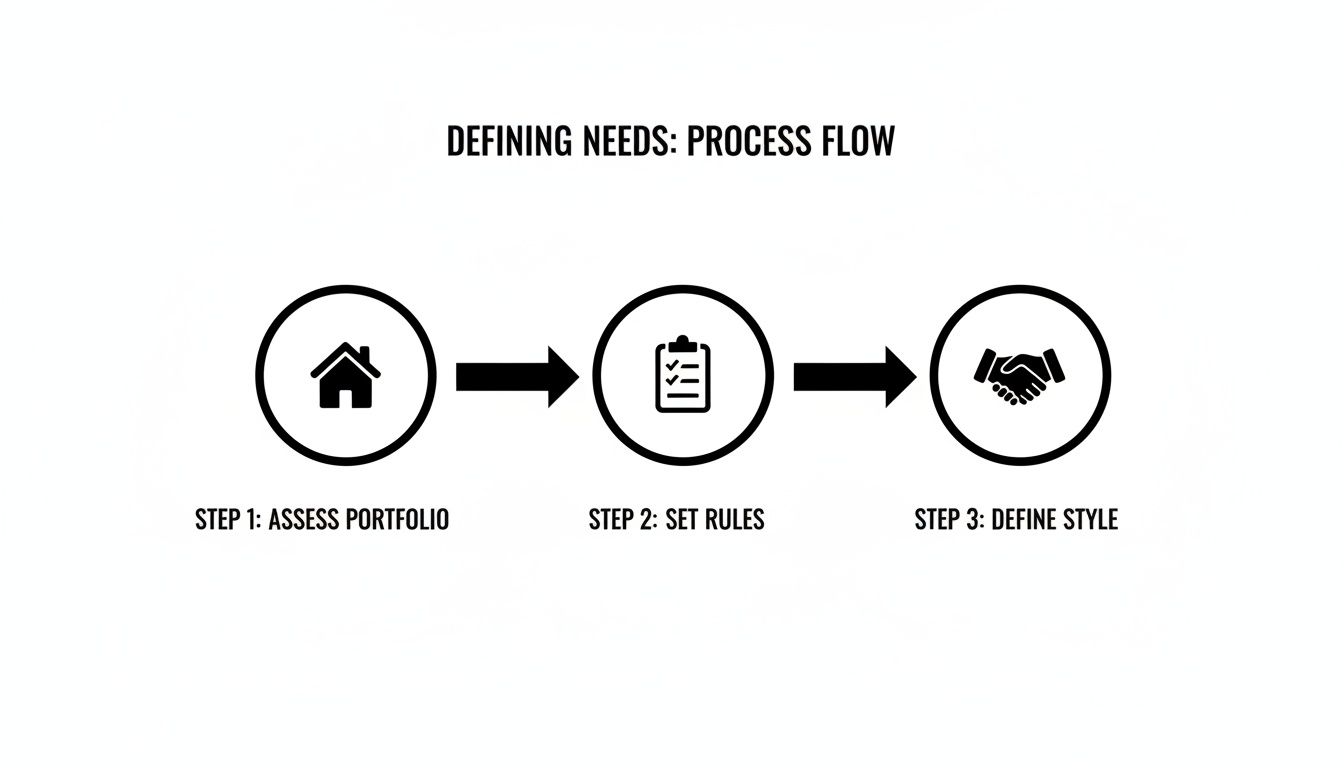
This visual reinforces that a successful search always starts with a clear understanding of your own portfolio and management style before you even think about interviewing anyone.
Conducting Thorough Due Diligence
Before you pick up the phone to schedule interviews, it’s homework time. A little pre-screening now will save you a ton of time later by weeding out the unqualified or unprofessional candidates right from the start.
First, verify their license. This is non-negotiable. In California, anyone managing property for others must have a real estate broker's license. You can—and absolutely should—verify this on the California Department of Real Estate (DRE) website. An unlicensed operator is a massive red flag. Don't even consider it.
Next, dive into their online reviews on Google, Yelp, and the Better Business Bureau. Read them with a critical eye. Are there patterns in the complaints, like consistent issues with communication or slow maintenance? Also, pay close attention to how the company responds to negative feedback. A professional and constructive response to criticism is a very good sign.
A company's online reputation is a great starting point, but it's not the whole story. You have to balance what you read online with direct conversations with actual references to get a complete, accurate picture of how they operate.
Finally, always ask for references from both current and former clients. A current client can tell you what day-to-day life is like with the company, while a former client might give you the real scoop on why they decided to part ways. Be specific with your questions—ask about communication, the timeliness of financial reports, and the quality of tenants they've placed.
The Critical Interview Process
The interview is your best shot at getting a feel for a company's expertise, communication style, and day-to-day processes. Don't settle for a phone call. An in-person or video meeting is a must; you need to see how they present themselves and interact.
Come prepared with a list of tough, scenario-based questions that can't be answered with a simple "yes" or "no." You're trying to understand their real-world problem-solving skills, not just listen to a sales pitch.
To help you get started, here are some essential questions to have in your back pocket.
Essential Interview Questions for Property Managers
| Category | Question to Ask | What to Listen For in Their Answer |
|---|---|---|
| Experience & Local Knowledge | "Walk me through a difficult eviction you handled for a property in Yucaipa or Beaumont. What were the challenges, and what was the outcome?" | A detailed, step-by-step process that shows they understand local laws and procedures. Vague answers are a red flag. |
| Tenant Screening | "Describe your tenant screening process from start to finish. How does it specifically comply with California's strict fair housing laws?" | Mention of credit checks, background checks, income verification (3x rent is standard), and landlord references. They should sound confident about legal compliance. |
| Maintenance & Emergencies | "A tenant calls on a Saturday night with a burst pipe. What is your exact emergency response protocol? Who do they call?" | A clear, 24/7 plan. They should have a network of trusted, after-hours vendors and a system for immediate communication with both the tenant and you. |
| Technology & Communication | "What software do you use for owner portals, rent collection, and maintenance requests? How often will I receive financial reports?" | Specific platform names (like AppFolio or Buildium). They should offer an online owner portal and provide monthly, easy-to-read financial statements. |
| Fees & Contracts | "Can you explain every single fee I might be charged, including management, leasing, renewal, and maintenance markups? What is your contract termination policy?" | Total transparency. They shouldn't hesitate to break down their fee structure. Look for a reasonable termination clause without excessive penalties. |
When vetting, it's also smart to ask about their use of modern tools. For instance, you could inquire if they use any AI receptionist solutions specifically designed for property management companies to ensure tenant calls are never missed. Their answers to these kinds of practical questions will reveal much more about their competence than any marketing brochure ever could.
With the U.S. property management sector recently adding over 14,000 jobs in a single year and now employing around 910,000 people, the competition is fierce. Asking the right questions ensures you hire from the top of that growing pool.
Understanding Management Fees and Contracts
The property management agreement is the single most important document you’ll sign. It’s the blueprint for your entire relationship with a manager, and glossing over the details is a costly mistake I’ve seen landlords make time and time again.
Before you put pen to paper, you have to get granular with the financial and legal terms. A clear, fair contract—whether your rental is in Redlands, Loma Linda, or Calimesa—is the only way to build a successful partnership and protect your investment.

Decoding Common Fee Structures
Property management fees aren't one-size-fits-all, so you'll run into a few different models. The two most common are percentage-based and flat-fee, and knowing the difference is critical to aligning your choice with your financial goals.
The industry standard is a percentage-based fee, usually somewhere between 8% to 10% of the monthly rent collected. This model is popular for a simple reason: it ties the manager's success to yours. If you're not getting paid, they're not getting their main fee. This gives them a powerful incentive to keep a great, paying tenant in your property.
On the other hand, a flat-fee structure means you pay a set dollar amount every month, no matter what the rent is or if it's even collected. For higher-rent properties, this can look like a great deal. But the downside is that the manager gets paid even when your unit is sitting vacant, which can sometimes reduce their urgency to get it filled.
A transparent company will have no problem handing over a complete fee schedule in writing. If they’re hesitant, that's a red flag. You need to see every potential charge upfront, so there are no surprises when you get your first statement.
Beyond that main management fee, you'll want to get familiar with all the other potential charges. Having a full picture of the typical property management fee structure helps you compare companies apples-to-apples.
Spotting and Questioning Every Line Item
Even with a professional company, it's your job to be your own best advocate and ask about every single charge. Hidden fees are profit killers, and they can turn what looked like a good deal into a financial headache.
Here are the most common fees to look for and question directly:
- Leasing Fee: This is a one-time fee for the work of finding and placing a new tenant. It’s often a percentage of the first month's rent, like 50%.
- Lease Renewal Fee: A smaller fee for the paperwork involved when a good tenant decides to stay for another year.
- Maintenance Markup: Some companies add a surcharge (say, 10%) to vendor invoices for arranging repairs. Ask about this! Many reputable firms, including us, don't mark up maintenance.
- Vacancy Fee: A fee charged for looking after an empty property. Be very wary of this one—it means they get paid while you're losing money.
- Eviction Fee: An hourly rate or flat fee to cover their time and the administrative work of an eviction.
Don't be afraid to ask for specifics. A simple question like, "I see a maintenance coordination fee in your agreement. Can you walk me through exactly when that applies and give me an example?" will tell you a lot.
Reviewing the Management Contract Clause by Clause
This agreement is a legally binding contract. Don't just skim it—read every single word. If anything feels confusing or overly technical, it’s worth having an attorney take a quick look. Pay close attention to a few key clauses that can become major problems if they aren't crystal clear.
A solid contract should protect both you and the manager. Here’s what to zero in on:
Services Provided: The contract needs to spell out exactly what you're paying for. Vague phrases like "handle tenant issues" aren't good enough. Look for specifics: marketing, tenant screening, rent collection, routine inspections, etc.
Owner Responsibilities: This section outlines your duties, like keeping a reserve fund topped up for repairs or maintaining the right kind of insurance.
Authority for Repairs: This is a big one. The agreement must state how much the manager can spend on a repair without getting your approval first. A standard limit is typically between $300 and $500.
Termination Clause: This might be the most important part of the entire contract. How do you get out of the agreement if things go south? Look for a reasonable notice period, like 30-60 days, and watch out for hefty early termination penalties. A company that’s confident in its service won't need to lock you into an ironclad contract you can't escape.
Navigating California's Complex Landlord-Tenant Laws
California is famous for a lot of things, and having some of the most intricate and tenant-friendly rental laws in the country is definitely one of them. For an independent landlord, just trying to keep up with the constant flow of new legislation and city-specific rules can feel like a full-time job.
It's a high-stakes game. A single, unintentional mistake can quickly blow up into a costly legal fight, turning your great investment into a massive liability.
This is exactly why one of the most important parts of learning how to hire a property manager is digging deep into their legal expertise. You aren't just looking for someone to collect rent; you're hiring a compliance shield for your asset. A truly great manager is fluent in the language of California's legal landscape.
State and Local Compliance Is Non-Negotiable
Any manager you consider must have a deep, practical understanding of major state regulations. This includes things like the Tenant Protection Act (AB 1482), which sets the rules for just-cause evictions and rent caps. But honestly, state law is just the starting point.
Many cities in our area, like Highland and Banning, have their own local ordinances that add yet another layer of complexity. An expert in Redlands property management will know the specific notice requirements for that city, while a Yucaipa property management specialist will understand the local quirks that affect tenant relations there.
Your manager needs to prove they have ironclad, legally sound processes for every single step of the rental cycle. This means:
- Lease Agreements: Crafting and using leases that are not only compliant with state law but can also stand up to the tough scrutiny of local statutes.
- Security Deposit Handling: Managing security deposits by the book, following California's strict rules on timelines for returns and proper documentation for any deductions.
- Notices and Disclosures: Serving all required notices—from a simple 24-hour notice to enter to a formal rent increase—in the correct format and within the legal timeframes.
- Eviction Procedures: Executing the eviction process perfectly. One small misstep can get the whole case thrown out of court, forcing you to start all over again from square one.
Proactive Legal Strategy and Documentation
A real professional doesn't just react to legal problems; they work proactively to stop them from ever happening. Their entire operation should be built on a foundation of rigorous documentation and a commitment to staying ahead of changes in the law.
This forward-thinking approach is more critical than ever. The U.S. property management market is projected to grow from $81.52 billion to $98.88 billion in the next four years, with North America driving 37% of that growth. This expansion is heavily influenced by new tech and increasing regulations, making expert legal navigation more valuable than ever. You can find more insights about these property management market trends.
When you're interviewing candidates, ask direct questions about how they stay current. Are they members of professional organizations like the California Apartment Association (CAA)? Do they attend legal seminars? Their answers will tell you whether they see legal compliance as a core part of their job or just an afterthought.
A property manager’s primary job is to protect the owner from liability. This is achieved through strict adherence to the law, meticulous record-keeping, and fair, consistent application of all policies.
Fair Housing and Consistent Policies
Beyond landlord-tenant laws, your manager must be an expert in Fair Housing. Federal and state Fair Housing laws prohibit discrimination against protected classes, and the penalties for violations are severe.
A top-tier manager ensures compliance by creating and consistently applying a written set of policies for every property they manage. This means every applicant is screened with the same criteria, every tenant is treated with the same professional respect, and every lease violation is handled according to a pre-defined, non-discriminatory process. That consistency is your best defense against a discrimination claim. For an in-depth look at these regulations, you can learn more about California's landlord-tenant laws in our detailed guide.
Ultimately, when you hire a property manager, you are entrusting them with your legal and financial well-being. Their ability to navigate California's complex laws isn't just a nice bonus—it's the absolute bedrock of their value.
Finding Local Expertise in Beaumont and Yucaipa
When you own a rental property, you quickly learn that every community has its own vibe, its own market quirks, and its own tenant pool. A generic, one-size-fits-all management style just doesn't cut it. For property owners in communities like Beaumont, Yucaipa, Calimesa, and Banning, hiring a manager with deep, on-the-ground knowledge is the single most important decision you'll make for your investment's success.

This kind of hyper-local expertise isn't just a nice-to-have feature; it’s a core component of maximizing your returns. A manager who truly gets the local landscape can navigate subtleties that a larger, more distant company would completely miss.
Why On-The-Ground Knowledge Matters
In a growing city like Beaumont, a local expert knows the specific tenant demographics drawn to the area. They understand which neighborhoods are attracting young families versus professionals and can tailor marketing efforts to reach them. This insight leads to finding higher-quality tenants faster, which dramatically cuts down on costly vacancy periods. For anyone with property in this market, our guide to property management in Beaumont offers a deeper look into these dynamics.
It's the same story in Yucaipa property management. A local firm knows how to market the unique charm and lifestyle of the community. They understand that highlighting proximity to local parks, great schools, and community events is key to attracting long-term residents who will care for your property like it's their own. That's a level of targeted marketing a non-local manager simply can't replicate.
A property manager with genuine local roots knows the right rent to charge, the right marketing channels to use, and has a network of trusted local vendors who can fix a plumbing issue on a Sunday afternoon. That kind of insight directly impacts your bottom line.
The Tangible Benefits of Local Expertise
Hiring a property manager who is an expert in your specific service area—whether it’s Redlands, Highland, Loma Linda, Mentone, or Banning—translates into real, concrete financial advantages. They aren't just guessing at rental rates; they have real-time data from the properties they manage right down the street.
Here’s what you actually get when you choose local:
- Accurate Rental Pricing: Setting the rent too high means long, expensive vacancies. Setting it too low leaves money on the table every single month. A local pro knows the sweet spot for your property type and neighborhood.
- Faster Tenant Placement: They have an established presence and often a waiting list of pre-screened tenants already looking for homes in the area.
- Reliable Vendor Relationships: When a repair is needed, a local manager has a list of trusted, affordable plumbers, electricians, and handymen they've worked with for years. No frantic searching or getting overcharged.
- Navigating Local Regulations: They are intimately familiar with city-specific ordinances or permitting requirements in places like Loma Linda or Calimesa, protecting you from potential fines and legal headaches.
Ultimately, when you learn how to hire a property manager, prioritizing their local expertise is the smartest move you can make. It transforms your rental from just another property into a high-performing, hassle-free investment.
Answers to Your Top Questions About Hiring a Property Manager
When you're thinking about bringing on a pro to manage your rental property, a lot of questions come up. Let's tackle some of the most common ones California landlords ask when they're figuring out how to hire a property manager.
What’s the Very First Thing I Should Do?
Before you even start Googling or making calls, the most important work is internal. You need to get crystal clear on what you actually want and need from a manager. Sit down and define your investment goals, figure out your budget for management fees, and list your non-negotiables for communication, financial reporting, and maintenance approvals.
Once you have that personal checklist ready, then you can start researching local companies in places like Redlands or Beaumont. Interviewing candidates becomes so much easier when you can compare them against your own well-defined criteria. Starting with a clear vision saves you a ton of time and leads to a much better partnership.
Is Hiring a Management Company Really Worth the Money?
For the vast majority of investors, the answer is a definite yes. It’s easy to get hung up on the management fee, but a great property manager doesn't just cost you money—they often make you more. They do this by finding high-quality tenants faster, which dramatically cuts down on expensive vacancy time. They also help you sidestep costly legal missteps or maintenance blunders that can drain your profits.
The real game-changer is the value of your own time and peace of mind. That’s a massive, often overlooked benefit that makes the management fee a smart investment in your property's long-term health.
How Can I Tell if a Property Manager Is Legit?
You'll want to look for a few key indicators. First and foremost, always verify their license with the California Department of Real Estate (DRE). That's non-negotiable. After that, read online reviews, but don't stop there. Insist on speaking directly with a few of their current clients to get the real, unfiltered story.
When you interview them, a reputable manager will be an open book. They'll be totally transparent about their process, give you straight answers to tough questions, and show you a professional, documented system for everything they do.
What Are Some Red Flags to Watch for in a Management Contract?
Be very careful with the contract. A few things should make you pause. Watch out for vague descriptions of services, long and difficult termination clauses, and unclear rules about maintenance spending limits. If you have to fight to get out of the contract or they can spend a fortune without your approval, walk away.
The agreement needs to spell out every single potential fee and clearly define the responsibilities for both you and the manager. A solid contract prevents headaches and disagreements down the road.
Ready to protect your investment and get your time back? AIM PROPERTY MANAGEMENT COMPANY delivers expert, hands-on management for properties in Redlands, Beaumont, Calimesa, Yucaipa, Loma Linda, Mentone, Highland, and Banning California. Let us take care of the day-to-day work so you can focus on the rewards. Learn more about our professional property management services today.