
Becoming a landlord is so much more than just buying a house and waiting for the rent checks to roll in. If you want to succeed, you have to treat it like a strategic business decision right from the start. That journey begins with serious research, a rock-solid financial plan, and a deep understanding of your local market—especially in unique communities like Beaumont, CA, and the surrounding areas. At AIM Property Management, we specialize in serving Beaumont, CA, for your property management needs, ensuring your investment is handled with local expertise.
Building Your Foundation As A Landlord
Jumping into the world of rental properties is an exciting move that can create a steady income stream and build real, long-term wealth. But success isn't built on luck; it's built on a strong foundation. Before you even think about looking at properties, you need to approach this as the business it truly is. That means creating a comprehensive plan that maps out your goals, strategies, and financial projections.
Think of a well-crafted business plan as your personal roadmap. It forces you to get honest about every single part of your future rental business, from analyzing the market to figuring out how you'll handle risks. This isn't just a piece of paper—it's the tool that will guide your biggest decisions and help you secure the financing you need.
To really lay that solid groundwork, you have to understand what makes an investment property tick. A great place to start is with resources that break down the details. You can learn a lot by reviewing this guide on Understanding Investment Properties.
Assessing Your Personal Readiness
The first step isn't about property, it's about you. Are you really cut out for the day-to-day responsibilities of being a landlord? This job demands a unique mix of financial smarts, patience, and practical skills. It’s crucial to take an honest look at your lifestyle and finances before you commit.
Ask yourself these key questions:
- Financial Stability: Do you have enough saved to cover the down payment, all the closing costs, and at least six months of mortgage payments without any rental income?
- Time Commitment: Are you prepared for the late-night emergency calls, the hassle of coordinating repairs, and the constant back-and-forth with tenants?
- Risk Tolerance: How will you react when a tenant doesn't pay, you have an unexpected vacancy, or a major repair bill for thousands of dollars lands on your desk?
A successful landlord doesn't just own a property; they actively manage an asset. Your readiness to handle both the financial and operational challenges will directly impact your profitability and stress levels.
Pinpointing The Right Location
In real estate, location is everything. The right neighborhood can be the difference between a profitable investment and a constant financial headache. Your research needs to be laser-focused on areas with strong rental demand, steady job growth, and a healthy local economy. We specialize in property management across several key communities, including Redlands, Beaumont, Calimesa, Yucaipa, Loma Linda, Mentone, Highland, and Banning, California.
When you're looking at an area like Beaumont or Yucaipa, search for signs of a healthy rental market. That means low vacancy rates, rising property values, and easy access to things people want, like good schools, parks, and shopping. Taking the time to learn what makes a good rental property will give you a huge advantage in your search.
Why Long-Term Rentals Are A Smarter Choice
As you research, you'll come across two main strategies: long-term and short-term rentals. At our company, we exclusively provide services for long-term leases of six months or longer. We focus on this for a reason—we firmly believe it offers far more stability and predictable returns for property owners.
Long-term rentals almost always provide more consistent income with less turnover. That means fewer empty months, lower marketing costs, and less wear and tear from a constant stream of new people. While short-term rentals might promise higher nightly rates, they bring the intense demands of the hospitality industry—endless cleaning, constant guest communication, and a maze of local regulations. For a sustainable, hands-off investment, the stability of a long-term tenant is simply the more prudent financial choice. It's a core belief shared by the best property management companies near me.
Securing Financing and Your Financial Strategy
You’ve got your business plan mapped out. Now comes the part that makes it all real: getting the money. Your financial strategy isn't just a spreadsheet—it's the engine that will power your entire investment. Getting the numbers right from the start is everything. From sorting through mortgage options to planning for the unexpected, a solid financial base is what will protect your investment and pave the way for long-term success.
This whole process really starts with assessing your readiness, researching the market, and then building out that financial plan.
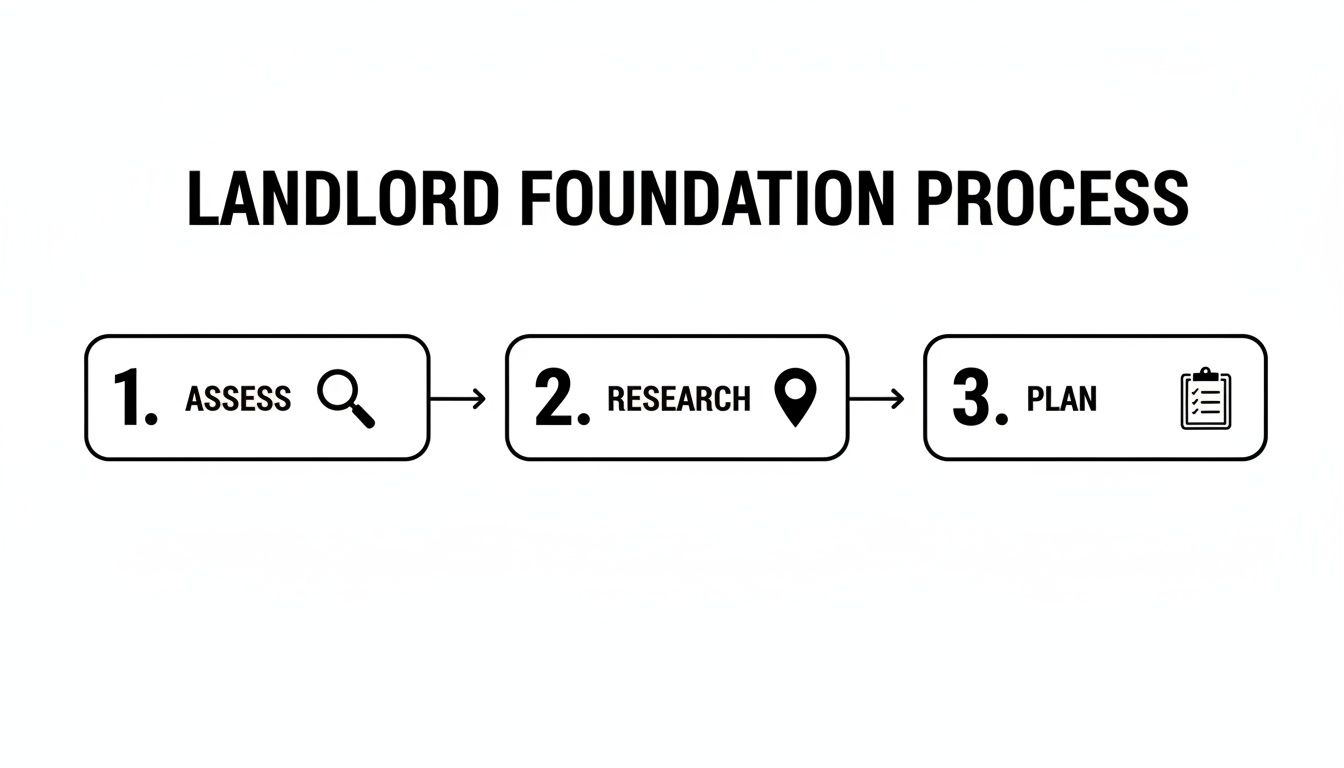
As you can see, a successful journey into landlording begins long before you ever sign on a property. These early steps are what will guide you as you secure your financing and structure the deal for maximum benefit.
Exploring Your Financing Options
For most people jumping into the rental game, the path begins with a traditional investment property mortgage. Be prepared, though—these aren't the same as the loan you got for your own home. Lenders typically require a much larger down payment, usually in the ballpark of 20% to 25%, and the interest rate will likely be a bit higher. They see investment properties as a greater risk, so they want to see that you're financially solid.
To get the best possible terms from a lender, you'll want to have your ducks in a row:
- A strong credit score: Lenders really want to see a score of 720 or higher. This shows them you're reliable and will unlock the most competitive rates.
- Low debt-to-income (DTI) ratio: This proves you can comfortably take on another mortgage payment without being stretched too thin.
- Plenty of cash reserves: This isn't just for the down payment. You'll need extra cash for closing costs and to create a buffer for any initial expenses that pop up.
Of course, some seasoned investors get creative with things like seller financing or bringing in partners. But for anyone just learning how to become a landlord, sticking with a conventional mortgage is almost always the most straightforward and sensible approach.
Budgeting for Every Possibility
One of the easiest traps for new landlords to fall into is underestimating the true cost of owning a rental. The mortgage payment is just the tip of the iceberg. To ensure your properties actually generate positive cash flow, you need a budget that accounts for everything.
Your gross rental income is not your profit. True profitability comes from meticulously tracking and minimizing expenses while maintaining a high-quality property that attracts and retains great long-term tenants.
Make sure your budget has dedicated lines for all the essentials:
- Property Taxes
- Landlord Insurance
- HOA Fees (if you have them)
- Routine Maintenance and Repairs
- Vacancy (A safe bet is to set aside 5-10% of the annual rent)
- Property Management Fees
Don't forget one of the most critical parts of your budget: a capital expenditure (CapEx) fund. This is money you earmark for the big, expensive, and infrequent stuff—like a new roof, an HVAC system, or major appliances. A good rule of thumb is to save 1-3% of the property's value every year just for CapEx. To get a better handle on what your potential income looks like, check out our guide explaining what cash flow is in real estate.
Adapting to Current Market Trends
The real estate market never sits still, and the most successful investors are the ones who adapt. We've seen a fascinating trend emerge recently where landlords are shifting their focus from buying new properties to investing in the ones they already own.
Research shows that between late 2024 and mid-2025, the percentage of landlords planning to buy more properties dropped from 67% to 53%. This change is happening mostly because of higher interest rates and steep home prices.
Instead of taking on new loans, smart investors are pouring that capital into renovations and upgrades on their current rentals. It's a strategy designed to squeeze more cash flow out of existing assets when borrowing money is expensive. For new landlords in places like Beaumont, CA, this trend underscores just how important it is to not only buy right but also to manage and improve your investment intelligently from day one.
Navigating California's Legal Landscape
Understanding your legal duties isn't just a good idea—it's absolutely essential for protecting your investment and your reputation. This is the point where you stop being just an investor and become a professional landlord. Mastering the legal side of things is non-negotiable.
California's rental laws are notoriously complex, and one wrong move can land you in serious legal and financial trouble. Every action you take, from advertising to eviction, needs to be compliant and completely above board.
The journey starts with federal law. The Fair Housing Act is the big one, prohibiting discrimination against tenants based on race, color, national origin, religion, sex, familial status, or disability. This law touches everything—how you word your rental ads, the questions you ask during screening, everything. Even an unintentional misstep can be seen as discriminatory, which is why a standardized, fair process for every single applicant is so critical.

State and Local Regulations
Beyond the federal rules, California piles on its own extensive set of landlord-tenant laws. These state-level regulations govern the really crucial parts of the rental relationship, from security deposit limits to the proper eviction process. For example, California law is very specific about how and when you can enter a tenant's unit, the notice periods required for a rent increase, and the habitability standards your property must meet.
And it doesn't stop there. Many cities add another layer of complexity with their own local ordinances. If you own city properties in our service areas like Beaumont or Yucaipa, you have to be aware of any local rent control measures, specific inspection requirements, or business licenses that might apply. These local rules can and do change, making it vital to stay informed or work with a team that specializes in the region.
Staying current with the ever-changing legal landscape is one of the biggest challenges for independent landlords. Professional property management for your Beaumont, CA, rental ensures continuous compliance, shielding you from costly legal pitfalls.
Crafting an Ironclad Lease Agreement
Your lease agreement is the single most important legal document between you and your tenant. It’s a binding contract that lays out the rights and responsibilities for both of you. A generic template you download online just isn't going to cut it in California's unique legal environment—it won't be enough to protect your investment.
A strong, California-specific lease agreement must clearly detail:
- Lease Term: Specify the exact start and end dates. As a company focused on stability, we only manage long-term leases of six months or more.
- Rent Details: State the monthly rent amount, the due date, what payment methods are acceptable, and any policies on late fees.
- Security Deposit: Clearly outline the amount, what it covers, and the conditions for its full return, making sure you adhere strictly to California's limits and timelines.
- Rules and Policies: Include specific rules on things like pets, smoking, property alterations, and guests.
- Maintenance and Repairs: Define who is responsible for what regarding property upkeep and spell out exactly how repair requests should be submitted.
This document is your first line of defense in any dispute. To make sure your agreement is as comprehensive and compliant as possible, you can deepen your knowledge by exploring the nuances of California landlord-tenant laws.
Essential Insurance Coverage
Finally, protecting your asset means having the right insurance. Your standard homeowner's policy won't cover a rental property, so you'll need a specific landlord insurance policy. This type of coverage typically protects the physical structure of the property from things like fire or storm damage.
Crucially, it also includes liability protection. This is what covers you if a tenant or their guest gets injured on your property and you're found legally responsible. Many experienced landlords also get an umbrella policy for additional liability coverage, which provides an extra layer of financial security. Getting your legal and insurance protections right from the very beginning sets a professional foundation for your entire rental business.
Finding and Keeping Great Long-Term Tenants
You’ve got the property and handled the legal prep work. Now comes the part that will truly make or break your experience as a landlord: finding the right people to call your property home.
Let me be blunt: the quality of your tenants will single-handedly define your profitability and your stress levels. Great tenants are the bedrock of a stable rental business, turning your asset into a source of consistent income instead of a constant headache.
This is where focusing on long-term leases—our specialty for properties in places like Beaumont, CA—really shows its value. A tenant who stays for years means predictable cash flow, fewer turnover costs, and a resident who treats the property like their own. The goal isn’t just to fill a vacancy; it’s to start a multi-year professional relationship with a reliable partner.

Marketing Your Property to Attract the Best
To get high-quality applicants, your marketing has to be sharp and targeted. Start with high-resolution photos that show off your property's best features, ideally shot in bright, natural light. Your listing description should be more than just a list of rooms; make it compelling, highlighting key amenities, the neighborhood's vibe, and clear rules (like pet policies) to help pre-qualify renters from the start.
Post your listing on reputable online platforms where serious renters are looking. While the big sites are a must, don't overlook local community boards and social media groups in areas like Yucaipa and Beaumont—they can be goldmines for excellent local candidates. You want to present your rental as a well-maintained, professionally managed home, which naturally attracts a more responsible type of applicant.
If you’re looking for a deeper dive, our guide on how to find good tenants lays out even more detailed strategies.
The Power of a Bulletproof Screening Process
Once the applications start rolling in, your best defense against future problems is a rigorous, consistent screening process. It's not about being judgmental; it’s about making an informed business decision based on facts. And to comply with the Fair Housing Act, this process must be identical for every single applicant.
Your screening checklist should always include these non-negotiables:
- Credit Report: Look for a pattern of on-time payments. A history of collections or a very low score is a major red flag.
- Background Check: This uncovers relevant criminal history that could pose a risk to your property or the neighborhood.
- Income Verification: The industry standard is solid: a tenant's gross monthly income should be at least three times the monthly rent.
- Rental History and References: Actually call their previous landlords. This is where you get invaluable insight into their reliability, payment habits, and how they treated their last home.
A meticulous screening process is the single most effective tool you have for mitigating risk. I’ve seen countless landlords try to skip a step to fill a vacancy quickly, only to face much bigger financial and legal problems down the road. It’s never worth the shortcut.
Why Long-Term Rentals Win Every Time
At our company, we've built our business around managing properties with long-term leases of six months or more. This isn’t by accident. It’s a deliberate strategy designed to maximize stability and profit for our clients.
Sure, the high nightly rates of short-term rentals can seem tempting, but that model operates more like a high-maintenance hospitality business than a steady investment. It’s a completely different ballgame with a lot more work.
Take a look at how the two models stack up.
Long-Term vs. Short-Term Rentals: A Landlord's Comparison
| Feature | Long-Term Rentals (Our Focus) | Short-Term Rentals |
|---|---|---|
| Income Stability | Predictable, consistent monthly income. | Variable and seasonal; risk of zero income. |
| Management Workload | Low, with minimal tenant interaction. | High, requiring daily management. |
| Turnover Costs | Low. Marketing, cleaning, and prep are infrequent. | Very High. Constant cleaning and marketing costs. |
| Tenant Relationship | Tenants develop a sense of ownership and care. | Transactional, with little attachment to the property. |
| Regulatory Risk | Generally fewer and more stable regulations. | Increasingly strict local laws and HOA rules. |
The takeaway is clear: choosing a long-term rental model offers tangible benefits, especially for new landlords. The stability of a year-long lease gives you a predictable revenue stream, dramatically cuts the costs and hassle of frequent turnover, and encourages tenants to care for the property as if it were their own.
For any investor seeking reliable returns without the daily grind, the long-term approach is simply the smarter, more sustainable path.
Managing Your Property for Long-Term Success
Once your new tenant has the keys, your role officially shifts from investor to hands-on property manager. This is where the real work begins, and your long-term success hinges on how you handle the day-to-day. Consistent, professional management is what separates a profitable, low-stress investment from a constant headache.
The foundation of good management is surprisingly simple: clear and proactive communication. Right from day one, you want to establish a professional yet approachable relationship. Your tenants need to know exactly how to reach you (or your property manager) for routine questions and, more importantly, for urgent maintenance issues. A landlord who responds quickly is a landlord who earns respect and keeps good tenants happy.
Handling Maintenance and Inspections
Maintenance requests aren't a matter of "if," but "when." The speed and quality of your response directly impact tenant satisfaction and the physical condition of your asset. A dripping faucet or a dead appliance can't wait. This is why having a pre-vetted list of reliable local contractors—plumbers, electricians, and handymen—is non-negotiable for anyone serious about this business.
It’s also smart to know who to call for security issues. Understanding the various locksmith services available is crucial for handling lockouts, rekeying between tenants, or upgrading security. Being prepared shows you're a professional who prioritizes their safety.
Beyond just fixing what's broken, routine inspections are your best friend. These checks, done annually and with proper notice to the tenant, let you spot small issues before they blow up into expensive disasters. They’re also a great way to ensure the tenant is holding up their end of the lease, protecting your investment for the long haul.
Streamlining Rent Collection
Consistent cash flow is the lifeblood of any rental property. That's why a smooth, modern rent collection process is so essential. While you can still collect paper checks, the best landlords are moving to online payment portals. These systems are a win-win: they give tenants a convenient, secure way to pay and provide you with a clean, digital record of every transaction.
This professional approach dramatically cuts down on late payments and saves you from having awkward conversations about overdue rent. It turns a monthly chore into an automated, predictable part of your business.
To Self-Manage or Hire a Pro?
At this point, you'll face a major decision: manage the property yourself, or hire a professional? Going the DIY route can seem tempting as a way to save money, but it demands a huge amount of time, expertise, and patience. You’re the one fielding late-night emergency calls, chasing down rent, and navigating tricky legal waters.
This is where experienced property management companies in Beaumont, CA, prove their worth. A professional manager handles all the operational headaches for you, from tenant communication and maintenance calls to rent collection and legal compliance. They serve as a buffer between you and the tenant, giving you back your time and energy.
For many investors, especially those with multiple city properties or those who simply value their time, the choice is obvious. The management fee is a small price to pay for the peace of mind and professional oversight. You can see exactly how we handle these details in our guide to property management for single-family homes.
The decision to hire a professional property manager often marks the transition from being just a landlord to becoming a serious investor. It allows you to focus on growing your portfolio while experts handle the day-to-day operations.
Recent industry data shows just how complex being a landlord has become. An analysis of landlord statistics reveals that 85% of landlords raised rents in 2024 to keep pace with inflation. At the same time, the professional property management market is expected to grow to nearly $99 billion by 2029, showing a clear trend toward outsourcing these increasingly complicated operations. You can dig into more of these landlord marketing statistics to see how the pros are adapting.
Answering Your Top Landlord Questions
Jumping into property investment always kicks up a lot of questions. As you figure out how to be a successful landlord, it's completely normal to want some straight answers on the day-to-day realities of the job. Here are a few of the most common questions we hear from property owners in communities like Redlands, Beaumont, Calimesa, and Mentone.
The good news? The rental market has incredibly strong fundamentals. There's an estimated global shortfall of 6.5 million housing units, a gap that naturally pushes more and more households into renting. Research from Hines.com even shows that over 80% of households in many developed markets are in countries where renting is gaining serious momentum over buying. This built-in demand is what helps keep occupancy rates high and creates a stable runway for long-term rental investments.
How Much Profit Should I Expect From a Rental Property?
A good rule of thumb is to aim for a monthly profit margin of 5% to 10% of your rental income after every single expense is paid. But let’s be clear: this number can swing wildly depending on your property’s location, how you financed it, and your ongoing operational costs.
For instance, a property in Yucaipa will have different tax rates and insurance costs than one in Loma Linda, and that directly hits your bottom line. The secret is to run a detailed cash flow analysis before you even think about making an offer. Don't just look at the mortgage payment. You need to account for everything—property taxes, insurance, HOA fees, and a healthy budget for vacancies and surprise repairs.
When Is the Right Time to Hire a Property Manager?
This is a question every new landlord asks. The decision usually boils down to a simple trade-off: is your time and sanity worth the management fee?
Here are a few signs it’s time to make the call:
- You're Not Local: If your rental is in Highland or Banning but you live hours away, trying to self-manage is a recipe for disaster. A local manager is non-negotiable.
- Your Portfolio is Growing: The work involved in managing rentals doesn't just add up—it multiplies. If you own several city properties, a professional firm is the only way to scale your portfolio without burning out.
- You Want a Passive Investment: Tired of late-night tenant calls and coordinating plumbers? It's time to hire a property manager and get your life back.
The moment a landlord hires a professional is often when they truly become an investor. It frees you up to focus on the big picture—like finding your next deal—while an expert handles the daily grind.
Should I Focus On Short-Term or Long-Term Rentals?
This is a huge strategic decision. Short-term rentals might flash the appeal of high nightly rates, but they also bring the non-stop demands of the hospitality industry, a maze of local regulations, and wildly inconsistent income.
Our company focuses exclusively on long-term leases of six months or longer. We’re convinced this model provides far better advantages for property owners, including:
- Stable, Predictable Income: A signed year-long lease means guaranteed cash flow you can build a budget around. No guesswork.
- Lower Turnover Costs: You'll spend a lot less time and money on marketing, deep cleaning, and prepping the unit between tenants.
- Reduced Wear and Tear: Long-term tenants tend to treat a property like a home, not a hotel room. That means better care and fewer maintenance headaches for you.
For investors in places we serve like Beaumont, CA, the stability and lighter workload of a long-term rental strategy is the most reliable path to building wealth. The best property management companies near me will almost always recommend this approach for its dependability and smarter risk management. It's simply the more dependable way to be a landlord.
At AIM PROPERTY MANAGEMENT COMPANY, our specialty is making property ownership both profitable and stress-free. Serving Beaumont, Yucaipa, and the surrounding communities, we manage everything from tenant screening to 24/7 maintenance, all built around the stability of long-term rentals. Let our team protect your investment and maximize your returns.
Ready to make your landlord journey simpler? Visit us at https://aim-properties.com to see how we can help.