

Most owners who hire a property manager pay 8% to 12% of collected monthly rent, or a flat fee around $100 to $300 per month. If your rental brings in $1,500 a month, that usually means $120 to $180 monthly for ongoing management.
If you're juggling a rental in Redlands, Beaumont, Yucaipa, Banning, or Loma Linda while also managing a career, family, and everything else, the question isn't just how much to hire a property manager. It's whether paying for management protects your time, your rent stream, and your property better than self-managing does.
For most busy owners, it does.
The mistake I see most often is focusing only on the monthly percentage and ignoring the actual cost drivers. Leasing fees, maintenance markups, renewal charges, and the quality of tenant screening matter just as much as the base rate. A cheap manager who places the wrong tenant is expensive. A transparent manager with strong systems is usually the better business decision.
That matters even more in local markets like Redlands property management, Property Management Beaumont, and Yucaipa property management, where rents, property types, and owner expectations vary from one city to the next. Inland Empire pricing isn't identical to a national average, and owners should stop shopping for management like they're buying a commodity.
Your Guide to Property Management Costs in 2026
Your phone buzzes at 8:30 p.m. A tenant in Beaumont has a repair issue, rent from your Redlands property still has not cleared, and the lease on your Yucaipa rental expires next month. If that sounds familiar, your rental is no longer passive income. It is a part-time operations job.
That is the point where owners should stop asking only, "What does a property manager cost?" and start asking, "What does poor management cost me?"

The right way to judge pricing is by return, not sticker shock. In the Inland Empire, owners with demanding careers and high-value rentals usually do better with professional management because time, vacancy loss, bad tenant placement, and sloppy follow-up cost more than the monthly fee. If you want a clear look at what is typically included, review this breakdown of property management service costs.
What owners in the Inland Empire should expect
Start with local reality, not a generic national quote.
A condo in Loma Linda, a single-family rental in Beaumont, and a higher-rent home in Redlands do not create the same workload. Rent level matters. Property condition matters. Tenant quality matters. The manager's systems matter even more.
In my experience, owners in Redlands, Beaumont, and Yucaipa should expect pricing to reflect the property's rent, age, maintenance needs, and turnover risk. A clean, well-positioned property with stable tenants usually costs less to manage than a home with deferred maintenance, frequent lease changes, or heavy owner involvement.
That is why low advertised pricing means very little by itself.
A manager who answers late, screens weakly, and treats maintenance like chaos will cost you more than a firm with tighter processes and clearer communication. Owners who understand that usually make better decisions.
Practical rule: Treat management as an investment in income protection, occupancy, compliance, and asset condition.
Why the fee can pay for itself
Good management improves the numbers that drive your return. It shortens vacancy, supports stronger tenant retention, keeps maintenance from turning into larger repair bills, and reduces the odds of placing the wrong resident in the first place.
That is the actual math.
If your manager keeps a Redlands rental occupied with qualified tenants, catches lease issues before they become disputes, and coordinates repairs without delay, the fee is doing its job. If your manager creates confusion, piles on surprise charges, or lets small problems sit, the fee is wasted.
Local execution matters here. Beaumont, Yucaipa, and Redlands are not interchangeable rental markets, and owners should stop hiring management as if every company delivers the same result. In the Inland Empire, market knowledge, response time, vendor coordination, and screening discipline have a direct effect on your bottom line.
Understanding the Main Fee Structures Percentage vs Flat Fee
You get two proposals for a Redlands rental. One says 8 percent. The other says $149 per month. On paper, the flat fee looks cheaper. In practice, that answer is useless until you know what work is included, how the company handles vacancy, and whether leasing support is built in or billed separately.
That is the actual comparison.
Percentage pricing is usually the better fit for Inland Empire rentals
Percentage pricing is the standard model for single-family homes, condos, and townhomes across Redlands, Beaumont, and Yucaipa. The manager charges a share of collected rent, so the fee rises or falls with the income the property produces.
For owners who want full oversight, this structure usually makes more sense than a flat monthly number. A property that rents for more, turns faster, or needs more day-to-day coordination creates more work. Percentage pricing reflects that reality instead of pretending every rental takes the same effort to manage.
It also keeps the conversation tied to return. If your Beaumont home rents at a stronger rate because the manager knows the local market, tighter pricing and better execution can more than cover a slightly higher management fee.
When percentage pricing makes sense
Choose percentage pricing if your rental needs active management, not basic rent collection.
It is usually the right call when:
- You own one or a few residential rentals: This is the common setup for owners in Redlands, Yucaipa, and Beaumont.
- You expect full-service management: Leasing, tenant communication, maintenance coordination, notices, inspections, and collections all require ongoing attention.
- You want the manager focused on rent performance: Better pricing, stronger collections, and lower vacancy directly protect your income.
- Your property is not fully predictable: Older homes, tenant turnover, and deferred maintenance all create work that a flat fee often underprices.
For high-income owners, this matters. You are not hiring a manager to save twenty dollars a month. You are hiring one to protect rent, reduce avoidable downtime, and keep the property from becoming another part-time job.
Flat fees can work, but only in a narrow set of situations
Flat-fee pricing is simple. You pay the same amount each month regardless of rent.
That simplicity appeals to owners with a very stable property, a long-term tenant, and low service needs. If the home is in good shape, the tenant rarely calls, and the agreement clearly spells out what is covered, a flat fee can be reasonable.
The problem is that flat-fee contracts often look cleaner than they really are. If inspections, lease renewals, maintenance coordination, vacancy oversight, or after-hours issues sit outside the base fee, the low monthly number stops mattering fast. Review the full property management fee structure for Inland Empire rentals before you compare offers.
A cheap flat fee is usually cheap for a reason.
What I tell Inland Empire owners
If you own a rental in Redlands, Beaumont, or Yucaipa and want real management, choose the pricing model that matches the level of work the property requires. In most cases, that is percentage pricing.
Flat fees make sense for low-touch rentals with clear boundaries and very few surprises. Percentage pricing fits owners who care about performance, response time, and asset protection.
Judge the fee structure by ROI. The better model is the one that keeps rent coming in, keeps vacancy down, and keeps your property from slipping through the cracks.
A Complete Breakdown of Additional Management Fees
The monthly management fee is only part of the cost. Owners get frustrated when they focus on the base rate and ignore everything that can sit around it.
That frustration is avoidable. You just need to ask for the full fee schedule before you sign.
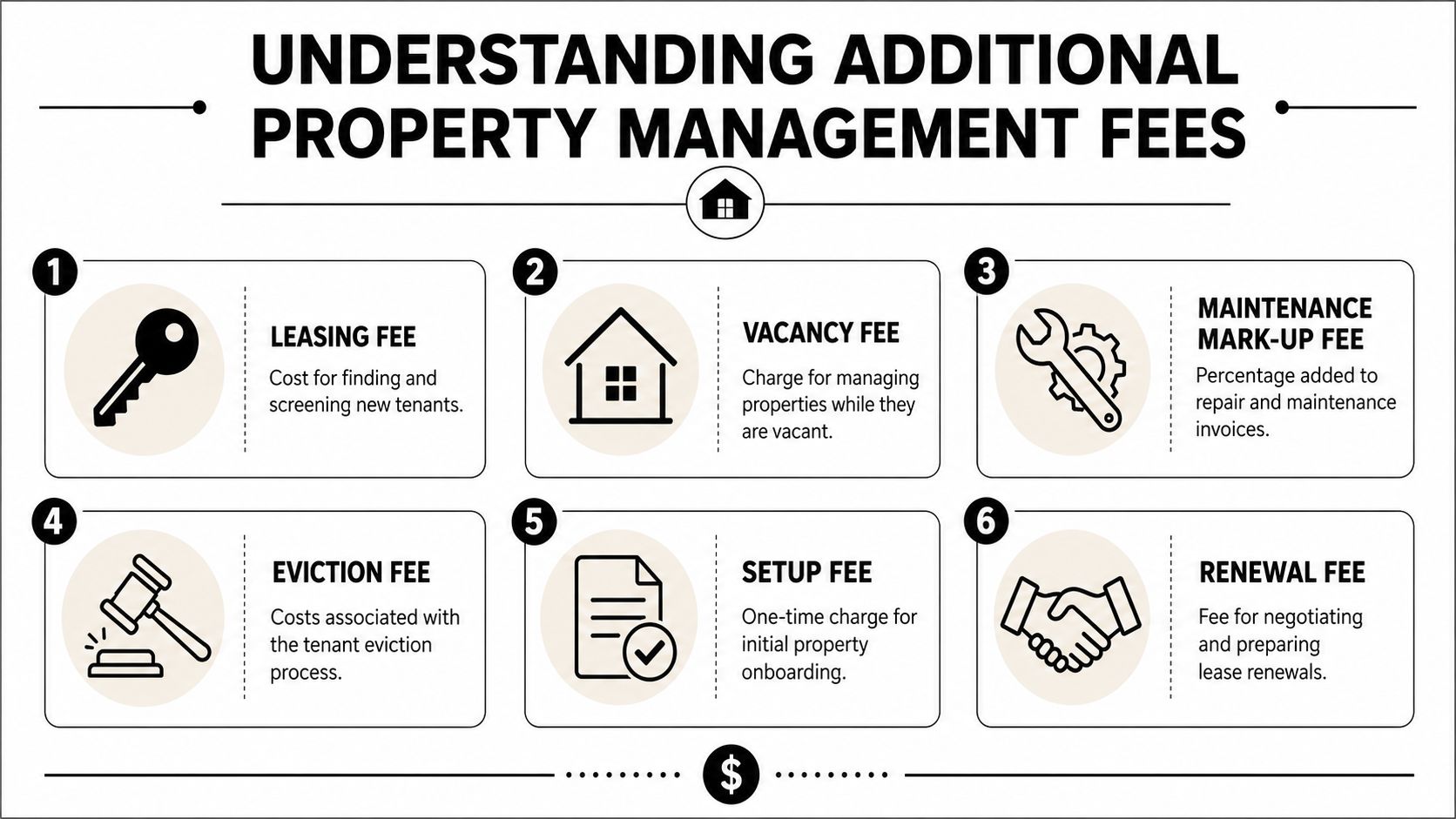
The fees that usually catch owners off guard
Beyond the monthly charge, property management often includes leasing fees of 50% to 100% of one month's rent, setup fees of $100 to $500, lease renewals around $200, and maintenance markups of 10% to 25%, according to LeaseRunner's property management fee guide.
Those numbers aren't unusual. They're common enough that every owner should expect to discuss them upfront.
Here's the plain-English version of what these fees usually mean:
- Leasing fee: This pays for advertising the property, responding to inquiries, showing the home, screening applicants, and preparing lease paperwork.
- Setup fee: This covers onboarding the property into the manager's system and handling the initial administrative work.
- Renewal fee: This applies when the tenant stays and the manager prepares and processes the lease renewal.
- Maintenance markup: Some firms add a percentage to repair invoices for coordinating vendor work.
- Vacancy oversight: Some managers charge while the property is vacant, especially if they're still inspecting and monitoring it.
- Eviction-related charges: If a tenancy turns into a legal problem, some firms charge separately for their role in the process.
Typical Property Management Fee Structure
| Fee Type | Industry Standard Cost | What It Covers |
|---|---|---|
| Monthly management fee | 8% to 12% of collected rent, or flat fee around $100 to $300 monthly | Ongoing management, rent collection, maintenance coordination, reporting |
| Leasing fee | 50% to 100% of one month's rent | Marketing, showings, screening, tenant placement |
| Setup fee | $100 to $500 | Onboarding, account setup, property intake |
| Lease renewal fee | Around $200 | Renewal paperwork and lease administration |
| Maintenance markup | 10% to 25% | Coordination and management of repairs |
| Vacancy-related fee | Varies by company | Inspections, oversight, and vacancy administration |
| Eviction-related fee | Varies by company | Administrative handling tied to eviction support |
What I'd tell any owner reviewing a contract
Don't ask only, "What's your monthly fee?" Ask, "What does your monthly fee exclude?"
That's the better question.
If you want a broader sense of what should be included in day-to-day management, review these property management company responsibilities. The answer should cover screening, collections, maintenance coordination, documentation, communication, and routine oversight.
Watch for this: A low advertised rate paired with multiple add-on charges can cost more than a straightforward, higher base fee.
For Beaumont property management and property management Redlands owners, transparency matters more than a slick quote. The right manager spells out every fee category before the first tenant call, maintenance issue, or renewal notice ever hits your inbox.
Key Factors That Influence Your Final Cost
Two owners can both ask how much to hire a property manager and get different answers for good reason. The final price moves with the property, the location, and the service package.
That doesn't mean pricing should be mysterious. It means you need to know what drives it.

Location changes the economics
Hyper-local pricing matters in the Inland Empire. In communities like Beaumont, Yucaipa, and Redlands, single-family homes often see management rates in the 7% to 10% range because rents commonly fall around $1,800 to $2,500 per month, and some firms offer flat-fee options starting around $125 monthly for stable rentals, based on Thumbtack's property management fee overview.
That's why Property Management Beaumont doesn't always price the same as property management Yucaipa, even when both are handling residential homes. Local rent levels and service expectations shape the quote.
Property type and condition matter
A clean, updated condo with a stable tenant is one thing. An older single-family home with deferred maintenance is another.
Managers price for work. More repair coordination, more tenant communication, and more oversight usually mean a higher effective cost. Multi-unit properties can also change the conversation because one agreement may involve more doors but more operational efficiency.
When owners compare proposals, they should ask themselves:
- What kind of rental is this really? A townhouse, condo, and detached home don't create the same management load.
- How much maintenance friction is built in? Older systems and frequent repair calls affect the manager's workload.
- Will this be stable or turnover-prone? The more often a property needs marketing and leasing support, the more the fee structure matters.
Service scope changes the quote more than owners expect
Some companies price lean and bill separately for everything else. Others build more tasks into the agreement.
That includes things like inspections, after-hours response, leasing administration, and owner reporting. If one quote looks lower, check whether it excludes services you'll absolutely need.
If you're also evaluating systems for tracking communications, maintenance workflows, and owner reporting, this guide to choosing the right property software is worth reviewing. Good software doesn't replace a good manager, but bad software can make even a decent manager feel disorganized.
Local pricing only helps if the service package is clear. The quote has to match the actual work.
Why local market knowledge still wins
For Redlands property management, Beaumont property management, and Yucaipa property management, local familiarity isn't fluff. It affects pricing, maintenance response, vendor coordination, and how quickly problems get handled.
A manager who knows the service area can usually price more realistically and operate more smoothly than a company trying to manage Inland Empire rentals from a distance.
Calculating the ROI of Professional Property Management
The monthly fee matters. The return matters more.
Owners who self-manage often assume they are saving money because they aren't paying a manager. Sometimes they are. Often they aren't. They're just moving the cost into lost time, weak screening, delayed maintenance, legal exposure, and vacancy.

Where the return actually comes from
The strongest financial argument for professional management isn't convenience. It's damage control and income protection.
Thorough tenant screening can reduce turnover by 20% to 30%. A 50% leasing fee on a $2,000 rental can make sense if it helps prevent a 45-day vacancy costing more than $3,000 in lost rent, and managed properties can achieve over 95% on-time rent collection through automated systems, according to Good Life Management's cost analysis.
That gets to the core issue. One bad tenant, one extended vacancy, or one sloppy process can erase what you thought you saved by self-managing.
A practical way to judge management ROI
Don't ask whether management has a cost. It does.
Ask these three questions instead:
- Will better screening reduce expensive turnover risk?
- Will faster, more consistent rent collection improve cash flow discipline?
- Will documented maintenance and compliance reduce legal and property risk?
If the answer is yes, the fee is doing real work.
For owners who want a clearer picture of what operational oversight should include, this overview of vital property management services is useful. A manager should be doing more than collecting rent. They should be reducing friction across the whole rental process.
The hidden cost of self-management
Self-management usually breaks down in predictable places:
- Tenant screening gets rushed: Owners want the vacancy filled and loosen standards.
- Repair coordination gets delayed: Vendors don't get called quickly or the issue gets patched instead of solved.
- Documentation gets sloppy: Notices, records, and communication aren't handled with enough consistency.
- Boundaries disappear: Tenants start treating the owner like an on-call help desk.
Those problems don't always show up in month one. They show up later, usually when the lease goes sideways or the property needs costly attention.
This short video is a useful companion if you're comparing management cost against owner workload.
My view for high-income owners
If your time is limited and the property is a serious asset, management is usually a business expense worth paying. Owners in property management Redlands, Property Management Beaumont, and property management Yucaipa markets don't need to do every task themselves to prove they're maximizing profit.
You're not buying a fee. You're buying fewer preventable mistakes.
One local option is AIM Property Management Company, which handles residential properties such as individually owned condos, townhomes, single-family homes, and investment properties across the Inland Empire, including tenant screening, rent collection, maintenance coordination, inspections, and compliance support.
How to Hire the Right Manager for Your Inland Empire Property
Most owners don't make a bad management hire because the company charged too much. They make a bad hire because they didn't ask sharp enough questions.
Price matters. Process matters more.
Ask for the operating details, not the sales pitch
When you're interviewing a manager, push past the polished intro. Ask how they run the property.
Use this guide on how to hire a property manager as a starting point, then press for specifics in the meeting.
Ask questions like:
- How do you screen tenants? You want a clear process, not a vague promise.
- How do you handle maintenance after hours? Emergency response can't be improvised.
- How do you collect rent and report to owners? The system should be consistent and documented.
- How often do you inspect the property? Regular oversight helps catch issues before they become expensive.
- How do you handle lease renewals and notices? Administrative discipline matters.
What a strong manager should make easy
The right manager should create order. If their answers sound fuzzy during the sales conversation, operations probably look worse after signing.
A dependable company should provide:
- Clear financial reporting: Owners should know what came in, what went out, and why.
- Documented maintenance handling: Repair requests, approvals, and invoices should be tracked.
- Reliable tenant communication: Tenants need a defined channel for routine and urgent issues.
- Consistent lease administration: Renewals, notices, and compliance tasks shouldn't be handled casually.
Local fit matters more than broad coverage
For owners in Mentone, Calimesa, Highland, Loma Linda, Banning, Beaumont, Redlands, and Yucaipa, local understanding isn't optional. The manager needs to know the neighborhoods, rental expectations, vendor network, and owner concerns in that region.
That's especially true if you're searching for property management near me or trying to hire a property manager quickly after a tenant issue. A local operator is usually easier to hold accountable and better positioned to handle the property in real time.
Good managers don't just answer questions. They answer them clearly, with process behind the answer.
My hiring checklist
Before you sign, make sure the company can show you these basics:
- A written fee schedule
- A clear screening process
- A maintenance workflow
- An owner reporting process
- A lease and compliance procedure
- A practical answer for vacancies and renewals
If any of those are vague, keep looking. That's true whether you're evaluating Beaumont property management, Yucaipa property management, or Redlands property management providers.
Is a Property Manager Worth the Cost? The Final Verdict
For most busy owners, yes.
If your rental is in Beaumont, Yucaipa, Redlands, Highland, Banning, Calimesa, Loma Linda, or Mentone, the fee for management should be treated like any other smart operating expense. You're paying for structure, responsiveness, documentation, and reduced exposure. That's not a luxury. That's asset protection.
The wrong way to evaluate management is to compare one monthly fee against zero. Zero isn't the true alternative. The true alternative is self-management with all the work, risk, interruptions, and avoidable mistakes attached to it.
The owners who benefit most
Professional management usually makes the most sense for:
- High-income owners with limited time
- Investors who want cleaner operations
- Homeowners renting out a former residence
- Owners who live outside the immediate area
- Anyone who wants less day-to-day tenant friction
Smart ownership also means knowing when to bring in licensed specialists. For example, if a vacancy or tenant complaint reveals a pest issue, comparing DIY against hiring licensed Crown Point exterminators is the same kind of decision. You pay for speed, expertise, and lower risk of the problem getting worse.
If you're still deciding how much to hire a property manager, stop looking for the lowest number and start looking for the strongest operation. In this business, cheap often gets expensive later.
Frequently Asked Questions
How much to hire a property manager for a single-family home?
Most owners pay a monthly percentage of collected rent or a flat monthly fee. In many residential cases, percentage pricing is the common format, while some stable rentals may fit a flat-fee arrangement better. The exact quote depends on location, service scope, and how hands-on the property is likely to be.
Is property management near me better than hiring a company from outside the area?
Usually, yes. Local managers tend to handle maintenance coordination, inspections, vendor relationships, and tenant issues more smoothly because they're operating in the same market. For Inland Empire rentals, that local edge matters in Beaumont, Yucaipa, Redlands, Banning, Highland, Calimesa, Loma Linda, and Mentone.
What should be included when I hire a property manager?
At minimum, you want tenant screening, rent collection, maintenance coordination, owner reporting, lease administration, and compliance support. If those functions are scattered across extra fees or handled vaguely, the contract isn't strong enough.
Do property managers charge while the property is vacant?
Some do. Vacancy-related charges vary by company and contract structure. Always ask whether the manager charges for inspections, property checks, advertising oversight, or other vacancy tasks while no rent is coming in.
Is a flat fee better than a percentage fee?
Sometimes. A flat fee can work well for stable properties with predictable needs. A percentage fee usually makes more sense when the property needs active oversight and you want the manager's compensation tied to rent performance.
Why do leasing fees matter so much?
Because the tenant placed at the beginning affects everything that follows. Good screening, solid documentation, and a careful placement process often save far more than the upfront leasing charge. Owners who ignore that usually learn the lesson the hard way.
How do I compare Beaumont property management companies fairly?
Compare full contracts, not headline rates. Review monthly fees, leasing charges, renewal fees, maintenance markups, inspection practices, reporting systems, and response times. That's the only way to compare Property Management Beaumont providers.
Is Yucaipa property management priced differently than Redlands property management?
It can be. Local rent levels, property type, and service expectations can shift the quote. That's why Yucaipa property management, property management Yucaipa, Redlands property management, and property management Redlands shouldn't be treated as interchangeable categories.
What kind of owner should hire a property manager?
Owners with demanding careers, multiple obligations, out-of-area rentals, or little interest in hands-on tenant management are usually strong candidates. If the property is supposed to be an investment rather than a daily interruption, management is often the better choice.
What's the biggest mistake owners make when hiring a property manager?
They focus on the monthly fee and ignore how the company operates. The better move is to evaluate screening quality, communication systems, maintenance handling, reporting, and contract transparency before you sign.
If you own a rental in Beaumont, Yucaipa, Redlands, Banning, Highland, Calimesa, Loma Linda, or Mentone and want a clear, local assessment of your options, contact AIM PROPERTY MANAGEMENT COMPANY. A good management quote should show you exactly what you're paying for, how the property will be handled, and whether the service fits your goals as an owner.