
If you're a landlord, understanding average rent prices by ZIP code is the secret weapon for maximizing your rental income and keeping vacancies to a minimum. It’s not about city-wide guesswork; it’s about getting a precise, street-level snapshot of your property's true market value.
Why ZIP Code Rent Data Is Your Most Powerful Tool

Think of city-wide rent data as a blurry, old map. It gives you a general idea of the terrain but completely misses the details you need to navigate successfully. ZIP code-level data, on the other hand, is like a high-resolution satellite image. It shows you exactly what's happening on your block, in your neighborhood.
This granular view is absolutely essential for landlords in communities like Redlands, Beaumont, Calimesa, Yucaipa, Loma Linda, Mentone, Highland, and Banning, where rental values can change dramatically just a few streets over.
This level of detail lets you swap guesswork for a smart, data-driven strategy. It ensures your pricing is competitive enough to attract great tenants quickly but high enough to be profitable and perfectly aligned with what the market will bear right now.
The Problem with Generic Rent Averages
Leaning on city or county-wide averages is one of the most common—and costly—mistakes we see landlords make. A city like Highland might have a single "average rent," but that number lumps together brand-new luxury homes with small, older apartments. The result is a misleading figure that doesn't reflect your specific property's worth at all.
For example, a three-bedroom house near a top-rated school in Yucaipa will always command a different price than a similar-sized home in a different school district just a few miles away. ZIP code data is what captures these subtle but critical differences.
By focusing on the hyper-local market, you gain a true understanding of what tenants are willing to pay for properties just like yours, in your immediate area. This insight is the foundation of a successful rental investment.
To make it crystal clear, let's break down why this matters so much.
ZIP Code Data vs City-Wide Averages A Comparison
This table shows just how different these two approaches are and why one is a clear winner for serious investors.
| Data Type | Level of Detail | Pricing Accuracy | Market Competitiveness |
|---|---|---|---|
| City-Wide Average | Very low. Groups diverse neighborhoods and property types into one number. | Poor. Often leads to underpricing or overpricing your unit. | Low. You're either leaving money on the table or scaring away tenants. |
| ZIP Code Data | High. Reflects specific neighborhood dynamics, school districts, and amenities. | Excellent. Helps you set a price that's both profitable and attractive. | High. Allows you to price your property to beat the local competition. |
As you can see, relying on broad averages is like flying blind. Precise ZIP code data gives you the vision you need to make the right call every time.
The California Context A High-Stakes Market
In the incredibly competitive California rental market, analyzing average rent prices by ZIP code is non-negotiable. It reveals striking differences that directly impact property owners in areas like Banning, Loma Linda, Beaumont, and Calimesa.
In fact, California's median rent is miles above the national average, which is exactly why hyper-local data is so critical. This premium market is why savvy investors turn to experts in Property Management Beaumont to navigate the complexities.
While places like Yucaipa and Redlands see incredibly strong demand, they have a more accessible market driven by growth in the Inland Empire, with occupancy rates hitting 95% in some key ZIP codes. For property owners, these numbers prove that hiring a property manager isn't just a convenience—it's essential for maximizing your ROI in a state where a single ZIP code can mean a 30-50% difference in rent.
You can dig deeper into how different cities stack up in this in-depth rental market analysis.
Finding Reliable Rent Data for Your Property
Trying to pin down accurate rent data for your specific ZIP code can feel like searching for a needle in a haystack, but there are credible sources you can turn to. This is where we move from understanding the why to mastering the how. A smart pricing strategy is built on solid data, and for property owners in Loma Linda, Mentone, and Banning, knowing where to look is half the battle.
Think of these data sources as different tools in your toolbox. One might be great for a broad overview, while another is perfect for getting the fine details just right. Using them together is how you build a rental pricing strategy that’s both solid and profitable.
Starting with National Data Platforms
Your first stop should be the big national platforms that specialize in crunching rental data. These sites use massive datasets, pulling from millions of listings and public records to give you a baseline of average rent prices by ZIP code.
These platforms are excellent starting points for a high-level overview. They’ll give you a quick snapshot of market trends and general price ranges in your area.
- Zillow Rental Manager: Its "Zestimate" for rental prices is a household name for a reason, drawing from a huge database of current and past listings. It’s a useful benchmark to see what similar properties are being listed for.
- Rentometer: This tool offers a simple, direct comparison. You just plug in your property's details, and it shows you how your potential rent stacks up against others right in your neighborhood, often on a handy map.
- HUD Fair Market Rent (FMR) Database: This government source is essential for understanding an area's affordability baseline, especially if you’re considering participating in housing assistance programs. While it won't reflect market rates for high-end rentals, it provides a crucial foundational data point.
These resources give you the initial numbers, but they don't always capture the unique vibe of your specific street or subdivision. That’s where the next step comes in.
The Power of Local Cross-Referencing
A national average is a great guide, but the real story is always found on the ground. To avoid making a costly pricing mistake, you absolutely have to cross-reference the data from big platforms with what’s happening in your local market right now. This is the art of verification.
This means manually digging into active rental listings in your exact ZIP code on the websites where local tenants are actually looking for their next home. This hands-on research shows you your real-time competition.
The most accurate rent price is found at the intersection of aggregated data and active, local listings. One tells you the historical average; the other tells you the current reality.
By comparing these two sets of information, you can confidently figure out where your property fits in. For example, if a national site suggests a rent of $2,400 for your Yucaipa property, but you see several similar, active listings priced at $2,550 and they're getting snapped up quickly, you know you have room to adjust upward.
Verifying with Active Listings
To get this kind of hyper-local intelligence, you need to go where the tenants are. Spend some time really analyzing what your direct competitors are doing.
- Search Actively: Head over to sites like Zumper, Apartments.com, or even local classifieds. Search for properties that match yours in bedroom/bathroom count, square footage, and ZIP code.
- Analyze the Details: Don't just stop at the price. Look closely at the quality of their photos, the amenities they list, and the property's condition. How does your rental in Beaumont truly compare to another one just two blocks away?
- Track Time on Market: Pay attention to how long a property has been listed. If comparable units are renting in under two weeks, the market is hot. If they’re sitting for over a month, they’re likely overpriced.
This practical, hands-on validation gives you the confidence to set a price that isn't just based on an algorithm but is confirmed by real-world market activity. For a preview of how professionally managed properties are presented, take a look at our current property listings. It's a great way to get a feel for the competitive landscape in communities from Redlands to Highland.
Translating Data Into the Perfect Rent Price
With solid data in hand, it’s time to move from research to reality. This is where you translate the average rent for a ZIP code into the optimal rent for your specific property. An average is just a starting point; what really matters are the unique features that make your rental stand out.
Think of the ZIP code average as the base price for a car. Upgrades like a premium sound system or a more powerful engine add to the final sticker price. Your rental property works the same way—its distinct attributes are what justify adjusting the rent up or down from that local baseline.
What Makes Your Property Different
Even in the same neighborhood, no two properties are exactly alike. Honing in on these differences is how you set a rent that’s both competitive and profitable. As any expert in Redlands property management or Beaumont property management will tell you, small details can make a huge difference in your monthly income.
So, what are the key factors that let you command a premium price or signal that you need to be a bit more competitive?
- Property Condition: It's simple—a recently renovated home with modern finishes will always fetch more than a dated property with worn-out carpets and old appliances.
- Unique Amenities: Features like a fenced-in yard, a two-car garage, central air, or an updated kitchen are huge draws for tenants and absolutely justify a higher rent.
- Square Footage and Layout: While bigger properties naturally rent for more, don't underestimate the power of an efficient, open-concept floor plan. It can be just as valuable as raw square footage.
- Location-Specific Perks: Is your property close to top-rated schools, parks, or major commuter routes? That convenience is something tenants are definitely willing to pay for.
Conducting Your Comparative Market Analysis
To really zero in on the perfect price, you need to conduct a comparative market analysis (CMA). This isn't just a quick glance at Zillow; it’s a detailed, feature-by-feature comparison of your property against similar rentals that have recently been leased in your immediate area.
A CMA is your reality check. It moves you beyond theoretical averages and shows you what actual, qualified tenants in your area have recently agreed to pay for a property just like yours.
This analysis is the most reliable way to position your property to attract high-quality tenants quickly while maximizing your return. It’s a method professionals in Yucaipa property management rely on every single day to make sure their clients' assets are performing at their peak.
Adjusting Your Rent From The Average
Now let's get practical. How do specific features actually impact the final rent price? The table below gives you a clear idea of how common property attributes can shift your price away from the ZIP code average.
Factors Adjusting Rent From The ZIP Code Average
| Property Feature | Potential Impact on Rent | Example |
|---|---|---|
| Upgraded Kitchen | + $75 to $200 / month | A kitchen with new granite countertops and stainless steel appliances vs. one with laminate counters and older appliances. |
| Fenced Backyard | + $50 to $150 / month | Highly desirable for tenants with pets or children, adding a significant premium in family-friendly areas like Yucaipa. |
| Attached Garage | + $50 to $125 / month | Provides secure parking and extra storage, a valuable amenity especially in areas with limited street parking. |
| Dated Interior | – $100 to $250 / month | A property that hasn't been updated in over a decade will need to be priced below market average to attract tenants. |
By walking through these factors methodically, you can build a strong, data-backed case for your asking price. This isn't guesswork; it's a strategic business decision designed to optimize what you earn.
And if you're looking to dive deeper into the financial metrics, you can learn more about how to calculate rental yield in our detailed guide.
A Hyper-Local Look at Beaumont and Yucaipa Rents
Understanding average rent prices by ZIP code is great in theory, but it really clicks when you see it play out in the real world. Let’s zoom in on two communities we know inside and out—Beaumont (92223) and Yucaipa (92399). They’re neighbors here in the Inland Empire, but their rental markets tell two very different stories.
By comparing these two side-by-side, you can see how things like community vibe, new construction, and local amenities create unique rental values. This is the kind of on-the-ground knowledge that gives property owners a real competitive advantage.
Beaumont 92223: A Market Driven by Growth
Beaumont’s rental scene is all about growth. The city has exploded in recent years, attracting families and commuters with a steady supply of modern, single-family homes loaded with the amenities tenants are looking for.
This wave of new construction has a huge impact on pricing. A pristine, well-maintained home with updated finishes will always outperform an older, dated property. It's that simple.
In a fast-growing city like Beaumont, tenants have choices. Your property isn't just competing with the house down the street; it's competing with brand-new builds. This is where professional staging and sharp marketing really pay off.
The sweet spot in Beaumont is three- and four-bedroom single-family homes. Families love the area for its schools and community feel. Plus, its prime location right off the I-10 makes it a magnet for commuters, which keeps demand strong and rental values high. For landlords here, tapping into these drivers is key.
Yucaipa 92399: Established Charm and Diverse Housing
Yucaipa (92399) also has a strong family-friendly appeal, but its rental landscape is completely different. This is a more established community with a much wider mix of homes, from quaint older houses in the heart of town to newer developments on the edges. That variety creates more distinct pricing pockets all within the same ZIP code.
Here, a property’s value is often tied to its specific neighborhood. Being close to the shops and restaurants in Uptown Yucaipa or falling within a top-rated school's boundary can easily justify a higher rent.
Unlike Beaumont, where "new" is the main draw, Yucaipa’s market has a soft spot for well-kept older homes that ooze character. If you own one of these properties, playing up unique features—like original hardwood floors or a big, shady backyard—is how you attract the perfect tenant at the right price.
The chart below breaks down the major factors that shape rent prices, once you've accounted for the ZIP code.
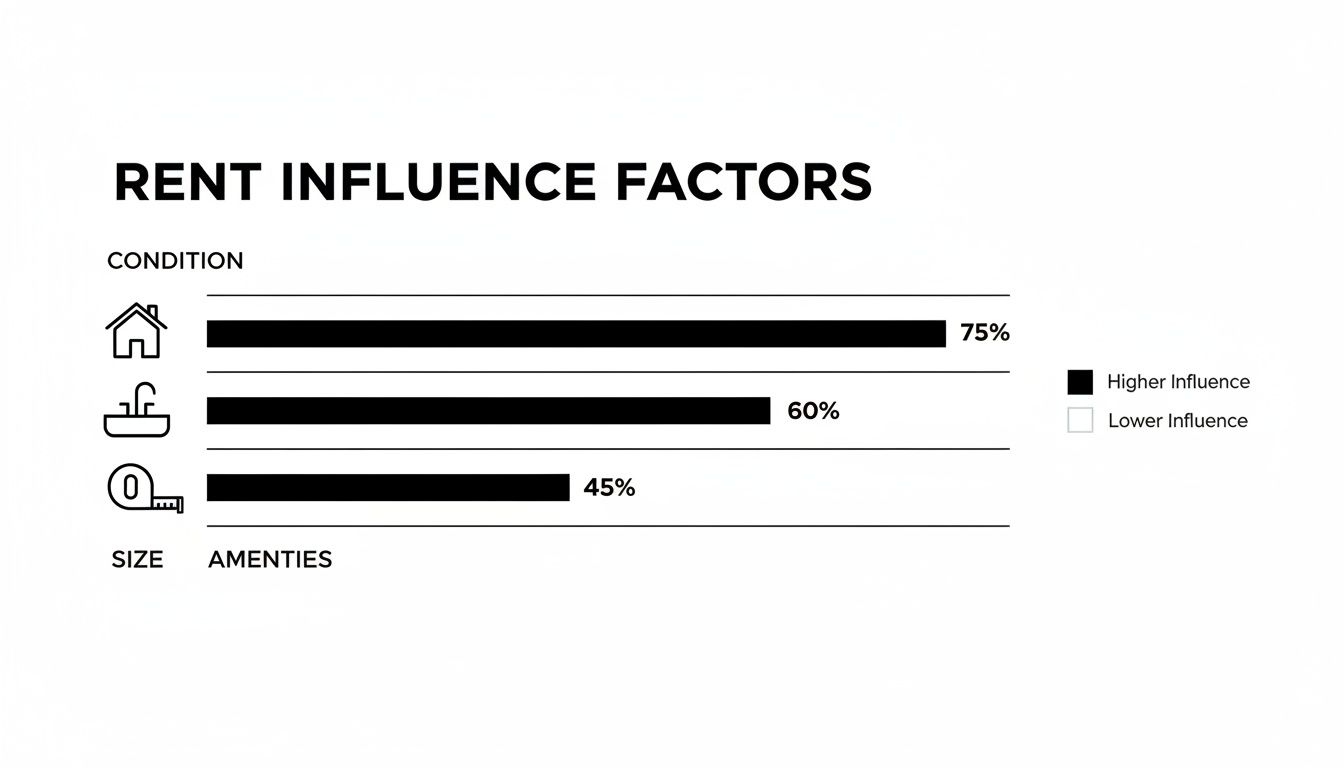
As you can see, location sets the baseline, but the condition, amenities, and size of your actual property are what really dial in its true market value.
Comparing the Two Markets
While both cities are fantastic places to live, their rental markets have some clear differences:
- Dominant Property Type: Beaumont is all about newer single-family homes. Yucaipa, on the other hand, offers a rich mix of older homes, condos, and some new construction.
- Key Value Drivers: In Beaumont, new developments and easy freeway access are game-changers. In Yucaipa, it’s more about the charm of established neighborhoods, school reputations, and that unique local feel.
This is exactly the kind of hyper-local analysis a dedicated property manager uses to get the most out of your investment. To see how we put this expertise to work, take a look at our approach to property management in Beaumont.
Using Professional Management for a Data-Driven Edge
Staying on top of rental data isn't a one-and-done task—it's a constant, demanding job. The moment you set a rent price, the market has already started to shift. This is exactly where a professional property manager becomes your most valuable player.
Hiring a manager is about more than just finding someone to collect rent and field maintenance calls. It’s about partnering with a market strategist who is 100% focused on optimizing your asset’s financial performance through hard data. For owners in places like Redlands or Calimesa, that partnership is a serious competitive advantage.
Going Beyond Public Data
While public websites offer a decent starting point, a dedicated management company operates on a completely different level. We don’t just glance at Zillow; we use sophisticated tools and deep market intelligence to build a much richer, more accurate picture of the local rental landscape.
We go far beyond the basics, tapping into proprietary data sources, professional networks, and historical performance metrics that simply aren’t available to the public. This lets us run exhaustive market analyses that are both broader in scope and more granular in detail.
A professional manager turns raw data into actionable intelligence. We see the subtle trends that signal when to adjust rent, how to position a property against new competition, and which amenities are commanding premium prices in a specific ZIP code.
This isn’t just a one-time analysis before you list the property. It's a continuous cycle of monitoring, analysis, and adjustment.
The Strategic Process of Rent Optimization
Our approach to pricing is a dynamic, multi-step process designed to maximize your returns while keeping vacancies to a minimum. It's a system built on precision and proactive management.
- Initial Rent Valuation: We kick things off with an in-depth analysis of your property and the specific average rent prices by ZIP code. This sets a strong, data-backed baseline for your initial asking price.
- Ongoing Market Monitoring: Once a tenant is in place, our work is far from over. We are constantly tracking comparable listings, vacancy rates, and neighborhood trends in communities from Highland to Banning.
- Lease Renewal Strategy: About 90 days before a lease is up for renewal, we conduct a fresh market analysis. This timing is strategic—it allows us to determine if a rent adjustment is warranted, ensuring your property's rent keeps pace with the current market.
- Performance Reporting: You get clear, easy-to-understand financial reports showing exactly how your investment is performing, all backed by the data that drives our decisions.
As a landlord, you always face the choice: handle these tasks yourself or bring in an expert. To help weigh the options, you can explore the key considerations for whether to DIY or hire a professional. This resource can help you decide which path aligns best with your financial goals and time.
Ultimately, using a professional service ensures you’re not just reacting to the market—you’re staying ahead of it. To find out how our data-driven approach can benefit your specific property, learn more about the advantages of hiring a professional property management manager.
Common Questions About Setting Rent Prices
Even with the right data, landing on that perfect rent price can feel a bit like throwing darts in the dark. As a property owner, you want confidence, not guesswork. So, let's tackle some of the most common questions we hear from landlords about using average rent prices by ZIP code and when it makes sense to bring in a property manager.
How Often Should I Re-evaluate My Rent Price?
Rental markets are living, breathing things—they're always in motion. A smart rule of thumb is to review the rent prices in your specific ZIP code at least once a year.
The most crucial time for a deep dive is 60-90 days before a lease is set to expire. This gives you the perfect window to see what the market is doing, decide if a fair rent increase is justified, and give your tenant the proper legal notice they're entitled to.
Of course, if a vacancy pops up, you need to be much more nimble. That's when you should be checking out comparable listings on a weekly basis. A professional partner with on-the-ground experience in places like Redlands, Beaumont, Calimesa, Yucaipa, Loma Linda, Mentone, Highland, and Banning is constantly tracking these shifts to make sure your property is priced competitively, which is key to cutting down that costly downtime between tenants.
How Do I Price My Property If It Has Premium Upgrades?
This is a great question. Those superior features—like a freshly remodeled kitchen, a sparkling private pool, or a killer location—absolutely justify a higher rent. A good starting point is to price your property 5-15% above the ZIP code's median rent if it has significant, desirable upgrades that truly make it stand out from the competition.
To really zero in on the right number, you'll need to do a direct comparison with other premium listings in your neighborhood.
- Look closely at their specific amenities and square footage.
- Check how long they've been sitting on the market.
- Pay attention to the quality of their listing photos and descriptions.
This is where a local expert, like our Yucaipa property management team, brings invaluable insight. We know exactly which upgrades are commanding the highest premiums from tenants in this market right now.
Is Hiring a Property Manager Worth It for Setting Rent?
Absolutely. It's easy to get hung up on the management fee, but what many owners find is that a professional manager actually leads to a higher net return and a whole lot less stress. When you hire a property manager, you’re not just getting someone to collect rent—you’re gaining a strategic partner. We use advanced tools and hyper-local knowledge to set the optimal rent from day one, which is the single best way to minimize those expensive vacancy periods.
Their expertise also covers marketing, in-depth tenant screening, and coordinating maintenance. And if you want to get a better handle on the legal side of things, you can learn more about navigating California's landlord-tenant laws in our detailed guide.
A professional property manager does more than just price your rental; they protect your investment's long-term value by handling the complexities of legal compliance and tenant relations.
And when tenants ask about the full scope of renting costs, explaining why renters insurance is important can add real value and protect both parties. It’s just one more of those small but crucial details an experienced manager handles seamlessly.
Which Inland Empire Communities Do You Serve?
We're proud to offer our expert property management services to landlords all across the Inland Empire. Our primary service areas include:
- Redlands
- Beaumont
- Calimesa
- Yucaipa
- Loma Linda
- Mentone
- Highland
- Banning, California
Whether you own a single-family home in Beaumont or a condo in Redlands, our team brings focused service and deep local market knowledge to meet the unique needs of your community.
Ready to take the guesswork out of pricing your rental and start maximizing your return? Contact AIM PROPERTY MANAGEMENT COMPANY today and let's talk about how our data-driven approach can work for you. Visit us online to get started.