

Navigating California's tenant eviction laws can feel like trying to solve a complex puzzle with a rulebook that's constantly changing. For property owners, a single wrong move isn't just a mistake—it can derail the entire process, costing you months of time and thousands in lost rent.
The biggest shift for landlords to understand is this: you can no longer end a tenancy on a whim. The days of simply giving notice without a specific, legally valid reason are over.
The Foundation of California Evictions: "Just Cause"
At the heart of California's modern eviction framework is a concept called "just cause." Think of it as the legal backbone for every eviction, established statewide by the Tenant Protection Act of 2019 (AB 1482). This law essentially says that to remove a tenant, a landlord must have a legitimate, state-approved reason.
This is a critical departure from how things used to be, and it's the most important piece of the puzzle for any rental property owner in the state. The law then splits these approved reasons into two distinct categories. Getting this part right from the very beginning is essential.
At-Fault vs. No-Fault Just Cause
Understanding which path your situation falls into will dictate everything that follows—from the type of notice you serve to your potential financial obligations.
At-Fault Just Cause: This is when the tenant has done something wrong to violate their lease agreement. It's what most people think of when they hear the word "eviction." Common examples include a tenant failing to pay rent, causing serious damage to the property, or using the unit for illegal activities.
No-Fault Just Cause: This path applies when you need the property back for reasons that have nothing to do with the tenant's behavior. For instance, you might decide you want to move into the home yourself, take the property off the rental market entirely, or undertake a major renovation that requires the unit to be empty.
Each of these scenarios triggers a different set of legal requirements. At-fault evictions have specific notice periods based on the violation, while no-fault evictions often require the landlord to pay for the tenant's relocation assistance. For owners in places like Redlands, Beaumont, Calimesa, Yucaipa, Loma Linda, Mentone, Highland, and Banning, having an expert who knows both the state and local rules is priceless.
Eviction is no longer a simple notice. It’s a formal legal procedure. Every detail, from the wording on the notice to strict adherence to timelines, must be handled perfectly to succeed in court.
Successfully managing your investment property means going beyond just collecting rent; it's about mastering the legal landscape you're operating in. To get a broader picture of your responsibilities, it's worth reading our comprehensive guide on landlord and tenant laws in California. Building that foundational knowledge is the best way to protect your asset and ensure any future eviction is handled legally and efficiently.
The Rules of Just Cause Eviction and Notices
In California, the reason you need to evict a tenant is the single most important factor. It dictates the entire legal path you'll have to follow. Thanks to the Tenant Protection Act of 2019, nearly every eviction must have a "just cause," which falls into one of two buckets: at-fault or no-fault.
Think of it as a fork in the road. One path is for when the tenant has done something wrong, like breaking the lease. The other is for situations where the landlord needs the property back for personal reasons, even if the tenant has been perfect. Each path has its own map, with specific rules, timelines, and required notices.
This flowchart helps visualize the two main paths in the California eviction process, starting from the tenancy and branching into 'At-Fault' and 'No-Fault' scenarios.
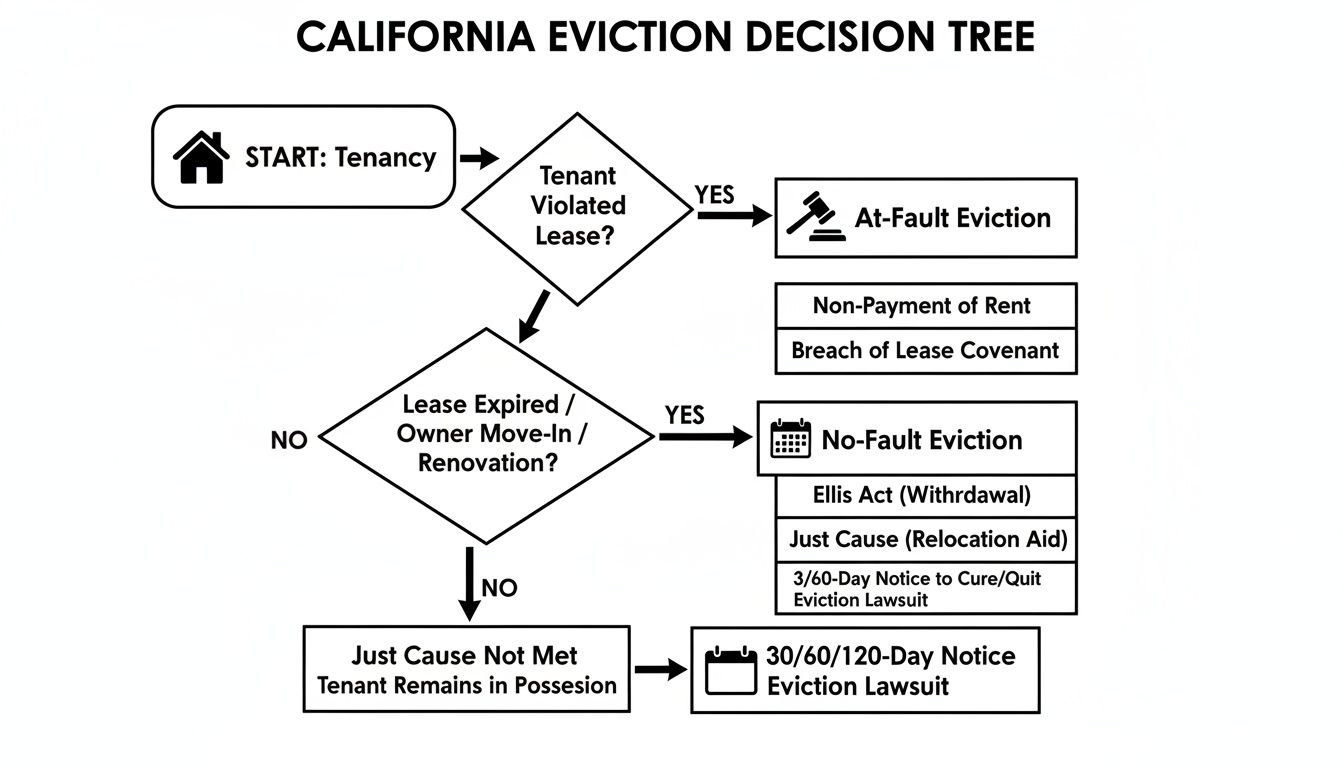
The key takeaway here is that your reason for the eviction directly locks you into a specific legal process. There’s no mixing and matching.
At-Fault Just Cause Evictions
An at-fault just cause eviction is exactly what it sounds like—the tenant is at fault for breaching the lease agreement. This is the most common reason landlords start the process, and it usually involves a shorter notice period that gives the tenant a chance to fix, or "cure," the problem.
Common grounds for an at-fault eviction include:
- Failure to Pay Rent: This is, by far, the number one reason. The first step is serving a 3-Day Notice to Pay Rent or Quit.
- Lease Violations: This covers everything from an unauthorized pet to subletting the unit without your permission. A 3-Day Notice to Cure or Quit is typically used here.
- Creating a Nuisance: Actions that disturb other tenants or damage the property, like constant loud parties or illegal activity, are grounds for eviction.
- Committing Waste: This is a legal term for causing significant, intentional damage to the property that lowers its value.
For property owners in Yucaipa, what seems like a minor lease violation can quickly escalate. That's where our Yucaipa property management team comes in, conducting annual inspections and coordinating maintenance to nip these issues in the bud before they ever become grounds for an at-fault eviction.
No-Fault Just Cause Evictions
A no-fault just cause eviction is when the tenancy has to end for reasons that have nothing to do with the tenant's behavior. Because the tenant hasn't done anything wrong, California law gives them greater protections, including longer notice periods and, often, relocation assistance.
The list of valid reasons for a no-fault eviction is very short and specific:
- Owner Move-In: The owner or their immediate family member intends to occupy the property as their primary residence.
- Withdrawing the Property from the Rental Market: The owner decides to stop renting out the unit altogether (under the Ellis Act).
- Substantial Remodel: The planned renovations are so extensive that the unit must be vacant to complete the work safely.
- Compliance with a Government Order: A city or county agency has ordered the property to be vacated for safety or legal reasons.
With a no-fault eviction, the landlord is typically required to provide relocation assistance equal to one month's rent or waive the final month's rent. This is a critical detail. Missing this step can get the entire eviction thrown out of court.
A Quick Look at California's Eviction Notices
To make sense of the different notices, here’s a quick summary table. It breaks down the most common types, their purpose, and when they apply. Choosing the right one is the first, and most crucial, step in the process.
California Eviction Notice Types At A Glance
| Notice Type | Primary Use (Grounds) | Typical Cure Period or Timeline | Applies To |
|---|---|---|---|
| 3-Day Notice to Pay Rent or Quit | Tenant has failed to pay the rent owed. | Tenant has 3 business days to pay the full amount or move out. | At-Fault Evictions |
| 3-Day Notice to Cure or Quit | Tenant has violated a lease term (e.g., unauthorized pet). | Tenant has 3 business days to fix the violation or move out. | At-Fault Evictions |
| 3-Day Unconditional Quit Notice | Tenant committed a serious, unfixable violation (e.g., crime). | Tenant must move out within 3 business days with no option to cure. | At-Fault Evictions |
| 30-Day Notice to Vacate | Landlord terminates a month-to-month tenancy for a no-fault reason. | Tenant has lived in the unit for less than one year. | No-Fault Evictions |
| 60-Day Notice to Vacate | Landlord terminates a month-to-month tenancy for a no-fault reason. | Tenant has lived in the unit for one year or more. | No-Fault Evictions |
This table is a great starting point, but remember that local city ordinances can add extra layers of requirements. Always double-check what applies in your specific area.
Why Every Detail on a Legal Notice Matters
The eviction notice isn't just a letter; it's a legal document that has to be perfect. A single mistake—a misspelled name, an incorrect rent calculation, or serving it the wrong way—can force you to start the entire process over from scratch, costing you weeks of lost rent and mounting legal fees.
The numbers tell a sobering story. Los Angeles County saw a jaw-dropping 245,599 eviction notices filed between February 2023 and September 2025, and a staggering 93% of them were for non-payment of rent. This isn't just an L.A. problem. San Mateo County saw a 35% jump in eviction filings in 2023 compared to pre-pandemic levels. You can see the full details in this Stanford Law School study on California evictions.
For owners in communities like Beaumont, this data is a wake-up call about the importance of getting every legal detail right. Professional Beaumont property management is the best defense against the common mistakes that lead to these high filing rates. It’s also why so many local owners searching for "property management near me" trust AIM PROPERTY MANAGEMENT COMPANY to handle their legal paperwork flawlessly from the start.
Filing an Unlawful Detainer Lawsuit
When a tenant doesn’t pay rent, fix a lease violation, or move out after you’ve given them a valid notice, your only legal path forward is a court action called an Unlawful Detainer. This is the formal lawsuit in California designed specifically to reclaim possession of your property. It’s not just a piece of paperwork; it’s a legal proceeding where every detail matters.
Think of it like building a case for a judge. Your lease agreement is the foundation, and every document—from rent ledgers to the notice you served—is a brick. If even one of those bricks is weak or missing, your entire case could fall apart under scrutiny. Frankly, this is where the eviction battle is either won or lost.

This process demands perfection. Any slip-up can lead to costly delays or even a full dismissal, forcing you to start from square one. Understanding the key steps is critical to getting it right.
The Initial Court Filing
The lawsuit officially kicks off when you or your representative file two essential documents with the local Superior Court.
- The Complaint: This is the document that tells your side of the story. It lays out the facts: where the property is, what the lease terms were, how the tenant broke those terms, and what you’re asking the court to do—namely, give you back your property and award a judgment for unpaid rent.
- The Summons: This is a formal notice from the court, informing the tenant that they are being sued and have a strict, very short deadline to respond.
Filing these documents involves paying a court fee, which differs from county to county. This is a point where having an expert on your side, like a professional Redlands property management firm, prevents common mistakes that get cases thrown out before they even begin.
Serving the Tenant Properly
Once filed, you can't just drop the Summons and Complaint in the mail. California has very strict rules for "service of process" to make sure the tenant is officially notified. The documents have to be hand-delivered by someone who isn't you—either a registered process server or another adult not involved in the case.
This step is absolutely non-negotiable. If the tenant isn't served according to the letter of the law, the court can—and often will—dismiss your entire case. You’ll have to pay the filing fees all over again and start the process from the beginning.
If personal delivery fails after several attempts, there are backup options like "substituted service," but they have their own complicated set of rules. This is another area where professional handling saves landlords from major headaches.
The Tenant's Response Window
After being served, the clock starts ticking fast. The tenant usually has just five business days to file a formal response with the court. This is a much quicker turnaround than most civil lawsuits, reflecting the urgent nature of eviction cases. If they choose to respond, they will file an "Answer" outlining their defenses.
If those five days pass without a response, you can ask the court for a default judgment. In that case, the judge typically rules in your favor without a trial because the tenant never contested the suit. But if they do file an Answer, the case moves toward a trial. You can learn more about how these crucial timelines fit together in the complete landlord eviction process in California.
Preparing for a Court Date
If the tenant files an Answer, the court will set a trial date, often within 20 days. This is when your careful record-keeping pays off. Your property manager will be busy pulling together all the evidence needed to present a rock-solid case:
- The fully executed lease agreement.
- A copy of the eviction notice and solid proof it was legally served.
- Detailed rent ledgers showing all payments and the outstanding balance.
- Any relevant communication, like emails or texts, concerning the violation.
For our property owners in Beaumont, Calimesa, and Mentone, we handle this entire evidence-gathering process. We organize everything into a clear, compelling package for the court, which shows professionalism and dramatically increases the odds of a favorable outcome.
Why Local Ordinances Matter More Than Ever
California’s statewide eviction laws, like the Tenant Protection Act, provide a solid foundation for landlords. But if you stop there, you’re only seeing half the picture. The reality on the ground is that individual cities and counties have the power to create their own, often much stricter, tenant protection rules.
Think of state law as the official rulebook for a game. Now, imagine every town you play in has its own unique "house rules" that are non-negotiable and can completely change how you have to play. For a landlord, ignoring those local house rules is the fastest way to lose an eviction case before it even gets started.
This complex patchwork of regulations is exactly why having true local expertise isn't just a bonus—it's an absolute necessity. A property owner in Redlands has to play by a different set of rules than one just down the road in Banning or Yucaipa.
The Impact of Rent Control and Local Moratoriums
Many cities across California have their own rent control ordinances, which almost always come packaged with tougher eviction protections. These local laws create a legal environment that is far more favorable to tenants than what state law alone requires.
For instance, a local ordinance might throw these hurdles in your path:
- Demanding a significantly higher relocation assistance payment for a no-fault eviction.
- Creating additional "just cause" reasons for eviction that the state doesn't recognize.
- Forcing landlords into a mandatory mediation process before they can even file in court.
These local rules can dramatically alter a landlord's ability to manage their own property. And the stakes are incredibly high. Just look at Los Angeles, where a staggering 93% of the 245,599 eviction notices filed between 2023 and 2025 were for non-payment of rent, with an average of $3,972 owed per case. You can explore the data on L.A. evictions to see just how prevalent these issues are.
Relying solely on your understanding of statewide tenant eviction laws in California is a risky bet. It’s the local ordinances—the fine print—that can make or break your case, turning what should be a straightforward process into a legal nightmare.
Why Hyper-Local Knowledge Is Your Best Defense
Keeping up with this tangled web of local rules requires constant vigilance. For property owners in our service areas, this is where professional management becomes indispensable. An expert in Redlands property management isn't just familiar with state law; they live and breathe the specific municipal codes that apply only within Redlands city limits.
The same is true for every community we serve. A landlord in Loma Linda might face different notice requirements than one in Highland. This is precisely why smart investors searching online for "property management near me" always prioritize companies with deep, proven experience in their specific city. To see what we mean, you should read our article on how recent legislation impacts landlords in Redlands and Loma Linda.
For our clients with properties in Beaumont or Yucaipa, having a manager who truly understands the local landscape is critical. Our specialized Beaumont property management and Yucaipa property management teams ensure every notice served and every action taken is fully compliant with both state and local laws. This is what protects you from costly violations and legal challenges, safeguarding your investment and ensuring any necessary eviction proceeds smoothly and by the book.
How Professional Management Prevents Evictions
Dealing with California's tricky eviction laws is what you do when something’s already gone wrong. Real success as a property owner comes from being proactive. Let’s be honest: the only way to truly "win" an eviction is to prevent it from ever happening in the first place.
This is where a professional property manager stops being a simple service and becomes your first line of defense. A solid management strategy is the best protection against the time, money, and sheer stress of an Unlawful Detainer lawsuit. It all starts way before a tenant even gets the keys.

Rigorous Tenant Screening
The single most critical step in avoiding an eviction is placing the right person in your property from day one. A truly thorough screening process acts like a high-quality filter, catching red flags long before they can cause problems. It’s about more than just finding someone who can pay; it's about finding someone who is responsible.
At AIM PROPERTY MANAGEMENT COMPANY, our process is non-negotiable:
- Comprehensive Background Checks: We dig into an applicant's rental and criminal history to spot any warning signs.
- Credit Report Analysis: This paints a clear picture of their financial habits and whether they have a history of paying their bills on time.
- Income and Employment Verification: We confirm applicants have a stable, verifiable income sufficient to comfortably cover the rent.
This intense vetting process is the bedrock of a stable tenancy. For homeowners in Yucaipa and Redlands, our deep knowledge of the local rental market means we know exactly what a qualified, reliable applicant looks like, securing your investment for the long haul.
Proactive Lease Enforcement and Communication
Your lease is the rulebook for the tenancy, but it’s useless if it just sits in a drawer. Professional management means the lease terms are applied consistently and fairly for everyone, which stops minor misunderstandings from spiraling into major conflicts.
Clear and consistent communication is the secret sauce. When tenants know they have a reliable way to report maintenance issues or ask questions, they feel respected, which fosters a much more cooperative relationship. Good communication, sometimes handled by a dedicated property management answering service, prevents the small frustrations that can fester and lead to bigger disputes.
The goal is to solve problems, not create confrontations. Proactive communication and diligent lease enforcement create an environment where tenants understand the rules and are more likely to comply, dramatically reducing the risk of at-fault eviction scenarios.
For property owners in Beaumont and the surrounding communities like Banning and Calimesa, this hands-on approach is a game-changer. Our Beaumont property management team handles every tenant interaction with professionalism, making sure your property is managed by the book—both the lease and the law.
The Statistical Case for Professional Oversight
The risks of DIY landlording aren't just talk; the numbers tell a stark story. Before recent law changes, California saw over 160,000 eviction filings in a single year. That’s a staggering 29 evictions for every 1,000 renter households. For an owner of a single-family home in Yucaipa, a poorly screened tenant can easily lead to non-payment, which was the reason behind a whopping 93% of eviction notices in Los Angeles from 2023-2025. AIM's rigorous tenant screening, a cornerstone of our Yucaipa property management service, is designed to prevent this exact nightmare.
Flawless Execution When Eviction Is Unavoidable
Even with the best preventative measures, sometimes an eviction is the only option left. When that day comes, there is zero room for error. Our job is to manage the process perfectly, ensuring every document is correct and every deadline is met.
From drafting and serving the initial notice to preparing the Unlawful Detainer lawsuit, our expertise in Redlands property management ensures you are in full compliance with the maze of tenant eviction laws in California. We handle the paperwork, coordinate with legal counsel, and build a meticulous case for court. This professional oversight is what separates a swift, successful resolution from a costly legal battle you might lose on a technicality. We cover many of these duties in our guide on property management company responsibilities.
When you partner with AIM PROPERTY MANAGEMENT COMPANY, you aren't just hiring someone to collect rent. You're investing in a system built to protect your asset, minimize your risk, and maximize your return.
Answering Your Eviction Questions
Let's be honest: navigating tenant eviction laws in California can feel like trying to solve a puzzle in the dark. It’s a process that naturally brings up a lot of questions. For property owners in communities like Redlands, Beaumont, and Yucaipa, knowing the answers is key to protecting your investment.
Here, we'll tackle some of the most common concerns we hear from landlords who are considering or already going through an eviction.
How Long Does an Eviction Typically Take in California?
There’s no single answer to this, and the timeline can swing wildly. In a best-case scenario—an uncontested eviction where the tenant moves out without a fight—you might be looking at 3 to 6 weeks after the initial notice period ends.
But that’s where the good news often stops. If a tenant decides to contest the Unlawful Detainer lawsuit, the brakes get slammed on the whole process. A contested eviction can easily drag on for 60 to 90 days or even longer, especially if the courts are backed up. Even a tiny mistake on your paperwork can get the case thrown out, forcing you to start all over again and adding weeks or months to the timeline.
What Are the Average Costs of an Eviction?
The cost of an eviction is a huge worry for landlords, and for good reason. Just like the timeline, the final bill really depends on how much of a fight the tenant puts up.
- Uncontested Eviction: If things go smoothly, you could be looking at costs between $500 and $1,500. This usually covers the basics like court filing fees, paying a process server, and some professional oversight.
- Contested Eviction: This is where things get expensive. If the eviction goes to trial, legal fees become the biggest expense. It’s not uncommon for costs to climb to $2,500 to $10,000 or more in complicated cases. And that number doesn’t even factor in the months of lost rent you’re accumulating.
This financial risk is exactly why professional oversight from a firm specializing in Redlands property management is so critical. We nail the details to prevent the kind of delays that cause these costs to skyrocket.
What Are Common Tenant Defenses Against Eviction?
Tenants have every right to defend themselves in court, and knowing what you might be up against is the first step to building a solid case.
Here are a few of the most common defenses we see:
- Improper Notice: This is, without a doubt, the most frequent reason landlords lose in court. The tenant can argue the notice had a mistake—like the wrong rent amount or incorrect dates—or that it wasn't delivered correctly according to the law.
- Breach of the Warranty of Habitability: This defense claims the property was unlivable. The tenant might argue you failed to fix a serious issue, like a leaky roof or a broken heater, which makes the eviction invalid.
- Retaliatory Eviction: A tenant can claim you're evicting them as punishment for exercising a legal right, like calling a health inspector about a code violation.
- Waiver: This happens if you accept a partial rent payment after the notice to pay has expired. By accepting the money, you may have legally "waived" your right to proceed with that specific eviction.
Even one successful defense can lead to a judge ruling for the tenant. That means you could be on the hook for their attorney fees and have to start the entire eviction process from scratch. Meticulous documentation is your best shield.
While we're focused on the legal side, tenants should also think about their own protections. To safeguard their belongings, we always recommend tenants get a comprehensive renters insurance California policy. It provides coverage for their personal property and liability, which is completely separate from the landlord-tenant legal relationship.
When Should I Hire a Professional?
The short answer? Immediately. It’s tempting to try and save money by handling an eviction yourself, but California's laws are a minefield of technicalities. The real question isn’t if you need help, but who you should hire.
You absolutely need a professional on your side if:
- The tenant has already hired an attorney.
- The tenant is claiming issues like habitability or retaliation.
- You aren't completely comfortable with court procedures and legal deadlines.
- Your property is in a city with its own local rent control or eviction rules.
One procedural slip-up can easily cost you more in lost rent and legal fees than you would have spent hiring an expert from day one. When owners are searching for a "property manager near me," choosing a company with a proven track record in legal compliance, like AIM PROPERTY MANAGEMENT COMPANY, is the smartest financial move you can make. Our deep experience in Beaumont property management and Yucaipa property management ensures your case is handled right, right from the start. You can find answers to more common questions on our FAQs page.
Navigating the legal landscape of evictions in California demands precision, expertise, and a proactive strategy. Protecting your investment means ensuring every step is compliant and every action is decisive. Let AIM PROPERTY MANAGEMENT COMPANY handle the complexities for you. We provide the professional oversight needed to manage your properties in Redlands, Beaumont, Calimesa, Yucaipa, Loma Linda, Mentone, Highland and Banning California, safeguarding your assets and maximizing your peace of mind.
Learn more about our property management services at aim-properties.com