

Staring at a pile of rental applications can feel like placing a bet. You're left wondering: is this the perfect tenant for my property, or am I about to sign up for months of headaches? This is where professional tenant background check services come in. They take the guesswork out of the equation, turning that uncertainty into confidence. Frankly, it's the single most important tool you have for managing your risk.
Why Tenant Screening Is Your First Line of Defense

It’s best to think of a thorough tenant screening not as an expense, but as an insurance policy on your investment. Every landlord wants the same thing: reliable, responsible tenants who pay their rent on time and treat the property with care. A comprehensive background check is the first and most crucial step to making that happen.
This process protects you from the very real possibility of financial loss, property damage, and frustrating legal battles down the road. It moves beyond a simple gut feeling and gives you a clear, data-driven picture of who you're renting to. It’s all about verifying the story an applicant tells on paper and uncovering red flags before they become your problem.
The Most Important Pieces of the Puzzle
The real power of a background check is that it looks at the whole picture. A professional service doesn’t just rely on one piece of information. Instead, it pulls together several key indicators to build a complete profile of a potential renter.
- Credit History: This isn't just about a three-digit score. It’s a detailed report card on an applicant's financial responsibility, showing if they have a history of paying bills on time, managing debt, and honoring their commitments.
- Criminal Background: A check for relevant criminal history is non-negotiable. It’s essential for the safety of your property, your other tenants, and the community you operate in.
- Eviction History: Past evictions are one of the strongest predictors of future rental problems. This check tells you if an applicant has a documented history of breaking their lease or failing to pay rent, leading to a formal eviction.
A meticulous screening process is the key to unlocking the stability and sustained profitability of a long-term tenancy. It is the most effective way to filter out applicants who pose a risk to your investment.
Building a Foundation for Long-Term Success
This detailed vetting is especially vital for landlords who prefer stable, long-term rentals over the high-turnover world of short-term stays. While short-term rentals might promise high nightly rates, they often come with inconsistent income, frequent vacancies, and a lot more wear and tear on your property.
A well-screened, long-term tenant, on the other hand, provides a stable and predictable revenue stream, month after month. For property owners with a long-term vision, finding that right tenant is everything. An experienced partner, especially one with deep roots in the community since 1997, knows exactly how to manage this process. By investing in a proper screening upfront, you’re setting the stage for a profitable, low-stress relationship that will stand the test of time.
What a Tenant Screening Report Actually Tells You
A tenant screening report is so much more than a simple pass-or-fail document. Think of it as the complete story of your potential tenant—and learning to read that story is your best defense for protecting your investment.
When you understand what each part of the report reveals, you can move past first impressions and make a smart decision based on hard facts. This is what effective tenant screening is all about. It’s like getting a professional resume for a renter, with each section giving you another piece of the puzzle. You’re not looking for a "perfect" applicant, but a reliable partner you can trust with your property.
To help you get a clearer picture, here’s a quick breakdown of what each part of the screening report really tells you.
Key Insights From a Tenant Screening Report
| Report Component | What You Learn as a Landlord |
|---|---|
| Credit Report | This goes beyond the three-digit score. It reveals an applicant’s financial habits, payment history, and whether they honor their commitments. |
| Criminal History | A crucial safety check. This identifies patterns of behavior that could put your property, other tenants, or the community at risk. |
| Eviction History | This is a direct look at their past as a renter. A previous eviction is a major red flag for serious lease violations or non-payment. |
| Income Verification | The final piece of the financial puzzle. This confirms they have a stable, sufficient income to comfortably afford the rent each month. |
By piecing these insights together, you build a comprehensive profile that helps you choose a tenant who is not just qualified on paper, but truly a good fit for your property.
Decoding the Credit Report
The credit report is usually the first thing landlords glance at, but that three-digit score is just the headline. The real story is in the details. A full credit check gives you a window into an applicant's financial responsibility. Do they pay their bills on time, or is there a pattern of late payments and defaults?
This report shows you their active lines of credit, how consistently they pay, and if any accounts have been sent to collections. It's a direct reflection of how they manage their financial promises. A solid credit history is a strong indicator that they'll treat their rent payment with the same priority.
Assessing Criminal and Eviction Histories
A criminal history check is a non-negotiable safety measure. It helps you spot behaviors that could jeopardize your property or the safety of your other tenants. The key is to look at any findings in context, paying attention to offenses that are recent and relevant to a tenancy.
Likewise, the eviction history is one of the most powerful predictors of a tenant's future behavior.
An eviction is a significant red flag because it demonstrates a history of serious lease violations or non-payment that a previous landlord had to resolve through legal action. This is precisely the kind of costly and stressful situation that a thorough screening process is designed to prevent.
This historical data gives you a clear-eyed view of how an applicant has handled their rental obligations before. Making this part of your process is simple when you learn more about how tenant screening is made easy with AIM Property Management.
The Non-Negotiable Step of Verifying Income
Finally, you absolutely have to verify their employment and income. A great credit score and a clean record don’t mean much if the applicant can’t actually afford the rent. This step confirms they have a stable income source that can comfortably cover their monthly rent and other bills.
When you’re looking at an applicant's finances, you also need to be on the lookout for fraud. For example, it’s worth learning how to spot fake bank statements to protect yourself from dishonest applications. A little due diligence here ensures the financial story they’re telling you is the real one.
The data below shows just how much of a positive impact this kind of thorough screening has for landlords.
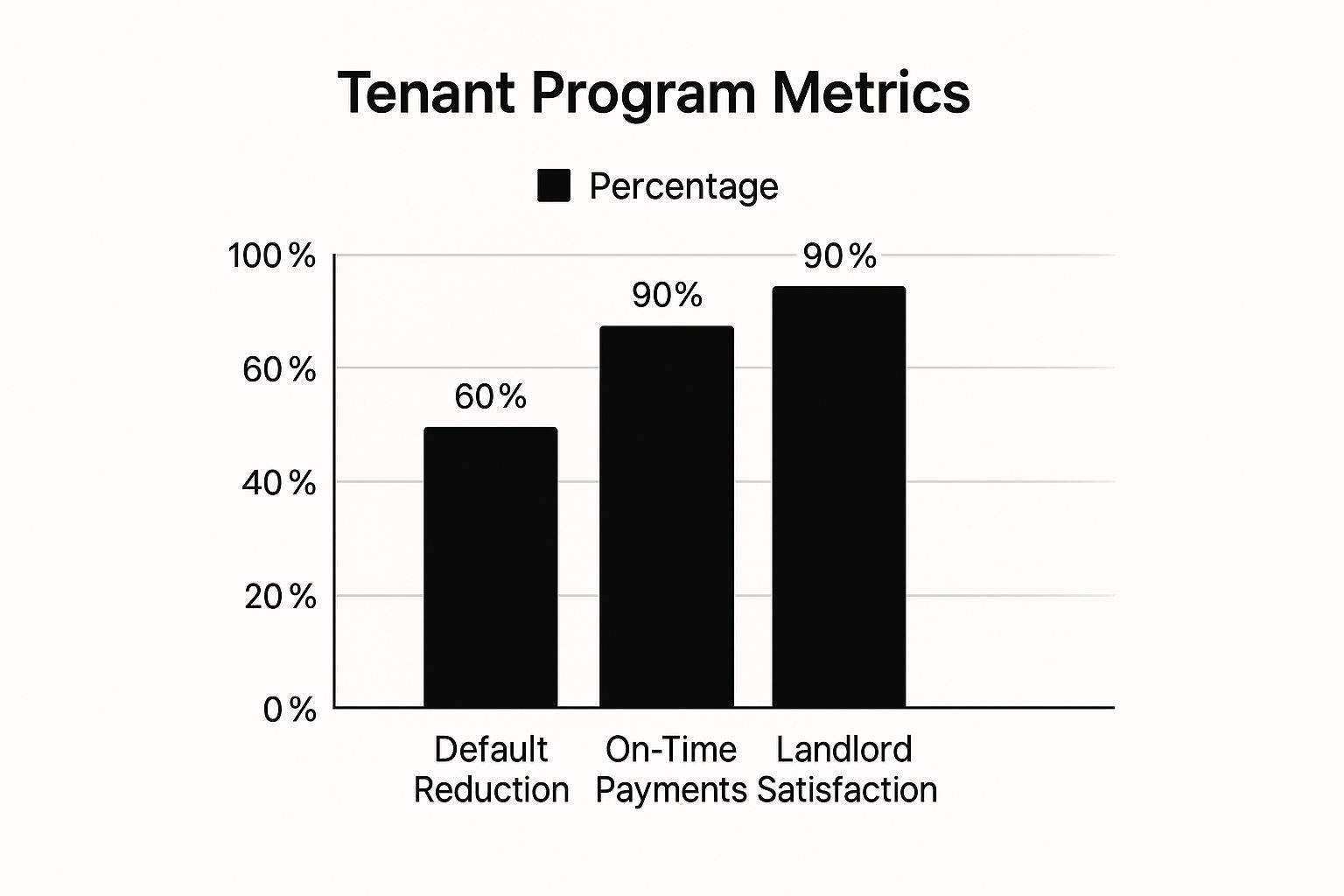
As you can see, a well-run screening process leads directly to fewer defaults, more on-time payments, and a much better experience for property owners.
Recent trends show just how critical this comprehensive approach has become. A new survey found that 40% of landlords now see background checks as their top priority—even more important than credit scores. On top of that, over 90% of landlords verify employment and income, showing just how essential this step is in today's rental market.
Staying Compliant with Screening Laws

Running tenant background check services puts a lot of legal responsibility on your shoulders. It’s not just about finding a great tenant; it's about making sure you do it fairly and by the book. Diving into the complex world of rental laws can feel overwhelming, but getting a handle on the basics will empower you to protect your investment without crossing any legal lines.
Think of the Fair Housing Act (FHA) and the Fair Credit Reporting Act (FCRA) as the two main pillars of your screening process. They’re the guardrails that keep you on the right track, ensuring every single applicant gets a fair shot.
Understanding the Fair Housing Act
The Fair Housing Act is the absolute cornerstone of anti-discrimination law in real estate. It makes it illegal to deny housing to anyone based on their race, color, religion, sex, national origin, familial status, or disability.
What does this mean for you? Simple: your screening criteria must be applied the exact same way for every applicant. No exceptions.
For example, you can’t set a higher income requirement for a single mother than you do for a married couple. You also can't turn someone down just because you’d rather not rent to people from a certain country. The magic word here is consistency. Your rules for one are your rules for all.
Navigating the Fair Credit Reporting Act
While the FHA is about who you can't discriminate against, the FCRA is all about how you use the information you collect. The moment you use a third-party service to run a background or credit check, you're officially a user of a "consumer report," and the FCRA’s rules kick in immediately.
This law is all about protecting consumer privacy and making sure the data used to make decisions is accurate. To stay compliant, you have to follow three critical steps:
- Get Written Consent: This is non-negotiable. Before you run any checks, you must have clear, written permission from the applicant.
- Use Information Properly: The report is only for one thing: evaluating that rental application. That’s it.
- Provide an Adverse Action Notice: If you decide to reject an applicant based on something in their screening report, you are legally required to give them an "adverse action notice."
This notice is a formal letter that tells the applicant why they were denied, names the screening company that supplied the report, and informs them of their right to see the report and dispute any errors. Skipping this step is a common—and very expensive—mistake for landlords.
The tenant screening industry is a complicated space, constantly facing new regulations. A deep dive by the Consumer Financial Protection Bureau found a market full of small providers and a few giants, all grappling with issues like the accuracy of public records. You can learn more about these industry-wide challenges in their tenant background checks market report.
The Value of Professional Guidance
Keeping up with ever-changing regulations, from federal laws down to specific city ordinances, can feel like a full-time job in itself. This is where a seasoned property manager becomes your greatest asset.
An expert who has been navigating these laws since 1997 already knows the ins and outs and can shield you from costly legal traps. For landlords in our area, it's also crucial to understand local rules; our guide on how AB 681 impacts landlords in Redlands & Loma Linda is a perfect example.
When you have a professional handling compliance, you can get back to focusing on what matters—the return on your investment—knowing your screening process is both effective and ironclad.
The Financial Case for Long-Term Tenants
https://www.youtube.com/embed/cyahBccVxmw
That high nightly rate for a short-term rental looks great on paper, doesn't it? But any seasoned property owner will tell you it's often a mirage, hiding a relentless cycle of high effort and unpredictable income. The real path to financial stability and peace of mind isn't in chasing weekend guests—it's in securing a great long-term tenant.
Think about it. A reliable, year-long lease gives you something priceless: a predictable income stream. Instead of constantly gambling on seasonal demand and juggling a never-ending calendar of bookings, you get a steady payment, month in and month out. This kind of dependable cash flow makes budgeting for maintenance, taxes, and future investments so much easier.
The Hidden Costs of High Turnover
The glamour of short-term rentals wears off quickly once you start tallying up the hidden costs of constant turnover. Every time a guest checks out, the meter starts running on a fresh set of expenses. This churn isn't just a hassle; it's a direct hit to your bottom line.
Just look at what's involved:
- Constant Marketing: You're always on the hook, advertising to fill empty nights. That costs time and money.
- Intense Cleaning: After every single stay, the property needs a top-to-bottom clean. This is far more frequent and expensive than the simple turnover between long-term tenants.
- Endless Admin: Managing bookings, answering dozens of inquiries, and coordinating check-ins and check-outs can easily become a part-time job you never wanted.
- Accelerated Wear and Tear: A revolving door of different guests inevitably means more scuffs on the walls, more broken dishes, and just more general wear on your home and furnishings.
Those operational headaches add up fast, eating away at the very profits that looked so attractive in the first place. You end up on a treadmill of expensive, repetitive tasks.
Comparing the Two Rental Models
When you put the two approaches side-by-side, the financial and operational benefits of a long-term strategy become impossible to ignore. A meticulous tenant background check service is your key to unlocking these benefits, making sure you place a responsible person who will treat your property like their own home.
Securing a high-quality, long-term tenant is a strategic investment in stability and profitability. It shifts the focus from filling a vacancy to building a sustainable, low-maintenance asset.
This is exactly where an experienced property management partner, in business since 1997, proves its worth. For an exceptionally low 7.9% monthly management fee and a simple $750 placement fee with no hidden add-ons, you get decades of expertise dedicated to finding and keeping excellent tenants for your property.
To make it even clearer, here's a look at how the two models stack up financially.
Long-Term vs Short-Term Rentals A Financial Comparison
The table below breaks down the core financial differences, highlighting why a long-term approach often builds more sustainable wealth with far less stress.
| Factor | Long-Term Rentals | Short-Term Rentals |
|---|---|---|
| Income Stream | Consistent and predictable monthly rent. | Volatile and seasonal, with frequent vacancies. |
| Turnover Costs | Minimal; incurred only between tenants. | High; includes constant cleaning and marketing fees. |
| Management | Lower day-to-day involvement. | Requires constant, hands-on administrative work. |
| Property Wear | Less wear and tear over the lease term. | Accelerated wear from frequent guest turnover. |
Ultimately, a well-screened, long-term tenant provides a foundation for steady growth, while the short-term model often trades stability for a high-maintenance, unpredictable income.
Building a Stable Investment
At the end of the day, the right choice comes down to your goals. Short-term rentals can feel more like running a high-stakes, hands-on business. Long-term rentals, on the other hand, function as a more stable, passive investment. By focusing on quality, long-term tenants, you're not just renting a house—you're building a resilient financial asset.
This approach also fosters more stable communities, as long-term residents are naturally more invested in their neighborhood. And while the legal side is generally simpler, staying on top of changing laws is still crucial. For a detailed look at what's ahead, make sure to review our guide covering the 2025 California landlord laws you must know.
With the right tenant in place, your property transforms from a source of constant work into a reliable, income-generating investment you can count on.
How an Experienced Partner Streamlines Screening
Knowing what goes into a tenant background check service is one thing. Actually running the process—from getting consent to reading complicated reports and staying on the right side of the law—is a whole different ballgame. This is where bringing in a professional property management firm changes everything, turning a stressful chore into a smooth, hands-off operation. It’s the difference between just doing a job and mastering a craft.
An experienced partner, especially one that’s been in the community since 1997, brings more to the table than just a screening service. They bring decades of proven processes, deep-rooted connections with vendors, and a gut instinct for spotting red flags that only comes with years in the trenches. Think of it like hiring a seasoned detective instead of trying to solve the case yourself—the pro knows exactly where to look and what questions to ask.
The Value of Deep-Rooted Experience
A long-standing property manager offers insights that newer companies or DIY landlords just can't compete with. After navigating the rental market for decades, they understand the local quirks, they've seen every trick in the book from shady applicants, and they've built a network of trusted contacts to verify information quickly and accurately.
That depth of experience is priceless. It means your screening process isn’t just a checklist; it’s a strategic system built to protect your investment. Instead of you spending hours trying to get a call back from an applicant's boss or a previous landlord, an established firm gets it done with professional efficiency.
For a competitive 7.9% monthly management fee and a straightforward $750 tenant placement fee—with no hidden junk fees—you can offload this entire time-sucking burden. This isn’t just about saving a few hours; it’s about investing in real expertise to avoid the disastrous costs a single bad tenant can bring.
Focusing on What Matters: Long-Term Stability
The real goal of a great screening process isn't just to fill a vacancy. It's to find a tenant who will provide stable, long-term income. This is where our professional focus on long-term rentals, rather than the rollercoaster of short-term lets, really pays off. Long-term tenants mean predictable cash flow, less wear and tear on your property, and a more stable community vibe.
A seasoned property management company is built entirely around this model. They use their powerful screening process to find people who are looking for a place to call home, not just a temporary crash pad. This commitment to long-term tenancies is what protects your asset and maximizes your return year after year. You can see more on how we make this happen in our guide to professional property management in Beaumont, CA.
An Investment in Peace of Mind
At the end of the day, partnering with an experienced firm is an investment that pays for itself many times over. That modest management fee is a small price for total peace of mind and the confidence that your property is in expert hands. You sidestep the risk of costly legal blunders, slash the odds of long vacancies, and attract higher-quality tenants who will treat your property with respect.
Here’s a quick rundown of the direct benefits:
- Expert Legal Compliance: Navigating the Fair Housing Act and FCRA becomes a non-issue. The experts handle all the necessary disclosures and follow every rule, so you don't have to.
- Time and Resource Savings: Get your valuable time back. By delegating the whole screening and placement process, from marketing to lease signing, you're free to focus on what you do best.
- Better Tenant Quality: Putting decades of experience to work leads to more reliable tenants, fewer missed rent payments, and a far more profitable investment.
When you trust your tenant screening to a veteran team, you’re not just hiring a service. You’re gaining a strategic partner dedicated to protecting and growing the value of your real estate investment.
Why Professional Screening Is the New Standard

The days of making a decision based on a handshake and a gut feeling are long gone. As the rental market gets tighter and regulations pile up, DIY tenant screening just doesn't cut it anymore. For serious investors, using professional tenant background check services isn't just a nice-to-have; it's the new standard for protecting your investment.
Your property is one of your biggest assets. Securing its future starts with getting the right person to live there. The only reliable way to do that is with a thorough, compliant, and professional screening process handled by a partner who knows exactly what to look for.
The Growing Demand for Expert Vetting
It’s not just a hunch—landlords everywhere are turning to experts to reduce their risk. The global market for screening services hit about USD 3.67 billion in 2023 and is expected to nearly double to USD 7.10 billion by 2032. This boom is driven by more people renting and a very real concern about finding quality tenants. You can explore the full market analysis on tenant screening services to see just how massive this trend is.
This incredible growth points to a simple truth: landlords know that one bad tenant can cost thousands in lost rent, property damage, and legal fees. A professional screening is your first and best line of defense, making sure you place tenants who are financially responsible and will treat your property with respect.
Think of a professional screening service as a powerful filter. It takes all the guesswork and emotion out of the decision, replacing gut feelings with hard data. That's how you build a successful, long-term rental business.
Why Experience Matters More Than Ever
Partnering with a seasoned property management firm, especially one that's been in the business since 1997, gives you an edge that goes way beyond just pulling a report. Decades of experience mean we’ve fine-tuned our process, built mature relationships in the community, and can spot red flags that others might miss.
For a low 7.9% monthly management fee and a simple $750 placement fee with no add-on fees, you get access to that deep-seated expertise. This isn’t about convenience; it's a strategic move to protect your investment. We vet every applicant against the highest professional standards, all with the goal of finding you a stable, long-term tenant who makes your life easier.
Common Questions About Tenant Screening
If you're getting into the world of tenant background check services, you're bound to have questions. Getting clear, simple answers is the key to using these tools the right way and protecting your investment with confidence. Let's tackle some of the most common questions we hear from landlords.
What Is the Most Important Part of a Background Check?
This is a big one. Many landlords want to know if there's a single "make or break" part of a screening report. The honest answer? It’s not about one single piece of data; it’s about the whole picture. If you only look at one thing, you’re likely to get a skewed and incomplete view of an applicant.
Think of it like a three-legged stool. The credit report shows you their financial responsibility. The criminal history gives you insight into safety and risk. And the eviction record reveals their track record as a renter. Each leg is crucial, and together they create a stable foundation for making a good decision.
Can I Deny an Applicant Based on a Screening Report?
Yes, absolutely—as long as it's for legitimate, non-discriminatory business reasons. A history of late payments, a relevant criminal conviction that could pose a risk, or a previous eviction are all valid grounds for denial. Spotting these issues is what screening is all about, and you can learn more about the top tenant red flags every landlord should watch for in our detailed guide.
But you have to be careful. The Fair Housing Act is clear about avoiding discrimination. And if you do deny someone based on their report, the Fair Credit Reporting Act (FCRA) requires you to send them an "adverse action notice" explaining your decision.
How Long Does a Tenant Background Check Take?
The timeline can really vary. Many modern online services can pull credit and criminal reports almost instantly, which is great. But a truly comprehensive check goes a bit deeper than that.
A proper screening process that includes verifying their employment and actually calling their previous landlords usually takes about 1 to 3 business days. An experienced property manager, especially one who's been rooted in the community since 1997, often has the right systems in place to get this done quickly without cutting corners.
Taking that extra day or two is worth it. It’s what separates a quick placement from finding a fantastic, long-term tenant who provides steady income and takes care of your property.
Ready to find reliable, long-term tenants without the hassle? AIM PROPERTY MANAGEMENT COMPANY has been providing expert tenant screening and placement since 1997. For a low 7.9% monthly fee and a simple $750 placement fee, we handle everything, giving you complete peace of mind. Partner with an experienced team you can trust. Learn more and get started at https://aim-properties.com.