
Your phone lights up in the middle of a workday. The tenant in your Beaumont rental says water is backing up under the sink. The plumber you used last time isn't answering. Rent is due from another tenant in Yucaipa, and you still haven't reviewed the new lease language you know needs to comply with California rules. Meanwhile, your actual career, the one that pays you far more than landlording tasks ever will, is waiting for your attention.
That is the central landlord dilemma for successful owners in the Inland Empire. The property is a solid asset. Managing it can become a second job you never meant to take on.
If you're asking should i hire a property manager, my answer is straightforward. If your time is valuable, your standards are high, and you want the property to perform without pulling you into constant operational noise, hiring a manager is usually the smarter move. That's especially true in Redlands, Beaumont, Calimesa, Yucaipa, Loma Linda, Mentone, Highland, and Banning, where local market knowledge matters and California compliance isn't something you can wing.
Owners who want a local framework for that decision should start with Inland Empire property management services. It gives you a practical picture of what delegation looks like when the goal is stable income, fewer surprises, and less landlord fatigue.
Introduction The Landlord's Dilemma in the Inland Empire
You bought the rental for cash flow, appreciation, and long-term financial growth. You did not buy it to spend evenings coordinating repairs, weekends showing vacant units, or mornings chasing rent before your first meeting.
That disconnect is where most high-earning owners get stuck. They still think of management as a fee line item, when the actual issue is whether the asset is serving their life or hijacking it.
In Redlands property management conversations, I hear the same pattern. Owners can handle one problem at a time. What wears them down is the constant interruption. Tenant screening. Vendor calls. Lease renewals. Notices. Inspections. Maintenance follow-up. It never arrives as one big crisis. It arrives as a steady stream of small demands.
Practical rule: If your rental property regularly interrupts higher-value work, family time, or travel, you're already paying a management cost. You're just paying it in time and attention instead of on an invoice.
The Inland Empire adds another layer. These are not generic markets. Beaumont property management requires local judgment. So does property management Yucaipa. Rental demand, tenant expectations, and practical vendor response all vary by community.
That's why the right question isn't just “Can I manage this myself?” Most owners can. The better question is “Should I keep doing work that someone else can handle more systematically than I can?”
For a time-poor owner, that answer is usually no.
Self-Management vs Professional Management A Clear Comparison
Self-managing sounds efficient when you look only at the monthly fee you'd avoid. It looks a lot less efficient when you list the actual work.
You're not just collecting rent. You're marketing vacancies, answering inquiries, screening applicants, coordinating showings, writing leases, handling maintenance requests, documenting problems, keeping records, enforcing terms, and responding when tenants decide your emergency is now their emergency.
Professional management changes the operating model. Instead of you reacting to every issue, there's a system handling recurring tasks with process, documentation, and follow-through.
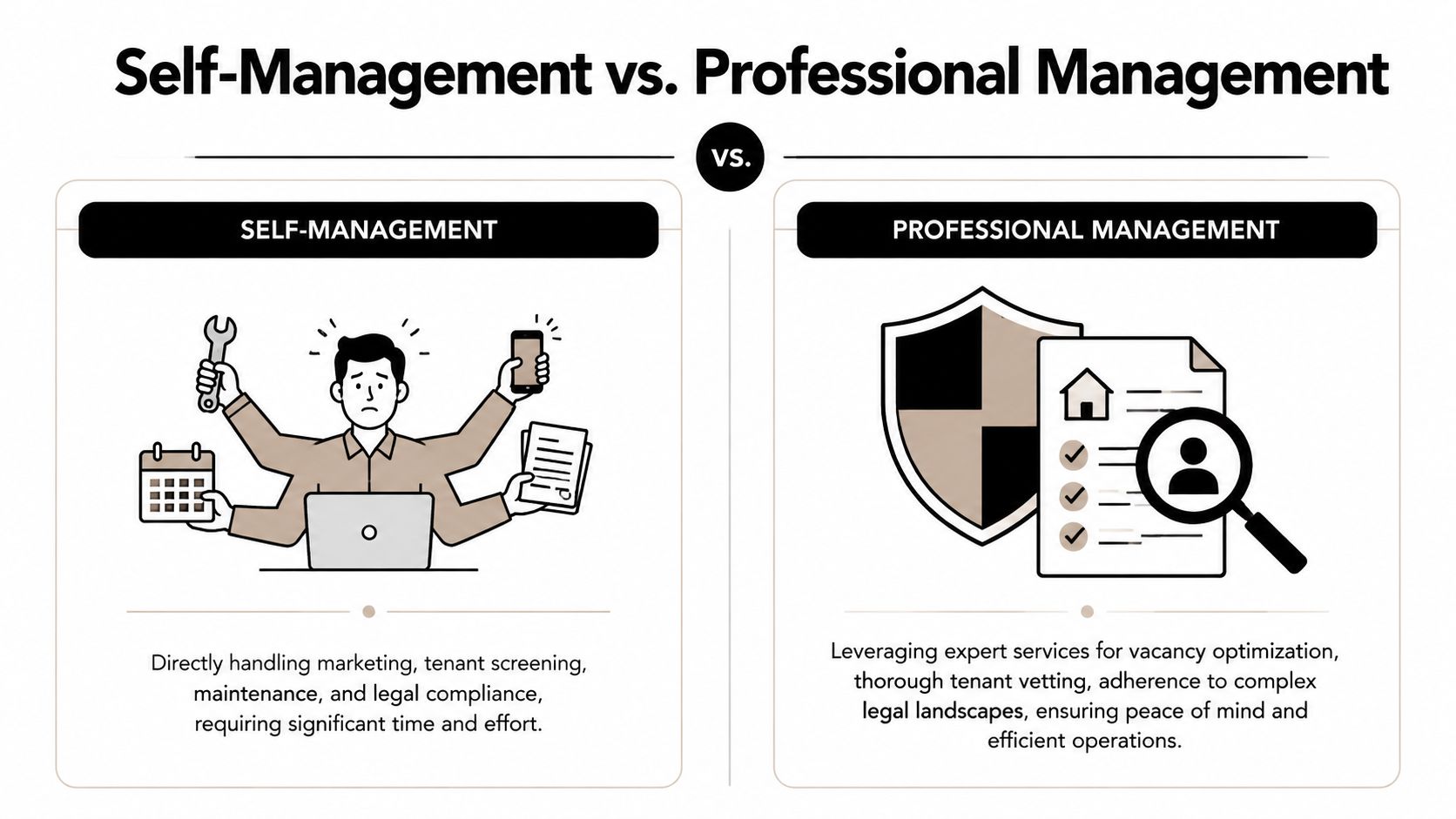
What self-management really looks like
The DIY approach works best when the property is nearby, the owner enjoys operations, and the owner has time to spare. That's not most affluent rental owners in the Inland Empire.
The common failure point isn't effort. It's fragmentation. Every task competes with your real job and your personal life. You don't get to batch most landlord work neatly. It arrives unpredictably.
A useful analogy is housekeeping. On paper, doing it yourself looks cheaper. In practice, many owners eventually realize they're paying with weekends, inconsistency, and deferred upkeep. The same tradeoff shows up in rentals, much like the logic behind Professional cleaning vs DIY, where the decision turns on time, consistency, and the cost of doing a specialized job yourself.
What professional management changes
A manager doesn't remove your ownership. A manager removes your operational drag.
With RentSmart property management, the core idea is simple. Tenant placement is handled through screening. Rent collection runs through a system. Maintenance requests don't land on your phone first. Documentation and day-to-day coordination stop living in your head.
That matters because rental performance usually suffers from ordinary delays, not dramatic mistakes. A slow response to a prospect. A maintenance issue that sits too long. A lease task pushed to next week. A missed follow-up. Systems solve that better than owner willpower.
A rental becomes easier to own when the owner only deals with decisions that actually require ownership judgment.
DIY Landlording vs. AIM Property Management
| Task | Self-Management Reality | With AIM Property Management |
|---|---|---|
| Marketing a vacancy | You write the listing, field inquiries, schedule showings, and hope your pricing is right | A structured leasing process handles exposure, inquiry response, and showing coordination |
| Tenant screening | You make judgment calls under pressure and risk inconsistency | Screening follows a defined process with background checks, credit review, and income verification |
| Rent collection | You track due dates, late payments, excuses, and follow-up | Collection runs through a dedicated system with regular owner reporting |
| Maintenance | Your phone becomes the dispatch center | Tenants use a support process and maintenance gets coordinated through trusted vendors |
| Emergencies | You are the after-hours contact | Emergency response no longer depends on your availability |
| Inspections | Easy to postpone, easy to do inconsistently | Regular inspections create accountability and early issue detection |
| Paperwork | Notices, lease files, and records stay on your plate | Documentation management becomes part of an operating process |
| Legal compliance | You have to keep up with changing rules yourself | Procedures are handled with compliance in mind |
| Tenant conflict | You handle uncomfortable conversations directly | A third party enforces terms with professional distance |
| Owner time | Nights and weekends stay vulnerable to interruptions | Your role shifts back to oversight and major decisions |
If you still enjoy all of that, keep self-managing. If reading that table feels exhausting, hire help.
Calculating the True Financial Return of a Property Manager
Most owners get stuck on the fee. That's the wrong place to focus.
The smarter calculation is return on management. You need to ask what changes when a professional handles leasing, pricing, vacancy reduction, and the daily operating friction that erodes income.

Start with the fee, then stop staring at it
Property management fees typically range from 8-10% of monthly rent, and one source notes the wider range can run 7-12%, depending on the arrangement. That same analysis also states that a professional manager can reduce vacancy periods by approximately 40% within six months, and cites a case where a landlord cut vacancy by 40% and achieved a $350 monthly rent increase after hiring management, producing a net gain even after fees. It also gives a break-even example in which a $1,800 rental with an 8% management fee equals $144 per month, while a self-managing owner spending 5 hours monthly at $50 per hour incurs $250 in DIY time cost. The same source adds that reducing vacancy by 15 days annually on a $1,800 rental generates $900 in recovered income, and includes a Los Angeles example where pricing strategy led to rents 8% higher than planned and a $24,000 annual increase in cash flow for a multifamily property. Those figures come from this cost-benefit analysis of hiring a property manager.
That's the conversation you should be having. Not “What does the manager cost?” but “What income do I lose by running this asset suboptimally?”
The high-earner's calculation
If you own a rental in Redlands or Loma Linda and earn strong income in your primary business or profession, your time has a market value. You may not bill by the hour, but your calendar still has an economic value.
Consider a practical approach:
- Leasing time: Vacancy marketing, inquiry follow-up, showings, screening, and lease prep
- Maintenance time: Calls, approvals, scheduling, invoice review, tenant updates
- Admin time: Rent tracking, statements, notices, recordkeeping
- Mental load: The background attention tax that comes with being the default contact
That last one doesn't show up on a spreadsheet, but it's real. It drags on focus. It steals evenings. It turns an investment into a constant low-grade responsibility.
Where the financial return usually comes from
The fee gets offset in three places.
First, better leasing execution can support stronger rent positioning. Second, tighter processes can reduce vacancy. Third, faster response and better oversight can keep ordinary maintenance from turning into larger problems.
Owners often underestimate how much rental underperformance comes from delay rather than disaster.
You don't need every lever to improve at once. If even one of them moves materially in your favor, the fee becomes easier to justify.
For owners comparing options, property management pricing and service structure is useful because it reframes the monthly charge as one variable inside a larger operating equation.
If your property is easy, nearby, and stable, self-management may still pencil out. If the property needs active attention, if the tenant base turns over, or if your own time is expensive, management often stops being a cost and starts acting like a profit protection tool.
Five Signs You Are Ready to Hire a Property Manager
Some owners don't need convincing. They need confirmation. If several of the signs below describe you, you're ready.

Your time is worth more elsewhere
If you earn at a high level, landlord tasks are usually low-value uses of your attention. One analysis aimed at this exact issue notes that for high-income earners earning over $300,000, the opportunity cost of time spent on 10+ distinct tasks such as tenant screening, maintenance, and legal compliance is rarely monetized. It argues that owners need a personal ROI model that compares their own hourly value against the management fee because that often reveals management is the more profitable choice. That comes from this discussion of when to hire a property manager.
This is the biggest sign. Not because you can't do the work, but because you shouldn't be the one doing it.
You own more than one property, or plan to
One property can feel manageable right up until two maintenance issues and one lease problem hit in the same week. Portfolio growth exposes weak systems fast.
Scaling self-management usually means scaling interruption. That's a bad business model.
You live too far from the rental
Distance changes everything. Even if you're still in the Inland Empire, a property that isn't close enough for easy oversight creates friction. Showing coordination gets harder. Vendor access gets harder. Inspections get easier to postpone.
If you're out of state, the answer gets even simpler. You need local boots on the ground.
You want a passive investment, not another job
Some people enjoy landlording. Most successful professionals tolerate it because they haven't yet built a better operating structure.
If your ideal role is owner, not operator, that's your answer.
A quick perspective shift helps:
You hesitate when legal issues come up
If a notice, lease update, screening issue, or habitability question makes you pause, pay attention to that instinct. It's telling you the risk is no longer casual.
Use this self-check:
- You delay tasks: You know what needs to be done, but your schedule keeps pushing it back.
- You resent interruptions: Tenant communication feels like an intrusion rather than a business process.
- You avoid compliance questions: You hope your current paperwork is good enough.
- You're building wealth elsewhere: Your income doesn't depend on personally answering maintenance calls.
- You keep saying “for now”: That usually means your current system has already expired.
Hiring a manager isn't giving up control. It's deciding your time has a better use.
Navigating California's Legal Landscape The Risk You Cant Ignore
A lot of owners treat legal compliance as background noise until they need it. That's a mistake.
California doesn't reward casual landlording. If you self-manage, you are responsible for notices, procedures, habitability issues, screening practices, documentation, and the local differences that can trip you up even when your intentions are good.

The compliance gap is real
One source focused on this issue points out that while people acknowledge California's changing rental laws, they often fail to quantify the risk of non-compliance. It also notes that owners lack reliable data on the actual costs they may avoid in fines or litigation, and that in Riverside County communities such as Beaumont and Yucaipa, local ordinances can differ significantly from statewide rules. That creates a compliance gap that professional managers fill, effectively making the management fee function like a form of insurance. That framing comes from this analysis of whether to hire a property manager.
That matters directly for Property Management Beaumont, Beaumont property management, Yucaipa property management, and property management Yucaipa. These aren't abstract labels for SEO. They reflect the fact that rental operations are local.
The expensive mistakes are ordinary mistakes
Most owners don't get into trouble because they're reckless. They get into trouble because they're busy.
A screening decision made too informally. A notice served incorrectly. A habitability complaint handled too slowly. A repair issue documented poorly. A lease provision that hasn't kept pace with current rules. None of those feel dramatic in the moment. They become dramatic later.
For owners in Beaumont, Yucaipa, and Banning, local knowledge matters because practical compliance is not just about reading statewide summaries. It's about applying the rules correctly in the city and county context where your property operates.
Why legal peace of mind has real value
If you're a surgeon, executive, business owner, or other high-income professional, you already buy forms of insurance in every serious part of your life and business. You don't do that because you expect disaster every day. You do it because one preventable error can cost more than years of premiums.
That's the right way to think about management in California. Not as a convenience purchase. As risk control.
For owners who want a working overview of the rules that shape rental operations, California landlord-tenant laws is a useful starting point. It won't replace legal advice, but it will remind you how much is in play.
When owners say, “I can handle it myself,” what they often mean is, “Nothing bad has happened yet.”
How AIM Property Management Delivers Peace of Mind
Delegation only works when the operating process is clear. Otherwise you've just traded one headache for another.
The practical value of a management company comes down to whether it takes recurring problems off your plate without cutting you out of the major decisions. That's the model most serious owners want. You stay in control of strategy, approvals, and asset direction. Someone else handles the daily execution.
What the service actually solves
A manager should solve concrete problems, not offer vague reassurance.
- Tenant screening and placement: This protects income quality. The point isn't filling a vacancy. It's placing tenants who can meet the lease terms and reduce avoidable friction.
- Rent collection and financial reporting: This removes the need for you to chase payments and piece together your own records every month.
- Maintenance coordination: This keeps routine requests and urgent issues from landing directly on your phone.
- Inspections: These create visibility into property condition and lease compliance before issues become more expensive and harder to unwind.
- Documentation and compliance handling: This reduces the risk that important paperwork gets delayed, missed, or mishandled.
That operating model is why many owners eventually stop searching “hire a property manager” in the abstract and start evaluating local execution.
What ownership still looks like
You don't disappear from the process. You shift roles.
You still set goals for the property. You still approve major decisions. You still own the asset and its long-term direction. What changes is that you no longer need to function as dispatcher, collector, leasing coordinator, and compliance monitor at the same time.
One local option is why homeowners choose property management support, which outlines a service model built around tenant screening, rent collection, maintenance coordination, inspections, and documentation management for owners in Redlands, Calimesa, Highland, Mentone, and Loma Linda.
That's what good management should feel like. Fewer interruptions. Better oversight. Less emotional bandwidth wasted on routine tasks.
Common Questions About Hiring a Property Manager
Isn't a property manager too expensive
It's too expensive only if you look at the invoice and ignore everything around it.
The better question is whether self-management is costing you more through slower leasing, inconsistent follow-up, avoidable vacancy, or time diverted from higher-value work. If your rental already feels like a second job, the cost exists either way. Professional management just makes it visible and structured.
Will I lose control of my property
No. You should lose tasks, not control.
A good management relationship keeps major decisions with the owner and moves the repetitive work to a system. If you're approving the big items and receiving consistent reporting, you still control the asset. You've just stopped micromanaging operations.
Can't I just use software instead
Software helps with collection, communication, and recordkeeping. It does not show the property, evaluate applicants with experienced judgment, coordinate messy maintenance situations, or manage tense tenant conversations for you.
Software is a tool. Management is an operating function. They are not the same thing.
How do I know if I should search for property management near me
If your property needs local market judgment, local vendor coordination, and local compliance awareness, you should absolutely search for property management near me rather than choosing a generic remote solution.
That's especially important for owners who need property management Redlands, Redlands property management, Beaumont property management, or Yucaipa property management. Local knowledge is part of the service, not a bonus feature.
What should I look for when I hire a property manager
Use a simple filter:
- Clear screening process: Ask how applicants are evaluated and documented.
- Defined maintenance handling: Ask who responds, how repairs are coordinated, and when owners approve work.
- Consistent reporting: You should know what you'll receive and when.
- Local operational knowledge: The company should understand your market, not just rental management in theory.
- Real communication standards: You need a point of contact and a clear process.
So, should i hire a property manager
If you are time-poor, income-rich, growth-focused, or done being on call for your rental, yes.
If you enjoy the operational side, live close to the property, understand the legal framework, and actively seek hands-on involvement, self-management can still work. But most affluent owners eventually reach the same conclusion. The asset performs better when they stop treating themselves as the property's unpaid operations manager.
The right move is to evaluate your time, your risk exposure, and the quality of your current system. Then choose the model that suits the life you want.
If you own rental property in Redlands, Beaumont, Calimesa, Yucaipa, Loma Linda, Mentone, Highland, or Banning and you're done treating your investment like a side job, talk with AIM PROPERTY MANAGEMENT COMPANY . A direct conversation can help you decide whether keeping the work or delegating it will produce the better financial and lifestyle return for your specific property.