
When you're looking at rental property maintenance, the numbers you hear tossed around—like 1% to 3% of the property's value annually—are really just the tip of the iceberg. For landlords, these costs aren't just about fixing a leaky faucet now and then. They're a huge part of your operating budget, and they directly shape your profitability and the long-term health of your investment.
The Real Cost of Maintaining Your Rental Property

Getting a real handle on maintenance costs is the first step to building a rental portfolio that doesn't keep you up at night. Too many new landlords get fixated on the mortgage payment and the rent check, only to get completely blindsided by what it actually costs to keep the property in good shape.
These expenses are a mix of everything—from the predictable, routine stuff to the sudden, wallet-draining emergencies.
Think of your maintenance budget as a financial shield. It's what protects your investment from the inevitable wear and tear that happens when people live in a home day in and day out. This is the fund that covers everything from a jammed garbage disposal to a full-blown HVAC system failure during a brutal Banning heatwave.
Budgeting Rules of Thumb: A Starting Point, Not a Finish Line
To get a grip on what to expect, investors often lean on a few trusted guidelines. These aren't unbreakable laws, just handy tools to sketch out a baseline for your annual expenses.
Two of the most common ones you'll hear are:
- The 1% Rule: This one's simple. Plan to set aside 1% of your property's value each year for maintenance. If you own a $500,000 home in Redlands, that’s $5,000 a year.
- The 50% Rule: This is a broader guideline that suggests about half of your gross rental income will go toward all operating expenses—maintenance, taxes, insurance, the works.
But here's the thing: while these rules are a decent compass, they're not a map. For landlords here in communities like Yucaipa, Beaumont, and Loma Linda, local factors are everything. An older home with its original plumbing is going to demand a much bigger budget than a new build, no matter what you paid for it. That's why you need to move beyond simple rules and get specific.
A proactive maintenance strategy isn't an expense; it's an investment in asset protection. By anticipating costs instead of just reacting to them, you preserve your property's value and ensure consistent cash flow.
In fact, if you look at what experienced owners are actually spending, the numbers get more precise. Many are now budgeting between $0.90 and $1.30 per square foot annually for maintenance, a figure that slides up or down depending on the property's age and where it's located.
For a typical 1,500-square-foot home, that’s somewhere between $1,350 and $1,950 a year just for routine items like HVAC tune-ups and minor plumbing fixes. It’s this kind of detailed tracking that reveals the true financial picture of your investment.
Ultimately, staying ahead of those unpredictable expenses comes down to having a proactive mindset, guided by real, local expertise. When you truly understand the numbers, you can protect your property and, most importantly, your cash flow. If you want to dive deeper, you can learn more about how to calculate and improve your rental property cash flow in our detailed guide.
Why "I'll Fix It Later" Is a Landlord's Worst Enemy
Putting off repairs is easily one of the most common—and costly—mistakes a landlord can make. It’s always tempting to push a non-urgent fix to next month to save a few hundred dollars now, but that’s a dangerous financial game. Kicking that can down the road is like letting a small debt build interest with a loan shark; it rarely stays small and almost always blows up into a crisis.
This happens because small problems are famous for creating bigger ones. A tiny drip under the sink isn't just a drip; it’s a constant source of moisture that will warp cabinets, invite mold, and eventually ruin the flooring. What starts as a simple, cheap fix can quickly spiral into a multi-thousand-dollar disaster.
The Expensive Domino Effect of Delay
The math behind deferred maintenance is unforgiving. A minor plumbing leak that might cost $300 to fix today doesn't just vanish if you ignore it. Instead, it slowly soaks the surrounding drywall and subfloor, creating the perfect breeding ground for mold.
Fast forward six months, and that ignored $300 problem has morphed into a $5,000 nightmare that now requires:
- Mold Remediation: You'll need to call in professionals to safely contain and remove the mold, a process that can easily run into the thousands.
- Drywall Replacement: The soggy, mold-infested sections of the wall will have to be cut out and replaced.
- Flooring Repair: Any ruined vinyl, tile, or carpet—along with the damaged subfloor beneath it—needs to be torn out and reinstalled.
- Cabinet Replacement: The warped and water-damaged kitchen or bathroom cabinets might be a total loss and require complete replacement.
This chain reaction applies to nearly every system in your property. With both labor and material costs on a steady incline, waiting is a guaranteed way to pay more for the exact same repair down the road.
Ignoring a small maintenance issue doesn't save you money—it just postpones the expense and multiplies it. Proactive repairs protect your asset's value and prevent minor annoyances from becoming major financial drains.
Local Issues Landlords in the Inland Empire Face
For property owners in communities like Redlands, Beaumont, and Calimesa, our local environment adds another layer of risk to putting off maintenance. The Inland Empire has unique challenges that can accelerate property wear and tear if you aren't paying attention.
Take the hard water we have throughout the region. It leaves mineral deposits that build up inside pipes and on fixtures, which restricts water flow and causes water heaters and faucets to fail prematurely. Ignore it, and you’re risking burst pipes and serious water damage.
Another classic example is the intense summer heat we get in areas like Banning, Yucaipa, and Highland. An unserviced HVAC unit is pushed to its absolute limit, turning what could have been a simple tune-up into a complete system failure right in the middle of a heatwave. That’s not just an expensive emergency replacement; it’s a miserable, unhappy tenant.
Your Financial Shield Against Escalating Costs
This is precisely where professional property management acts as your financial shield. At AIM Property Management, we don’t wait for problems to get worse. Our entire strategy is built on regular, thorough inspections designed to catch these issues at the earliest possible stage.
By spotting a small leak before it grows mold or servicing an HVAC unit before it fails, we stop these expensive chain reactions before they even start. This proactive approach to rental property maintenance costs is fundamental to protecting your asset and making sure your investment stays profitable for years to come.
Building a Bulletproof Maintenance Budget
Moving past those back-of-the-napkin estimates is the first step to protecting your investment. A truly effective financial plan for your rental isn’t about just picking a percentage and crossing your fingers; it's about building a multi-layered budget that sees different expenses coming. It’s how savvy investors in places like Redlands, Yucaipa, and Calimesa stay profitable and sleep at night.
Think of a bulletproof budget like a well-organized toolkit. Instead of one big, messy pile of cash you have to dig through, you create separate funds for specific jobs. This structure brings clarity and makes sure you're ready for both the predictable tune-ups and the out-of-the-blue disasters.
This kind of proactive financial planning is what separates amateur landlords from professional investors. It shifts your entire approach from reactive and chaotic to strategic and controlled.
The Three Pillars of a Strong Maintenance Budget
To build a budget that actually works, you need to think in three distinct categories. Each one serves a critical purpose in protecting your property and your cash flow.
- Routine Maintenance Account: This is your fund for all the predictable, recurring stuff. Think of it as your property's operational slush fund for things like seasonal landscaping, pest control, and those semi-annual HVAC service calls.
- Capital Expenditures (CapEx) Fund: This is your long-term savings account for the big-ticket items that have a definite expiration date. Every roof, water heater, and appliance will need replacing eventually, and a CapEx fund ensures the money is sitting there when that day arrives.
- Emergency Reserve: This is your break-glass-in-case-of-emergency fund. It covers the true unknowns—a burst pipe in the middle of the night, a fallen tree on the roof, or a furnace that dies during a winter cold snap.
This flowchart shows just how fast a small, ignored maintenance issue can spiral into a full-blown crisis if you aren't prepared.
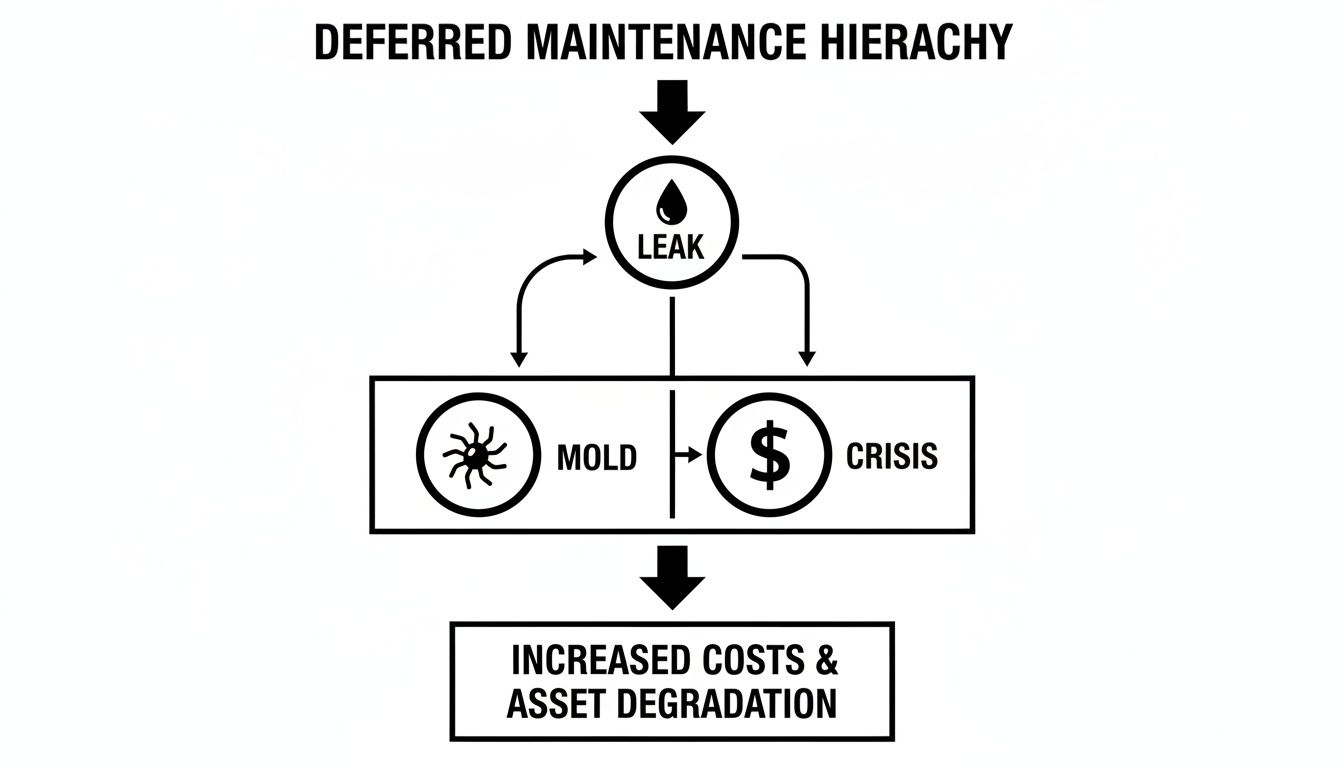
As you can see, a simple leak that gets ignored can lead directly to much bigger headaches like mold remediation or a major financial drain, hammering home the need for a solid emergency fund.
Calculating Your Allocations
With these three pillars in mind, the next step is to actually fund them. A common starting point is the classic 1% to 3% rule, which suggests setting aside that percentage of your property's value each year for total maintenance. For a $300,000 home, this means budgeting between $3,000 to $9,000 annually to cover everything from routine upkeep to emergency repairs and planned upgrades.
A well-structured budget is the ultimate defense against unexpected expenses. By separating funds for routine care, future replacements, and emergencies, you can handle any maintenance issue without jeopardizing your financial stability or profitability.
Let's break that down with a real-world example. Say you land on an annual budget of $6,000. You might allocate it like this:
- Routine Maintenance: $1,800/year ($150/month) to cover landscaping, gutter cleaning, and HVAC tune-ups.
- CapEx Savings: $2,400/year ($200/month) that goes straight into a savings account for that future roof, appliance, or flooring replacement.
- Emergency Fund Contribution: $1,800/year ($150/month), which you'll contribute until you've built a safety net of 3-6 months' worth of operating expenses.
To help you visualize this, here's what a sample annual budget might look like for a typical single-family rental.
Sample Annual Maintenance Budget for a Single-Family Rental
| Expense Category | Monthly Allocation | Annual Total | Notes |
|---|---|---|---|
| Routine Maintenance | $150 | $1,800 | Landscaping, pest control, HVAC service contracts, smoke detector batteries, etc. |
| Capital Expenditures (CapEx) | $200 | $2,400 | Saved for future roof (15-20 yrs), water heater (8-10 yrs), appliances (10 yrs). |
| Emergency Reserve | $150 | $1,800 | Builds a fund for unexpected events like plumbing leaks or storm damage. |
| Total Annual Budget | $500 | $6,000 | Represents 2% of a $300,000 property value. |
This table provides a clear roadmap, turning a vague percentage into a concrete, actionable plan that prepares you for almost anything.
To build a really solid budget, it helps to understand what things actually cost. For instance, a detailed guide to HVAC maintenance costs can help you refine your estimates and avoid underfunding such a critical system. Keep in mind, the fees for professional property management can often be offset by the savings from proactive, cost-effective maintenance coordination. You might be interested in our guide on property management services cost to see how that investment really pays off.
Proactive Maintenance That Saves You Thousands
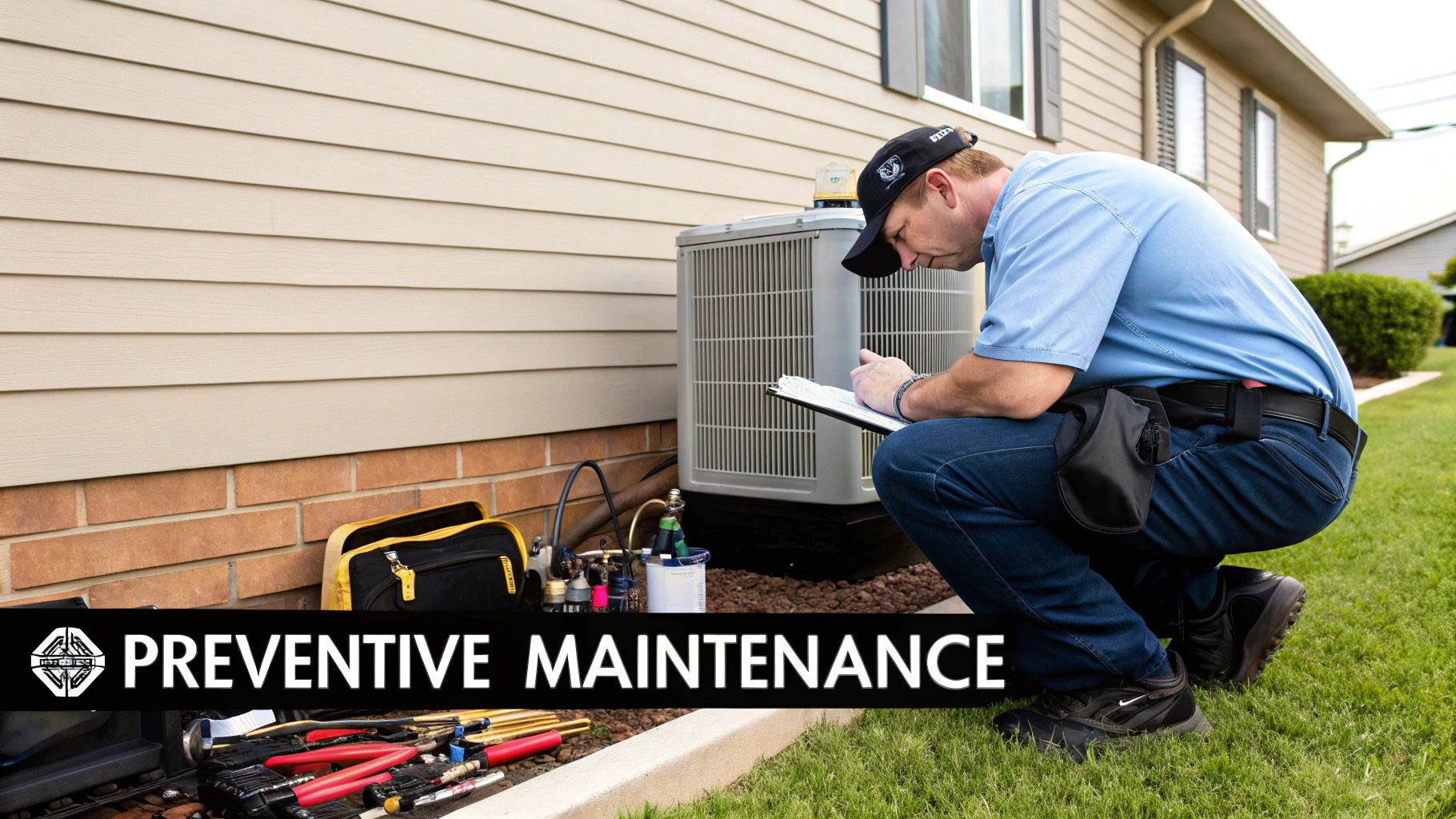
The secret to getting your rental property maintenance costs under control isn't about finding a cheaper plumber after a pipe bursts. It’s about preventing that pipe from bursting in the first place.
This shift from reactive panic to proactive planning is what separates stressed-out landlords from savvy, successful investors. Reactive maintenance is a constant fire drill—it's expensive, stressful, and a huge disruption for your tenants. Proactive maintenance, on the other hand, turns upkeep into a scheduled, predictable process that protects your asset and keeps renters happy.
The Math of Prevention
The financial case for proactive maintenance is crystal clear. Just think about the intense summer heat that hits communities like Loma Linda, Mentone, and Highland every year. A simple, preventative HVAC tune-up in the spring might cost you around $150.
That small investment ensures the system is clean, running efficiently, and ready for a triple-digit summer. Ignoring it, however, is a gamble. It dramatically increases the odds of a total system failure in July, leading to an emergency replacement that can easily cost $3,000 or more—not to mention an unhappy, overheating tenant.
By investing a small amount in scheduled upkeep, you avoid massive emergency expenses. A proactive mindset turns maintenance from an unpredictable cost center into a strategic tool for preserving your profitability.
This logic applies to everything. Inspecting roof seals before winter rains can prevent thousands in water damage. Regularly snaking a main drain line can stop a costly and disgusting sewer backup. Each proactive step is a financial shield, defending your budget against the most expensive repairs.
Your Seasonal Maintenance Playbook
For landlords in the Inland Empire, a seasonal approach is the smartest way to stay ahead of problems. Our local climate dictates which systems are under the most stress at different times of the year.
Here’s a practical, seasonal playbook to get you started:
Spring (March-May): Time to prep for the heat. This is perfect for servicing the HVAC system, checking irrigation for leaks to avoid high water bills, and inspecting window and door seals to keep the cool air inside.
Summer (June-August): This season is all about monitoring and maintaining. Regularly check for pests that thrive in the heat, make sure landscaping isn't getting out of control, and address any exterior paint that’s peeling or cracking under the intense sun.
Fall (September-November): Get your property ready for cooler, wetter weather. This means cleaning gutters and downspouts to prevent water damage, inspecting the roof for any damaged shingles, and testing the heating system before it’s actually needed.
Winter (December-February): Focus on indoor systems and safety. Test all smoke and carbon monoxide detectors, check for any plumbing leaks under sinks and around toilets, and inspect for drafts that could lead to sky-high heating bills.
Making Proactive Maintenance Work
Putting a preventative schedule in place turns maintenance from a source of anxiety into a manageable part of your business. It also builds goodwill with tenants, who always appreciate a well-cared-for home, and provides the ultimate protection for your investment.
To make sure your efforts are effective and truly save you thousands, check out these top preventive maintenance best practices. This approach not only lowers your overall rental property maintenance costs but also maximizes the long-term value and cash flow of your asset—which is the real goal for any smart investor.
Dealing with Vendors and Staying Compliant in California
Let's be honest: managing vendors and staying on the right side of the law are two of the biggest headaches for landlords, especially when it comes to maintenance costs. Finding a reliable, fairly-priced contractor here in the Inland Empire can feel like a full-time job. And if you make a mistake? It’s not just about a sloppy repair; you could be exposing yourself to some serious legal and financial trouble.
This is where you need a system. You can't just call the first plumber you find online and hope for the best. For any repair, especially the bigger ones, you absolutely have to get multiple quotes. This one simple step is your first line of defense against overpaying and can save you hundreds, if not thousands, of dollars over the course of a year.
How to Vet Contractors and Manage Repairs
Once you have a few quotes in hand, the real work begins. It’s about more than just finding the lowest price—it's about finding a trustworthy partner who will do the job right. A great vendor is the cornerstone of keeping your maintenance costs under control.
Here are the non-negotiable steps every landlord should take before hiring anyone:
- Verify Licenses and Insurance: This is a big one. Always confirm that any contractor you hire is properly licensed by the California Contractors State License Board (CSLB). They also need to carry both liability insurance and workers' compensation. This is what protects you from a lawsuit if someone gets hurt on your property.
- Check References and Reviews: Don't just take their word for it. Ask for references from recent jobs and actually call them. A quick search for online reviews can also give you a gut check on their professionalism and the quality of their work.
- Get Everything in Writing: A handshake isn't enough. A clear, written contract should detail the exact scope of work, the total cost, a payment schedule, and a timeline for completion. This document protects both you and the contractor if things go sideways.
It’s a time-consuming process, no doubt. But one bad experience with a shady contractor can wipe out an entire year's profit and cause a mountain of stress.
A pre-vetted network of trusted, local contractors is one of the most valuable assets a property owner can have. It eliminates the guesswork, ensures quality workmanship, and provides peace of mind that every repair is handled correctly and professionally.
Recent data shows just how fast these costs are climbing. Total repairs and maintenance for rental properties jumped 13.7% in recent years, with a median cost of $950 per incident. That surge was driven by huge spikes in appliance repairs, painting, and general upkeep—all up over 20%. And these operating expenses are going up everywhere, with 96% of markets seeing increases, including right here in Riverside, California. You can get more details in this report on the challenging times in the rental housing industry.
Understanding California's Warranty of Habitability
Beyond finding good people to do the work, California landlords have to follow some very strict legal standards. The most important one is the implied warranty of habitability. This state law requires you to keep your property in a safe and livable condition at all times.
This isn't just a suggestion; it's a legal obligation. If you fail to promptly fix issues that affect a tenant's ability to live safely—like a broken heater in winter, a major plumbing leak, or a pest infestation—you can face severe consequences. Tenants may have the right to withhold rent, make the repairs themselves and deduct the cost from their rent, or even break the lease entirely. For a deeper dive, check out our guide on the essential landlord responsibilities in California.
Trying to juggle these rules while finding and managing vendors is where many DIY landlords get into trouble. It's also where professional management provides its greatest value.
At AIM Property Management, we take this entire burden off your shoulders. We lean on our established network of trusted, local contractors in communities like Redlands, Yucaipa, Beaumont, Calimesa, Loma Linda, Mentone, Highland, and Banning who we know deliver quality work at fair prices. Every single repair is documented and handled in full compliance with California law, protecting your investment and giving you complete peace of mind.
How Professional Management Reduces Your Total Costs
It's one of the biggest misconceptions we see from rental owners: viewing professional property management as just another line-item expense. In reality, a great management partner is an investment—one that’s specifically designed to lower your total rental property maintenance costs and protect your asset for the long haul.
Hiring a manager isn't about adding a cost. It’s about plugging into a system built for savings, efficiency, and—most importantly—peace of mind. This is where all the pieces we've talked about, from proactive maintenance to vendor relationships, come together under one roof.
Shielding Your Investment from Day One
The savings don't start with the first repair request. They start the moment we begin looking for a tenant. A rock-solid, rigorous tenant screening process is your first line of defense against the headaches of property damage, excessive wear and tear, and the nightmare of a costly eviction.
Placing a high-quality tenant who treats your home like their own immediately drops your future maintenance spending. It’s a foundational step that many DIY landlords overlook, but it has a massive impact on your rental's profitability in areas like Redlands, Beaumont, and Loma Linda.
From there, the savings really start to multiply through smart, professional operations. A good manager brings systems to the table that an individual landlord simply can't replicate.
- 24/7 Maintenance Coordination: Problems don't wait for business hours. When an issue pops up, it’s addressed right away, stopping a minor leak from becoming a catastrophic flood. Quick action turns expensive disasters into manageable fixes.
- Regular Property Inspections: Our team conducts scheduled inspections to catch the little things—a small drip under a sink, the first sign of pests—before an untrained eye would ever notice. This proactive approach turns potential budget-breakers into minor, affordable repairs.
Hiring a property manager flips the script from reactive and expensive to proactive and controlled. It's an investment in proven systems that cut expenses, minimize risk, and ultimately boost your return.
Leveraging Networks and Expertise for Financial Gain
Beyond just being proactive, a huge financial win comes from a manager’s established network of vendors. We’ve spent years building relationships with trusted, licensed, and insured contractors across the Inland Empire, from Yucaipa and Mentone to Loma Linda and Banning.
This network gives you two massive advantages. First, you get access to preferred pricing that isn't available to the general public, which directly lowers the cost of every single job. Second, you get the confidence of quality work, which means you won't be paying to have the same job done twice.
The final layer of protection comes from meticulous financial tracking and ironclad legal compliance. We make sure every expense is documented and that every action follows California’s complex landlord-tenant laws. This shields you from the risk of expensive fines and legal battles down the road. You can learn more by exploring our detailed guide on the crucial property management company responsibilities that generate these savings.
At the end of the day, professional management is about optimizing your investment. It saves you time, gets rid of the stress, and—most importantly—puts more money back in your pocket by systematically driving down your biggest operational expense.
Frequently Asked Questions About Maintenance Costs
We get a lot of questions from landlords trying to get a handle on maintenance costs. Here are some of the most common ones we hear, with straightforward answers to help you plan better and protect your investment.
What Is a Realistic Annual Maintenance Budget?
A smart place to start is the 1-3% rule. For a $500,000 home here in Beaumont, Yucaipa, or Highland, that works out to between $5,000 and $15,000 a year set aside for maintenance.
But that’s just a ballpark estimate. The real number depends heavily on your property’s age and condition. A brand-new build might sit comfortably at 1%, but an older home with some deferred projects could easily need 3% or more. This is where a professional assessment makes a world of difference in creating an accurate, reliable budget.
Is It Worth Hiring a Property Manager for Maintenance?
Absolutely, but thinking about it just in terms of maintenance is missing the bigger picture. A great property manager saves you money everywhere. They find better tenants who cause less wear and tear, market your property effectively to slash vacancy time, and handle all the legal compliance that keeps you out of expensive trouble.
The savings from preventing just one bad tenant or one major, mishandled repair can often pay for the management fee for an entire year. It’s about total asset protection, not just fixing things when they break.
By streamlining every part of the operation, a manager boosts your overall return. When you look at it that way, the decision to hire a property manager becomes much clearer.
What Are the Biggest Hidden Costs for Landlords?
Beyond the usual repairs, some of the sneakiest costs for California landlords are water-related issues like slow leaks and mold, HVAC systems failing under our intense Inland Empire heat, and the surprisingly high cost of tenant turnover.
Every time a tenant moves out, you’re on the hook for cleaning, repairs, and marketing—all while losing rent. Proactive management in areas like Redlands, Yucaipa, and Mentone tackles these risks head-on with routine inspections, preventative servicing, and a laser focus on keeping great, long-term tenants happy. You can dive deeper by checking out our answers to other maintenance questions we often get from landlords.
How Much Should I Have in an Emergency Fund?
Having a solid cash reserve is non-negotiable for a landlord. We always recommend keeping an emergency fund with at least 3-6 months' worth of your total operating expenses—that includes the mortgage, taxes, and insurance.
This fund is your safety net. It means you can handle a massive, unexpected hit—like a main sewer line collapse or a sudden roof replacement—without having to sell off other assets or take on debt. It’s what lets you sleep at night, knowing you can weather any storm and keep your investment profitable.
Managing rental property maintenance costs is the difference between a successful investment and a financial headache. If you're looking for expert Yucaipa property management or Beaumont property management services, AIM PROPERTY MANAGEMENT COMPANY has the local knowledge and proven systems to protect your property, cut down your stress, and boost your bottom line. We proudly serve Redlands, Beaumont, Calimesa, Yucaipa, Loma Linda, Mentone, Highland, and Banning, California. Contact us today to see how we can help. https://aim-properties.com