
Redlands rentals don’t sit still for long. In one local snapshot, vacancy rates hover around 4% and well-priced rentals lease within 28 to 35 days according to Rentix’s Redlands market overview. That single fact changes how owners should think about management. In a market that moves this quickly, small delays in pricing, screening, maintenance follow-up, or legal paperwork can turn into avoidable vacancy and stress.
Many owners start out thinking self-management will be simple. Then the first weekend repair call comes in. Rent is late on Monday. A lease renewal needs updated terms. A question about California compliance lands in your inbox. Managing one home can start to feel like trying to conduct an orchestra while also playing every instrument.
That’s where redlands property management becomes less of a convenience and more of an operating system. A solid manager helps owners make faster decisions, protect income, and avoid hidden costs that don’t show up on a simple fee sheet. This matters in Redlands, and it also matters for owners searching for Property Management Beaumont, Beaumont property management, Yucaipa property management, property management Yucaipa, and property management Redlands support across nearby Inland Empire communities.
Why Redlands Property Management Matters
A rental home can look calm from the street and still be full of moving parts behind the scenes. Rent collection has to happen on time. Repairs need triage. Tenants need answers. Lease files need to stay organized. California rules don’t pause because an owner is traveling, busy at work, or tired of handling every detail alone.
That’s why many owners hit the same wall. They aren’t failing. They’re trying to do three jobs at once. They’re acting as bookkeeper, maintenance coordinator, leasing agent, and compliance monitor, often after normal business hours.
The hidden work owners underestimate
The visible parts of landlording are easy to name. The invisible parts are what usually create friction.
- Timing decisions: A property may need a quick pricing adjustment, faster photo scheduling, or immediate vendor dispatch.
- Documentation discipline: Lease clauses, notices, inspection notes, and payment records need to be consistent and accessible.
- Judgment calls: Owners have to decide what’s urgent, what’s cosmetic, and what creates bigger liability if ignored.
A lot of people search for property management near me only after a stressful moment. That’s understandable, but the smarter move is earlier. The best management relationships are built before an issue becomes expensive.
Practical rule: Good management isn’t just about collecting rent. It’s about reducing the number of bad surprises an owner has to absorb.
Owners who want a more local perspective on why neighborhood familiarity matters can compare that thinking with AIM’s explanation of hometown property management.
Why local context changes the answer
Redlands isn’t a generic rental market. Tenant expectations, property types, commute patterns, and neighborhood differences all affect how a home should be marketed and managed. The same is true for nearby cities. A condo in Beaumont, a single-family rental in Redlands, and a home in Yucaipa may need different messaging, maintenance planning, and lease handling.
That local nuance is what separates basic administration from thoughtful property management Redlands service.
Understanding Redlands Rental Market Dynamics
A few pricing decisions can change a full year of return. In Redlands, the difference between a home that leases on time and one that lingers often comes down to local fit, not broad county averages.

What the rent numbers actually mean
Owners usually see rent ranges first. The harder question is what those ranges should change in day to day decisions.
Current Redlands rent data in this article shows a clear split by property type. Single-family homes sit at the higher end, while condos and townhomes rent for less. That pattern matters because pricing a rental works more like setting the starting point on a map than picking a number out of thin air. If the starting point is off, every later step gets harder. Showings slow down, applicants compare more aggressively, and vacancy days start to add up.
Higher local rents can create good income potential. They also raise renter expectations. A resident paying premium rent usually expects faster communication, cleaner presentation, and fewer unresolved repair issues.
That is where transparent management fees matter too. A strong monthly rent figure can look better on paper than it feels in practice if hidden maintenance markups, after-hours dispatch charges, or vague inspection fees keep shaving off the owner’s return.
Speed matters, but accuracy matters first
Redlands is active enough that early listing performance carries a lot of weight. The first few days after a property goes live often shape the whole leasing cycle. If photos are weak, the description is generic, or inquiry follow-up is slow, the listing can lose momentum before the owner realizes anything is wrong.
A good comparison is a doctor reading symptoms early. Small signals matter. Fewer saves, fewer showing requests, or repeated comments about price usually mean the market is pushing back.
Owners should ask three questions right away:
- Is the asking rent matched to this neighborhood and property type?
- Is the home presented at the standard renters expect at this price?
- Is the manager tracking response speed and application drop-off?
Those questions sound basic, but they prevent expensive drift.
Low vacancy does not protect a poorly run property
A tight market helps competent operators more than it helps careless ones. Low vacancy means there are renters looking. It also means competing listings that are cleaner, faster, and easier to rent stand out quickly.
That is why hyper-local analysis matters. One Redlands neighborhood may attract commuters who care about parking and freeway access. Another may draw households focused on school routines, yard space, or bedroom count. A condo renter and a single-family renter are often solving different problems, so the same ad copy and repair plan should not be used for both.
Owners also need to connect market conditions to compliance. Recent rent control and notice-rule changes across California have made "good enough" lease administration riskier than it used to be. Even when a Redlands property is exempt from a specific cap or rule, the owner still needs clear documentation showing why. Compliance is part of market strategy because a pricing decision only helps if the lease, notices, and increase timing are handled correctly.
Different property types produce different management math
A single-family home, condo, and townhome can all rent well in Redlands, but they do not perform the same way operationally.
Single-family homes often bring higher rent, but maintenance costs can be broader because the owner may be responsible for more exterior systems, landscaping, or larger-ticket repairs. Condos may have lower rent ceilings, yet HOA rules, access procedures, and maintenance boundaries can create their own friction. Townhomes often sit in the middle.
That is why owners should look past gross rent and ask what the property keeps after routine costs, turnover risk, and fee structure. A lower-rent property with fewer surprise expenses can outperform a higher-rent home with frequent repairs and unclear vendor billing.
For owners comparing nearby patterns, single-family rental trends in Redlands, Yucaipa, and Beaumont add useful local context.
A simple way to read this market
| Market signal | What it suggests for owners | What to ask your manager about this |
|---|---|---|
| Higher rents by property type | Pricing has to match the exact home, not a citywide average | How did you set rent for this property type and neighborhood? |
| Strong renter expectations | Condition, communication, and repair speed affect leasing results | What service standards do you follow after a lead comes in or a repair is reported? |
| Tight vacancy conditions | Preventable mistakes become more visible, faster | How quickly do you adjust price, photos, or showing strategy if traffic is weak? |
| Different operating costs by property type | Net return matters more than headline rent | Which maintenance fees, markups, and inspection charges should I expect in writing? |
| Compliance changes affecting rent and notices | Lease handling can create legal and financial risk | What recent rent increase and notice rules apply to my property, and how do you document them? |
Redlands rewards owners who treat pricing, cost control, and compliance as one system. That is the core purpose of property management here. The goal is not just to fill a vacancy, but to protect income after fees, avoid preventable legal mistakes, and keep the property competitive in its specific neighborhood.
Core Redlands Property Management Services
Owners often hear a list of services and still wonder, “What does that do for me on a Tuesday?” The answer becomes clearer when you connect each service to a problem it prevents.
Screening is the front gate
Tenant screening is the first checkpoint system. Once a resident moves in, nearly everything gets harder to change. That’s why screening deserves more attention than flashy marketing.
In one Redlands-focused summary, rigorous screening with credit checks, background verifications, and income validation is tied to reduced vacancy and lower financial loss, with tenant placement within 30 days according to TrueDoor’s Redlands property management page.
That matters because screening isn’t about finding a perfect tenant. It’s about lowering the odds of predictable trouble.
A careful process usually looks at:
- Income consistency: Can the applicant realistically support the rent?
- Credit behavior: Not as a moral score, but as a pattern of financial follow-through.
- Background review: A way to surface issues an owner should know before signing a lease.
- Application completeness: Missing details often create later confusion.
Rent collection is a system, not a monthly reminder
Owners sometimes treat rent collection like a calendar event. Professional management treats it like a workflow. Payment methods, reminders, documentation, and follow-up all matter.
A digital process helps tenants pay consistently and gives owners cleaner records. Even if you self-manage, a basic tracking system is useful. If you want a simple way to organize unit-level revenue and occupancy details, this rent roll template excel resource can help you understand what managers are typically tracking behind the scenes.
Maintenance coordination protects more than comfort
Maintenance is where many owners lose time and money because they react too late. A small leak can become drywall damage. A tenant complaint can become frustration if no one closes the loop. Fast coordination protects the property and often preserves the relationship with the resident.
Think of maintenance like air traffic control. The repair itself matters, but so does routing. Someone has to decide urgency, contact the right vendor, confirm access, monitor completion, and record the outcome.
A repair ticket isn’t finished when the vendor leaves. It’s finished when the issue is documented and the property is stable again.
Inspections work like routine checkups
An inspection isn’t there to “catch” people. It’s a health check for the asset. Small wear patterns, lease concerns, and early system issues are easier to address before they become expensive.
Regular inspections can help owners answer practical questions:
- Is the property being cared for?
- Are there signs of deferred maintenance?
- Does anything need attention before renewal or turnover?
Lease and compliance management reduce avoidable risk
California rental rules aren’t something owners can afford to treat casually. Lease language, notice handling, and recordkeeping all need consistency. Consistency is why process matters more than personality.
One option owners use for these day-to-day tasks is AIM’s residential property management service, which covers tenant screening, rent collection, maintenance coordination, inspections, and document handling for nearby Inland Empire communities.
For anyone evaluating Redlands property management, Beaumont property management, or Yucaipa property management options, the core question isn’t “Do they offer services?” Most do. The better question is, “What process do they follow when something goes wrong?”
Case Studies of Effective Redlands Property Management
Stories make management choices easier to judge because they show how decisions play out in ordinary situations.

A single-family owner buried in after-hours issues
A Redlands homeowner had a familiar problem. The home itself was attractive, but every issue reached the owner directly. Evening texts about a clogged drain. Weekend calls about a garage remote. Follow-up questions after a repair because nobody had clearly explained what was done.
The largest problem wasn’t one giant emergency. It was interruption.
After shifting to a managed workflow, the owner’s role changed. Tenants had a clear path for repair requests. Vendors could be coordinated without the owner acting as dispatcher. Inspection notes and service records gave the owner a cleaner picture of the property.
The result wasn’t magic. It was structure. The owner stopped living in a state of low-grade alert.
A condo investor comparing long-term and short-term strategy
Another owner held a condo and kept circling the same question. Should the unit stay in traditional leasing, or did short-term rental economics justify a different strategy?
In Redlands, short-term rental data shows average annual income of $25,445 per listing, 44.8% occupancy, a $188 average daily rate, and $90 RevPAR, according to AirROI’s Redlands Airbnb data. That doesn’t mean every property should become a short-term rental. It does mean owners should evaluate use case, location, turnover burden, and management intensity instead of relying on guesswork.
For this investor, the right answer depended on temperament as much as revenue. Short-term rentals can bring more moving pieces, including guest communication, cleaning coordination, calendar management, and compliance review. A traditional lease offered steadier operations and less frequent turnover friction.
Sometimes the smartest management decision isn’t the highest upside on paper. It’s the model the owner can sustain without chaos.
What these examples reveal
Both owners had different properties and different pain points. But the pattern was the same. They didn’t just need tasks completed. They needed a repeatable process.
That’s also why owners often compare individual homes with nearby professionally managed communities such as Pebblebrook Apartments in Redlands. Even when the property type differs, the lesson is useful. Consistent communication, organized maintenance, and clear standards tend to produce more stable day-to-day operations.
For property management Redlands decisions, the takeaway is simple. The quality of the system matters as much as the quality of the property.
Step by Step AIM Property Management Process
A management relationship works best when owners know what happens first, what happens next, and who handles each decision. Confusion usually starts when the process is vague.
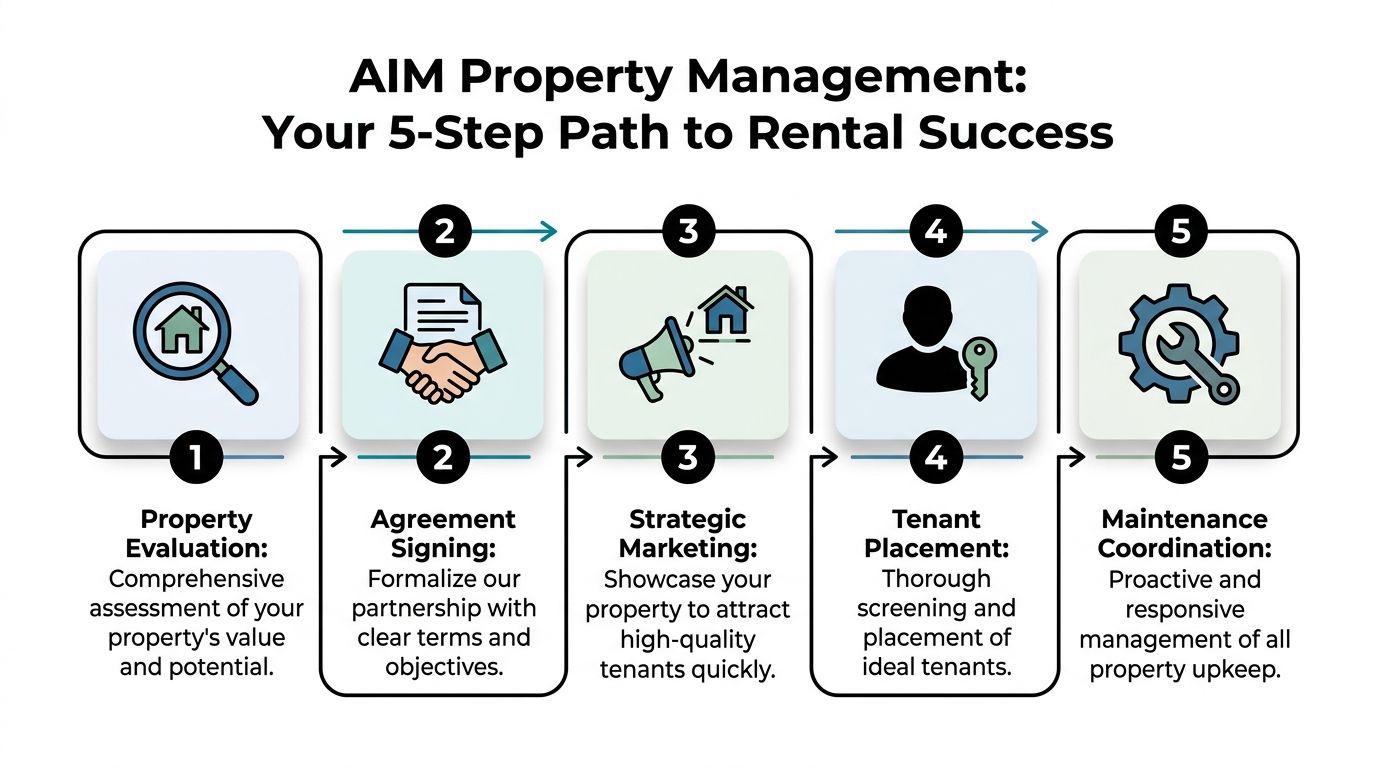
Step 1 Evaluate the property
The first stage is diagnosis. Before rent is discussed or marketing begins, the property needs to be reviewed as a rental asset. Condition, layout, target tenant profile, likely maintenance needs, and documentation all shape the management plan.
Owners often get their first useful reality check then. A home may have strong rental potential but still need minor adjustments before it’s ready to market well.
Step 2 Set the agreement and operating rules
Next comes the operating framework. This includes the management agreement, communication expectations, approval thresholds for repairs, owner disbursement setup, and document collection.
The point isn’t paperwork for its own sake. It’s clarity.
A good agreement answers practical questions:
- Who approves non-emergency repairs
- How often the owner receives reporting
- How tenant communication is routed
- What happens when a lease renews or ends
Step 3 Prepare marketing and pricing
Once the property is ready, marketing starts. That usually means photos, listing copy, pricing review, showing coordination, and application handling. In a market like Redlands, early accuracy matters because interest tends to cluster near the start of a listing’s life.
Step 4 Screen and place the tenant
Applications need consistent review. Screening standards should be applied evenly and documented carefully. This stage also includes lease preparation, deposit handling, move-in condition tracking, and clear tenant onboarding.
That onboarding piece gets overlooked. A resident who knows how to pay rent, request repairs, and understand lease expectations is less likely to create preventable confusion later.
Step 5 Manage the home through the lease cycle
This is the longest phase. It includes rent collection, maintenance coordination, inspection planning, owner reporting, renewal decisions, and turnover handling if the tenant leaves.
The process should feel steady, not improvisational.
Owner checklist: Ask how the manager handles communication during ordinary months, not just emergencies. Most of property management is routine follow-through.
Why compliance now needs more attention
One of the biggest gaps in local content is that many owners still don’t have plain-language guidance on newer California rules. A local analysis notes that late 2025 rent control expansions under AB 1482 extensions cap annual increases at 5% plus CPI, up to 10%, and 68% of Inland Empire landlords report compliance confusion, which is associated with 22% higher vacancy rates according to this review of questions to ask before hiring a property manager.
That has practical implications for redlands property management:
- Lease renewals need review before notices go out.
- Rent increase decisions shouldn’t be made casually.
- “Just cause” protections and property-specific exemptions need careful handling.
For owners searching hire a property manager options, this is one of the clearest dividing lines. Some firms mainly coordinate tasks. Others build compliance into the workflow so owners don’t have to reverse-engineer legal requirements later.
Local Service Areas in Beaumont and Yucaipa
Owners rarely manage in just one city forever. Many hold a home in Redlands, then buy in Beaumont, inherit in Yucaipa, or compare returns across nearby communities. That’s why local adaptation matters.
What owners in Beaumont and Yucaipa should compare
The table below isn’t a market-stat table because city-level figures weren’t provided here. It’s a management lens. It helps owners compare how service needs can differ even when the basic property management framework stays the same.
| Metric | Beaumont | Yucaipa |
|---|---|---|
| Typical owner concern | Leasing speed for newer suburban inventory | Ongoing upkeep and neighborhood-specific expectations |
| Marketing emphasis | Positioning the home clearly for commuter-oriented renters | Highlighting lifestyle, space, and long-term livability |
| Inspection focus | Seasonal wear, turnover readiness, exterior review | Preventive checks, resident care patterns, HOA-aware details where relevant |
| Maintenance priority | Fast vendor dispatch and clean documentation | Follow-up communication and clear reinspection habits |
| Best fit for owners who want | Efficient leasing structure | More hands-on oversight rhythm |
Why transparency matters across all service areas
A recurring problem in local property management content is vague maintenance language. One Redlands-focused review notes that only 12% of top results explain markups or post-repair reinspection policies, while average third-party repair markups are listed at 15% to 20%, and maintenance disputes cause 31% of tenant turnover in San Bernardino County according to this maintenance FAQ analysis.
That matters beyond Redlands. It matters for Property Management Beaumont, Beaumont property management, Yucaipa property management, and property management Yucaipa searches too.
Owners should ask direct questions such as:
- Do you add a markup to outside vendor invoices
- Do you reinspect after significant repairs
- Who communicates with the tenant after the work is completed
- How are estimates, approvals, and invoices documented
If a company can’t explain its maintenance workflow plainly, the owner is the one who usually absorbs the confusion later.
Beaumont often rewards clean leasing execution
In Beaumont, many owners benefit from disciplined listing preparation, prompt lead response, and organized turnover work. A home can be attractive on paper and still lose momentum if showing logistics are clumsy or repair punch-list items linger.
That’s why owners comparing options often start with a dedicated local page such as AIM’s Beaumont property management service area.
Yucaipa often rewards maintenance follow-through
Yucaipa owners often pay closer attention to property condition over time. The practical issue isn’t just whether a repair happened. It’s whether the repair solved the issue cleanly, whether the resident was informed, and whether the file reflects what was done.
That distinction sounds small. It isn’t. Clear follow-up is one of the biggest separators between a manager who reduces friction and one who forwards invoices.
Ask every property manager the same thing: “Walk me through a non-emergency repair from tenant request to final closeout.” The quality of the answer tells you a lot.
For owners with homes spread across neighboring cities, that local customization matters more than a generic promise of “full service.”
Conclusion and Next Steps
Redlands offers strong rental potential, but strong markets don’t forgive sloppy operations. Owners still need accurate pricing, dependable screening, organized maintenance, and careful compliance handling. That’s true whether you own one house in Redlands or a small portfolio that also includes Beaumont, Yucaipa, Loma Linda, Mentone, Highland, Calimesa, or Banning.
The most useful way to evaluate redlands property management isn’t by asking who says they do everything. It’s by asking who can explain their process clearly. How do they screen? How do they handle repairs? How do they document approvals? How do they adapt to California rent-control rules and lease changes? How transparent are they about vendor markups and maintenance follow-up?
Those answers shape your real return more than a polished website headline ever will.
If you’re comparing property management Redlands, Property Management Beaumont, Beaumont property management, Yucaipa property management, or property management Yucaipa options, focus on operating discipline. The right manager should reduce noise, protect your time, and give you cleaner visibility into the property without forcing you back into day-to-day firefighting.
Common Questions About Hiring a Property Manager
How do I find property management near me
Start with geography, then move quickly to process. A local office matters, but local knowledge only helps if the company can explain how it handles leasing, maintenance, inspections, renewals, and compliance. If you search property management near me, don’t stop at proximity. Ask for their workflow.
What fees should I expect in Redlands property management
Fee structures vary, so the bigger issue is transparency. Ask whether the manager charges separate leasing fees, renewal fees, inspection fees, or vendor markups on repairs. Hidden maintenance handling can cost more than the base management fee if the process is vague.
What’s the difference between full-service and à la carte management
Full-service management usually means one team handles leasing, screening, rent collection, maintenance coordination, inspections, and lease administration together. À la carte service can work for some owners, but it often leaves gaps. If nobody owns the whole process, details can slip between vendors and the owner ends up stitching it all together.
How do I hire a property manager without signing a bad agreement
Read the management contract slowly. Look for termination terms, repair approval rules, fee disclosures, and who controls vendor selection. If you want a practical outside example of how to understand what to look for in contracts and spot red flags, this guide from West Pest Co. is useful because the contract-review mindset applies beyond pest control.
What should I ask about lease compliance
Ask who updates lease language, how notices are handled, and how the company tracks California law changes. This is especially important if you’re trying to hire a property manager for a single-family home and assume the rules are always simple. They often aren’t.
What should I ask about maintenance response
Ask how requests are submitted, who decides urgency, whether outside vendors are marked up, and whether repairs are reinspected when needed. A fast response is good. A documented response is better.
If you own a rental in Redlands, Beaumont, Yucaipa, Loma Linda, Highland, Mentone, Calimesa, or Banning and want a clearer management process, review AIM PROPERTY MANAGEMENT COMPANY and request a conversation about leasing, maintenance coordination, inspections, and compliance support for your property.