
You bought the property for a reason. Maybe it became a rental when you moved up, maybe it’s part of a growing portfolio, or maybe you held onto a Redlands home because you knew the location would stay desirable. What usually catches owners off guard isn’t the property itself. It’s the constant management.
A lease renewal lands in the middle of a work trip. A maintenance request comes in after dinner. A tenant pays late and suddenly you’re checking notices, timelines, and California rules instead of focusing on your own business and family. For many owners, the rental starts producing income but also starts acting like a second job.
That’s where redlands ca property management matters. In a market this active, good management isn’t just about convenience. It’s about protecting income, reducing downtime, and making sure the property performs the way it should.
Maximize Your Redlands Rental Without the Headaches
If your rental has started to feel like an interruption machine, you’re not alone. Owners in Redlands often have strong equity, strong incomes, and very little spare time. They don’t need more to do. They need a reliable operating system for the property.

Why Redlands still rewards careful operators
The local rental picture is strong. Average rent across property types in Redlands reached $2,307 per month, which is 13% above the national average, and well-priced rentals lease in about 28 to 35 days according to Zillow’s Redlands rental market trends. That kind of demand is good news, but it also creates pressure to price accurately, respond quickly, and avoid sloppy tenant placement.
In practice, that means a property owner has two choices. You can try to manage every showing, notice, repair approval, and lease detail yourself. Or you can build a process that keeps the property occupied and compliant without taking over your schedule.
Practical rule: Strong markets don’t fix weak management. They expose it faster.
A lot of owners assume a desirable home in Redlands will “rent itself.” That usually leads to predictable mistakes. The listing goes live with weak photos, screening standards get loose because the owner wants the property filled quickly, and maintenance becomes reactive instead of organized.
What relief actually looks like
Professional management should do three things at the same time:
- Protect your time by handling daily tenant communication and coordination
- Protect your income by reducing vacancy and enforcing lease terms
- Protect your asset by keeping the home maintained and legally compliant
If you’re still deciding whether to self-manage or hand it off, this guide on how to rent out your house is a useful starting point because it frames the operational work owners often underestimate.
When Redlands property management is handled correctly, your rental stops being a recurring distraction and starts behaving like what it should be: a well-run investment.
The AIM Advantage A Strategic Approach to Property Management
Generic management advice usually stops at “screen tenants and collect rent.” That’s not enough in Redlands. The owners who do well over time are the ones who match their strategy to the actual local renter pool, the property type, and the legal environment.
Local strategy beats generic management
One of the more important shifts in Redlands is the pressure in moderate-income housing. Since 2021, the city has struggled to meet state mandates for moderate-income housing, creating a real missing middle renter segment, as discussed in Community Forward Redlands. For owners, that matters because it changes how you think about pricing, screening, and lease stability.
These renters often aren’t looking for luxury positioning or distressed housing. They want a well-kept home, clear expectations, responsive maintenance, and a landlord or manager who runs the property professionally. That’s a good fit for owners who care more about stable occupancy and consistent performance than constant turnover.
What changes when management gets strategic
A serious property manager isn’t just a rent collector. The job is to balance three competing priorities:
| Area of Management | DIY Approach (The Risks) | AIM Professional Solution (The Protection) |
|---|---|---|
| Leasing | Owner writes a quick listing, answers inquiries when available, and risks weak applicant filtering | Professional marketing, organized showings, and consistent qualification standards |
| Screening | Decisions get rushed when vacancy feels urgent | Background checks, credit review, income verification, and documented approval criteria |
| Rent collection | Late payments become awkward personal conversations | Structured collection process and clear lease enforcement |
| Maintenance | Repairs depend on owner availability and vendor scrambling | Coordinated repair dispatch and tenant communication |
| Inspections | Condition issues stay hidden until they’re expensive | Routine inspections and documented property condition |
| Compliance | Owners try to interpret legal notices and deadlines themselves | Organized documentation and process-driven compliance support |
That distinction is why many owners eventually decide to see why clients renew year after year. They aren’t paying to avoid one task. They’re replacing an unstable system with a reliable one.
A well-managed rental doesn’t feel busy. It feels controlled.
A Redlands property management approach that understands local demand, renter behavior, and operational discipline tends to produce better tenancy decisions. That’s especially true when you’re serving the missing middle, where retention often depends on fairness, responsiveness, and consistency more than flashy amenities.
Our Full-Service Property Management Process
Owners usually want the same thing. They want to know what happens after they hand over management. Not in broad terms. In actual day-to-day terms.
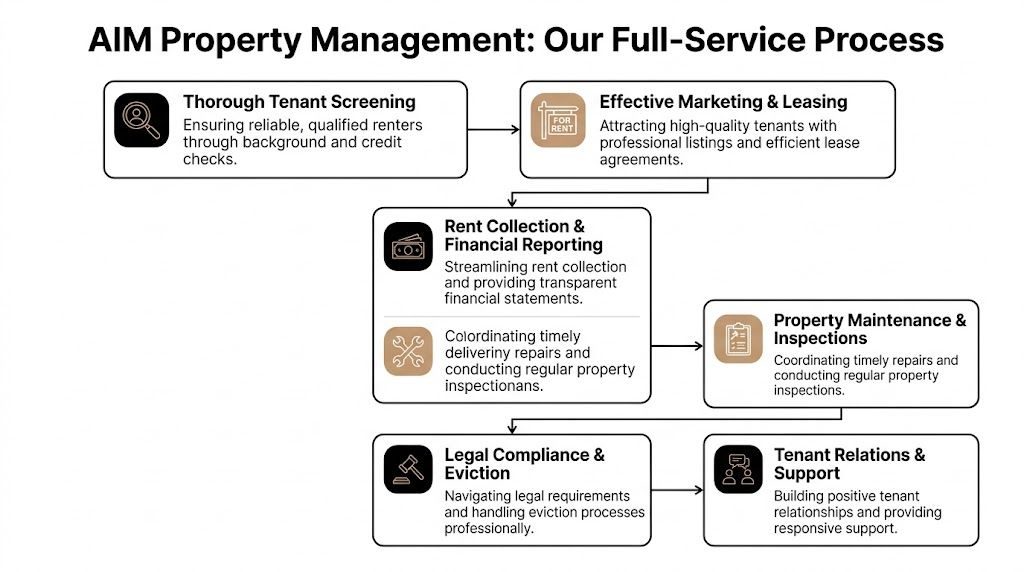
Thorough tenant screening
Good management starts with effective screening. A weak screening decision can create months of friction, delayed rent, property wear, and legal expense. A disciplined screening process reduces that risk before the lease is signed.
The basics matter. Background checks, credit reports, and income verification all serve a different purpose. Together, they give a more complete picture of whether an applicant is likely to perform under the lease.
Rigorous tenant screening can reduce eviction risk, and preventing one eviction can save 60 to 90 days of lost rent in California. That’s not a small operational detail. It directly affects your net operating income.
What works in screening:
- Consistent criteria so every applicant is measured the same way
- Verified income so the rent burden is realistic
- Background review to flag avoidable risk
- Credit review to identify payment patterns, not just a single score
What doesn’t work is emotional leasing. Owners sometimes approve the applicant who seems nicest at the showing or the one who wants to move in fastest. That shortcut often creates the exact problem they were trying to avoid.
Diligent rent collection
Rent collection isn’t complicated when the lease is clear, the process is standardized, and tenants know the expectations from day one. It becomes messy when owners make exceptions casually or collect in different ways from different tenants.
Professional management creates structure. Rent is due on a known schedule. Communication is documented. Late payment procedures follow the lease, not the owner’s mood that week.
That structure helps in two ways. First, tenants take the obligation more seriously when the process is formal. Second, owners don’t get pulled into personal negotiation every time a payment issue appears.
A solid management platform also gives owners regular statements and a cleaner record of income and expenses. If you want a broader view of what falls inside that operational role, this overview of property management company responsibilities is useful.
Owner insight: The goal isn’t to chase rent better. The goal is to create a system where chasing rent becomes less necessary.
24 7 maintenance and repairs
Maintenance is where many self-managed rentals start to slip. The issue usually isn’t that owners don’t care. It’s that repairs arrive at inconvenient times, vendors aren’t always available, and tenants lose confidence when communication slows down.
A reliable maintenance process has several moving parts:
- Tenant reporting channels that are easy to use
- Triage to separate urgent issues from routine ones
- Trusted vendors who can do the work properly
- Documentation so the owner knows what happened and why
Plumbing problems are a good example. A small leak under a sink can be a minor service call or the beginning of cabinet damage, flooring damage, and tenant frustration if no one acts quickly. Owners who want a practical outside resource on this topic should review Plumbing Maintenance And Repair In Your Rental Property, because plumbing failures are one of the easiest ways a manageable issue turns into a disruptive one.
What works is speed plus judgment. You need someone who can respond promptly and still make disciplined repair decisions. What doesn’t work is approving everything blindly or delaying everything to “save money.”
Proactive property inspections
Inspections protect both the property and the lease. They help identify deferred maintenance, unauthorized occupants or animals, safety issues, and housekeeping patterns before those problems become expensive.
In Redlands property management, inspections are especially important because many owners are holding properties for long-term appreciation, not just monthly income. If the property condition erodes imperceptibly over time, you lose on both fronts. You lose current cash flow through repairs and future value through neglect.
A useful inspection process should include:
- Move-in documentation that records the starting condition
- Routine inspections during tenancy
- Photo records that support maintenance and lease enforcement
- Clear follow-up when a concern needs correction
Annual inspections are one of the simplest habits that separate active management from passive hope.
Ironclad legal compliance
California owners don’t need vague reassurance. They need process. Legal compliance touches advertising, application handling, lease language, notices, habitability issues, documentation, and, when necessary, eviction procedure.
That’s where experienced management earns its keep. Good operators don’t wait for a dispute to become a legal problem. They use standardized documents, maintain records, and follow procedure early so the property doesn’t drift into avoidable risk.
This matters in property management Redlands because many owners live busy lives and assume they can “figure it out if something comes up.” That’s rarely the safest approach. Lease enforcement is easier when expectations are clear and documented from the start.
Tenant relations and support
Not every problem is a legal problem or a maintenance problem. Many are communication problems. Tenants stay longer and cooperate more when they know where to go, how to report an issue, and what kind of response to expect.
That doesn’t mean management should be soft. It means management should be professional. Clear communication lowers friction. Lower friction usually means fewer unnecessary escalations.
For owners, that kind of tenant experience has a practical value. It protects the tone of the tenancy. And when the tone of the tenancy stays stable, the property tends to operate more smoothly.
AIM Property Management Company handles those functions for owners of single-family homes, condos, townhomes, and investment properties across this part of the Inland Empire, with screening, rent collection, maintenance coordination, inspections, and document management built into one operating process.
Driving Your Financial Success and ROI
Most owners don’t hire a manager just to avoid phone calls. They hire one because the property needs to perform financially.
Vacancy costs more than most owners think
In Redlands, homes sold after an average of 48 days in March 2026, and average rents in the market were 13% above the national average, according to Redfin’s Redlands housing market data. For rental owners, the takeaway is straightforward. Empty time is expensive.
A vacant property isn’t “waiting for the right tenant.” It’s producing no rent while still carrying taxes, insurance, utilities, mortgage obligations if applicable, and wear from turnover. When a property can command strong local rent, every unnecessary week off market matters.
The financial levers that actually move results
The strongest property management Redlands results usually come from four disciplines working together:
- Accurate pricing so the property attracts the right applicants without lingering
- Fast, professional leasing so interest converts into signed agreements
- Expense control through planned maintenance and trusted vendors
- Clear reporting so the owner sees performance instead of guessing at it
Owners who self-manage often focus too heavily on the asking rent and not enough on downtime, repair coordination, or renewal quality. That can be a costly trade. A slightly higher asking figure doesn’t help if the property sits, attracts weak applicants, or turns over more often.
Your rental’s return is shaped by operations, not just by market appreciation.
Good reporting matters here too. You should be able to review income, expenses, maintenance history, and lease status without digging through texts and invoices. If you’re evaluating the math behind long-term ownership, this guide to rental property cash flow helps frame the decisions that affect monthly performance and long-range equity.
Serving Property Owners Across The Inland Empire
A lot of owners begin by searching for redlands ca property management, then realize they need help in more than one city. That’s common in the Inland Empire, where owners often hold properties across nearby communities and want one management team that understands the region, not just a single ZIP code.

AIM serves Redlands, Beaumont, Calimesa, Yucaipa, Loma Linda, Mentone, Highland, and Banning. The properties may differ, but the owner concerns are usually familiar: tenant quality, maintenance response, lease enforcement, and preserving property condition over time.
Expert Property Management Beaumont
Property Management Beaumont requires an eye for long-term upkeep. Owners there often want a home to remain attractive to stable renters while protecting resale appeal and neighborhood fit.
Preventive maintenance matters in that environment. Mesa Properties notes that preventive maintenance, including bi-annual inspections, can avert 40 to 50 percent cost escalations by catching small issues before they become major repairs. In Beaumont property management, that principle shows up in very practical ways. A small roof issue, a plumbing drip, or HVAC neglect can become a much larger ownership problem if no one is watching.
The management style that works in Beaumont is steady and methodical. The style that fails is “wait until the tenant says it’s serious.”
Dedicated property management Yucaipa
Yucaipa property management has its own rhythm. Many owners care a great deal about tenant fit, property standards, and avoiding the kind of small neglect that changes the feel of the home over time. Property management Yucaipa succeeds when the manager keeps communication clean and the property consistently monitored.
That means regular follow-through, not just emergency reaction. It also means setting expectations early with tenants so maintenance reporting, lease compliance, and renewal conversations stay professional.
For a broader look at the region and the communities owners are evaluating, this local video is worth a quick watch.
Across Redlands, Beaumont, Yucaipa, Calimesa, Loma Linda, Mentone, Highland, and Banning, the core job stays the same. Keep good tenants, catch issues early, and run the property with enough consistency that the owner doesn’t have to.
Partner With AIM and Reclaim Your Time
If your property is producing income but consuming attention, it’s time to simplify the way it’s managed. Hiring a property manager should remove friction, not create more of it.
The process should feel straightforward:
Initial conversation
Review the property, your goals, and the level of support you want.Personalized management plan
Set expectations for leasing, communication, maintenance handling, reporting, and oversight.Seamless onboarding
Transfer documents, confirm property details, and move daily operations into a professional system.
That’s the primary benefit of professional management. You still own the asset and control the major decisions. You just stop being the person handling every text, repair request, rent issue, and compliance question personally.
If you’ve been waiting for a “better time” to make the change, the better time is usually when you’re already tired of doing it all yourself.
Your Property Management Questions Answered
When should I hire a property manager
You should hire a property manager when the rental starts taking time away from higher-value work, family time, or other investments. That often happens before an owner admits it. If leasing, maintenance, tenant communication, or legal paperwork is becoming inconsistent, it’s usually time.
How do I choose the right property management near me
Look for a company that can explain its process clearly. Ask how they screen tenants, handle maintenance, document inspections, collect rent, and manage compliance. A good local manager should give you operational answers, not just sales language. You can review common owner concerns on the AIM FAQs page.
Is professional management worth it for one house
Often, yes. One house still has the same leasing risk, legal exposure, maintenance needs, and tenant issues as a larger portfolio. In some cases, it makes even more sense because one vacancy or one bad tenant has a bigger effect when you only own a small number of rentals.
What type of properties do managers usually handle
Most residential managers work with single-family homes, condos, townhomes, and investment properties. The right fit is less about property count and more about whether the property benefits from organized leasing, financial reporting, maintenance coordination, and consistent oversight.
Can a manager help me reduce tenant headaches
Yes, but only if they have a real process. Tenant headaches usually come from weak screening, unclear lease enforcement, poor communication, or delayed maintenance. A strong manager addresses those upstream instead of just reacting after things go wrong.
If you’re ready to stop self-managing by default and start operating your rental more intentionally, contact AIM PROPERTY MANAGEMENT COMPANY to discuss your property in Redlands, Beaumont, Yucaipa, Calimesa, Loma Linda, Mentone, Highland, or Banning. A clear management plan can protect your time, stabilize your rental, and make ownership feel manageable again.