
You bought rental property for income, not interruptions. Yet many owners in Yucaipa, Beaumont, and Redlands end up acting as unpaid operators. They field repair calls, chase rent, sort through applications, and worry that one paperwork mistake could become an expensive legal problem.
That’s a bad use of your time, especially if you already run a business, manage a portfolio, or value your bandwidth. High-income owners don’t need more tasks. They need tighter systems, better reporting, and someone who understands how California rules affect cash flow, tenant placement, and risk.
Good property management Yucaipa service should do more than keep the property occupied. It should protect income, limit preventable loss, and reduce decision fatigue. The same standard applies across Property Management Beaumont, Beaumont property management, Redlands property management, and property management Redlands. If your manager can’t operate with discipline, transparency, and local knowledge, they’re not helping your investment. They’re just standing between you and your rent.
Your Partner in Yucaipa Property Success
Yucaipa is not a market for casual management. It rewards owners who move decisively and run clean operations. The housing market is very competitive, scoring 77 out of 100, with a median home price of $569K in March 2026 and homes selling in an average of 32 days, down from 55 days the previous year, according to Redfin’s Yucaipa housing market data. That tells you something important. Demand is real, and sloppy execution costs money.
If you own in Yucaipa, or nearby in Beaumont or Redlands, your property needs professional handling from day one. Strong markets don’t forgive weak screening, delayed maintenance, or unclear accounting. They expose those mistakes faster.
Passive income only works with active systems
Many owners say they want passive income, but what they really have is a second job with random emergencies. A resident reports a leak on a weekend. Another pays late. A lease renewal needs attention. An owner statement raises questions at tax time. None of this is unusual. It’s what rental ownership looks like without disciplined management.
That’s why I view Yucaipa property management as an operating function, not a convenience. A manager should protect the asset the same way a good CFO protects margin. They should create predictable rent collection, cleaner documentation, faster maintenance response, and fewer avoidable problems.
Practical rule: If your rental requires your constant attention, you don’t own a passive asset. You own an under-managed business.
Why local coverage matters
Owners often think in city lines. Tenants don’t. Vendors don’t. Regulations don’t become easier because a property sits five miles away. If you hold assets across Yucaipa, Beaumont, Redlands, Calimesa, Loma Linda, Mentone, Highland, or Banning, you need one management approach that works across the Inland Empire without becoming generic.
That’s where continuity matters. You want one team, one reporting rhythm, one screening standard, and one maintenance process. If you want to understand what keeps owners working with the same manager long term, review why clients renew year after year.
What sophisticated owners should expect
A serious property manager should give you:
- Clear financial visibility so you know what was collected, what was spent, and what needs approval
- Strong tenant qualification to reduce avoidable turnover and conflict
- Reliable maintenance coordination that protects the home and keeps tenants responsive
- California compliance awareness so routine operations don’t become legal exposure
That’s the standard. Anything less is expensive.
The AIM Process A Blueprint for Passive Income
Passive income comes from process, not hope. The owners who get the best results in property management Yucaipa, Property Management Beaumont, and property management Redlands are the ones who insist on repeatable systems. A rental should run like a well-maintained operating machine. Applications go through the same standards. Rent moves through the same workflow. Repairs follow the same chain of communication. Documentation stays organized from lease signing through renewals and, if necessary, enforcement.
Tenant screening that filters risk early
The first and biggest decision is who gets the keys. Everything after that is damage control or performance management.
A strong screening system doesn’t rely on instinct. It uses verifiable data. As Ziprent’s Yucaipa property management overview notes, a multi-layered screening process can integrate income verification, credit scoring, and background data to quantify tenant risk with standardized metrics. That matters because one poor tenant placement can result in over $15,000 in lost rent, legal fees, and damages, according to the same source.
That is why serious managers verify more than surface-level information. Income has to make sense. Credit has to fit the risk profile. Background information has to be reviewed consistently. In many cases, a minimum income-to-rent ratio is part of the evaluation. The goal isn’t to fill the vacancy fast. The goal is to fill it correctly.
A vacant unit is frustrating. A bad tenant is worse.
For high-net-worth owners, professional management earns its keep. One preventable placement mistake can wipe out months of net income. A disciplined screening standard is cheaper than an eviction, cheaper than repairs, and cheaper than extended downtime.
Rent collection and financial management that respect cash flow
Most owners don’t fire a manager because of one late repair. They fire a manager because the money feels unclear.
Rent collection needs to be routine, documented, and easy for tenants to follow. Owners also need regular statements that make income and expenses understandable without forcing them to decode a spreadsheet. If you own multiple properties across Yucaipa, Beaumont, and Redlands, this becomes even more important. You’re not just collecting rent. You’re managing timing, reserves, approvals, and tax records.
This is also where smart owners bring in outside financial coordination when needed. If your portfolio is growing or your reporting needs are getting more complex, it helps to work with professionals who can align bookkeeping and tax planning. A useful starting point is this directory of tax accountants for real estate-minded owners.
California trust account compliance is not optional
Many owners underestimate this point until they notice a disbursement timeline they don’t like. Then they assume the manager is slow. Sometimes the issue is service. Sometimes it’s California compliance.
California has strict rules around how rental income is collected, held, and disbursed. That means your cash flow timing isn’t just an operations question. It’s a compliance question. Owners with several homes often care less about speed in the abstract and more about predictability. They need to know when funds are released, what approvals affect timing, and how trust accounting procedures work.
If your current manager can’t explain that clearly, that’s a problem. You should never have to guess whether delayed owner funds reflect poor process or legal requirements.
Maintenance coordination that prevents small problems from becoming capital hits
Maintenance is where many self-managing owners lose control. Not because repairs are impossible, but because repairs arrive unpredictably and require coordination. The tenant reports an issue. Someone has to respond. Someone has to evaluate urgency. Someone has to contact a vendor, approve the work, document the invoice, and confirm completion.
That system needs to run whether you’re in town or not.
The right maintenance setup does three things well:
- Triage requests fast so actual emergencies are handled immediately and non-urgent items are scheduled properly
- Use reliable contractors who show up, communicate clearly, and invoice in a usable format
- Document the work so you can track recurring issues, tenant-caused damage, and long-term property condition
This is especially important in single-family homes, townhomes, and individually owned condos where deferred maintenance hurts value quickly. Professional coordination protects the asset and lowers the odds that a minor issue turns into a larger restoration project.
Inspections that protect value without creating friction
Good inspections are preventive, not performative. You’re checking for lease compliance, deferred maintenance, habitability concerns, and signs that the property is drifting from the condition you expect.
Annual inspections are a sensible standard because they create a regular checkpoint without harassing the resident. They also give owners an evidence-based view of the asset. That’s far better than relying on assumptions until move-out.
In practical terms, inspections help answer questions like:
- Is the tenant caring for the home properly
- Are there repair issues forming that should be handled now
- Does the property need updates to stay competitive at renewal time
That last point matters more than many owners admit. Rent performance doesn’t come only from market demand. It also comes from whether the home still presents well against competing inventory.
Legal compliance and document control
California is not a forgiving state for informal landlords. Lease documents, notices, communication records, inspection files, and enforcement steps all need to be handled correctly. That applies in Beaumont property management, Redlands property management, and every nearby city you serve.
This is one place where AIM Property Management Company fits as a practical option because it handles tenant screening, rent collection, maintenance coordination, annual inspections, and document management for residential rentals across local Inland Empire communities. That’s useful if you want one operating system rather than piecing together different vendors.
Below is the operating model every owner should expect from a competent manager.
| Service Category | Key Action | Benefit to Owner |
|---|---|---|
| Tenant Screening | Verify income, review credit, check background data | Reduces placement risk and lowers the chance of costly tenancy problems |
| Rent Collection | Process payments through a consistent workflow and issue statements | Improves visibility into cash flow and reduces owner involvement |
| Maintenance Coordination | Route requests, assign vendors, track completion | Protects property condition and limits operational stress |
| Property Inspections | Conduct regular inspections and document findings | Catches issues early and supports long-term asset preservation |
| Legal Compliance | Manage leases, notices, and required documentation | Reduces exposure tied to procedural mistakes |
Understanding Your Investment A Transparent Fee Structure
Owners usually ask the wrong fee question. They ask, “What percentage do you charge?” The better question is, “What losses does your process prevent?”
In practice, property management fees often include a percentage of collected rent and a leasing or placement charge when a new tenant is secured. The exact structure matters less than whether the manager is transparent, consistent, and aligned with performance. If you have to dig through emails to understand charges, that’s already a warning sign.

The fee matters less than the leak in your system
A good manager can offset their fee by preventing one vacancy stretch, one bad placement, or one compliance mistake. A bad manager can cost you far more while appearing cheaper on paper.
The issue experienced owners miss most often is trust accounting. California has strict rules on how rental income is held and disbursed, and that affects when owner funds are released. As explained in this discussion of questions to ask before hiring a property manager, clear documentation of the disbursement schedule is essential because compliance directly affects owner cash flow.
That’s not a detail. It’s a core part of the financial relationship.
What transparency should look like
You should expect a manager to explain:
- How management fees are calculated so there are no surprises on monthly statements
- When owner disbursements are processed and what trust account timing controls that schedule
- Which maintenance costs require approval before work is authorized
- How leasing fees, renewal fees, or notice-related charges are handled, if applicable
If a company gets vague when the conversation turns to money flow, move on. Financial clarity is part of the service. For a plain-language breakdown, review this page on property management fee structure explained.
Owner standard: You shouldn’t need a follow-up call every month to understand where your money went.
Proven Results in the Inland Empire
Results don’t need dramatic claims to be convincing. In this business, the strongest proof is often simple. Fewer owner interruptions. Better resident communication. Faster resolution when issues appear. Cleaner records at tax time. More confidence that the property is being watched.
A Yucaipa owner who wanted out of the day-to-day
One common scenario is the owner who started by self-managing a single-family home and then realized every tenant message interrupted work, family time, or travel. The property itself performed fine. The management experience did not.
The fix was straightforward. Put all communication, rent handling, maintenance coordination, and inspection follow-up into one system. The owner still approved major decisions, but routine operations stopped landing on their phone. That’s the right outcome. Ownership stayed strategic instead of becoming reactive.
A Beaumont investor who needed consistency
Another familiar case is the investor with properties in more than one city who got tired of inconsistent processes. One vendor handled repairs one way. Another handled leasing another way. Reporting felt fragmented, and every month required extra clarification.
For that kind of owner, consistency matters more than flair. One screening standard, one maintenance process, and one financial reporting rhythm makes the portfolio easier to manage. That’s why local owners looking for Property Management Beaumont and Beaumont property management usually benefit from a single operator who can handle nearby markets with the same discipline.
A Redlands landlord facing tenant friction
In Redlands property management, a frequent stress point is not the market itself. It’s tenant friction that grows because responses are delayed or documentation is weak. Minor disputes feel bigger when no one handles them early.
A competent manager resolves that by keeping communication professional, documented, and timely. Problems get addressed before they harden into legal issues or move-out disputes. Owners don’t need drama. They need process.
If you’re comparing local operators across Yucaipa, Beaumont, and Redlands, this overview of Inland Empire property management services is a useful reference point for what full-service coverage should include.
Your Local Expert for Yucaipa and Beaumont Properties
Local management matters because the same property strategy doesn’t fit every submarket. The home may be similar. The tenant pool, neighborhood expectations, vendor patterns, and leasing rhythm often are not. That’s why serious owners should expect more than generic “Inland Empire coverage.”
This is the local framework that matters.
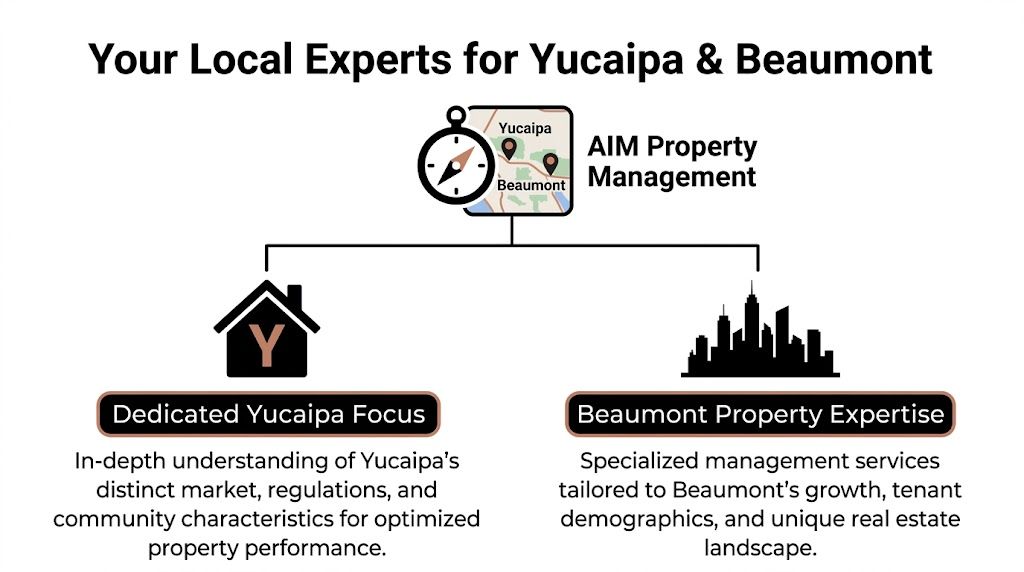
Dedicated Yucaipa property management
Yucaipa stands out because it offers stability that owners can work with. Zillow rental market data places the average rent for all property types at $1,875 per month, and the city has 18,600 residential properties in a market that supports consistent rental demand, according to Zillow’s Yucaipa rental market trends.
For owners, that means pricing discipline matters. You don’t want to underprice a good asset and leave income on the table. You also don’t want to overreach and sit vacant while better-positioned homes lease first. Good property management Yucaipa service uses the local market context to set rent at a level that attracts qualified residents without turning the listing into a stale asset.
Yucaipa owners also tend to care about asset preservation, not just occupancy. That makes annual inspections, responsive maintenance coordination, and lease enforcement especially important. In a stable market, you make money by avoiding unnecessary mistakes.
A stable rental market rewards owners who stay consistent. It punishes owners who get careless because things seem “easy.”
Full-service Beaumont property management
Beaumont demands a slightly different lens. Owners here often care about growth, neighborhood positioning, and keeping newer homes in strong condition as rental inventory evolves. That changes how a manager should think about tenant fit, maintenance timing, and renewal strategy.
The right Property Management Beaumont approach focuses on operational consistency. You want a resident placed with clear standards, a clean move-in process, documented maintenance communication, and fast handling when issues arise. That keeps the property competitive and keeps your involvement low.
Beaumont also matters because many owners don’t hold a single asset in a single city. They own in Yucaipa and Beaumont, or Beaumont and Redlands, and want one management relationship. That’s where a local operator with cross-market familiarity becomes more useful than a distant call-center model.
If you own or are acquiring in Beaumont, review this page on property management in Beaumont CA. It helps clarify what service should look like when local knowledge and operational consistency are both priorities.
Redlands fits the same strategy with different execution
Property management Redlands belongs in the same conversation because many portfolios span all three areas. The core standard remains the same. Tight screening. Clear accounting. Fast maintenance coordination. Proper documentation.
What changes is the on-the-ground judgment. A manager who understands Yucaipa, Beaumont, and Redlands can adjust execution without reinventing the operating system every time a property crosses a city boundary.
Take the Next Step Hire a Professional Property Manager
If your rental still depends on your personal availability, you’re leaving too much to chance. You shouldn’t be the maintenance dispatcher, collections department, lease administrator, and compliance backstop for an asset that’s supposed to generate income.
The right move is simple. Hire a property manager who can run the property with consistent systems, clear reporting, and a working understanding of California requirements. That’s how you protect income and reduce stress across Yucaipa, Beaumont, Redlands, Calimesa, Loma Linda, Mentone, Highland, and Banning.
Even small operational details matter more than most owners think. Turnover cleaning, for example, affects presentation, speed to market, and resident satisfaction. This property manager’s guide to stress-free cleaning services is a useful reminder that dependable systems beat last-minute scrambling.
If you’re ready to move from reactive ownership to structured oversight, start with this page on how to hire a property manager.
Frequently Asked Questions
I’m searching for property management near me. What areas do you serve
If you’re looking for property management near me, focus on managers who already work the surrounding corridor instead of a single isolated city. That gives you better vendor coverage, more consistent operations, and less friction if your portfolio expands.
The service area here includes Yucaipa, Beaumont, Redlands, Calimesa, Loma Linda, Mentone, Highland, and Banning, California. That local footprint matters whether you need Yucaipa property management, Property Management Beaumont, Beaumont property management, Redlands property management, or property management Redlands support.
What are the first steps to hire a property manager
Start with a practical review, not a sales conversation. A good onboarding process should feel organized.
Use this sequence:
- Review the property and discuss the home’s condition, rental positioning, and any immediate repair or compliance issues.
- Go through the management agreement so you understand responsibilities, approvals, fees, and owner disbursement timing.
- Transfer documents and records such as prior leases, maintenance history, warranties, and tenant information if the property is occupied.
- Confirm the operating workflow for rent collection, maintenance requests, owner statements, inspections, and renewals.
- Set decision thresholds so everyone knows what requires owner approval and what the manager can handle directly.
If a company can’t explain onboarding in simple terms, their back office probably isn’t organized enough for your property.
How do you handle difficult tenants or evictions
Start with prevention. Strong screening and documented lease expectations eliminate a large share of avoidable conflict before move-in.
When problems do happen, the response should be professional and documented. That means clear communication, written notices when needed, complete records, and steady adherence to California procedure. Owners get into trouble when they improvise. Professional managers reduce that risk by following established steps instead of reacting emotionally.
What should I ask before I hire a property manager
Ask questions that reveal process, not personality.
Focus on these:
- How do you screen tenants
- How do you handle owner disbursements and trust account timing
- What does your maintenance approval process look like
- How often do you inspect
- How do you document lease violations, notices, and disputes
- What reports do owners receive each month
Those answers will tell you far more than a polished pitch ever will.
If you want fewer interruptions, cleaner financial oversight, and stronger day-to-day control of your rental assets, talk with AIM PROPERTY MANAGEMENT COMPANY. They provide residential property management for owners in Yucaipa, Beaumont, Redlands, Banning, Loma Linda, Highland, Calimesa, and nearby communities, with services designed for single-family homes, townhomes, condominiums, and investment properties.