
A lot of Redlands owners arrive at the same moment in the same way. The home they kept after moving, the condo they bought as a long-term hold, or the inherited family property starts acting less like passive income and more like a second job. Rent questions come in at dinner. A repair request lands on a Sunday. Then the harder problems show up. Is the lease current, are the notices compliant, and is the tenant you approved the right fit for a high-value asset?
That tension is why property management redlands california isn't a convenience purchase for many owners. It's risk control for a valuable property in a market where mistakes cost real money, real time, and sometimes real legal exposure.
Your Thriving Redlands Investment Deserves Expert Protection
A Redlands rental often starts with a simple plan. Keep the property, rent it well, let the asset grow, and avoid major headaches. Then reality sets in. Leasing requires judgment, maintenance requires systems, and California compliance requires attention to detail that most owners don't have time to manage consistently.

Redlands isn't a casual market. As of September 2025, the median home sale price was about $665,000, up about 8.9% year over year, according to Mesa Properties' Redlands property management market overview. When an asset carries that kind of value, every lease decision, maintenance delay, and legal shortcut matters more.
When ownership becomes operations
The owners who struggle most are rarely careless. They're usually busy, successful, and stretched thin. They may live nearby, or they may own across Redlands, Beaumont, and Yucaipa. What changes is not their intelligence. It's the number of moving parts.
A rental home needs someone to handle:
- Tenant selection: Not just filling vacancy, but choosing a renter likely to pay on time, follow lease terms, and communicate early when issues arise.
- Vendor coordination: Plumbing leaks and HVAC failures don't wait for business hours.
- Documentation: Leases, notices, renewals, inspection records, and maintenance records all need to be handled cleanly.
- Judgment calls: Knowing when to repair, when to replace, when to negotiate, and when to document more carefully.
Practical rule: The more valuable the property, the less room there is for casual management.
That is where Redlands property management provides a significant advantage. A manager isn't only answering calls. A good one is protecting the condition of the home, the quality of the tenancy, and the owner's options if something goes sideways.
Why professional management changes the owner experience
Owners often think the main benefit is saving time. Time matters, but the bigger value is consistency. Screening is done the same way every time. Maintenance is documented. Notices are handled correctly. Inspections happen on schedule. Rent collection isn't personal. It follows a process.
If you're weighing whether to keep managing on your own, it's worth reviewing why homeowners choose professional property management when the property has become too important to run informally.
For owners in Redlands, Beaumont, Calimesa, Yucaipa, Loma Linda, Mentone, Highland, and Banning, the question usually isn't whether the work exists. It does. The important question is who should carry it.
Our Comprehensive Property Management Services
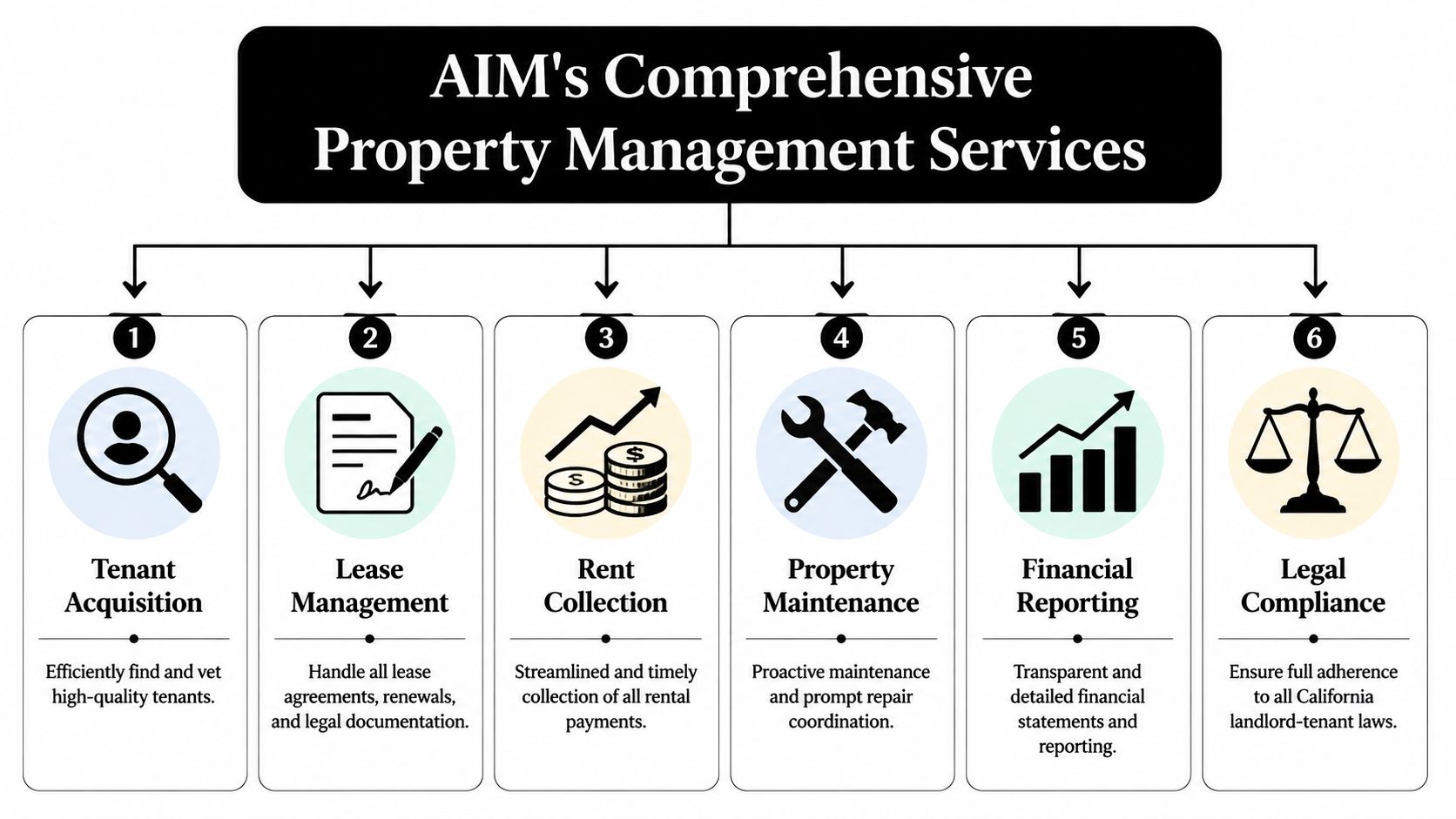
Property management Redlands owners need isn't a list of promises. It's an operating system. Each part supports the next one. Weak screening leads to harder collections. Weak inspections lead to bigger repair bills. Weak documentation creates legal problems at the worst possible time.
One local benchmark matters here. In Redlands, well-priced rentals lease in about 30 days, according to Rentix's Redlands property management page. That speed only helps owners when pricing, marketing, showing, and screening all work together.
Tenant placement that protects the lease before it starts
The first job is not finding a tenant fast. The first job is finding a tenant you won't regret approving.
That means looking beyond a surface application. Screening should include background checks, credit review, and income verification. It should also include consistency checks. Does the application match the documents? Do timelines make sense? Does the communication style suggest reliability or future friction?
A rushed approval often creates months of avoidable problems. A vacant unit is expensive. A bad tenancy is usually more expensive.
Rent collection and owner reporting
Cash flow depends on routine, not improvisation. Rent collection works best when tenants understand the process, deadlines are clear, and follow-up happens promptly. Owners also need visibility. A monthly statement should show income and expenses cleanly enough that tax prep and portfolio review don't become their own projects.
For owners comparing responsibilities, this breakdown of what a property management company handles is useful because it maps the work that disappears from the owner's plate once management is structured properly.
Maintenance coordination and tenant support
Good maintenance isn't only about speed. It's about triage. Some issues are urgent. Some are annoying but not urgent. Some are signs of a larger problem that should be addressed before damage spreads.
A strong management process usually includes:
- 24/7 intake for real emergencies: Tenants need a clear path when something serious happens after hours.
- Trusted vendor relationships: Owners benefit when the manager already knows which contractors show up, communicate well, and document work.
- Repair history tracking: Repeated fixes on the same system often signal replacement is the smarter financial choice.
Good management doesn't treat maintenance as an interruption. It treats maintenance as asset preservation.
Lease administration and inspections
Leases need to be current, enforceable, and supported by documentation. Renewals need timing. Notices need accuracy. Annual inspections help catch deferred maintenance, confirm general condition, and identify lease compliance issues before they become disputes.
One practical option in this market is AIM Property Management Company, which provides tenant screening, rent collection, maintenance coordination, inspections, and compliance support for residential rentals in Redlands and surrounding Inland Empire communities. That mix matters because isolated services rarely solve the full ownership problem.
Maximizing Your Rental Income and Financial Performance
Owners usually focus on rent first, and that's reasonable. But financial performance comes from the full chain. Price the property well, fill it with a qualified tenant, keep the home in good condition, reduce preventable turnover, and make reporting clear enough that you can evaluate the investment without guessing.

Redlands gives owners room to do this well. Zillow's rental data shows average rent at about $2,250 per month, about 13% above the national average, with only about 169 active rental listings in the city, according to Zillow's Redlands rental market trends. In a tighter market like that, pricing discipline matters. Overprice and the home sits. Underprice and the owner leaves money on the table.
The real money is made in the details
A lot of landlords think income optimization means pushing rent as high as possible. That works in theory, not always in practice. The better strategy is to set rent where the property competes well, attracts strong applicants, and supports fast placement without signaling desperation.
Three habits usually improve results:
- Use current local comparisons: Not broad county averages. The relevant comps are similar homes in similar condition competing right now.
- Prepare the home before marketing: Cleanliness, minor repairs, lighting, and photos influence applicant quality more than many owners expect.
- Reduce turnover friction: Every delayed make-ready, missed vendor appointment, or slow response pushes vacancy longer.
A month of avoidable vacancy can erase the gain from aggressive pricing.
Reporting that helps owners make decisions
High-income owners often own more than one property, or they're trying to decide whether to keep acquiring. They need reporting that supports decisions, not just bookkeeping. A clean statement helps answer practical questions: Is this home performing well, are repairs trending up, and is the current rent aligned with the market?
If you're reviewing returns, this guide to rental property ROI is a useful framework for thinking through income, expenses, and long-term performance instead of looking at rent alone.
Owners also benefit from understanding cash flow separately from appreciation. This rental property cash flow overview is a good reference for evaluating whether a property is carrying its weight month to month.
A short video can help frame how owners think about the income side of rental performance.
The True Cost of DIY vs Professional Property Management
DIY management looks cheaper on paper because the line item is easy to see. The hidden costs are harder to see until they show up. Owners spend personal time coordinating vendors, chasing rent, answering tenant messages, posting listings, handling renewals, and researching legal requirements they hoped would never matter.
That doesn't mean every owner should hire a manager immediately. Some owners are organized, local, and willing to build systems. But many discover that self-management works right up until something goes wrong. Then the cost of inexperience appears all at once.
DIY vs. AIM Property Management A Comparison
| Aspect | DIY Management | AIM Professional Management |
|---|---|---|
| Tenant screening | Owner gathers applications and decides alone. Screening standards often shift from applicant to applicant. | Screening follows a consistent process with background checks, credit review, and income verification. |
| Leasing and notices | Owner writes, updates, and delivers documents personally. Errors can create disputes later. | Lease paperwork, renewals, and notices are handled as part of an established management workflow. |
| Rent collection | Owner follows up directly, which can strain the relationship and delay enforcement. | Collection follows a routine process with clear expectations and documentation. |
| Maintenance | Owner has to field calls, find vendors, compare bids, and track completion. | Maintenance requests are coordinated through an existing vendor network and support system. |
| Inspections | Often delayed or skipped because the owner is busy or uncomfortable. | Annual inspections are scheduled as a standard part of management. |
| Compliance | Owner researches California rules as needed, usually under pressure. | Compliance is handled as an ongoing operational responsibility, not a last-minute scramble. |
| Owner time | Nights, weekends, and workday interruptions are common. | The manager handles daily operations so the owner stays focused on higher-value decisions. |
| Portfolio scalability | Each additional property adds complexity fast. | Systems scale more cleanly across Redlands, Beaumont, Yucaipa, and nearby markets. |
Where DIY usually breaks down
The weak points are predictable. Screening gets rushed because the unit is vacant. Maintenance gets deferred because the owner wants another quote. Documentation gets cobbled together from old files. None of that feels fatal in the moment.
Then an owner needs to compare management cost to operational risk. If you're working through that decision, this explanation of property management service costs is a useful starting point because cost only makes sense when viewed against workload, liability, and asset protection.
Owners rarely regret paying for structure. They regret the expensive month when there was no structure.
For Redlands property management, the most expensive mistake is usually not the fee. It's the assumption that good intentions can replace systems.
Navigating California's Complex Landlord-Tenant Laws
A Redlands owner can do almost everything right and still create expensive exposure. The rent is collected. The home is in a strong neighborhood. The tenant relationship feels stable. Then a notice is served with the wrong language, a repair response is documented poorly, or a deposit deduction cannot be supported line by line. In California, that is often where the problem starts.
The legal side of property management Redlands owners face leaves little margin for informal systems. Vague lease terms, inconsistent records, and casual notice practices create risk fast. Owners with significant assets face more than a one-off mistake. If the same weak process shows up across several units, liability spreads across the portfolio.

California compliance reaches well beyond eviction procedure. Owners need to account for AB 1482, just-cause rules, security deposit handling, habitability standards, fair housing requirements, and local ordinances that can change by city. For a landlord protecting a high-value Redlands asset, legal compliance is not paperwork for its own sake. It protects income, reduces dispute risk, and preserves options when a tenancy goes sideways.
Where legal exposure starts
Many landlords assume legal trouble begins when they need to remove a tenant. More often, it begins months earlier. It starts with an outdated lease, a maintenance request that sat too long, incomplete move-in photos, or a notice delivered in a way that cannot be proven later.
The pressure points are predictable:
- Lease quality: Generic forms often miss California requirements and property-specific terms.
- Notice handling: Timing, wording, and delivery method need to be correct and documented.
- Security deposit records: Condition reports, invoices, and itemized deductions need to hold up if challenged.
- Habitability response: Water intrusion, HVAC failure, plumbing issues, and safety defects need prompt action and a clear paper trail.
Experienced investors protect themselves with process, not memory. A clean file matters. If a dispute reaches an attorney, mediator, or courtroom, the owner with dated records, signed documents, inspection notes, and vendor invoices is in a far stronger position than the owner relying on verbal history.
Owners who want a practical overview of the rules should review this summary of California landlord-tenant laws. It outlines the obligations that commonly create problems when they are handled informally.
Why owners with significant assets hire for compliance
Landlords in higher income brackets usually outsource specialized work in other parts of their financial life because the cost of an error is too high. Rental housing deserves the same discipline. A Redlands property can represent a major asset, a meaningful income stream, or both. Running that asset on old templates and inconsistent follow-up is a poor trade.
A strong compliance system includes current lease documents, documented inspections, consistent tenant communication, reliable vendor coordination, and timely notices when facts support action. It also requires judgment. Some tenant issues are routine operations. Others have legal consequences the moment an owner delays, improvises, or says the wrong thing in writing.
Legal risk in rental ownership rarely comes from one dramatic mistake. It usually comes from a series of small shortcuts that leave the file weak when it matters most.
That level of discipline is required whether the focus is Redlands, Yucaipa, or Beaumont property management. The city may change. California's documentation standards, timing requirements, and liability exposure do not.
Your Local Expert Across the Inland Empire
Owners often search for property management Redlands because that's where the rental sits today. But many portfolios don't stop at one city. A landlord may own a home in Redlands, a second property in Beaumont, and a third in Yucaipa. The operational needs are similar, but local execution still matters.
Regional coverage makes management more practical
A manager who works across the Inland Empire sees patterns that single-neighborhood operators may miss. Vendor reliability, tenant expectations, make-ready standards, and leasing rhythm often carry across nearby communities. That regional view helps owners make cleaner decisions on rent readiness, maintenance planning, and turnover timing.
The same asset-protection logic that applies in Redlands also matters in Property Management Beaumont and Yucaipa property management work. In Redlands, median sale price per square foot was $360 with 2.4% year-over-year appreciation, according to Redfin's Redlands housing market data. That reinforces a practical principle. As property values rise, owners need proactive maintenance to preserve condition and avoid letting small issues degrade a valuable asset.
The communities we serve
Our service area includes:
- Redlands
- Beaumont
- Calimesa
- Yucaipa
- Loma Linda
- Mentone
- Highland
- Banning
That breadth matters for owners searching for property management near me because the best fit isn't always the closest office. It's the team that already understands the leasing and maintenance realities of your corridor.
For owners comparing Redlands property management with Beaumont property management or property management Yucaipa options, the right standard is straightforward. Look for local responsiveness, disciplined compliance, reliable vendor coordination, and reporting that helps you manage the property like an investment instead of a side task.
Frequently Asked Questions About Hiring a Property Manager
How do I know when it's time to hire a property manager
It's usually time when the property starts interrupting your primary work, family life, or decision-making bandwidth. If screening feels rushed, maintenance is reactive, or you're worried about whether your notices and lease documents are current, the rental is already asking for a more professional system.
Another sign is emotional fatigue. If every tenant message feels personal, you're too close to the operations.
What should I look for when searching property management near me
Start with local coverage, but don't stop there. You want a company that understands Redlands and the surrounding Inland Empire, including Beaumont, Calimesa, Yucaipa, Loma Linda, Highland, Mentone, and Banning.
Then ask practical questions:
- How do you screen tenants
- How do you handle after-hours maintenance
- How often do you inspect
- How do you manage lease renewals and notices
- What reporting do owners receive
Those answers tell you more than marketing language does.
Is professional management worth it for one rental home
Often, yes. One rental can still create legal exposure, maintenance coordination problems, and time drain. Owners sometimes think management only makes sense for larger portfolios, but a single high-value home can justify professional oversight if you want stronger systems and less operational stress.
What does a property manager actually do day to day
The daily work includes marketing vacancies, screening applicants, preparing leases, collecting rent, coordinating repairs, communicating with tenants, documenting issues, scheduling inspections, and keeping records organized. The owner keeps control over major decisions, but the manager handles the recurring work that keeps the tenancy stable.
Can a property manager help with properties outside Redlands
Yes, if the company serves the broader area. Many owners need one point of contact for Redlands property management, Property Management Beaumont, Beaumont property management, Yucaipa property management, and property management Yucaipa needs rather than a different manager in every city.
How do I hire a property manager without making the wrong choice
Use a short process.
- List your pain points: Vacancy, maintenance, compliance, reporting, or time.
- Review their service scope: Make sure they handle screening, rent collection, inspections, maintenance, and documentation.
- Ask how they deal with legal compliance: California procedure isn't a side topic.
- Evaluate communication: Slow communication during onboarding usually stays slow later.
- Read the agreement carefully: You should understand responsibilities, owner approvals, and how issues escalate.
The right time to hire a property manager is before a vacancy problem, legal issue, or major repair forces the decision under pressure.
If you own a rental in Redlands or nearby communities and want a more reliable system for leasing, maintenance, reporting, and compliance, AIM PROPERTY MANAGEMENT COMPANY is one practical place to start. They serve residential owners across Redlands, Beaumont, Calimesa, Yucaipa, Loma Linda, Highland, and Banning, with management built around tenant screening, rent collection, inspections, maintenance coordination, and California compliance.