When you start searching for a "property management company near me," you’re not just looking for someone who's a short drive away. You’re hunting for a strategic partner—a team with deep, ingrained knowledge of your local market. This expertise isn't just a nice-to-have; it's your most valuable asset for boosting rental income and protecting your investment.
Why Local Knowledge Is Your Greatest Asset

Sure, a national firm might have a recognizable brand, but a local expert has something far more powerful: boots-on-the-ground intelligence. This is the bedrock of effective management, and it’s something a one-size-fits-all approach from afar can never replicate.
From setting the perfect rent to handling a middle-of-the-night emergency, that local insight is what makes all the difference.
Setting Optimal Rental Rates
A true local manager doesn’t just plug your address into a national database and spit out a number. They understand the nuances between neighborhoods—sometimes even from one street to the next. They know that a home near that popular new cafe in Yucaipa can fetch a higher rent than a nearly identical property just a few blocks away.
This hyper-local knowledge means your property gets priced to attract high-quality tenants fast. You minimize those painful, costly vacancies without undercutting your potential earnings.
Key Takeaway: A local property management company prices your rental based on real-time, on-the-ground factors like school district reputation, walkability, and even upcoming community projects—details national models almost always miss.
Navigating Local Ordinances and Regulations
Rental laws are a confusing maze of city, county, and state rules. A manager based in the Banning or Redlands area lives and breathes these local requirements, from specific habitability codes to the exact wording needed for eviction notices.
Their expertise is your best defense against accidental legal trouble and expensive fines. They make sure your property and lease agreements are always buttoned-up and compliant, which is a huge weight off your shoulders.
The property management industry is a major economic player, with over 304,000 companies in the U.S., most of them focused on residential properties just like yours. This field, expected to be worth over $98 billion by 2029, is built on the value of local specialization. You can get a better sense of the property management industry's scale and growth from in-depth market reports.
Leveraging an Established Vendor Network
Picture this: a pipe bursts at 2 AM. The last thing you need is a manager fumbling through an online directory, trying to find a plumber who might answer the phone. A local company already has its go-to people. They have a curated network of trusted, reliable, and cost-effective vendors they've worked with for years.
These long-standing relationships translate into real benefits for you:
- Faster Response Times: They know exactly who to call for any emergency, getting problems fixed quickly.
- Vetted Quality: They only work with contractors they know and trust to do good work.
- Better Pricing: Because they send a lot of business to these vendors, they often get preferential rates, and those savings get passed directly to you.
How to Find Your Ideal Property Manager

Sure, you can kick off your search with a quick "property management company near me," and that's a decent start. But to find the right partner—the one who truly gets your local market—you need to dig a little deeper than the first page of search results.
The real gems are often found through more focused, boots-on-the-ground methods. The goal here isn't to create a massive list, but to identify 3-5 highly qualified candidates you can seriously consider. It’s about quality, not quantity. Think of it as detective work, blending online sleuthing with old-fashioned networking to find a property manager who’s a perfect fit for your specific rental in Yucaipa or Beaumont.
Ask Your Professional Circle
Your first, and often best, resource is the team of professionals you already work with. Think about it: your real estate agent, mortgage broker, or even your real estate attorney all have a stake in your success as a landlord. They work with property managers day in and day out. They know who answers the phone and who lets it go to voicemail.
Don't be shy. Ask them directly, "Who would you trust to manage a rental home in Redlands?" Their referrals are gold because their own reputation is on the line. A bad recommendation reflects poorly on them, so they're only going to send you to the people they know are reliable. This simple question can often give you one or two solid names right off the bat.
Expert Tip: Go beyond just getting a name. Dig for the "why." Ask follow-up questions like, "What do your other clients say about them?" or "What makes them stand out from the competition?" The details are what really help you build a picture of the company.
Connect with Local Landlords
Who knows the local rental scene better than other landlords? Nobody. Tapping into local real estate investor groups is one of the smartest moves you can make. These are the people who have been in the trenches and can give you unfiltered, honest feedback.
Here are a couple of ways to find them:
- Real Estate Meetups: Look for local investor meetups in your area. Spending an hour at a meeting can give you more practical insight than a full day of online research.
- Online Forums: Websites like BiggerPockets are a treasure trove of information. Jump into the local forums and ask for recommendations. You'll find candid discussions about which managers are great and which ones to avoid.
An investor who's been managing properties in Loma Linda for a decade has insights you just can't get from a company's slick marketing brochure.
Look for Professional Credentials
Finally, a great way to filter your search is to look for professional affiliations. In the world of residential property management, the big one is the National Association of Residential Property Managers (NARPM).
Membership in NARPM isn't just about paying dues. It means the manager has committed to a strict code of ethics and ongoing professional education. They’re serious about their craft.
You can search the NARPM directory for certified managers right in your city. It’s a solid indicator that you’re dealing with a professional, not a hobbyist. By combining these three strategies, you'll have a strong, well-vetted shortlist ready for the next phase: the interview.
You’ve done your initial research and have a shortlist of property management companies. Now comes the most important part: the deep dive. This is where you separate the true professionals from the rest.
Think of this stage less like a quick chat and more like hiring a critical business partner. You're entrusting them with a significant asset, and a mistake here can cost you dearly in both time and money. A great manager is an asset protector; a bad one is a liability waiting to happen.
The Interview: Asking the Right Questions
Your first real conversation with a potential manager is telling. You can learn a lot about their entire operation just by how they answer a few specific, well-thought-out questions. Don't settle for vague responses—press for details.
Here are a few questions I always start with:
- How do you screen tenants? Get specific. Do they run credit checks, verify employment, and check references? Critically, ask about their policy on thorough court record checks to understand their approach to criminal background history.
- What's your process for maintenance calls? What happens when a tenant calls at 2 AM with a burst pipe? Do they have their own maintenance crew, or do they rely on a network of contractors? It’s also wise to ask about their spending limit—at what dollar amount do they need your approval before starting a repair?
- How do you handle vacancies? A good manager should be able to tell you their average vacancy rate for properties similar to yours. Follow up by asking exactly where and how they market listings and how long it typically takes to place a qualified tenant.
This process gives you a roadmap of what a professional management relationship should look like, from the first property assessment all the way through to daily operations.
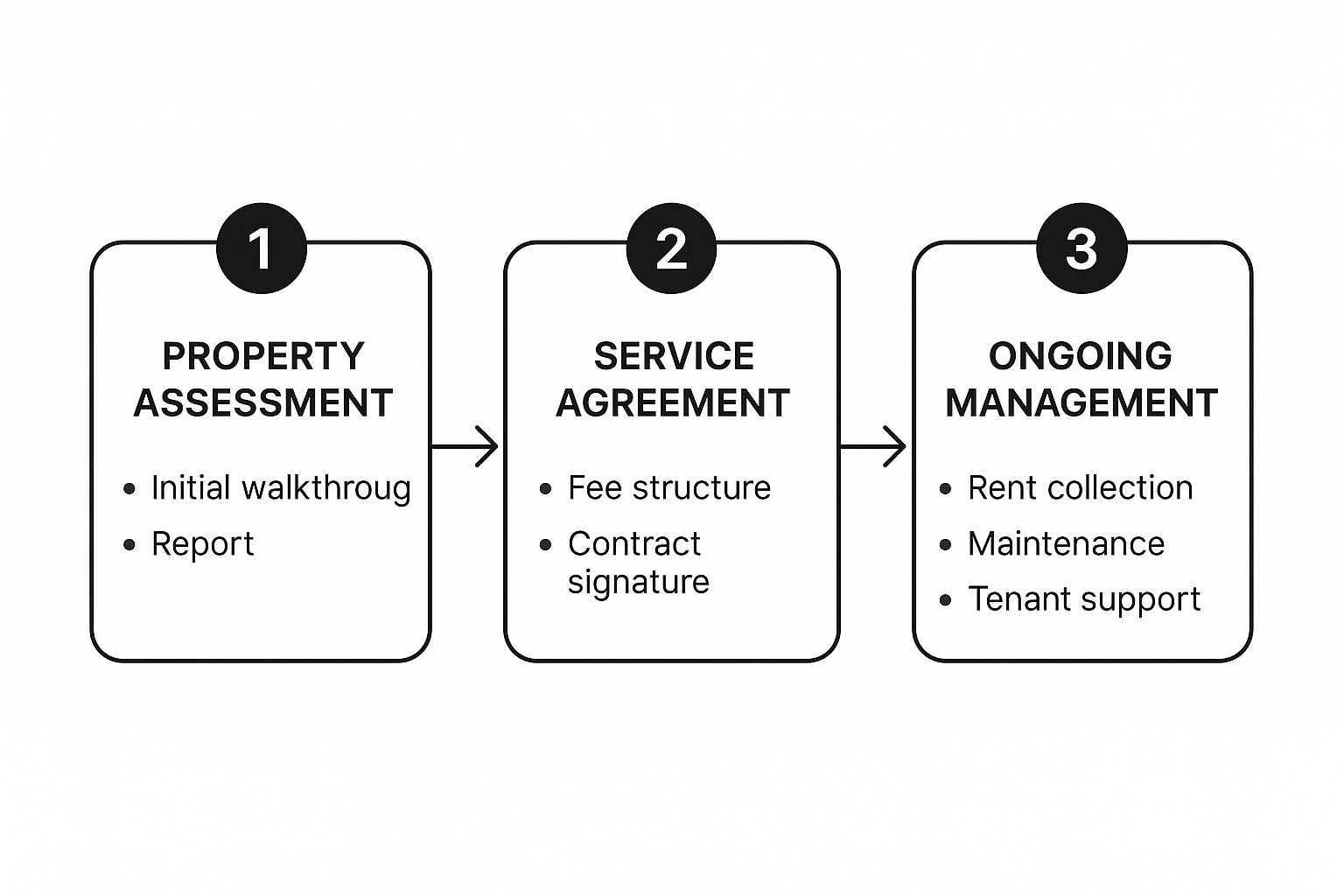
A structured, clear process is a hallmark of a company that knows what it's doing.
Beyond the Interview: Verifying Credentials
Talk is cheap. After the interview, it’s time to verify that they have the credentials to back up their claims. Any legitimate company will have this information ready and will be happy to provide it. If you get any pushback here, that’s a major red flag.
You need to see the documents that prove they're a real, insured, and licensed business. This isn't just a formality; it's about protecting yourself and your investment.
Here's what you need to ask for:
- A sample Management Agreement: This is your contract with them. You need to read every line, paying close attention to the fee structure, what happens if you want to terminate the contract, and who is responsible for what.
- Proof of Insurance: At a minimum, they need Errors & Omissions (E&O) and General Liability insurance. This is non-negotiable. It protects you from financial loss if they make a critical mistake.
- Relevant State Licenses: Most states require property managers to have a real estate broker's license or a specific property management license. Verify that theirs is active and in good standing.
My Two Cents: Don't just skim the management agreement. Read it. Then read it again. Look for automatic renewal clauses, high termination fees, and unclear language about who holds the security deposit. A contract that feels confusing or heavily one-sided is a dealbreaker, period.
To keep your findings organized and make a truly informed decision, use a checklist to compare each company side-by-side. This turns subjective feelings into objective data points.
Property Management Company Vetting Checklist
| Evaluation Criteria | Company A | Company B | Company C |
|---|---|---|---|
| Management Fee | |||
| Leasing Fee | |||
| Tenant Screening Process | |||
| Maintenance Approval Limit | |||
| Average Vacancy Rate | |||
| Contract Termination Clause | |||
| Insurance Verified (E&O) | |||
| Insurance Verified (Liability) | |||
| State License Verified | |||
| Online Reviews/Reputation | |||
| Communication Style | |||
| Overall Impression |
By the time you fill this out for your top candidates, the right choice often becomes surprisingly clear. This methodical approach ensures you're making a decision based on facts and professionalism, not just a good sales pitch.
Decoding Management Fees and Contract Terms

Let's talk about the money. The financial arrangement you have with your property manager is the engine that drives the whole partnership. A clear, fair agreement fuels a profitable relationship, but a confusing or one-sided contract can become a serious drain on your returns. Before you even think about signing on the dotted line, you have to get comfortable with the numbers and the fine print.
As you start vetting companies, you’ll quickly notice that fee structures are all over the map. It's not just about the monthly percentage they quote you; it’s about the total cost of their service over the entire year. Your goal here is to find a fee structure that makes them successful only when you are successful.
Common Fee Structures You Will Encounter
Most property management companies use a mix of fees. That low monthly rate that initially caught your eye might look great, but it’s essential to see the full picture to avoid getting nickel-and-dimed down the road.
Here are the usual suspects you’ll find in their proposals:
- Monthly Management Fee: This is the big one. It's usually a percentage of the monthly rent collected, often falling somewhere between 8% to 12%. Some firms might offer a flat fee, which can be a great deal for properties with higher rents.
- Leasing Fee: Think of this as a finder's fee. It’s a one-time charge for the work involved in marketing your property, screening tenants, and getting a lease signed. Expect this to be anywhere from 50% to 100% of the first month's rent.
- Lease Renewal Fee: When a great tenant decides to stay, the manager still has to handle the paperwork. This is a smaller fee to compensate them for drafting and executing the new lease agreement.
- Maintenance Markup: Some companies add a surcharge—often around 10%—to invoices from contractors for repairs. This fee is meant to cover their time finding a vendor, coordinating the work, and ensuring it's done right.
Before committing, it’s worth getting a solid understanding of pricing models and all the potential fees involved. This knowledge is your best tool for comparing companies apples-to-apples and asking the right questions.
Here’s a real-world scenario: Your property rents for $2,000 a month. Company A quotes you an 8% management fee and a 75% leasing fee. Sounds good, right? But Company B quotes 10% with no leasing fee, renewal fees, or maintenance markups. At first glance, Company A seems cheaper, but once you factor in placing one new tenant and a few maintenance calls, Company B's all-inclusive model might actually save you money over the year.
Spotting Red Flags in the Management Agreement
The contract is the rulebook for your relationship, and it needs to be transparent and fair. Vague language or overly restrictive clauses are huge warning signs. A reputable manager will always have a clear, easy-to-read agreement and should be more than willing to walk you through it line by line.
Keep a sharp eye out for these potential pitfalls:
- Iron-Clad Termination Clauses: Be wary of contracts that lock you in for a long term with no easy exit. You should always have the ability to terminate the agreement with reasonable notice (30-60 days is standard) if you’re not happy with the service.
- Excessive Cancellation Penalties: A massive fee for ending the contract early is a major red flag. It often means the company isn't confident they can keep your business by providing excellent service alone.
- Vague Maintenance Spending Caps: The agreement must clearly define how much the manager can spend on a single repair without getting your approval first. An ambiguous or excessively high limit gives them too much control over your checkbook.
At the end of the day, a good contract protects both you and the property management company. It’s all about setting clear expectations from the start, creating a roadmap for a successful partnership built on trust.
What a Property Manager's Tech Stack Tells You
In today's market, the technology a property management company uses is a massive tell. It reveals how efficient, transparent, and forward-thinking they really are. A modern tech stack isn't just a "nice-to-have"—it's the engine that drives your profitability as a landlord.
Forget about the days of chasing down paper statements or digging through old email threads. A top-notch firm will give you a dedicated online owner portal, which is essentially your command center. This is your 24/7 window into your investment’s performance, putting all the critical information right at your fingertips.
The Owner Portal: Your Key to Transparency
A solid owner portal should be your single source of truth. You shouldn't have to wait for an end-of-month email to see where your money is going or how your property is performing.
Here's what a great portal should deliver:
- Live Financials: Think real-time access to income and expense reports. No more guessing about cash flow.
- Document Library: Instantly pull up lease agreements, signed addendums, maintenance invoices, and inspection reports whenever you need them.
- Centralized Communication: A secure, built-in messaging system is a game-changer. It keeps every conversation about your property organized and easy to reference.
A seamless owner portal completely changes the dynamic. It shifts you from being a reactive landlord to a proactive investor, giving you the clarity and control to make smart decisions without constantly hunting for information.
Tenant Technology That Directly Benefits You
The tech your manager offers tenants is just as crucial, if not more so. Why? Because a good tenant experience leads to better outcomes for you. Happy tenants are far more likely to pay on time, take care of the place, and renew their lease.
This directly slashes your turnover costs and minimizes vacancy—two of the biggest profit killers for landlords.
At a minimum, their tenant-facing tech must include:
- Online Rent Payments: This is non-negotiable in this day and age. It makes it incredibly easy for tenants to pay, which means you get your money faster.
- Digital Maintenance Requests: An online system where tenants can submit a repair request, track its status, and see updates is essential. It leads to quicker fixes and keeps small problems from becoming big, expensive ones.
The backbone of all this is a powerful Property Management System (PMS). You'll find the best companies use platforms that offer seamless hotel PMS integration and similar sophisticated systems for the residential side, connecting all these features into one cohesive unit.
The entire property management industry is moving away from manual, error-prone tasks and toward automated platforms. This digital shift is so significant that the global market for these solutions is expected to hit nearly $28 billion by 2028. You can read more about the growth of property management technology and see the trends for yourself.
Ultimately, a company that invests in modern technology is a company that's investing in a more efficient, transparent, and profitable future for your rental.
Still Have Questions? Let’s Clear Things Up.
Even with a short list of promising candidates, it’s completely normal to have some last-minute questions before you sign on the dotted line. This is a big decision, after all. You're not just hiring a vendor; you're bringing on a partner to manage one of your most valuable assets.
Handing over the keys marks a huge shift in your role—from a hands-on landlord bogged down in daily tasks to a savvy investor focused on the big picture. Let's walk through some of the most common questions that pop up at this final stage.
When Does Hiring a Manager Actually Make Financial Sense?
This is the big one, isn't it? Many owners get stuck wondering if a manager's fee is an expense or an investment. The truth is, it's rarely about just the fee. It’s about the total value you get back, especially when you factor in your own time and the costly mistakes a pro helps you sidestep.
Think about it this way: what’s your time worth? Let's be conservative and say it's $50 an hour. If you spend 10 hours a month on your rental—chasing down rent, fielding late-night maintenance calls, showing the property—that’s $500 of your time gone. If a management company charges less than that, you're already ahead financially.
And that simple calculation doesn't even touch on the big-ticket items a good manager saves you from, like:
- Lingering Vacancies: An experienced manager with solid marketing can often find a great tenant weeks faster than you can on your own. That’s hundreds, maybe thousands, of dollars in rent that stays in your pocket.
- Nightmare Evictions: One wrong step in the eviction process can drag things out for months and rack up serious legal bills. A pro knows the law inside and out.
- The Wrong Tenant: A bad tenant can cause thousands in property damage, not to mention the headache of unpaid rent. A manager's rigorous screening process is your best defense.
What Am I Still on the Hook For?
Hiring a property manager doesn't mean you vanish completely. Your role just gets a major upgrade. You go from being the "doer" to being the CEO of your investment. You delegate the day-to-day grind while retaining control over the major decisions.
Typically, you’ll still be responsible for:
- Authorizing major repairs that go above a pre-agreed spending limit (e.g., anything over $500).
- Giving the final green light on a new tenant from the pool of qualified applicants your manager brings you.
- Keeping the property's reserve fund topped up for planned maintenance and those inevitable surprise repairs.
They handle the frantic calls and tedious paperwork; you make the key strategic moves that affect your investment's long-term health.
Think of it as strategic oversight. You’ll review the monthly financial reports, approve any big-ticket expenses, and let your manager wrestle with the daily operational headaches. This frees you up to either find your next investment property or just enjoy the passive income you've worked hard to create.
What If This Just Doesn't Work Out?
It happens. Even with the most careful vetting, you might find that a company’s style just doesn't mesh with yours. That’s precisely why you need to read the termination clause in the management agreement before you sign anything. Any reputable company will have a clear and fair exit strategy spelled out.
If you’re running into issues, the first step should always be clear, direct communication. Put your concerns in writing and give the manager a fair shot at fixing the problem. If things don’t improve, you should be able to end the contract by giving written notice, usually 30 to 60 days in advance.
The good news is that with the global property management market projected to hit USD 38.48 billion by 2034, your options are better than ever. This growth, fueled by a complex rental landscape, means more professional and competitive companies are out there. You can read more about the expanding property management market and see why finding a great fit is more attainable now than ever before.
At AIM PROPERTY MANAGEMENT COMPANY, we believe in building strong, transparent partnerships with our property owners. From our meticulous tenant screening to our 24/7 maintenance support, we manage the daily details so you can have total peace of mind. To see how we can help you manage your property in Banning, Loma Linda, Beaumont, and the surrounding areas, visit us at https://aim-properties.com.
Article created using Outrank