
If you're searching for management property near me, you're probably not browsing casually. You're dealing with a rental that needs attention now. Maybe the calls are coming after work. Maybe a repair turned into three repairs. Maybe rent collection feels manageable until one payment goes late and you realize you're also the leasing agent, bookkeeper, maintenance coordinator, and compliance officer.
That's the point where most owners stop asking, “Can I do this myself?” and start asking a better question. Who can protect this property, the income it produces, and the time it takes off my plate without creating new problems?
In the Inland Empire, that question has real weight. Owners in Redlands, Beaumont, Yucaipa, Calimesa, Loma Linda, Mentone, Highland, and Banning aren't just hiring help. They're hiring systems, judgment, and local follow-through.
Why "Near Me" Matters for Your Rental Investment
A local property manager matters for reasons that go far beyond convenience. Yes, being nearby helps with showings, inspections, vendor access, and tenant communication. But the deeper issue is risk.

A rental home is a financial asset first. In practical terms, a property owner managing a $280K asset is protecting a capital base that can move by thousands of dollars with market shifts, and a manager's screening, rent collection, and compliance systems help reduce vacancy loss and turnover costs, as noted in Zillow's housing market data for Roanoke. The city is different, but the business lesson applies everywhere. Property management is financial risk control, not just administration.
Local knowledge changes daily decisions
An owner in Highland or Loma Linda doesn't need a manager who only knows broad California rental rules. They need someone who understands how this part of the Inland Empire leases.
That shows up in small decisions that affect returns:
- Pricing judgment so a listing doesn't sit because rent was set too aggressively
- Vendor coordination so routine repairs don't become emergency invoices
- Leasing speed because showing windows and applicant response times vary by neighborhood
- Resident fit because commuter households, medical-sector tenants, and local families don't always search the same way
A local manager also knows what owners often miss. A property in Redlands may attract a different applicant profile than one in Beaumont. A home near schools in Yucaipa may need different marketing language than a condo in Loma Linda. Those aren't branding details. They affect vacancy, tenant quality, and turnover.
Practical rule: The closer a manager is to your market, the easier it is for them to spot problems before they become expensive.
Near me should mean accountable
The phrase “near me” should really mean reachable, informed, and operationally present. If a manager can't inspect promptly, coordinate trusted contractors, or handle local leasing activity with consistency, distance becomes a business problem.
That's why many owners narrow their search to firms that actively serve their submarket, not just the county. If you want a better sense of what local oversight looks like in practice, this overview of hometown property management is a useful starting point.
The best local managers don't just answer the phone. They reduce the number of problems that require the phone call in the first place.
Building Your List of Local Management Candidates
Most owners start the right way and then stop too early. They search “property management Redlands” or “property management Yucaipa,” scan a few websites, and contact the first names that look professional. That's not enough.
You want a shortlist built from both visibility and trust. Start broad, then get local.
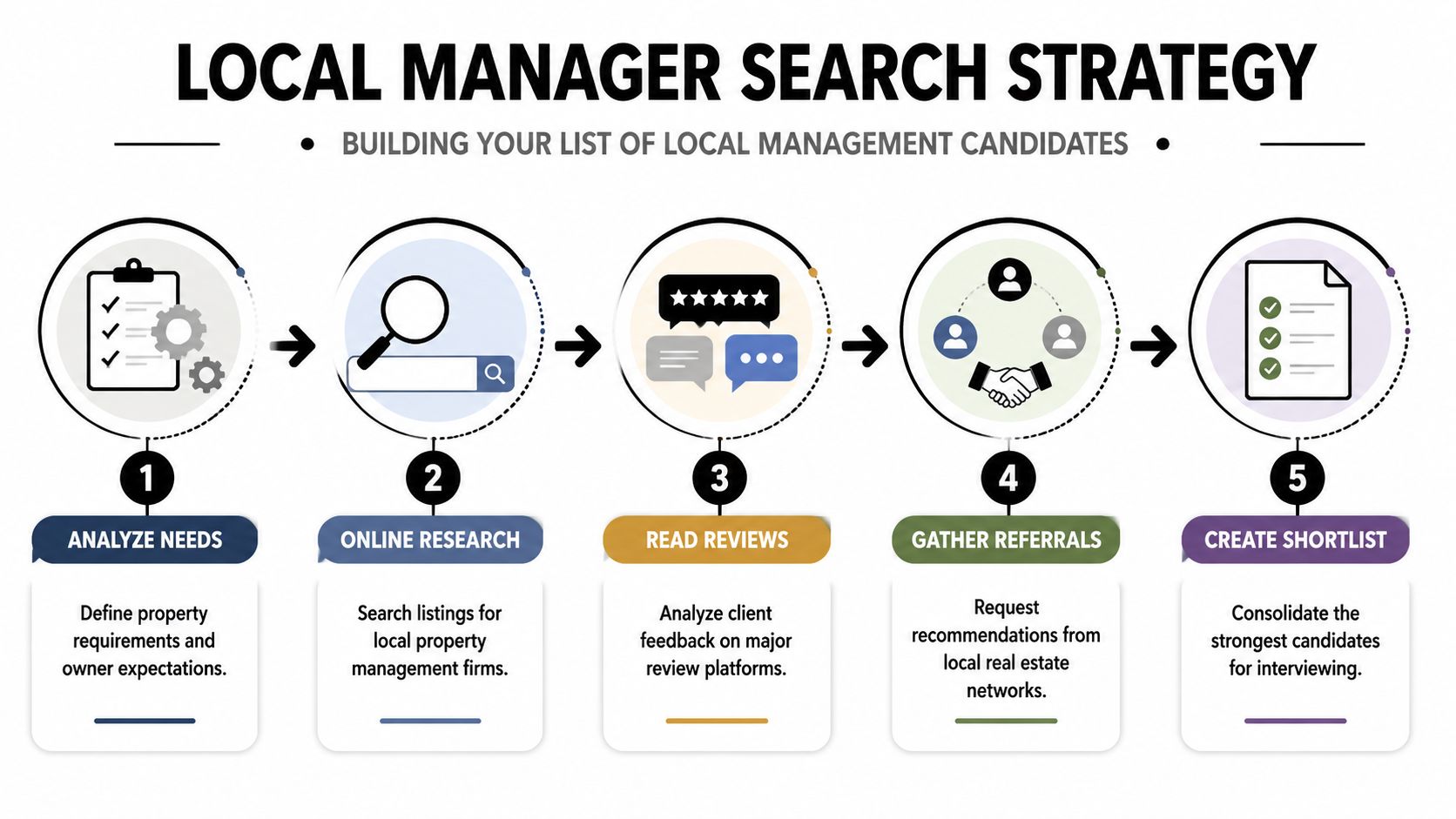
Start with search, then verify with local signals
Use search terms tied to your actual city and property type. Good examples include “Beaumont property management,” “Redlands property management,” “property management Calimesa,” and “hire a property manager in Yucaipa.”
Search gives you names. It does not give you quality.
After that first pass, look for signs that a company is active in your area:
- Local service pages that specifically mention your city, not just “Southern California”
- Current rental listings in the neighborhoods you care about
- Clear owner services that explain screening, maintenance, rent collection, and reporting
- Consistent contact details and a real operating presence
A broad comparison page like this guide to top property management companies near me can help you organize your early research before you start calling firms one by one.
Use higher-trust referral sources
The strongest referrals often come from people who see managers perform under pressure. That's why I'd put local referrals above online star counts.
Good people to ask include:
- Real estate agents who work with investor clients and see how managers communicate after closing
- Mortgage professionals who know owners with rental portfolios in Redlands, Beaumont, and Yucaipa
- Local contractors who can tell you which companies are organized, decisive, and good at approving work
- Other landlords who have dealt with renewals, maintenance issues, and nonpayment situations
Watch who's active in the neighborhoods you target
Drive or review listings in the neighborhoods where your rental competes. In Mentone, Banning, Calimesa, or Highland, active managers leave clues.
Look for:
- Well-written listings with complete property details
- Professional photos
- Consistent rent-ready standards
- Responsive leasing contact methods
- Signage or branding that appears repeatedly
A manager's field presence tells you more than a polished homepage. If they're leasing homes like yours in the same area, they're already reading the market in real time.
By the end of this process, most owners should have a workable shortlist. Not a giant spreadsheet. Just a focused group of local candidates worth interviewing seriously.
Evaluating a Manager's Core Competencies
A Redlands owner hires the cheapest manager on the shortlist. Three months later, a vacancy sits longer than expected, a plumbing issue turns into a weekend scramble, and the owner still cannot tell from the statement where the money went. That is usually not a fee problem. It is a systems problem.

In the Inland Empire, owners get better results when they compare managers on four operating areas: screening, maintenance execution, financial reporting, and compliance habits. Those are the functions that protect rent, reduce avoidable loss, and keep small issues from becoming expensive ones.
Tenant screening should follow written standards
Screening needs to be consistent across every application. If the leasing decision changes based on who is in the office that day, you are taking on unnecessary fair housing risk and increasing the odds of a bad placement.
Ask how the company verifies identity, income, rental history, and application completeness. Ask what happens when income cannot be documented cleanly, references do not respond, or an applicant wants an exception. Good managers can explain the standard, the documentation they require, and who has authority to approve or decline.
In Beaumont and Yucaipa, this matters even more for single-family rentals where one weak placement can wipe out months of expected cash flow. A disciplined screening process protects income better than a manager who promises to fill the property fast.
If you work with agents or handle leasing decisions collaboratively, tools like faster tenant decision tools for agents can help standardize application review and speed up communication without lowering standards.
Maintenance systems show you how the company performs under pressure
Every manager says they handle maintenance. The true question is how.
A capable firm should be able to explain the full chain clearly:
- How tenants submit routine and emergency requests
- Who reviews and prioritizes incoming work orders
- Which vendors are approved to enter occupied homes
- When owner approval is required
- How estimates, photos, invoices, and completion notes are stored
This area separates organized companies from reactive ones. In older parts of Redlands, deferred maintenance can hide behind cosmetic issues. In newer Beaumont rentals, the challenge is often speed, vendor coordination, and keeping tenant communication tight so a minor repair does not become a renewal problem.
For owners comparing scope of service, this breakdown of property management company responsibilities gives a practical checklist of what should be included and what some firms bill separately.
Watch the video here for a quick overview of owner expectations: https://www.youtube.com/watch?v=tuGMitHwMP0
Fees need a total-cost review
Owners lose money when they compare only the monthly percentage. A lower advertised rate can still produce a worse outcome if leasing, renewals, inspections, coordination, notice posting, or admin work show up as separate charges.
The better comparison is total value against total risk. If one company charges a little more each month but places better tenants, documents repairs properly, and produces clean statements, that can be the cheaper choice over a full year.
Use a side-by-side table when reviewing proposals:
| Category | What to look for |
|---|---|
| Monthly fee | Which recurring tasks are actually included |
| Leasing fee | Full placement only, or separate charges by step |
| Renewal fee | Flat charge, recurring charge, or waived |
| Maintenance coordination | Included in management or billed per event |
| Reporting | Owner statements, year-end documents, portal access |
Reporting and compliance should be easy to audit
Owner statements should make sense without a follow-up call. You should be able to see when rent was received, how repairs were coded, what owner reserves are held, and how disbursements are calculated.
Compliance matters just as much. A manager handling homes in Redlands, Beaumont, and Yucaipa should already have forms, notice procedures, inspection routines, and recordkeeping habits in place. Owners should not be paying a manager to figure those out in real time after a problem starts.
One local example is AIM Property Management Company, which handles tenant screening, rent collection, maintenance coordination, inspections, and owner reporting for residential rentals in Beaumont, Yucaipa, Redlands, and nearby communities. Use that kind of operating checklist as your baseline. Compare actual execution, not branding.
Good management usually looks ordinary from the outside. Rent posts correctly. Repairs get tracked. Leases are documented. Problems are handled early. That is what protects return on investment.
The Interview Questions That Reveal True Expertise
The interview is not a formality. It's a pressure test.
Some companies sound competent when they describe services in broad terms. The gaps appear when you ask them to walk through a real scenario from start to finish. That's where you find out whether the company runs on systems or on improvisation.
A key risk in this business is operational weakness. Small property management companies often fail from cash-flow problems and lack of a dedicated bookkeeper, and the strongest message a company can give an owner is how it prevents those failure points with centralized rent collection, bookkeeping, and maintenance ticket triage, according to Spirepoint's analysis of why small management companies fail.
Ask for process, not promises
Instead of asking “Do you handle maintenance?” ask questions that force detail.
Use questions like these:
After-hours emergency call
“Walk me through what happens when a tenant reports an emergency at night. Who receives the request, who decides the response, and when am I contacted?”Rent collection workflow
“How do you track unpaid rent, notices, partial payments, and owner disbursements?”Bookkeeping controls
“Who is responsible for trust accounting and owner statements, and how are errors caught before statements go out?”Vendor management
“How do you vet vendors, keep documentation current, and avoid delays when a unit needs fast turnover work?”Turnover coordination
“What happens between move-out and re-listing? Who inspects, approves work, verifies completion, and releases the property for marketing?”
Each question should produce a sequence, not a slogan.
Weak answers have a pattern
Owners often miss red flags because the person they're talking to is personable. Personality helps. It doesn't replace controls.
Watch for answers like:
- “We handle that as needed.”
- “It depends.”
- “We've been doing this a long time.”
- “Our staff just takes care of it.”
Those responses usually mean the company hasn't documented the workflow, or the process changes depending on who's in the office that day.
If a manager can't explain their system clearly before you hire them, you'll be the one learning their system during a problem.
Ask what happens when something goes wrong
The strongest interview questions focus on exceptions. That's where weak firms break down.
Ask about:
- disputed charges
- resident complaints
- failed inspections
- a vendor who doesn't show up
- an owner statement that needs correction
- a lease renewal that stalls
- a tenant who pays inconsistently
A serious company should answer calmly and specifically. This guide on how to hire a property manager is useful if you want a structured list to bring into those conversations.
If you leave the interview with clear notes on process, reporting, controls, and communication standards, you're not guessing anymore. You're evaluating risk.
Spotlight on Beaumont and Yucaipa Property Management
A home in Beaumont can lease fast with the right price and a clean approval process. A similar home in Yucaipa may need stronger positioning, better showing prep, and a manager who knows how buyers and renters talk about specific neighborhoods. Owners searching for management property near me usually see both cities grouped together. Operationally, that can be an expensive mistake.

Beaumont requires disciplined leasing and turnover control
In Beaumont, many rentals attract residents who want more square footage, newer housing stock, and a workable commute across the Inland Empire. That usually means inquiry volume can be healthy when the home is presented well. The risk is not lack of demand. The risk is approving too loosely, dragging out turn time, or pricing based on hope instead of current competition.
Owners should look for a manager with a structured screening process: identity checks, income review, credit evaluation, rental history, and consistent approval standards applied the same way every time. In Beaumont, weak process shows up quickly. A vacancy that should have turned in days can stretch longer because maintenance was not sequenced well, photos were delayed, or incomplete applicants were allowed to clog the pipeline.
For Beaumont property management, the better operator usually brings value in four places:
- Clear rental standards that reduce fair housing risk
- Fast application handling without cutting screening corners
- Tight make-ready coordination between move-out and marketing
- Consistent lease enforcement after placement
That combination protects income better than a lower monthly fee with loose execution. Owners who want a more local breakdown can review this guide on how Beaumont property management can maximize rental ROI.
Yucaipa rewards local market positioning
Yucaipa calls for a different skill set. Residents often pay closer attention to neighborhood feel, school access, lot size, upkeep, and whether the home matches the expectations of the immediate area. A manager who uses the same marketing language, showing approach, and rent strategy for every Inland Empire listing will usually miss part of the market here.
I would press harder on presentation in Yucaipa. Ask how the manager adjusts photos, showing notes, pricing logic, and renewal strategy for homes in different parts of the city. A property near schools or established residential pockets may need a different leasing conversation than a newer tract rental in Beaumont, even if the bedroom count is similar.
The real comparison is total value, not just the management fee. In Beaumont, that often comes down to process control and speed. In Yucaipa, it often comes down to positioning, communication, and protecting the perceived quality of the asset while it is occupied.
Both cities reward local competence. They just reward different kinds of it.
Answering Your Final Questions
Most owners reach the final stage with the same few concerns. Cost, control, contract terms, and onboarding usually matter more than marketing language.
How should I compare property managers if every company presents pricing differently
Don't compare only the monthly management percentage. Compare the full operating relationship.
Review the proposal line by line and look for leasing fees, renewal charges, maintenance coordination charges, inspection charges, and any administrative add-ons. If one company looks cheaper at first glance but bills more often outside the base fee, it may not be the better value.
If I want to hire a property manager, what should I prepare before the first meeting
Bring the practical documents and details that affect leasing and operations:
- Current lease documents if the property is occupied
- Repair history and any open issues
- Utility responsibility details
- HOA rules, if applicable
- Insurance and warranty information
- Your decision preferences for repairs, spending approvals, and communication
A manager can give a sharper recommendation when the property file is complete.
Will I lose control of my property
Not if the relationship is set up correctly.
A good manager handles day-to-day execution, but the owner still sets the larger boundaries. You should know how approvals are handled, when you're contacted, what spending authority exists, and how exceptions are escalated. Clarity matters more than micromanagement.
What should I expect during onboarding
Expect a review of the property, documents, lease status, maintenance condition, and communication preferences. If the home is vacant, the manager should also address rent readiness, marketing, showing logistics, and application handling. If it's occupied, the focus should shift to records, tenant communication, rent collection setup, and service procedures.
Is a local company better than a larger regional operator
Sometimes yes, sometimes no. The better question is whether the company has a real operating presence in your submarket and can show consistent processes. A large company without local attention can feel distant. A small company without systems can feel chaotic. You want both proximity and discipline.
Where can I review more practical answers before signing
A well-built FAQ page should answer common owner questions about services, communication, responsibilities, and next steps without forcing you into a sales call first. This collection of property management FAQs is a good place to review those details.
If you're still searching “management property near me,” narrow your decision to one standard: Which company reduces risk, protects income, and operates clearly enough that you can trust the process before the next problem arrives?
If you own a rental in Redlands, Beaumont, Calimesa, Yucaipa, Loma Linda, Mentone, Highland, or Banning and want a practical conversation about leasing, maintenance, screening, and owner reporting, contact AIM PROPERTY MANAGEMENT COMPANY .