
When you're looking to hire a Loma Linda property management company, the first thing you need to grasp is that this isn't just another SoCal suburb. It's a unique ecosystem, a world-renowned hub for health and wellness, and its rental market is driven by a very specific set of factors. Getting a handle on this environment is your first real step toward a successful investment.
Understanding the Loma Linda Rental Market
Success here begins with acknowledging what makes Loma Linda tick. The city's pulse is set by two massive institutions: Loma Linda University and the Loma Linda University Medical Center. These aren't just employers; they are the anchors that create a steady, high-quality stream of tenants—think students, doctors, nurses, and researchers.
This professional, academically-minded demographic has high expectations. They aren't just looking for a roof over their heads; they want modern, well-kept homes close to campus or the hospital. They're drawn to quiet, safe neighborhoods that reflect the city's broader emphasis on healthy living. A one-size-fits-all management style is destined to fail here.
How the City's Vision Shapes Your Investment
Loma Linda's economic development strategy is another major piece of the puzzle. City leaders are actively working to attract more retail, high-tech, and research-based businesses to diversify the local economy. This isn't just abstract planning; it directly impacts rental demand and even management practices, particularly in designated Redevelopment Project Areas targeted for growth. You can learn more about these local development strategies and see how they might affect your property's potential.
The Bottom Line: To win in Loma Linda, your property management strategy needs to be finely tuned to its professional, health-focused residents and in sync with the city's ambitious vision for the future.
What This All Means for Your Property
For a property owner, this specialized market is a double-edged sword. You've got consistent demand, which is great, but you're also facing stiff competition for those top-tier tenants. This is where an expert Loma Linda property management partner really proves their worth.
They need to be masters of this specific niche. A great manager here knows exactly how to:
-
Craft marketing that speaks directly to medical and academic professionals.
-
Set rental rates that are competitive but still maximize your return.
-
Keep your property maintained to the high standards this discerning group expects.
Grasping this is fundamental. It shifts your perspective from just comparing management fees to truly evaluating a company's deep, hyper-local expertise. You're not just hiring someone to collect rent; you're partnering with an expert who can navigate this unique market for you.
What You'll Really Pay for a Loma Linda Property Manager
Protecting your financial interests involves understanding the fee structure of a Loma Linda property management company. While it might be easy to get lost in the details, most pricing is generally based on a few common models that directly impact your cash flow. It's important to look beyond the initial figures to grasp the complete scenario.
The most common method is the percentage-based fee. In this model, the manager earns a portion of the monthly rent, usually between 8% and 12%. For instance, if your Loma Linda property generates $2,500 a month, an 8% fee would result in a monthly payment of $200. This approach is simple and adjusts your costs according to your income, which can be beneficial as rental income grows.
Percentage Models vs. Flat Fees
While some companies have adopted a flat-fee model for its predictability, the percentage-based model offers flexibility and efficiency, particularly for properties with fluctuating rental income. When the rent rises, the management costs proportionally reflect your increased revenue, ensuring that your expenses are aligned with your income level.
Overall, choosing a management partner that aligns with your financial goals is crucial, as it should enhance your profitability rather than just add another line to your budget.
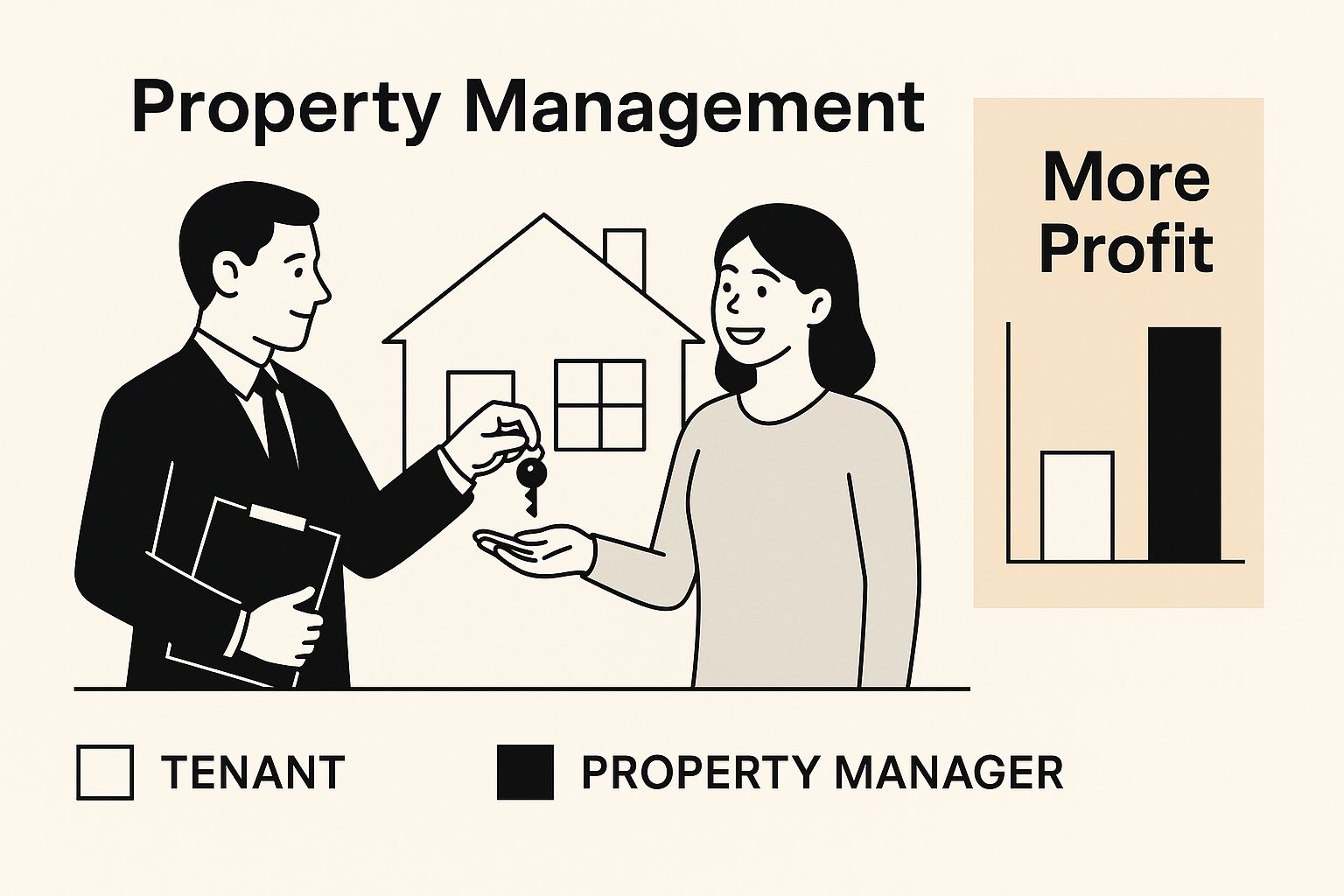
As you can see, the right partnership isn't a cost—it's a strategic investment in your property's long-term success.
Property Management Fee Structures
Let's examine how different fee models impact a property renting at $2,500 per month throughout the year.
|
Fee Model |
How It Works |
Estimated Annual Cost Example |
|---|---|---|
|
Percentage-Based |
A percentage (e.g., 8%) of monthly rent. |
$2,400 ($200/month) |
|
Flat-Fee |
A fixed amount (e.g., $150) each month, often with additional costs. |
$1,800 ($150/month) |
|
Hybrid Model |
A smaller flat fee plus specific service charges. |
Varies, e.g., $3,300 (base + placement fee) |
While the flat fee might initially seem the most economical, it can include numerous additional charges that could make it more costly than the percentage-based model, especially if high placement fees are involved.
Watch Out for the "Add-On" Costs
Beyond the main management fee, there's a whole world of other charges that can pop up on your statement. You absolutely have to ask about these before you sign anything, or you'll be in for a nasty surprise.
Here are some common fees to be aware of:
Tenant Placement Fee: This fee is typically charged for the process of finding, screening, and placing a new tenant. It is usually equivalent to one month's rent.
Lease Renewal Fee: Property managers may charge a smaller fee, often a few hundred dollars, to manage the paperwork when a tenant decides to renew their lease.
Maintenance Markups: Property managers may add a 10% surcharge to a contractor's invoice for coordinating repairs, which can increase the overall cost.
Vacancy Fees: Be cautious of companies that charge a monthly fee when a property is unoccupied and not generating rental income. It is advisable to avoid such fees.
A trustworthy property management partner will be completely upfront about their costs. If they can't give you a simple, all-inclusive fee schedule, walk away. You need to know the total annual cost before you commit to anything.
Finding the Right Management Partner
Once you have a shortlist of potential managers, it's time to dig in. The interview is your single most important tool for vetting a Loma linda property management company. This goes way beyond just checking for a license and insurance. You need to peel back the layers and understand exactly how they operate when things get tough.

Here's the thing: generic questions get you generic, rehearsed answers. Don't ask, "Do you screen tenants?" Everyone will say yes.
Instead, get specific. Try this: "What are the top three red flags you look for on a rental application, and why?" A question like that forces them to draw from real experience. A great manager won't hesitate. They'll immediately talk about things like unstable employment history, high debt-to-income ratios, or gaps in rental history—and explain why those are critical indicators.
Put Their Expertise to the Test with Scenarios
The best way I've found to gauge true competence is to throw them a curveball with a hypothetical situation. How they react tells you everything you need to know about their experience, knowledge of the law, and ability to think on their feet.
Try using these scenarios during your interviews:
-
The 2 a.m. Emergency: "It's Saturday night, 2 a.m., and your tenant calls in a panic. A pipe under the kitchen sink has burst and water is everywhere. Walk me through your exact process, step-by-step."
-
The Radio Silent Tenant: "I have a good, long-term tenant who is now two weeks late on rent. They aren't answering calls or emails. What are your immediate next three actions?"
-
The Lingering Vacancy: "My property has been sitting empty for over 45 days, which is costing me. What specific strategies would you use right now to get it rented, and how will you keep me in the loop?"
Pay very close attention to how they answer. Are they confident? Do they lay out a clear, systematic plan, or do they stumble and sound unsure? A seasoned pro has dealt with all of these situations before and will have a battle-tested protocol ready to go.
Their answers should also show a rock-solid grasp of California’s complex landlord-tenant laws. For that late-rent scenario, the only right answer involves serving the correct legal notices, like a 3-Day Notice to Pay Rent or Quit, at the legally required time.
Any hesitation or vagueness on that point is a massive red flag. This is what separates the true professionals from the rest of the pack.
Getting the Price Right: Smart Rental Rates in Loma Linda
Setting the right rent for your Loma Linda property is one of the most critical decisions you'll make. It’s a bit of an art and a science. If you price it too high, your property could sit empty for weeks, maybe even months, and those vacancy costs add up fast. But if you price it too low, you’re literally giving away profit each and every month. The goal is to hit that perfect balance that brings in great tenants quickly and keeps your investment healthy.
So, where do you start? With hard data. The Loma Linda real estate market is your best guide. We know the average home value is hovering around $632,740, and the median rent is sitting near $3,100. That gives you a solid starting point.
What’s even more telling is that local home prices have climbed 3.4% in the last year, which points to a strong, in-demand market. You can always dig deeper into Loma Linda’s current market trends to get a feel for what’s happening right now.
How to Run Your Own Market Analysis
With those baseline numbers in your back pocket, it's time to get a little more specific with a comparative market analysis, or CMA. This is something any good Loma Linda property management firm does as second nature, but you can absolutely do a solid version yourself. The idea is to find out what renters are actually paying for properties just like yours.
Here’s what to zero in on:
-
Apples to Apples: Make sure you're comparing your single-family home to other single-family homes, not condos or apartments. It's a different market.
-
Hyper-Local Focus: Stick to rentals within about a half-mile of your property. Proximity to key places like the university and hospital is a huge factor in Loma Linda, so location matters immensely.
-
The Specs: Compare properties with a similar bedroom and bathroom count, not to mention square footage.
-
The Finishes: Now, be objective. Is your kitchen from this decade, or does it have a vintage (and not in a good way) vibe? Modern appliances, a fenced-in yard, or a pool are all legitimate reasons to ask for more.
Find three to five truly comparable listings. This will give you a realistic price range. Your sweet spot is somewhere right in the middle of that range—not way above it, and certainly not below it.
This isn't about guesswork; it's about making an informed decision based on what the market is telling you. When you ground your rental rate in real data, you set yourself up for a profitable investment that attracts the kind of tenants you want.
Making the Transition: Onboarding Your New Property Manager

You’ve done the research and picked your Loma Linda property management partner. Now comes the part that sets the tone for your entire relationship: the onboarding process. A smooth handover isn't just a formality; it’s the bedrock of a transparent and successful partnership.
This all starts with a deep dive into the management agreement. Don’t just skim the pages—this document dictates the rules of your partnership. I always tell owners to pay close attention to the termination policies. You need to know exactly what the notice period is and if there are any fees should you ever need to part ways.
You also want absolute clarity on responsibilities. Who approves major repairs? How are owner funds handled? When can you expect financial reports? Getting these details straight from the beginning prevents so many headaches down the road.
The Handover: Getting Them Everything They Need
Once the ink is dry on the agreement, it's time to hand over the keys to the kingdom, so to speak. The more organized you are here, the faster your new manager can get to work.
To make sure nothing gets lost in the shuffle, have these items ready to go:
-
Property Access: Every key you have—for the unit, mailboxes, storage, and any garage door openers.
-
Lease Documents: The fully signed, current lease agreement along with any addendums or riders.
-
Tenant Files: The tenant's original application, contact details, and any communication history.
-
Vendor List: A list of any plumbers, electricians, or handymen you trust and have used in the past.
Remember, this transition isn't just about you handing things over. It's about seeing how your new manager takes the ball and runs with it. A great manager will immediately schedule an initial property inspection and formally introduce themselves to your tenant, establishing a clear line of communication from day one.
A solid lease is the foundation of any well-managed property. Before you even get to this stage, understanding the key clauses and essential elements to look for in a lease agreement is crucial. This groundwork ensures you're starting off on the right foot, with no surprises for you, your manager, or your tenant.
Answering Your Top Questions About Loma Linda Property Management
Even with a solid plan, it's natural to have a few lingering questions. Let's tackle some of the most common concerns we hear from property owners who are thinking about bringing in a professional to manage their Loma Linda rental.
One of the biggest hurdles landlords face in this area is the very specific renter pool. You’re not just renting to anyone; with Loma Linda University and the Medical Center as the main drivers, your tenants are often busy medical professionals and dedicated students. They have high standards for their living spaces and expect fast, professional service. On top of that, keeping up with California’s complex and constantly shifting landlord-tenant laws is a full-time job in itself.
How Do You Find Quality Tenants?
This is where a great property manager truly earns their keep. Their tenant screening process goes far beyond a basic credit check. We're talking about a comprehensive, multi-layered investigation.
A top-tier company will run thorough background checks that dig into:
-
Criminal history
-
Past eviction records
-
Employment and income verification
-
Direct calls to previous landlords to get the real story on their rental history
This isn't just about finding someone who can pay rent; it's about finding someone who will pay rent on time and treat your property like their own. It’s the single most important step in protecting your investment and your sanity.
Is the Management Fee Really Worth It?
For the vast majority of property owners, the answer is a resounding yes. It’s easy to get hung up on the management fee, but it's crucial to see it as an investment, not just an expense. In many cases, a good manager actually increases your net income.
A skilled property manager optimizes your investment by minimizing costly vacancies, securing better rates on maintenance, and ensuring you avoid expensive legal mistakes. The fee isn't just a cost—it's an investment in your property's long-term health and profitability.
Think about it. A manager’s network of trusted vendors is invaluable, especially when you move beyond routine fixes and need more significant property management remodeling and repair. They handle the bids, coordinate the work, and make sure it’s done right, saving you countless hours and headaches. That kind of comprehensive support is why partnering with an expert is often the smartest financial move you can make.
At AIM PROPERTY MANAGEMENT COMPANY, we handle every detail so you can enjoy the benefits of your investment without the day-to-day stress. From thorough tenant screening to 24/7 maintenance support, we protect your property and maximize your returns. Learn how our personalized services can help you succeed.
Article created using Outrank