
Evicting a tenant in California is a tightly regulated legal journey, not a simple request to leave. It's a formal process that starts with a valid reason, requires precise legal notices, and can involve court filings and even law enforcement if a tenant doesn't comply. One small mistake—say, an error on a notice form—can get the entire case thrown out, forcing you to start all over again from square one.
The Reality of Eviction and Why Experience Matters

Let’s be honest: dealing with an eviction is one of the most stressful and expensive challenges a property owner will ever face. It's a path riddled with legal landmines, strict deadlines, and a heavy emotional toll. Knowing how to evict a tenant legally is less about confrontation and more about executing a meticulous, step-by-step procedure.
The process is built to protect both landlords and tenants, which means you have to navigate a maze of regulations perfectly. A single misstep, like serving a notice improperly or filing the wrong court document, can cause major delays, rack up more expenses, and even expose you to legal penalties. This is where professional experience isn't just a nice-to-have—it's absolutely critical.
The Value of Seasoned Property Management
Since 1997, AIM Property Management has been a fixture in the local real estate community, providing experienced and mature relationships within the communities we serve, including Redlands, Beaumont, Calimesa, Yucaipa, Loma Linda, Mentone, Highland and Banning California. Our time in this business isn't just a number; it represents decades of building solid, working relationships with the local courts, legal professionals, and law enforcement. This deep-rooted community presence gives our clients a real advantage when things get tough.
We handle these sensitive situations with the kind of professionalism and precision that only comes from years of hands-on experience. For a low 7.9% monthly management fee and a transparent $750 placement fee with no other add-on fees, you get something invaluable: peace of mind.
An investment in professional property management is an investment in risk mitigation. It ensures that every step, from initial notice to final resolution, is handled correctly, protecting your property and your financial interests.
Long-Term Stability Over Short-Term Gains
At AIM, our entire focus is on long-term leases of six months or more. We do not provide services for short-term rentals, because we believe in building stable, profitable investments for our clients. Understanding the ins and outs of tricky tenant situations, like knowing how to get rid of bad tenants, has only strengthened our commitment to finding quality, long-term residents from the very beginning.
Long-term rentals offer clear advantages over the high-turnover churn of short-term stays:
- Consistent Cash Flow: Enjoy reliable monthly income without the seasonal gaps and unpredictable vacancies common with short-term rentals.
- Lower Turnover Costs: Fewer move-outs mean spending significantly less on advertising, deep cleaning, and preparing the property for new occupants.
- Reduced Wear and Tear: Long-term tenants tend to treat a property like their own home, leading to better upkeep and fewer maintenance issues over time.
- Stronger Tenant Relationships: Building a positive, long-term relationship fosters mutual respect and better care for your valuable asset.
Ultimately, this focus on stability dramatically lowers the odds of facing conflicts that could lead to an eviction. For property owners navigating the complexities of tenant issues, it's also crucial to have a game plan for dealing with nightmare tenants. Our approach is proactive, not just reactive, to protect your investment for the long haul.
Building Stability With Long-Term Rentals
Before we even get into the nuts and bolts of eviction, let's talk about something far more important: setting yourself up to avoid that process altogether. It all starts with your rental strategy. Here at AIM, we do not deal with short term rentals; we only provide services for long term leases of over 6 months or longer. This isn't just a business model; it’s a philosophy that comes from decades of seeing what truly works for property owners.
Long-term tenants are the bedrock of a stable real estate investment. They bring in a consistent, predictable income stream, slash your turnover costs, and, frankly, they just take better care of the place. It's a world away from the high-maintenance, high-risk game of short-term rentals.
The Pitfalls Of Short-Term Rentals
The high nightly rates of a short-term rental can look tempting on paper, but they hide a ton of operational headaches and financial risks. The constant churn of guests creates a unique set of challenges that can bleed your bank account dry and turn a passive investment into a second job.
- Accelerated Wear and Tear: A revolving door of guests with no long-term stake in the property’s condition leads to faster deterioration of furniture, appliances, and fixtures.
- Constant Management Demands: The model is anything but passive. It requires non-stop marketing, guest communication, check-ins, and cleanings, consuming your time and energy.
- Higher Turnover Expenses: The overhead can be substantial. Between professional cleanings, restocking supplies, and covering utilities between guests, your costs are significantly higher than with a long-term lease.
- Increased Risk of Conflict: The transient nature of short-term stays often leads to more frequent disputes, noise complaints from neighbors, and a higher chance of property damage.
This high-turnover model forces landlords into a reactive state, where you're constantly putting out small fires instead of building long-term value.
A rental strategy focused on short-term gains often overlooks the long-term costs of instability and frequent vacancies. True profitability comes from consistency, not constant turnover.
Advantages Of A Long-Term Leasing Strategy
On the flip side, focusing on long-term tenants creates a much more sustainable and profitable portfolio. When you secure residents for six months or longer, you’re cultivating a stability that pays real dividends. We've been serving communities like Redlands, Beaumont, Calimesa, Yucaipa, Loma Linda, Mentone, Highland, and Banning since 1997, and our experience has proven time and again that long-term tenancies are just the smarter investment.
The benefits are clear and hit your bottom line directly:
- Predictable Monthly Income: A signed lease means reliable cash flow you can build your finances around, month after month.
- Reduced Vacancy Costs: Fewer move-outs mean you spend far less time and money on marketing, property showings, and screening applicants.
- Better Property Care: When tenants see a property as their home, they are far more likely to report maintenance issues quickly and take genuine pride in its upkeep.
- Stronger Community and Tenant Relationships: Long-term residents become part of the neighborhood fabric, which fosters a sense of stability that benefits everyone involved.
This whole approach starts with a rock-solid screening process. By carefully selecting qualified, reliable residents from the get-go, we dramatically minimize the risk of future problems. If you're looking to tighten up your own process, our guide on how to find good tenants offers some practical steps for securing renters you can trust.
Ultimately, by prioritizing stable, long-term tenancies, you create an environment where eviction is a rare exception, not a recurring nightmare. It’s all about building a solid foundation to protect your asset for the long haul.
Initiating the Eviction with Proper Legal Notice
The very first move in any California eviction is serving the tenant with a formal, written notice. Think of this as the foundation of your entire legal case—because it is. A tiny mistake here, whether it's the type of notice you use, the information on it, or how you hand it over, can get your entire case thrown out. That means you’re back to square one, with the tenant still in your property, while you start the whole frustrating process over again.
Before you can even think about a notice, you need a legally valid reason, or "just cause," for the eviction. These reasons generally fall into two buckets: "at-fault" causes (the tenant did something wrong) and "no-fault" causes (you, the landlord, need the property back for specific, legally-sanctioned reasons). The reason you're evicting directly determines which notice you must serve.
The infographic below really drives home this critical first step.
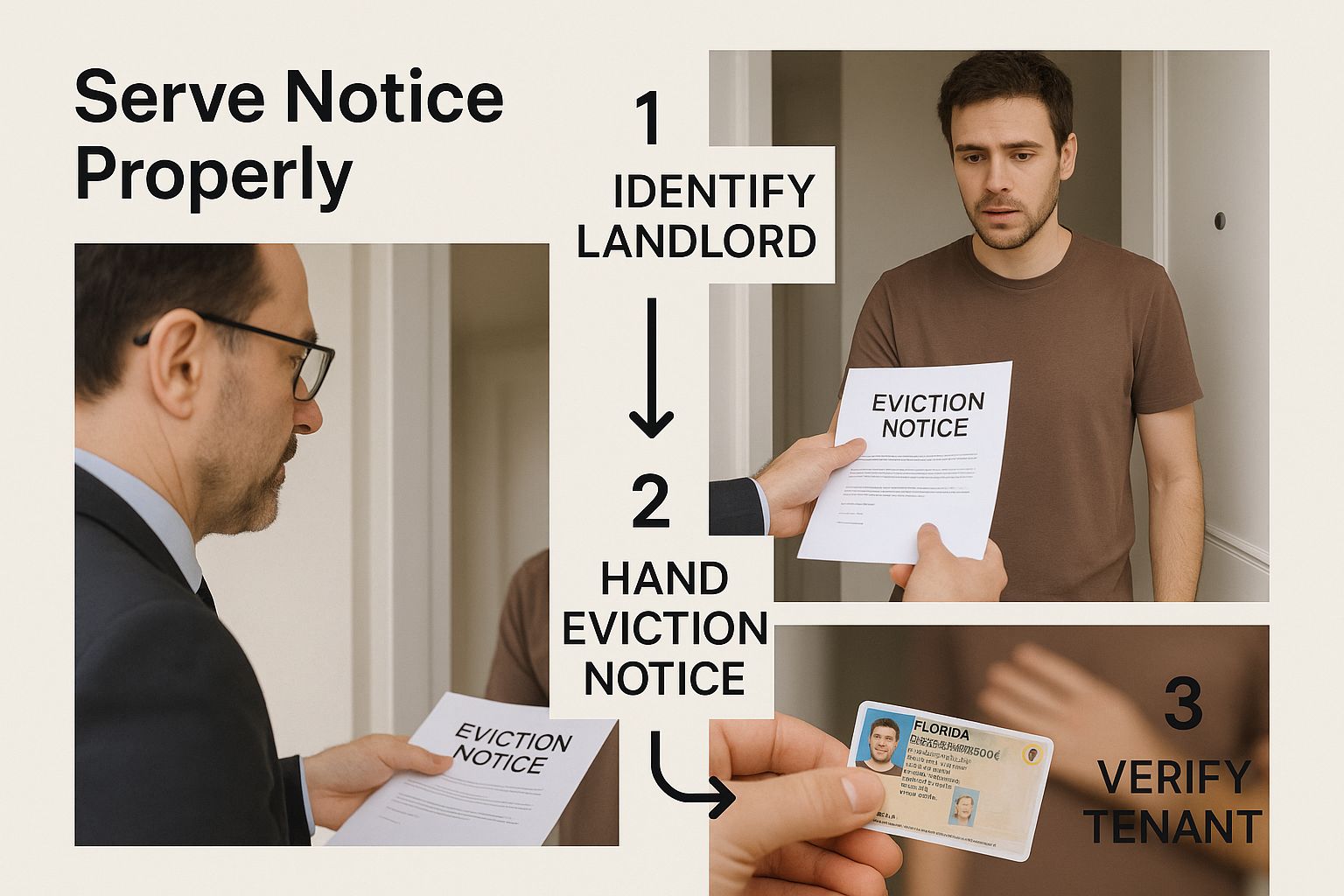
As you can see, getting the notice and its delivery right isn't just a suggestion; it’s non-negotiable if you want to avoid costly delays or an outright dismissal in court.
Understanding the Key Types of Eviction Notices
California law is incredibly specific about the types of notices and when to use them. Using the wrong one is probably the most common—and most expensive—mistake I see landlords make. For at-fault situations, there are three main notices you'll encounter.
-
3-Day Notice to Pay Rent or Quit: This is your go-to, and the most common notice by far. It’s used only when the tenant hasn't paid their rent. It gives them a clear choice: pay the full amount owed within three days, or move out. The notice absolutely must state the precise amount of rent due and exactly who and how to pay it.
-
3-Day Notice to Cure or Quit: This one is for lease violations that the tenant can actually fix, or "cure." A classic example is an unauthorized pet. This notice gives the tenant three days to get rid of the pet or move out. It also applies to things like unauthorized roommates or unapproved alterations to the property.
-
3–Day Unconditional Quit Notice: This is the most serious notice and offers the tenant no chance to fix the problem. It's reserved for major lease violations that can't be undone, like causing substantial damage to the property, conducting illegal activity on the premises, or creating a serious nuisance that disturbs other residents.
I can't stress this enough: choosing the correct notice is everything. If you serve a "Notice to Cure or Quit" for non-payment of rent, your case is dead on arrival. Each notice has a specific job, and it must be filled out with 100% accuracy.
The Critical Importance of Proper Service
Once you have the right notice filled out perfectly, you have to "serve" it to the tenant according to a strict legal playbook. You can't just text them a photo or slip it into their mailbox and call it a day. Proper service is the official act that starts the clock on the tenant's response time.
Here are the legally accepted ways to serve a notice in California:
- Personal Service: Handing the notice directly to the tenant. This is always the best and most bulletproof method.
- Substituted Service: If the tenant isn't there, you can leave the notice with another responsible adult at the property and then mail a second copy to the tenant.
- Posting and Mailing: If you can't find the tenant or another adult, you can tape the notice in a visible spot (like the front door) and mail a copy. This is often called "nail and mail."
Failure to follow these service rules to the letter is one of the most common reasons landlords lose eviction cases. A judge will not overlook procedural errors, no matter how valid your reason for eviction is.
The sheer number of evictions filed shows just how often landlords are forced down this path. For example, between February 2023 and April 2025, the Los Angeles Housing Department processed an incredible 210,901 eviction notices. A staggering 94% of those were for non-payment of rent. The average amount owed was $3,987.85, and 89% of cases were initiated with a 3-day notice. You can see more of this data on the LA City Controller's website.
This data really highlights why getting the notice right is so important. With non-payment being the primary driver of evictions, mastering the "3-Day Notice to Pay Rent or Quit" is a fundamental landlord skill. For a deeper look at the legal framework behind all this, check out our detailed guide on landlord-tenant laws in California. Starting the process correctly not only strengthens your legal position but also sets you up for a smoother, less stressful resolution.
Navigating the Unlawful Detainer Lawsuit
So, you’ve served the proper notice, the deadline has passed, and your tenant is still in the property. Now what? This is the point where many landlords feel stuck, but the path forward is clear—if you follow the law to the letter.
Your next move isn’t to change the locks or shut off the utilities. That’s a one-way ticket to a lawsuit against you. Instead, it’s time to file an Unlawful Detainer lawsuit with the Superior Court. This is the formal legal process to get a court order for possession of your property, and in this arena, precision is absolutely critical.
Filing this lawsuit officially moves your dispute from a landlord-tenant matter into a court case. The rules get stricter, the stakes get higher, and there's zero room for error. A simple mistake—a misspelled name, a wrong address on the form—can get your case thrown out, forcing you to start the entire eviction process all over again.
Filing the Lawsuit: The Summons and Complaint
To kick off the Unlawful Detainer, you’ll need to file two essential legal forms with the court: the Summons (SUM-130) and the Complaint (UD-100). These aren’t just suggestions; they are the official documents that initiate the legal action.
The Complaint is your side of the story, a sworn statement explaining why you have the legal right to evict. It lays out the facts: the property details, who the tenant is, the type of notice you served, and how the lease was violated.
The Summons acts as the official notification to your tenant that they are being sued and have a very brief window to respond.
Once you file these documents and pay the court filing fee, the court clerk issues the official Summons. This is the moment your case is officially opened, but the clock for the tenant doesn't start ticking just yet.
Serving the Lawsuit and the Tenant’s Response Window
Just like the initial eviction notice, the Summons and Complaint must be legally "served" to the tenant. This can't be done by you. It has to be handled by a neutral third party over the age of 18, which is why most landlords hire a professional process server or use the Sheriff's Department to guarantee it’s done right.
After being served, the tenant is on a tight deadline. They typically have just five days to file a formal response with the court. This quick turnaround is intentional, designed to keep Unlawful Detainer cases moving forward. The tenant generally has three ways to respond:
- File an Answer: This is the most common route. The tenant denies your claims or raises legal defenses, like claiming the notice was improper or the property was uninhabitable.
- File a Motion to Quash Service: The tenant argues the lawsuit papers weren't delivered correctly. If they win, you have to re-serve the documents, which means more delays.
- Do Nothing: If the tenant ignores the lawsuit and the five-day deadline passes, you can request a default judgment from the court, which can significantly speed up the final eviction.
Navigating the procedural hoops of an Unlawful Detainer lawsuit is where many landlords stumble. The court system is unforgiving, and a simple paperwork mistake can turn into a very expensive lesson on the importance of doing things by the book.
To give you a sense of the eviction landscape, consider that in Pennsylvania during 2023, landlords filed a staggering 114,272 eviction cases. That works out to about 314 renter households facing eviction every single day. The vast majority—over 90%—were due to unpaid rent, which highlights just how common this issue is.
The table below provides a general timeline for how these cases unfold in California.
California Eviction Process Timeline Overview
This table outlines the typical stages and estimated timelines for a standard eviction case in California, assuming no major delays or contested hearings.
| Eviction Stage | Typical Timeframe | Key Action Required |
|---|---|---|
| Notice Period | 3-90 days | Serve the correct legal notice (e.g., 3-Day Notice to Pay Rent or Quit). |
| Filing Lawsuit | 1-3 business days | File the Summons and Complaint with the Superior Court. |
| Serving the Tenant | 1-5 days | Have a third party legally serve the lawsuit documents to the tenant. |
| Tenant Response | 5 calendar days | Tenant must file a response with the court after being served. |
| Request for Trial | 1-3 business days | If the tenant responds, the landlord files a form to set a trial date. |
| Court Trial | Within 20 days | The court hearing is scheduled quickly after the request is filed. |
| Writ of Possession | 1-5 business days | If you win, the court issues a Writ of Possession authorizing removal. |
| Sheriff Lockout | 5-15 days | The Sheriff posts a 5-Day Notice to Vacate and then performs the lockout. |
These timelines show why every step matters. For California landlords, knowing the rules isn’t just about winning a case; it's about handling it efficiently and correctly. Our detailed guide on 2025 California landlord laws provides essential information to help you stay compliant and protect your investment.
Securing a Judgment and Regaining Your Property

Once you've filed the Unlawful Detainer lawsuit, the process really starts to pick up speed. At this point, the path forward splits into two very different directions, and it all hinges on what the tenant does next.
If your tenant doesn't file a formal response with the court within the tight five-day deadline, you can move for what's called a default judgment. This is the fastest route to getting your property back because you essentially win the case without a full-blown trial.
But if the tenant files an Answer, get ready to head to court.
Preparing for a Potential Court Hearing
If the tenant decides to fight the eviction, the court will set a trial date, usually within about 20 days. This is where all your diligent record-keeping pays off. Trust me, a judge isn’t interested in emotional appeals or he-said-she-said stories—they want cold, hard facts.
To build a rock-solid case, you need to have every piece of evidence organized and ready to go. This isn't just a good habit; it's absolutely critical.
- The Signed Lease Agreement: This is the contract, the foundation of your entire case.
- A Detailed Rent Ledger: Show every payment, the date it was made, and clearly highlight any missed or late payments.
- All Written Communication: Every email, text message, or formal letter about the lease violation or unpaid rent.
- Proof of Service: This is the copy of the eviction notice and the signed form proving it was delivered correctly.
Walking into court with this level of organization shows you're a professional who has followed the law to the letter. It’s also a reminder to stay on top of all your legal duties. For a refresher, check out our guide on landlord responsibilities in California.
Obtaining the Writ of Possession
Whether you win by default or in a courtroom trial, the end goal is the same: the judge signs a Judgment of Possession. This official court order legally confirms your right to take back the property. But that piece of paper by itself can't physically remove a tenant.
For that, you need one final document: the Writ of Possession.
The court clerk issues this writ, which you then take directly to the local Sheriff's department. The Writ is a powerful order commanding law enforcement to remove the tenant and officially restore possession of the property to you.
The Writ of Possession is the only legal way to have a tenant physically removed. A landlord can never, under any circumstances, take matters into their own hands.
The Dangers of "Self-Help" Evictions
I get it. It’s incredibly frustrating to lose money every day while a tenant refuses to pay or leave. It can be tempting to look for a shortcut. However, resorting to "self-help" eviction tactics is one of the worst mistakes a landlord in California can make. These actions are illegal and will land you in a world of legal and financial pain.
Illegal self-help measures include things like:
- Changing the locks.
- Throwing the tenant’s belongings out.
- Shutting off utilities like water or electricity.
- Harassing or intimidating the tenant to get them to leave.
California law comes down hard on landlords who do this, often forcing them to pay the tenant substantial damages. The formal eviction process might feel slow, but it is the only legal path forward.
Housing instability is a massive issue nationwide. While eviction threats impact over 7 million American renters annually, that number doesn't even include illegal lockouts and other informal removals that never make it to a courthouse. To see how cities are trying to get a better handle on this, you can learn more about how local governments are working to improve data tracking. Following the legal process protects you and ensures the system works as it should for everyone.
Common Questions About California Evictions
When it comes to evictions, every landlord has questions. The process is loaded with legal minefields, and getting clear answers is the only way to protect your investment and handle things the right way. We hear a lot of the same concerns from property owners in Redlands, Beaumont, and Yucaipa, so let's tackle the most common ones.
How Much Does It Cost to Evict a Tenant in California?
This is a tough one because the total cost can really swing. On the low end, you’re looking at several hundred dollars for the absolute basics: court filing fees and the Sheriff's fee to serve the final lockout notice. Think of these as the non-negotiable costs of entry to the legal process.
The real wildcard is whether the tenant fights the eviction. If you end up needing an attorney to argue your case in court, the costs can jump into the thousands pretty quickly. This is where an experienced property management firm becomes invaluable. We can often keep these costs down through our network of legal experts and by making sure every step is done right the first time, which dramatically lowers the risk of a long, expensive court battle.
Can I Evict a Tenant Without a Written Lease?
Yes, you can. It’s a common misconception that a handshake deal means you’re stuck. In California, if there’s no written lease, the law generally considers it a month-to-month tenancy. You still have to follow the formal eviction process, but the first step is a little different.
For a no-fault termination, you’ll need to give the tenant proper written notice.
- A 30-Day Notice to Vacate is used if the tenant has lived there for less than a year.
- A 60-Day Notice to Vacate is required if they’ve been in the property for a year or more.
Now, if the eviction is for a specific reason—what the law calls "just cause," like not paying rent—you’d fall back to the standard 3-Day Notice, just as you would with a formal lease. If they don't move out after the notice period ends, you're clear to file the Unlawful Detainer lawsuit with the court.
A verbal agreement doesn't give you a shortcut. The courts demand that you follow the exact same legal notice and filing procedures, whether you have a 20-page lease or just a verbal understanding.
What Happens to the Security Deposit After an Eviction?
California has incredibly strict rules for handling security deposits, and they don’t get relaxed just because the tenancy ended badly. The moment you legally get possession of the property back, a 21-day countdown begins.
Within that three-week window, you have to do one of two things:
- Return the tenant's entire security deposit.
- Send the tenant an itemized statement that lists every deduction, plus a check for any money that’s left over.
You can legally deduct for things like unpaid rent, cleaning costs to get the unit back to how it was at move-in, and repairs for any damage that goes beyond normal wear and tear. The key here is documentation. Keep every receipt, take photos, and get invoices. This proof is your best defense if a dispute over the deposit arises later on.
How Long Does the Eviction Process Take in California?
The timeline is probably the most unpredictable part of an eviction. In a best-case scenario—an uncontested eviction where the tenant doesn’t respond to the lawsuit—you could be looking at 3 to 6 weeks from the day you serve the first notice to the Sheriff performing the final lockout.
But if the tenant decides to contest it, that timeline can get stretched out for months. Court backlogs, tenant-filed motions to delay, or even a small mistake on your initial paperwork can bring everything to a grinding halt. Honestly, the single best way to keep the process moving is to ensure every form is filled out perfectly and every deadline is met without fail.
Navigating the complexities of tenant law requires experience and a steady hand. Since 1997, AIM PROPERTY MANAGEMENT COMPANY has provided landlords in the Redlands, Beaumont, Calimesa, Yucaipa, Loma Linda, Mentone, Highland, and Banning communities with the expertise needed to manage properties effectively and legally. With our low 7.9% monthly management fee and straightforward $750 placement fee, we protect your investment while you enjoy peace of mind. Learn more about how we can help you by visiting us at https://aim-properties.com.