
Facing a potential eviction is one of the toughest parts of being a landlord. Getting the first step right—the eviction notice itself—is absolutely critical. A legally sound notice isn't just a piece of paper; it’s the foundation of a lawful eviction in California, protecting you from expensive dismissals and frustrating delays.
Navigating California Eviction Notices: A Landlord’s First Steps

Before you can even think about filing an unlawful detainer lawsuit, you must serve the tenant with a proper written notice. This isn't a suggestion; it's a strict legal requirement. The type of notice you serve depends entirely on why you need the tenant to leave.
Picking the wrong form is a guaranteed way to get your case thrown out of court. This forces you to start the entire process over from square one—a common and costly mistake we see DIY landlords make. We serve the following communities: Redlands, Beaumont, Calimesa, Yucaipa, Loma Linda, Mentone, Highland and Banning California. Every day of delay means another day of lost rent and mounting legal fees.
That's why it's so important to understand the different types of California eviction notices and when to use them.
California Eviction Notice Types At A Glance
To help you get started, we've put together a quick reference table. This summarizes the most common notices used by landlords in California, what they're for, and the action required from the tenant.
| Notice Type | Primary Use Case | Tenant Action Required | Cure Period |
|---|---|---|---|
| 3-Day Notice to Pay or Quit | Tenant has failed to pay rent. | Pay the full, exact rent amount owed or vacate the property. | 3 days |
| 3-Day Notice to Cure or Quit | Tenant has violated a specific lease term (e.g., unauthorized pet). | "Cure" the violation (e.g., remove the pet) or vacate the property. | 3 days |
| 30-Day Notice to Terminate | Ending a month-to-month tenancy for a tenant living there less than 1 year. | Vacate the property. | 30 days |
| 60-Day Notice to Terminate | Ending a month-to-month tenancy for a tenant living there 1 year or more. | Vacate the property. | 60 days |
Think of this table as your starting point. Choosing the right notice is the first move in a complex legal process, and getting it right is non-negotiable.
The Most Common California Eviction Notices
For landlords in Banning, Calimesa, Loma Linda, Highland, and Mentone, three notices cover the vast majority of situations you'll face:
- 3-Day Notice to Pay Rent or Quit: This is your go-to when a tenant is behind on rent. It gives them three days to pay the exact amount owed or move out. Any error in the amount due or how you calculate the deadline can render the notice invalid.
- 3-Day Notice to Cure or Quit: This applies when a tenant breaks a specific rule in the lease agreement—think having an unauthorized pet, causing property damage, or creating a nuisance. The tenant has three days to fix ("cure") the problem or vacate.
- 30/60-Day Notice to Terminate Tenancy: This is a "no-fault" notice used to end a month-to-month rental agreement. A 30-day notice is for tenants who've lived in the property for less than one year, while a 60-day notice is required for tenancies of one year or longer.
Key Takeaway: The notice you serve is a legal document that sets the stage for any future court action. A minor error, like a miscalculation of the deadline or an incorrect rent amount, can invalidate the entire notice and jeopardize your case.
Why Your Lease Agreement Matters First
The eviction process doesn't start when a problem arises; it starts with your lease. A weak or poorly written lease creates loopholes that make it incredibly difficult to enforce its terms—or to evict a tenant when necessary.
Before you even get to an eviction notice, your foundational document has to be rock-solid. You can learn more about what makes an airtight lease agreement in California, which is always a landlord’s first line of defense. A well-written lease clearly defines everyone's obligations, making it much easier to prove when a violation has occurred.
Navigating this landscape requires precision. According to recent data, more than 7 million U.S. households face the threat of eviction each year. These numbers highlight just how critical it is for property managers and landlords to follow proper legal protocols, especially in markets served by Beaumont property management and Yucaipa property management services.
Ultimately, selecting and correctly completing the right eviction notice is your opening move in a complex legal game. For landlords in our service areas, from Highland to Banning, getting this initial step right is the difference between a swift resolution and a protracted, expensive legal battle. It’s a key reason so many owners choose to hire a property manager to handle these critical tasks with expertise and care.
Your Essential California Eviction Forms, Ready to Download
The first step in any eviction is also the most unforgiving: the notice. A single mistake on that form—the wrong date, an incorrect amount, or vague language—can get your entire case thrown out of court. You're then forced to start all over again, losing more time and money as the frustration builds.
Don't take that chance. Using a generic eviction notice template from a random website is a huge risk in California, where rental laws are notoriously strict. The forms below are tailored for California compliance, giving you a solid, legally sound foundation.
The Only 3 Notices Most Inland Empire Landlords Ever Need
In our years managing properties in Redlands, Beaumont, and Yucaipa, we’ve found that over 90% of tenant issues requiring formal action can be solved with one of just three documents.
Here are the direct download links for each one.
1. 3-Day Notice to Pay Rent or Quit
- When to Use: This is your go-to for the most common landlord headache: unpaid rent.
- What It Does: It gives your tenant a firm three-day window to pay the full, exact amount of rent owed or move out.
- Common Mistake to Avoid: Including anything other than rent. This notice is for past-due rent only. You cannot add late fees, utilities, or other charges.
[Download Your Editable 3-Day Notice to Pay Rent or Quit Template Here]
2. 3-Day Notice to Cure or Quit
- When to Use: This notice is for lease violations that aren't about money. Think unauthorized pets, property damage, or being a nuisance to neighbors.
- What It Does: The tenant gets three days to "cure" (fix) the problem or vacate the property.
- Common Mistake to Avoid: Being too vague. Your notice must state precisely what the tenant did to violate the lease and exactly what they must do to correct it.
[Download Your Editable 3-Day Notice to Cure or Quit Template Here]
3. 30/60-Day Notice to Terminate Tenancy
- When to Use: This is for ending a month-to-month tenancy without fault. Use the 30-Day Notice if the tenant has lived there for less than one year. Use the 60-Day Notice if they've been there for one year or more.
- What It Does: It officially terminates the tenancy and gives the tenant the legally required time to move.
- Common Mistake to Avoid: Miscalculating the notice period. The law is absolute on these timelines. One day short, and your notice is completely invalid.
[Download Your Editable 30/60-Day Notice to Terminate Tenancy Template Here]
A Word of Caution from Experience: These templates are an essential tool, but they're just the first step. We’ve seen landlords in Loma Linda and Highland serve a perfect notice, only to stumble on what comes next. If you feel even slightly unsure, it’s always smarter and safer to hire a property manager to guarantee compliance.
Why a Form Is Never Just a Form
While these documents give you a strong start, true legal compliance goes much deeper. You can find all sorts of free legal document templates online, but the eviction process is too high-stakes for a simple "fill-in-the-blanks" approach.
A professional firm specializing in Yucaipa property management, for example, doesn't just hand you a form. We manage its entire lifecycle. That means verifying every piece of information, ensuring the notice is served in a legally defensible way, and handling all follow-up communication and potential court filings.
It's the small details that trip up DIY landlords. For instance, did you remember to exclude weekends and court holidays when calculating the 3-day deadline? Forgetting to do so instantly invalidates the notice. A professional property manager in Banning or Calimesa handles these details automatically, protecting you from these expensive and time-consuming mistakes. For more on navigating landlord responsibilities, check out our guide to tenant resources.
How To Correctly Fill Out And Serve An Eviction Notice
Having the right eviction notice template is a great starting point, but it's really only half the job. In California, one small mistake in how you fill out the form or deliver it can unravel your entire effort, forcing you to start the clock all over again. I’ve seen it happen. This is your practical guide to getting every detail right and making sure your notice is legally sound.
The process itself is straightforward, but each stage has its own legal tripwires you need to be aware of.
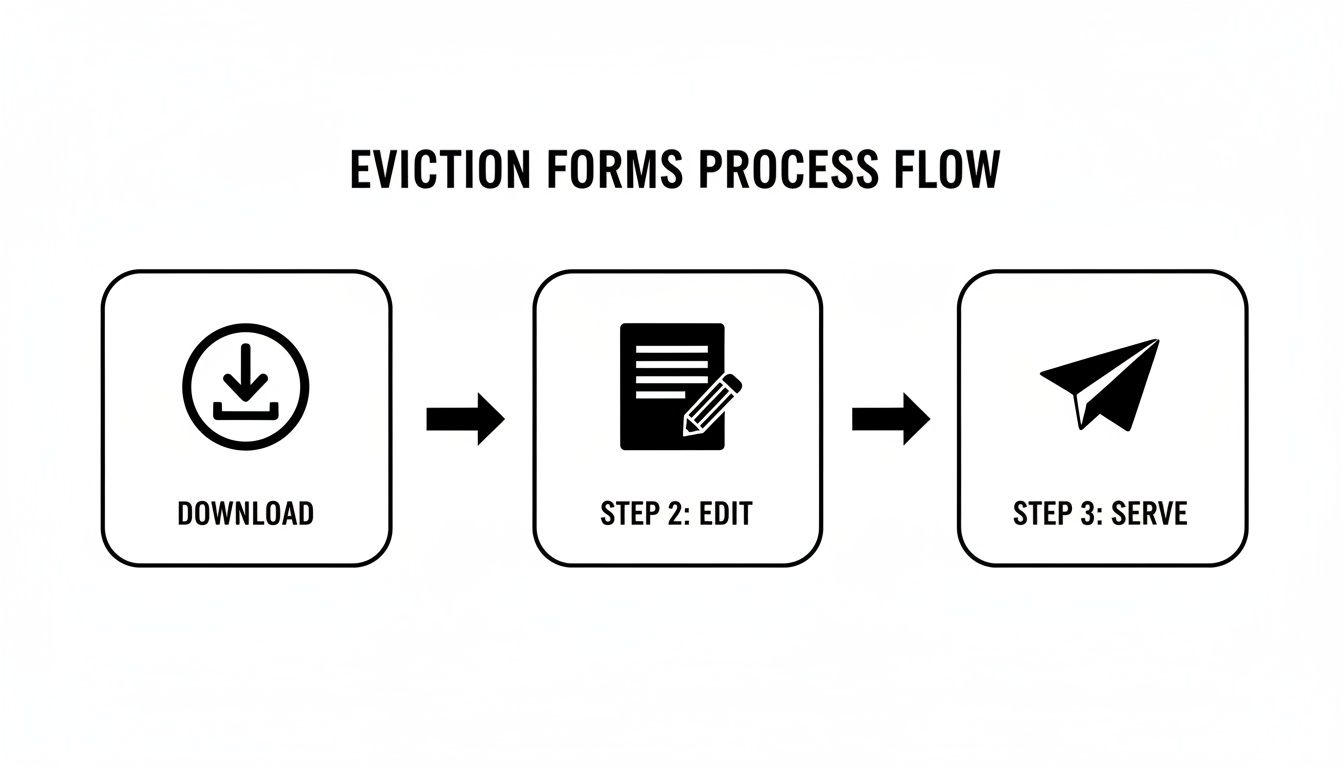
It really comes down to these three key actions: getting the right form, filling it out with total precision, and serving it in a way that the courts will recognize.
Filling Out Your Notice With Precision
When it comes to eviction notices, ambiguity is your worst enemy. California courts demand absolute clarity, and any minor error can give a tenant grounds to challenge the eviction, costing you time and money.
Here’s exactly what you need to get right:
- Full Legal Names: Don't use nicknames. You must list every single tenant named on the original lease agreement using their full, legal names.
- Property Address: State the complete, accurate address of the rental property. If it's an apartment or multi-unit building, be sure to include the specific unit number.
- The Exact Amount Due (for Pay or Quit Notices): This is where most DIY landlords get into trouble. The amount must be only for past-due rent. You cannot include late fees, unpaid utility bills, or any other charges.
- Clear Description of the Violation (for Cure or Quit Notices): Be specific. "Lease violation" won't cut it. Instead, write something like, "Possession of an unauthorized brown-and-white pit bull mix, in violation of Section 12 of the lease agreement, which prohibits pets."
A word of caution: The date on your notice and the deadline you provide must be calculated correctly. For a 3-Day Notice, you can't count weekends or court holidays. This small detail trips up countless landlords in the areas we serve: Redlands, Beaumont, Calimesa, Yucaipa, Loma Linda, Mentone, Highland and Banning.
Understanding The Legal Service Methods In California
Once your notice is filled out perfectly, you have to "serve" it to the tenant according to strict legal methods. Just taping it to the door and calling it a day is a recipe for disaster. Proving you served the notice correctly is essential if you end up in court.
In California, you have three main options for serving an eviction notice:
Personal Service: This is the gold standard. You, or another adult who isn’t part of the case, physically hand the notice directly to the tenant. It’s the most direct method and the hardest to dispute.
Substituted Service: If you can’t find the tenant at home, you can leave the notice with another person of "suitable age and discretion" at the property, like a roommate or family member over 18. You must also mail a second copy to the tenant at that same address.
Post and Mail Service: This is your last resort. If the first two methods fail, you can tape the notice to the front door (or another obvious place) and mail a copy. You can only do this if you have a good reason to believe the tenant is still living there.
No matter which method you use, you must complete a Proof of Service document. This is a sworn statement detailing who served the notice, along with the date, time, location, and method. This document is critical evidence. Meticulous documentation like this is standard practice for any professional handling Yucaipa property management.
Navigating these steps takes diligence, especially when economic pressures are high. As we saw when 1.17 million workers were laid off over 11 months leading into January 2026, and federal data showed about 1.7 million layoffs by November 2025, economic downturns often lead to an increase in eviction filings. For property owners who rely on expert Beaumont property management, staying aware of these trends is vital for anticipating tenant financial issues.
Ultimately, filling out and serving an eviction notice is a core component of the landlord eviction process in California. Getting it wrong can set you back weeks, if not months. The precision required is a major reason so many property owners in Banning and Highland choose to hire a property manager, turning this complex legal task over to seasoned experts.
Local Rules For Landlords In Redlands, Beaumont, And Yucaipa
While California provides the statewide rulebook for evictions, many landlords don’t realize that local courts can add their own unwritten chapters. An eviction notice template that works perfectly in one county might get tossed out in another for missing a small but crucial detail.
For property owners in our service areas—including Redlands, Beaumont, Yucaipa, Banning, Calimesa, Loma Linda, Highland, and Mentone—knowing these local nuances is the difference between a quick resolution and a costly delay.
These Inland Empire communities are mostly governed by state laws like the Tenant Protection Act (AB 1482), which dictates just-cause evictions and rent caps. Unlike major cities like Los Angeles or San Francisco, our local cities in San Bernardino and Riverside counties don't have their own strict rent control ordinances.
But that doesn't mean the process is the same everywhere. The real differences show up in how local courts handle eviction cases day-to-day.
Judicial Tendencies In Local Courts
From our years of on-the-ground experience, we know that a judge in San Bernardino Superior Court might interpret a case very differently than a judge in Riverside Superior Court. These "judicial tendencies" are the unwritten rules that can make or break an eviction. Some judges, for example, will scrutinize a "Notice to Cure or Quit" with a fine-toothed comb, looking for any possible ambiguity that could favor the tenant.
We once handled a case near Redlands where an eviction was stalled for three weeks simply because the judge felt the description of a lease violation was too vague. The landlord's notice said the tenant was "creating a nuisance." The judge wanted more: explicit dates, times, and a play-by-play of the disruptive behavior. It's a perfect example of how local court expectations can demand far more than what a standard state form requires.
The most significant local factor isn't a city ordinance, but the specific judge who hears your case. Their interpretation of state law and their procedural expectations are what truly shape the outcome of an eviction in the Inland Empire.
Navigating Just Cause In Our Communities
In all our service areas, California's "just cause" law is the gold standard. This means you can't just end a tenancy without a valid, legally-approved reason once a tenant has been in the home for 12 months. When you hire a property manager, a massive part of their job is to build an ironclad case file that not only proves just cause but also satisfies the high standards of local judges.
Here’s how this plays out in the real world:
- Documenting Non-Payment: For a 3-Day Notice to Pay or Quit in Yucaipa, we don’t just write down the total amount owed. We prepare a full payment ledger that shows exactly how the balance was calculated, preemptively answering any questions a skeptical judge might have.
- Proving Lease Violations: If a tenant is damaging a property in Beaumont, serving a notice is just the first step. We follow up by documenting everything with dated photos, gathering repair invoices, and getting written statements from neighbors. We build a comprehensive evidence package designed to hold up under intense scrutiny.
This kind of meticulous preparation is what separates a successful eviction from one that gets dismissed on a technicality. It’s all about anticipating what local courts demand and providing undeniable proof. This is a core benefit for landlords looking for dependable property management in Beaumont. Having a local team that knows the system inside and out can save you from incredibly expensive mistakes and delays.
Why The Smartest Landlords Hire A Property Manager

If you're here looking for an eviction notice template, chances are you're already dealing with a stressful situation. A properly filled-out notice is a crucial first step, but it’s often a sign that a small issue has snowballed into a major problem. Experienced landlords know the secret to handling evictions is to stop them before they ever start.
This is where you can shift from reacting to problems to protecting your investment for the long haul. Instead of scrambling to address late rent or lease violations, a professional property manager helps you build a system that encourages success from day one. It’s all about being proactive.
A System Built To Prevent Evictions
A great property manager does more than just collect rent; they put a proven strategy in place to protect your asset and your cash flow. We’ve seen firsthand how this system dramatically cuts down on the need for evictions in the communities we serve: Redlands, Beaumont, Calimesa, Yucaipa, Loma Linda, Mentone, Highland and Banning California.
Here’s a glimpse at how it works:
- Rigorous Tenant Screening: This is your first line of defense. Our screening goes far beyond a basic credit check. We conduct in-depth background checks, verify income and employment, and have real conversations with past landlords to get a complete picture of every applicant.
- Ironclad Lease Agreements: We ensure your lease is a robust legal document tailored to current California laws. It clearly lays out all the rules, expectations, and consequences, leaving zero room for "misunderstandings."
- Proactive Communication & Maintenance: A well-kept property with open lines of communication leads to happier tenants who treat your home with respect. When we address repair requests quickly, it shows we care, which fosters a much healthier landlord-tenant relationship.
This proactive approach filters out risky applicants and sets clear expectations from the start, which minimizes conflicts down the road.
From Paperwork Headaches To Peace Of Mind
Managing rentals in cities like Banning, Calimesa, and Loma Linda means dealing with a mountain of paperwork and a deep understanding of constantly changing laws. One small mistake can easily lead to legal trouble and financial loss.
The real value of a property manager isn't just in handling a crisis like an eviction; it's in the hundreds of details they manage correctly so that a crisis never develops.
Think about all the tedious work involved. Professional property management includes automated rent collection for consistent cash flow, detailed financial reporting so you always know how your investment is performing, and 24/7 support for tenant emergencies. We handle everything from lease signings and regular inspections to, if it ever becomes necessary, the entire legal eviction process.
For landlords in Highland and Mentone, this means you get your time and energy back. You’re no longer the one chasing late rent or fielding calls about a broken water heater on a Saturday night. We take on the operational burdens so you can enjoy the benefits of your investment.
A Local Expert For Your Investment
In communities like Beaumont, having a local expert on your side is a massive advantage. A firm specializing in Beaumont property management knows the local rental market, understands the nuances of the local courts, and has a network of trusted, affordable contractors. That kind of localized knowledge provides an efficiency and insight that an out-of-area landlord just can't match.
If you're ready to protect your investment and get true peace of mind, we have more information about the benefits you can expect. Learn more about what to look for when you hire a property manager and discover how the right partner can make all the difference.
Commonly Asked Questions About California Evictions
Even with a perfect eviction notice template in your hands, the reality of California’s eviction laws can still feel overwhelming. We get it. Landlords come to us all the time with questions born from real-world situations, so we've put together answers to the most common ones we hear.
What Is The Most Common Mistake On An Eviction Notice?
The single biggest—and most expensive—mistake we see is simple inaccuracy. It sounds basic, but a tiny error on an eviction notice can get your entire case thrown out, forcing you to start from scratch.
We’ve seen it all: a typo in the tenant’s legal name, putting the wrong rent amount due (a huge no-no is including late fees on a 3-Day Notice to Pay or Quit), or miscalculating the notice period. For a 3-day notice, you can't count weekends or court holidays, and getting that wrong is an instant do-over.
This is where having a team that specializes in Yucaipa property management is invaluable. We triple-check every detail to prevent these frustrating and costly delays before they ever happen.
Can I Evict A Tenant Without A Reason In California?
For the most part, no. If your tenant has lived in the property for more than 12 months, California's Tenant Protection Act (AB 1482) kicks in, and you must have a "just cause" to evict. This law is in effect across all our service areas, from Redlands to Banning.
"Just cause" is broken down into two types: "at-fault" reasons, like not paying rent, and "no-fault" reasons, like an owner wanting to move back in. While a "no-fault" eviction is an option, it comes with a mountain of strict rules and often requires you to pay a substantial relocation assistance fee to the tenant.
Successfully navigating these laws is one of the main reasons property owners decide to partner with a professional manager. We make sure you’re fully compliant with AB 1482, protecting you from the risk of lawsuits and steep financial penalties.
What Happens If The Tenant Stays After The Notice Expires?
If the notice period ends and your tenant hasn't paid, fixed the issue, or moved out, your next move is not to take matters into your own hands. You cannot legally change the locks, turn off the utilities, or haul their belongings to the curb. These "self-help" eviction tactics are illegal and will land you in serious legal and financial hot water.
The only legal path forward is filing an "unlawful detainer" lawsuit with the court. This is the formal legal process where you ask a judge to grant you possession of your property.
This is exactly why flawless documentation is so important from the very beginning. The eviction notice you served, along with your proof of service, becomes the backbone of your court case.
Our team takes this burden off your shoulders, managing the entire legal journey for our clients—from filing the initial lawsuit to coordinating with law enforcement if a formal lockout becomes necessary.
How Can You Help With Property Management In The Inland Empire?
If you own a rental in Redlands, Beaumont, Yucaipa, Calimesa, Loma Linda, Highland, Banning, or Mentone, we are your boots-on-the-ground experts. We can manage every step of the process we've talked about, from preparing and serving the right eviction notice template to handling court proceedings if a tenant digs in their heels.
But our real goal is to stop evictions before they even start. We do this by placing high-quality, fully-vetted tenants and maintaining positive landlord-tenant relationships from day one. We handle the legal compliance, paperwork, and tenant communication so you can enjoy the financial benefits of your investment without the stress. This is the true value you get when you hire a property manager.
For a closer look at other questions landlords often ask, feel free to explore our property management FAQs for more in-depth answers.