

Struggling with high vacancy rates? The answer might be in a market that many property owners in Beaumont, Redlands, and Yucaipa completely miss: 2nd chance apartments. This isn't about throwing your standards out the window. It's about implementing a smarter, more inclusive leasing strategy that can fill your units, boost your revenue, and genuinely serve a community need.
The Untapped Market of Second Chance Renters
If you own rental property, you know an empty unit is more than just a quiet space—it’s a constant drain on your income. Every single month that property sits unoccupied, you're losing money. Yet, many owners cling to rigid, black-and-white screening criteria, instantly disqualifying anyone with a single blemish on their credit or rental history. In doing so, they're unknowingly shrinking their own pool of potential tenants.
A well-designed 2nd chance program flips this script. It’s a strategic shift in perspective, moving from seeing only risk to recognizing a massive opportunity. It’s all about creating a system that is firm, fair, and ultimately, very profitable.
A Growing Need in Your Community
The hard truth is that a growing number of people right here in our communities—from Redlands and Beaumont to Calimesa, Yucaipa, Loma Linda, Mentone, Highland and Banning—are facing significant barriers to finding housing. These aren't necessarily "problem tenants." Often, they're good people who simply hit a rough patch, like a messy divorce, an unexpected medical crisis, or a sudden job loss that temporarily tanked their finances.
A single past mistake, like a broken lease from three years ago, can trap someone in a cycle of housing insecurity that feels impossible to break. By offering a second chance, you're tapping into a market of applicants who are often incredibly grateful, highly motivated, and deeply committed to proving they can be a stable, responsible tenant.
The Business Case for a Second Chance Program
Let’s be clear: implementing a second chance leasing program is a strategic business move, not a charity project. The demand for this type of housing is enormous. In fact, some data suggests that as many as 64% of Americans have faced some kind of rental history challenge in the last decade, from credit dings to past evictions. That's a huge market waiting for a solution. You can find more insights on this growing demographic at Second Chance Apartments.
Adopting this approach brings several powerful benefits directly to your bottom line:
- Slash Your Vacancy Rates: When you broaden your applicant pool, you fill empty units faster. It's that simple. Less downtime means less money lost.
- Boost Your Revenue: Consistent occupancy is the key to a stable and predictable cash flow. A 2nd chance program keeps the rent checks coming in.
- Strengthen Your Community: You’re providing vital housing that helps people in Loma Linda, Mentone, and our other service areas get back on their feet—all while running a profitable business.
For many applicants, the main hurdle is simply getting their foot in the door. Resources that offer targeted credit help for apartment approval can be invaluable, but a landlord willing to look at the bigger picture is the final piece of the puzzle. A smart leasing strategy acknowledges these past hurdles and builds a clear framework for success.
The goal isn’t to ignore past issues. It’s to evaluate them in the context of an applicant's current situation. A three-year-old eviction looks a lot different when it's paired with two years of stable employment and glowing personal references.
By creating a structured program, you're not just filling a unit. You’re building a more resilient, more profitable rental business that serves the real, practical needs of your local California communities.
Risk vs Opportunity in Second Chance Leasing
It's natural to focus on the "what ifs," but a well-managed program turns perceived risks into tangible opportunities. Here’s a quick breakdown of common concerns versus the reality when you have the right systems in place.
| Concern | Mitigation Strategy / Opportunity |
|---|---|
| Higher risk of non-payment. | Implement stricter income verification (3x rent), require a higher security deposit, or offer shorter initial lease terms (e.g., 6 months). |
| Potential for property damage. | Conduct more frequent, scheduled inspections (quarterly) and maintain a clear policy on tenant responsibilities. |
| History of lease violations. | Focus on recent history. An issue from 5+ years ago is less relevant than recent, positive landlord references and stable employment. |
| More administrative work. | Develop standardized, tiered screening criteria. This creates a clear, repeatable process that actually saves time in the long run. |
| Negative perception from other tenants. | A thorough screening process ensures you're still selecting responsible individuals, just with a different history. Good tenants are good tenants. |
Ultimately, a 2nd chance program isn't about taking blind risks. It’s about making informed decisions based on a holistic view of the applicant, which often leads to finding loyal, long-term tenants that other landlords have overlooked.
Design a Fair and Firm Screening Process
A successful second chance program lives and dies by its screening process—it has to be both compassionate and incredibly diligent. It's time to ditch the simple pass/fail model of a credit score check. For property owners in Redlands, Beaumont, and our other service areas, the goal is to build a review process that’s firm enough to protect your investment but fair enough to open doors for a wider pool of applicants. Think of it as creating a better blueprint for how you evaluate people.
This isn’t about lowering your standards; it’s about making them smarter. Instead of letting a single number define an applicant's future, you learn to look at each case individually. This is how you spot the difference between a promising tenant who hit a rough patch and someone who is a genuine risk.
Moving Beyond the Credit Score
A low credit score rarely tells the whole story. Was it a medical emergency that tanked their score? A divorce? A layoff? These are the critical details that a three-digit number just can't communicate. A truly effective screening process for your 2nd chance apartments program has to look at the bigger picture.
Consider creating a tiered system based on different factors. An applicant with a low score but a strong, verifiable income and glowing landlord references might be the best tenant you’ve ever had. You can learn more about building a solid framework by checking out our comprehensive guide to tenant screening.
This is the kind of strategic thinking that turns a "second chance" idea into a profitable reality.
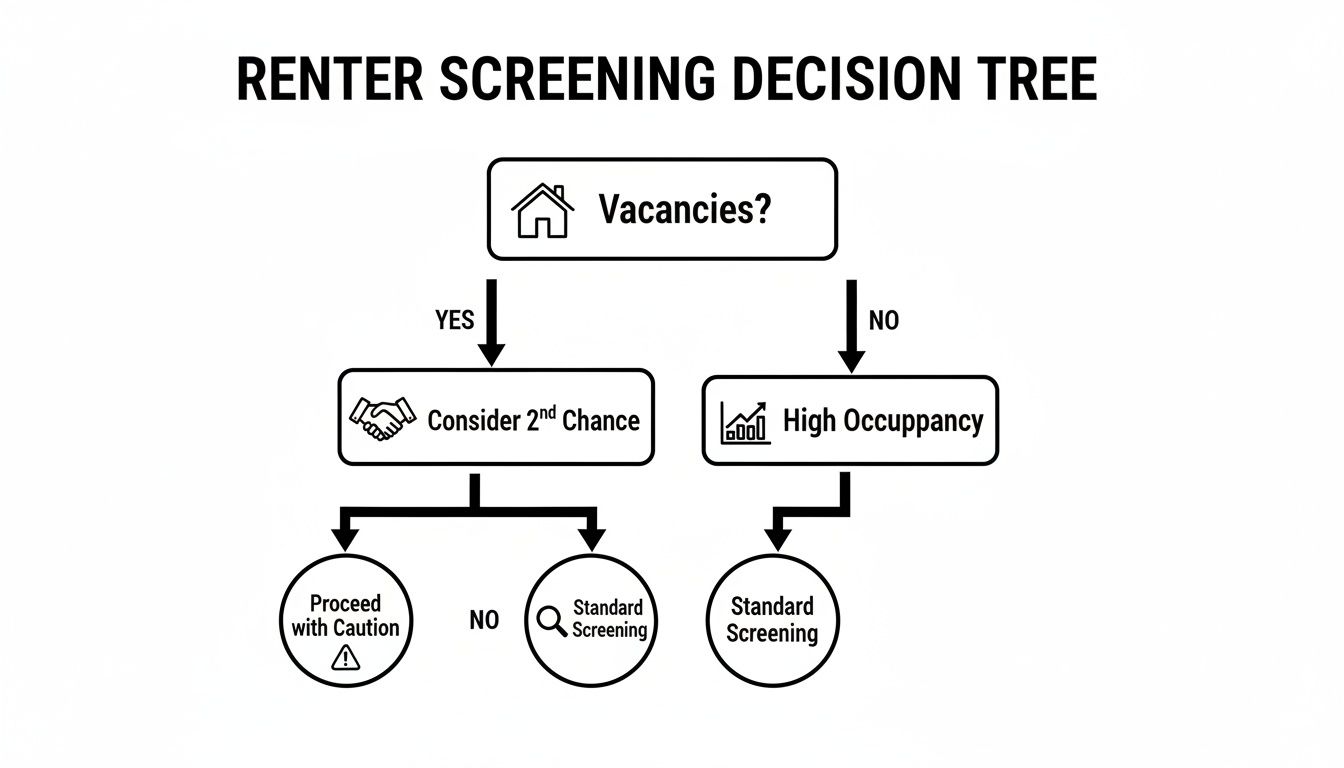
As you can see, a second chance program isn't a last resort—it's a smart response to vacancies that can transform a business challenge into a real opportunity.
Key Factors to Evaluate Holistically
When you're assessing applicants for your properties in Yucaipa, Mentone, or the surrounding areas, you need more data points than just a credit report. The absolute key here is consistency. You must apply the exact same criteria to every single applicant to stay compliant with Fair Housing laws.
Actionable Evaluation Criteria
- Income and Employment Stability: First things first, verify that their income is at least 2.5 to 3 times the monthly rent. But look deeper—consistency is what matters. Someone with a stable job for the last two years is often a much safer bet than someone with a higher but sporadic income.
- Rental History: Get on the phone and talk to previous landlords. Were they respectful of the property? Did they communicate issues properly? A positive reference from their most recent landlord can easily outweigh an older eviction.
- Age and Nature of Offenses: Context is everything. A single eviction from five years ago that was caused by a job loss is a world away from multiple, recent lease violations. The timeline and the "why" behind the issue matter immensely.
- Personal References: While you have to take them with a grain of salt, references from employers, mentors, or community leaders can help paint a fuller picture of an applicant's character and reliability.
A core principle of a successful program is understanding that people’s circumstances change. Your screening process should be designed to recognize positive momentum and recent stability, not just past mistakes.
For instance, say a property manager in Banning gets an application from someone with a broken lease from three years ago. That looks bad on paper. But if that same person has held the same job for two years, has a letter of recommendation from their boss, and can show you proof of on-time rent payments at their current place for the last 18 months, they are probably a very strong candidate. This is the kind of nuanced decision-making that fills vacancies with good, reliable people.
Structuring Your Application Review Process
To make this all practical, create a simple scoring system or a checklist. This is crucial for your legal protection, as it ensures you evaluate every applicant in your Loma Linda or Calimesa properties against the same objective measures.
You might decide to weigh recent, stable income more heavily than an old credit score. Or perhaps a glowing reference from a current landlord could offset a past rental dispute. The goal is to build a repeatable process that gives you a clear "yes," "no," or "yes, with conditions"—like a higher security deposit—for every application you review.
By creating a structured and fair system, you ensure your second chance policy doesn't become a "no standards" policy. It's the best way to protect your assets while keeping your occupancy rates high.
Craft a Lease That Protects Your Investment
Once you've greenlit a tenant for your 2nd chance apartments program, the lease agreement becomes your most important tool. It’s more than just a standard rental contract; it’s a strategic document designed to protect your investment while setting your new tenant up for success.
A well-crafted lease provides a clear roadmap for both parties. It cuts down on misunderstandings and helps you manage potential risks from day one.

For your properties in Banning, Highland, or any of the communities we serve, this document is the foundation of a successful tenancy. It establishes clear expectations and gives you legal recourse if issues come up, making sure your program stays both fair and financially sound.
Reinforce Financial Responsibility
Because a second chance program often works with applicants who've had financial troubles, it's just smart business to build extra layers of security into the lease agreement. These measures aren’t meant to be punitive; they are practical safeguards for your business that also encourage tenant accountability.
A common and effective strategy is to require a higher security deposit. In California, landlords can collect up to two months' rent for an unfurnished unit. Securing this maximum allowable amount provides a significant financial cushion against potential damages or unpaid rent. It’s a standard, legally sound practice that’s especially prudent here.
Another must-have is mandatory renters insurance. This policy protects the tenant's personal belongings, but more importantly for you, it provides liability coverage. If an accident caused by the tenant damages your property, their insurance can cover the costs, shielding you from unexpected and expensive repairs.
Implement Shorter Lease Terms Initially
For many property owners, a standard 12-month lease is the default. But when you’re working with second chance tenants, starting with a shorter term—like a six-month lease—offers a huge advantage. It essentially creates a built-in trial period.
This shorter timeframe lets you build a real-world track record with the tenant. It gives them a clear opportunity to prove their reliability by paying rent on time and taking care of the property. At the end of the six months, you have a concrete basis for deciding whether to offer them a full one-year renewal.
This strategy benefits everyone:
- For You: It significantly lowers your long-term risk. If the tenancy doesn't work out, you have a natural and non-confrontational exit point.
- For the Tenant: It provides a manageable, short-term goal. Successfully completing that initial lease term is a huge confidence booster and a positive step in rebuilding their rental history.
A six-month lease isn't a sign of mistrust; it's a structured pathway to a stable, long-term tenancy. It’s about verifying an applicant's positive momentum in a low-risk environment for your Highland or Redlands property.
This approach transforms the lease from a simple contract into an active management tool.
Proactive Rent Collection Strategies
Consistent, on-time rent payments are the lifeblood of any rental business. For tenants who may have struggled financially, aligning rent payments with their income schedule can make all the difference. Instead of one large payment on the first of the month, think about structuring a bi-weekly payment schedule.
For example, if the monthly rent is $1,600, you could arrange for two payments of $800, each due on the tenant's payday. This makes budgeting far more manageable and drastically reduces the likelihood of late payments. By being proactive and flexible, you’re setting up a system that encourages success.
Of course, it’s critical to ensure all lease addendums and terms comply with local and state laws. To get a better handle on these regulations, we have an in-depth guide covering landlord-tenant laws in California.
By combining these strategies—a higher security deposit, mandatory renters insurance, shorter initial lease terms, and flexible payment options—you create a lease agreement that is firm but fair. It protects your property in Yucaipa or Beaumont while providing a supportive framework that helps your second chance tenants thrive.
Navigate California Fair Housing Laws with Confidence
Legal compliance isn’t just a good idea for your 2nd chance apartments program—it’s the foundation that keeps your business from crumbling under lawsuits and fines. When you're a landlord in California, you aren't just renting a unit; you're navigating one of the most complex legal environments in the country. A single misstep, even an honest mistake, can quickly spiral into a costly discrimination claim.
For property owners in places like Loma Linda or Calimesa, a solid grasp of both federal and state Fair Housing laws is non-negotiable. These laws are in place to prevent discrimination against protected classes, which include race, religion, family status, and disability. Your screening process for a second chance program must be meticulously fair and, most importantly, consistent for every single applicant who walks through your door.
Create Consistent and Defensible Screening Criteria
The absolute key to staying out of legal hot water is to establish a written policy and stick to it religiously. Making decisions based on a "gut feeling" is a recipe for a discrimination lawsuit. Your criteria must be objective, measurable, and directly tied to an applicant's ability to be a good tenant.
This means if you decide to overlook a five-year-old eviction for one person because they have a stable job, you have to be prepared to do the same for another applicant in a similar situation. A standardized checklist or a scoring system is your best defense. It proves your decisions are based on business logic, not personal bias.
A consistent, written policy is your single greatest asset in preventing Fair Housing complaints. It demonstrates that every applicant for your properties, whether in Redlands, Beaumont, or Banning, is judged by the exact same yardstick.
This documented process protects you by creating a clear, defensible paper trail for every application you approve or deny. It shifts the focus from subjective feelings to objective facts.
Legally Evaluating Criminal Backgrounds
One of the trickiest parts of a second chance program is handling applicants with criminal records. California law has become incredibly specific about how landlords can use this information. Blanket bans on anyone with any criminal history are flat-out illegal and will attract legal trouble.
Instead, the law requires you to conduct an individualized assessment. The focus has to be on the nature and severity of the crime and how recently it occurred. A conviction for a non-violent offense from seven years ago carries far less weight than a recent, serious conviction that could directly impact the safety of your property or other residents.
Key things to consider for background checks include:
- Recency: How long ago did the conviction happen?
- Nature: Was the crime violent or related to property damage?
- Relevance: Does the conviction pose a direct threat to the property or community?
Laws are always changing, as we've seen with initiatives like D.C.'s Second Chance Amendment Act, which expands record-sealing opportunities. This reflects a broader societal shift toward rehabilitation that landlords need to be aware of. Staying updated is crucial, and you can explore our guide on 2025 California landlord laws for the latest details.
Handling Past Evictions Properly
Just like with criminal records, you can’t have a blanket policy that automatically rejects anyone with a past eviction. An eviction from years ago, especially one tied to a specific life event like a medical crisis or job loss, should be evaluated in the context of the applicant’s current situation.
Look for signs of stability since the eviction. Have they held down a steady job? Can they provide positive references from a more recent landlord? A past eviction is a single data point, not an automatic disqualifier. Your policy should clearly outline how you weigh these factors, ensuring fairness and protecting you from claims of arbitrary decision-making.
Market Your Program to Find Qualified Tenants
You’ve put in the work to design a solid 2nd chance apartments program. Now, the big question: how do you find the right people to fill those vacancies? The last thing you want is to cast a wide, generic net. Your marketing needs to be strategic, transparent, and targeted, speaking directly to a motivated audience that is actively looking for this exact opportunity.
This is all about connecting with individuals who are ready to prove they can be reliable tenants. It’s a mix of smart online tactics and old-fashioned community outreach.

Ultimately, effective marketing for these rentals boils down to building relationships and using clear language that sets the right expectations from day one. It saves everyone a lot of time.
Build Partnerships with Community Organizations
Honestly, one of the best ways to find pre-vetted, serious applicants is to team up with local community groups. Nonprofits, reentry programs, and social services organizations right here in Yucaipa, Beaumont, and the surrounding areas are on the front lines, working with people who need stable housing to get back on their feet.
These organizations aren't just sending you names. They often provide case management, financial counseling, and job placement support. That means their clients are already plugged into a system designed to help them succeed.
Key Groups to Connect With:
- Reentry Programs: These groups are specialists, helping formerly incarcerated individuals find their footing in the community.
- Transitional Housing Providers: They’re a perfect referral source for clients who have proven themselves and are ready for independent living.
- Veterans Affairs Offices: Local VA chapters frequently assist veterans who are facing housing instability and just need a fair shot.
- Local Churches and Charities: Don't overlook faith-based groups. Many run programs aimed at helping community members in need.
When you reach out to these groups, you're not just advertising an apartment—you're offering a real solution they can provide to their clients. This creates a powerful referral network of motivated individuals.
This approach transforms your marketing from a simple ad campaign into a community-focused effort that benefits everyone.
Optimize Your Online Listings and Presence
While community outreach is powerful, you can't ignore your online presence. Most people, including second chance renters, start their search on the internet. They’re using specific keywords to find landlords who are willing to work with their situation. You need to meet them where they are.
A great first step is to create a dedicated page on your website that spells out your second chance program. This page should be crystal clear about your screening criteria, what you look for in an applicant, and how to apply. Transparency is your best friend here; it builds trust and helps weed out unqualified inquiries right from the start.
In your actual property listings, be direct. You need to use the exact keywords these tenants are searching for, like:
- "Second chance rentals"
- "Eviction friendly apartments"
- "Bad credit OK"
- "We work with past issues"
This straightforward language ensures your listings pop up in the right searches and immediately tells an applicant that your property might be a fit. For more ideas on writing great ads, you can check out our guide on how to advertise a rental property.
And don’t forget that reaching people directly is key. Understanding how to use modern tools like text messaging can be a game-changer for generating leads: How To Use Text Messaging To Generate Leads.
Finding qualified applicants in our local Inland Empire communities takes a smart, two-pronged approach. To help you get started, here's a breakdown of some of the most effective channels for reaching potential second chance tenants in our area.
Local Marketing Channels for Second Chance Apartments
| Channel | Strategy / Key Action | Target Audience |
|---|---|---|
| Local Nonprofits | Build direct relationships with case managers at organizations like Family Service Association of Redlands or Path of Life Ministries. | Individuals actively working to improve their situation with professional support. |
| Online Rental Platforms | Use targeted keywords like "second chance Yucaipa" or "Beaumont apartments bad credit OK" in your Zillow, Apartments.com, and Facebook Marketplace listings. | Self-starters actively searching for housing options that fit their unique circumstances. |
| Community Bulletin Boards | Post flyers at local libraries, laundromats, and community centers in Beaumont, Yucaipa, Calimesa, and Banning. Keep it simple and direct. | Local residents who may not be highly active online but are still seeking housing. |
| Your Company Website | Create a dedicated, easy-to-find "Second Chance Program" page detailing your criteria and application process. Use it as a central hub for all marketing efforts. | Applicants who want to learn more about your company and policies before applying. |
| Reentry & Transitional Housing Programs | Partner with programs that assist formerly incarcerated individuals or those graduating from sober living homes. They are a source of motivated, pre-screened applicants. | People who have completed rehabilitation programs and are focused on stable, long-term housing. |
Each of these channels targets a slightly different segment of the population, but together they create a robust pipeline of potential tenants.
By combining these strategic community partnerships with targeted online marketing, you'll build a steady stream of qualified applicants for your properties in Redlands, Loma Linda, and beyond. This focused strategy ensures you’re not just filling vacancies—you’re finding committed tenants who are truly grateful for the opportunity.
Answering Common Questions About Second Chance Programs
Even with the best strategy, it's completely normal for property owners to have a few lingering questions before launching a 2nd chance apartments program. Getting these concerns out in the open is the best way to build the confidence you need to move forward with a program that’s both profitable and a positive for the community.
Here are some of the most common questions we hear from property owners in places like Redlands, Beaumont, Calimesa, Yucaipa, Loma Linda, Mentone, Highland and Banning.
Won't This Program Just Increase My Eviction Rate?
This is, without a doubt, the number one fear we hear. But it's a fear that rarely comes to pass when the program is built correctly. A well-structured second chance program doesn't mean you throw your standards out the window; it means you get smarter and more holistic with your screening.
By verifying stable income, actually talking to recent landlords, and looking at the why behind past issues, you're making an educated decision—not taking a blind leap of faith. Don't forget, many of these applicants are incredibly motivated to make it work because they know just how hard it is to find decent housing. That gratitude often translates into them being some of your most responsible tenants.
The success of your program lives and dies by the quality of your screening. A firm but fair process that looks at the whole person, not just a three-digit score, is your best defense against future evictions. It helps you spot the tenants who are truly on the way up.
How Much Extra Work Is This Really Going to Be?
Okay, let's be upfront: there's a little bit of work on the front end. You'll need to invest some time setting up your new screening criteria and maybe building a few relationships with local organizations in Highland or Banning. But once that system is in place, it can actually reduce your workload over the long haul.
Think about the time you burn marketing a vacant unit, showing it over and over, and sifting through applications that go nowhere. A successful second chance program can seriously lower your vacancy rate by creating a steady pipeline of qualified applicants from your referral partners. Less turnover means less work, lower marketing bills, and more consistent cash flow.
But What If I Still End Up with a Bad Tenant?
No screening process on earth is 100% foolproof—not even for landlords with the strictest, highest-credit-score-only policies. Every landlord eventually deals with a difficult tenant. The key isn't a perfect screening process (which doesn't exist), but having a rock-solid lease and a clear, legal process for handling any violations.
This is exactly where strategies like starting with a six-month lease come into play. It’s essentially a "probationary period" that gives you a low-risk way to see how a new tenant fits. If problems pop up, you have a simple, non-confrontational exit strategy when the initial term ends. It's a built-in safety net to protect your asset.
If you have more specific worries about your property, we’ve tackled many common landlord questions on our frequently asked questions page.
Is This Kind of Program Even Legal and Fair?
Absolutely, so long as it’s built on one core principle: consistency. Fair Housing laws don’t stop you from having standards; they stop you from applying those standards differently to different people.
Your single greatest legal protection is a written policy that clearly outlines your screening criteria. This document ensures every single applicant is judged by the same objective yardstick. It doesn't matter if they're applying for a property in Loma Linda or Mentone—the process has to be identical. This consistency is what keeps your program fair, defensible, and fully compliant.
This approach doesn't just shield you from legal trouble. It also strengthens your reputation as a fair and professional property management provider in any of the communities we serve, from Yucaipa to Beaumont. You’re not lowering your standards; you’re just expanding them to look at a broader, more complete set of qualifications.
Managing a rental property, especially one with a specialized program, requires expertise and attention to detail. At AIM PROPERTY MANAGEMENT COMPANY, we handle the complexities for you. From thorough tenant screening and 24/7 maintenance to ensuring full legal compliance, we protect your investment and maximize your returns. We proudly serve Redlands, Beaumont, Calimesa, Yucaipa, Loma Linda, Mentone, Highland and Banning. If you're considering a 2nd chance program or simply want to improve your property's performance, let's talk. Discover the peace of mind that comes with professional management by visiting us at https://aim-properties.com.